'>
<rect width='100' height='100' fill='%23B22234'/>
<!-- stripes -->
<g fill='%23fff'>
<rect y='10' width='100' height='10'/>
<rect y='30' width='100' height='10'/>
<rect y='50' width='100' height='10'/>
<rect y='70' width='100' height='10'/>
<rect y='90' width='100' height='10'/>
</g>
<!-- blue box -->
<rect width='50' height='50' fill='%233C3B6E'/>
</g>
</svg>)
'>
<rect width='100' height='100' fill='%23fff'/>
<rect width='100' height='33.33' y='0' fill='%23FF9933'/>
<rect width='100' height='33.33' y='66.66' fill='%23138808'/>
<!-- Ashoka Chakra -->
<circle cx='50' cy='50' r='9' fill='none' stroke='%23000080' stroke-width='2'/>
<g stroke='%23000080' stroke-width='1'>
<line x1='50' y1='41' x2='50' y2='59'/>
<line x1='41' y1='50' x2='59' y2='50'/>
<line x1='44' y1='44' x2='56' y2='56'/>
<line x1='56' y1='44' x2='44' y2='56'/>
</g>
</g>
</svg>)
 info@blackmarlintechnologies.com

Picture it’s late at night, and a family is stressing about how to pick the right place for their aging parents. They open Google, and type “best assisted living near me” . Within seconds, there are hundreds of senior living options sitting on the screen. But people usually only tap the first few results, not the next page. If your community is not showing up on that first page, families might never discover you at all, even if you provide excellent care.
This is where senior living SEO starts to matter, really. Senior Living SEO, also known as senior living search engine optimization, helps your website show up higher in Google when families look for assisted living, memory care, retirement communities, or senior care offerings. When your rankings climb, more people can find your community, you gain credibility before the first phone conversation, and they feel invited to schedule a tour.
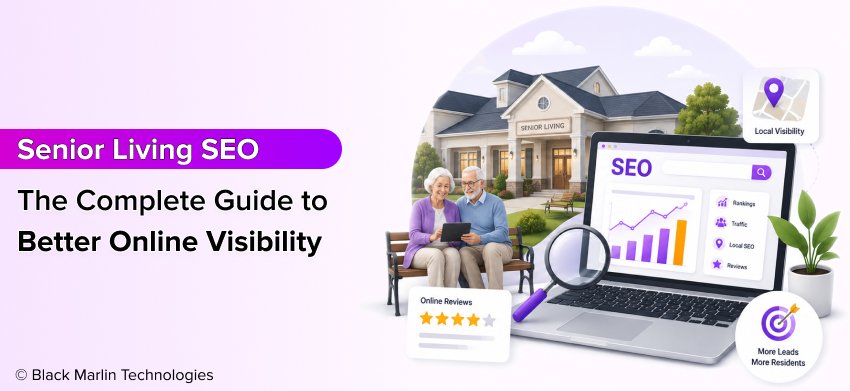 Today, most families do at least a little research online before making one of the biggest choices of life. They check reviews, services, cost, pictures, and neighbourhood details before they reach out to a community. A properly optimized website makes this part much easier, and it also lets Google “see” that your content feels useful and dependable, not random. In this full guide, you will pick up straightforward senior living SEO tactics to boost your online reach, draw in more fitting visitors, and turn search results into resident questions, and eventually occupancy growth.
- What is Senior Living SEO?
- Why Does Senior Living SEO Matter?
- How Senior Living SEO Works?
- Understanding Search Intent
- Assisted Living
- Memory Care
- Independent Living
- Nursing Homes
- Retirement Communities
- Why Understanding Search Intent Matters?
- How Search Engines Rank Senior Living Websites?
- How Google Decides Which Website to Show?
- 12 Proven Senior Living SEO Strategies
- 1. Keyword Research
- 2. Focus on Local SEO
- 3. Optimize Service Pages
- 4. Create Helpful Blog Content
- 5. Make Your Website Mobile-Friendly
- 6. Improve Website Speed
- 7. Earn More Positive Reviews
- 8. Build High-Quality Backlinks
- 9. Use Schema Markup
- 10. Optimize Every Image
- 11. Create Location-Specific Landing Pages
- 12. Track and Improve SEO Performance
- Local SEO Checklist for Senior Living
- Optimize Your Google Business Profile
- Keep NAP Information Consistent
- Collect and Respond to Reviews
- Build Local Backlinks
- Improve Your Google Maps Presence
- Create Location-Specific Landing Pages
- Add Local Schema Markup
- AI Search & SEO in 2026
- How AI Search is Changing Senior Living SEO?
- Google AI Overviews
- ChatGPT
- Gemini
- Perplexity
- Search Everywhere Optimization (SEvO)
- AEO (Answer Engine Optimization)
- GEO (Generative Engine Optimization)
- Senior Living SEO Metrics That Matter
- Common SEO Mistakes Senior Living Communities Make
- Best SEO Tools for Senior Living Communities
- Frequently Asked Questions (FAQs)
- Conclusion
What is Senior Living SEO?
Senior living SEO (Search Engine Optimization) is the whole process of making your senior living website work better so it shows up higher in Google and other search engines, when families are browsing around for places like assisted living, memory care, independent living, retirement communities, or senior care. The point is pretty basic, it’s about helping the right people land on your community at the right time.
Think about it this way. When a family searches for “best assisted living near me” or “memory care community in Dallas”, Google shows the websites it thinks are the most helpful and trustworthy. If your website is properly optimized, you have a much better chance of landing on the first page, where most people click.
Why Does Senior Living SEO Matter?
Today, families do not really choose a senior living community by driving around town or flipping through newspaper ads. They start their search online, then they eyeball reviews, services, snapshots, the cost, and the neighbourhood area before they ever make that phone call or lock in a tour. If your website is hard to locate, then residents in waiting may decide on a different community instead.
A strong senior living SEO strategy helps you:
- Increase your visibility in Google Search and Google Maps.
- Reach families actively searching for senior care services.
- Build trust with helpful, easy-to-read content.
- Generate more phone calls, tour requests, and resident inquiries.
- Reduce reliance on paid advertising over time.
Regular SEO vs. Senior Living SEO
While classic SEO is aimed at boosting rankings for all kinds of businesses, senior living SEO is built more specifically for senior care providers, and the families that are looking for them.
| Regular SEO | Senior Living SEO |
| Targets general business keywords | Targets assisted living, memory care, retirement, and senior care keywords |
| Focuses on website traffic | Focuses on qualified families looking for care |
| General local optimization | Strong emphasis on Google Business Profile, local SEO, and Google Maps |
| Basic content marketing | Educational content that answers families’ questions and builds trust |
| Standard conversions | Encourages tour bookings, phone calls, and resident inquiries |
How Senior Living SEO Works?
Every bit of improvement you make is it crafting useful content, fine tuning local keywords, gathering good reviews, or speeding up your website, helps Google get a clearer sense of your community. Over time this can raise your rankings, bring more visitors to your site, and connect extra families with the care and support they need.
Why is SEO Important for Senior Living Communities?
Picking a senior living community is one of the most significant choices a family can make. Before they book a tour, or even dial up on the phone, many families end up wandering around online, comparing communities, reading reviews, and digging into the services offered. And honestly, if your site doesn’t show up when someone searches on Google, quite a few prospective residents may never come across your community at all.
This is why senior living SEO is so crucial. It helps your website rank higher in search engines, so it becomes easier for families to locate your assisted living, memory care, or retirement community when they need it the most. Better visibility doesn’t just increase website traffic, it also builds credibility, brings in more requests, and leads to stronger occupancy in the long run.
Why Senior Living SEO Matters?
Here are a few facts that show why investing in senior living SEO is essential:
- More than 90% of online experiences begin with a search engine, making Google the starting point for most families looking for senior care.
- Most families compare several senior living communities before making a final decision, researching services, reviews, pricing, and locations online.
- Local searches have high purchase intent, meaning people searching for terms like “assisted living near me” or “memory care in Chicago” are often ready to contact a provider.
- Mobile devices dominate healthcare and senior care searches, so having a fast, mobile-friendly website is critical for attracting visitors and improving rankings.
How Families Search for Senior Living Today?
The way people look for senior living has changed, quite a bit, over the last few years. Rather than stopping by a handful of communities first, most families start their journey online, right away. They go to Google to contrast services, read reviews, examine photos, verify addresses, and get a clearer sense of the costs before they ever place a phone call or set up a tour.
One important thing to remember is that adult children are often the real decision makers and information seekers, not the seniors themselves. Sons, daughters, and other close family members usually do the investigating on different care options for their parents. They want solid guidance that lets them choose what works best for the people they care about, in other words their loved ones. So that’s why your website should cover the common questions using plain and easy to follow language, and also build confidence starting right from the first visit.
Understanding Search Intent
Search intent is basically the reason why someone is searching, not just the words they type in. If you understand what families need and want, you can produce content that speaks to their questions, and that definitely supports your senior living SEO.
Here are the most common types of searches families make:
Assisted Living
Families searching for assisted living are looking for communities that provide daily support while allowing seniors to live as independently as possible. Common searches include:
- Assisted living near me
- Best assisted living communities
- Assisted living costs
- Assisted living with medical support
Memory Care
When a loved one is living with Alzheimer’s disease or another form of dementia, families search for specialized care that offers safety, comfort, and trained staff.
Popular searches include:
- Memory care near me
- Alzheimer’s care communities
- Dementia care services
- Memory care facility reviews
Independent Living
Some seniors don’t need medical assistance but want a safer, more active lifestyle. Families often search for communities that offer convenience, social activities, and maintenance-free living.
Common searches include:
- Independent living communities
- Retirement apartments
- Senior independent housing
- Best independent living near me
Nursing Homes
Families looking for nursing homes usually need skilled medical care, rehabilitation, or long-term health support for a loved one.
Typical searches include:
- Nursing homes near me
- Skilled nursing facilities
- Long-term nursing care
- Rehabilitation centers for seniors
Retirement Communities
Many people also search for retirement communities that offer comfortable living, social activities, wellness programs, and different levels of care in one location.
Popular searches include:
- Retirement communities near me
- Senior retirement homes
- Active adult communities
- Best retirement communities
Why Understanding Search Intent Matters?
Every search tells a different story. Some families are just starting their research, while others are ready to book a tour, or talk with an advisor. If you understand what people are looking for, you can craft useful pages, address their questions, and help steer them through the decision process.
A solid senior living SEO plan is about making your content line up with the search intents that are already in people’s minds. If your site gives clear responses, useful info, and even the right local clues, Google is more likely to place your pages higher in results. That tends to help more households find your community, grows confidence, and brings in more leads from people who are actively searching for senior care.
How Search Engines Rank Senior Living Websites?
Have you ever wondered why certain senior living websites show up first on Google, while others end up page two or three. It really just comes down to this, Google is trying to lift the most useful pages, the ones that feel trustworthy and also deeply relevant for the person searching for senior care.
When someone searches for “assisted living near me” or “best memory care community”, Google checks hundreds of ranking factors before it figures out which sites get the top spots. The better your website matches these standards, the more likely it will climb the results pages and draw families who are looking for senior living services.
How Google Decides Which Website to Show?
- Helpful Content: – Google really wants to point people toward websites that answer real questions from families. So your own site should have helpful details all around assisted living and memory care, plus the pricing side, amenities and services, and how the admission process actually works, not just the brochure version. When the content is easy to read and it’s truly original, it tends to help visitors, and it also boosts senior living SEO.
- Website Speed: – Families expect websites to open quickly. If your pages take too long to show up, many visitors will go away before they read what you wrote. A swift website does better for the user experience, and it also matters as an important Google ranking factor.
- Mobile-Friendly Design: – A lot of people end up looking for senior living communities using their smart phones. Google then tends to favour sites that look sharp and run smoothly on mobile devices, with no real hiccups. The buttons should be easy to tap and the wording should be readable, at any moment, not just on certain screens. Also, the pages need to load fast across different screen sizes.
- Online Reviews: – Positive Google reviews do show that families trust your community. They also help with local search rankings, and they invite new visitors to reach out to you. When you reply politely to both good reviews and not so good ones, it signals that your community really listens to feedback.
- Location & Local SEO: – A lot of searches have wording like “assisted living near me”, or “memory care in Dallas”, and then Google does the deciding. It uses your location, plus what’s in your Google Business Profile, along with local keywords and business details to figure out which communities should show up in Google Maps and those local search results.
- Quality Backlinks: – Backlinks are links from other trusted websites leading back to your website. When hospitals, health care organizations, senior care directories, or local community sites mention your business, Google reads those links as small proofs that your site is dependable, and fairly authoritative.
- Trust & Experience: – Families are making a major life decision, so Google wants to suggest websites that feel trustworthy, really reliable. You see, clear contact details, staff credentials, actual photos, and customer testimonials matter. Also keep the content accurate, and make sure pages get refreshed regularly, because that gives visitors confidence and it also signals well to search engines.
12 Proven Senior Living SEO Strategies
Getting a senior living website to rank on Google is not something that happens overnight. It needs a clear playbook, supportive content, and steady refinements. The good news though is that you do not have to knock everything out in one sitting. If you work through these 12 proven senior living SEO strategies you can steadily boost your online presence, bring in more families, and earn more tour requests over time.
1. Keyword Research
Keyword research is basically the base, for every senior living SEO effort that works. It lets you see clearly what families are actually typing in when they are looking for senior care, not just assuming. Instead of guessing you can lean on keyword research tools to pull up phrase ideas that have decent search volume, and also good intent.
Try to zoom in on keywords that actually match what you do and where you are located. Like, if your service is memory care in Dallas, then write content that uses things like “Memory Care in Dallas,” “best memory care near me” , or even “assisted living community in Dallas.” Also go for the longer tail keyword phrases too, because they usually face less competition and they bring in visitors who are ready to act, not just browse around.
2. Focus on Local SEO
Most families look for senior living communities near home, or like nearby areas. That is why Local SEO is one of the most important elements in a well working strategy. Google actually uses location clues to figure out which businesses show up in Google Search and Google Maps, and it really does.
Start by making, then tweaking your Google Business Profile. Make sure your business name, address, and phone number, often called NAP, are exactly the same on your website and on every online listing too. Upload top quality photos, set business hours, add services in a clear way, and get residents or family members who feel satisfied to drop reviews.
Also, build local citations on well known healthcare directories, senior care websites, and community listings. Those local signals make it more likely you show up in the Google Map Pack where lots of families begin their search.
3. Optimize Service Pages
Every service you provide should have a dedicated page that is only for it. Don’t dump everything on one page, create a set of detailed pages that handle specific questions about each service, in a more deliberate way. Those way visitors can find what they need faster, and search engines gain a clearer understanding of your offerings.
Important service pages include:
- Assisted Living
- Memory Care
- Independent Living
- Skilled Nursing
- Respite Care
Each page should explain who this service is meant for, but also, the benefits, what amenities are really included, and the pricing info when it can be shared. Then there should be FAQs, plus a few testimonials, and a direct invite for action like “Schedule a Tour” or “Contact Our Team.” When the service pages are built really well, they also help you rank better for those service specific keywords.
4. Create Helpful Blog Content
Families often spend weeks, maybe more, researching before they finally choose a senior living community. A helpful blog lets you answer all their questions in a calm way while you also build trust, and yes, it can strengthen your search rankings too.
Write simple, informative articles that actually solve the real problem, not just make promotions look good. The educational content shows real expertise and it also encourages visitors to stay longer on your website.
5. Make Your Website Mobile-Friendly
Today, a lot of families look for senior living communities on their smart phones. If your website is awkward to navigate on a phone, visitors might step away within seconds.
A mobile friendly website need to have readable text, easy navigation, clickable buttons, and pages that load quickly. Google also uses Core Web Vitals to track the overall user experience.
Key Core Web Vitals include:
- Largest Contentful Paint (LCP): under 2.5 seconds
- Interaction to Next Paint (INP): under 200 milliseconds
- Cumulative Layout Shift (CLS): below 0.1
Improving these metrics creates a better experience for visitors while helping your website perform better in search results.
6. Improve Website Speed
Website speed is one of those big ranking factors and it directly touches user experience. Families looking for urgent care options don’t really want to sit and wait while slow pages load, it feels frustrating fast. Even a couple extra seconds can make visitors bounce and move on.
Aim for an ideal page load time of less than 3 seconds. Faster websites keep visitors engaged, reduce bounce rates, and improve conversion rates.
Simple ways to improve website speed include:
- Compress large images
- Enable browser caching
- Minify CSS and JavaScript
- Use fast web hosting
- Remove unnecessary plugins
- Use a Content Delivery Network (CDN)
A faster website benefits both Google and your potential residents.
7. Earn More Positive Reviews
Online reviews are probably one of the biggest trust signals for Google and families. Before reaching out to a senior living community, lots of people read them first to get a sense of how things go for other residents, and for the families too.
Encourage satisfied residents and family members to leave reviews on:
- Google Business Profile
- Caring.com
- A Place for Mom
- Senior care directories
Always reply professionally to every review, positive or negative. Proper review management shows your community values resident feedback, and it really matters for satisfaction. More upbeat reviews can boost local rankings, and also help conversion rates.
8. Build High-Quality Backlinks
Backlinks are links from other websites, pointing to your website, and in a way its like your pages are getting some attention. Google takes these backlinks as votes of confidence, especially when they come from respected organizations.
Instead buying links, try to earn them in a more natural way, by making truly valuable content and then building local partnerships.
Good backlink opportunities include:
- Hospitals
- Healthcare providers
- Local doctors
- Community organizations
- Senior associations
- Chambers of Commerce
- Local news websites
- Nonprofit organizations
High-quality backlinks improve your website’s authority and increase your chances of ranking higher in search results.
9. Use Schema Markup
Schema Markup is structured data that helps search engines read your website more clearly. It can also help your pages show up in search results in a better way, through rich snippets.
Useful schema types for senior living websites include:
- Healthcare Organization Schema
- Local Business Schema
- FAQ Schema
- Review Schema
- Organization Schema
Adding structured data, helps Google show useful info like business hours, review snippets, contact details, and those frequently asked questions right in search results. This tends to boost how visible you are and can raise your click through rate.
10. Optimize Every Image
Images make your website more appealing, but they also need a proper optimization a bit, not just “upload and go”. Bigger image files tend to slow down the website, and if the images are named in a sloppy way, they bring very little SEO value.
Best practices include:
- Use descriptive file names
- Add keyword-rich alt text
- Compress images before uploading
- Use modern WebP image format
- Include captions when appropriate
11. Create Location-Specific Landing Pages
If your organization serves multiple cities make a separate page for each place, instead of dumping everything onto one page. This helps local relevance a bit more and it lets you reach city specific keywords more precisely.
Examples include:
- Memory Care in Dallas
- Assisted Living in Houston
- Senior Living in Austin
- Retirement Community in Phoenix
Every page should have fresh, local flavored content about the community nearby, plus mention nearby hospitals, various amenities, testimonials, directions that actually help, and a few common questions. Don’t just reuse the same wording between city pages, because repeating the same content can lower your rankings.
12. Track and Improve SEO Performance
SEO is an ongoing thing, not a one-time task. Measuring your performance regularly helps you figure out what’s working and where there are needed improvements.
Monitor your website using tools such as:
- Google Analytics 4
- Google Search Console
- Rank Tracking Software
- Google Business Profile Insights
- Call Tracking Tools
Track important metrics like:
- Organic website traffic
- Keyword rankings
- Click-through rate (CTR)
- Phone calls
- Contact form submissions
- Tour bookings
- Qualified leads
- Conversion rate
Local SEO Checklist for Senior Living
Most families that are looking for senior living communities want a trusted provider close to home, and honestly that matters a lot. That’s why local SEO plays a big role in helping your community show up in Google Search and Google Maps, even when people are only casually looking. When a person searches for “assisted living near me” or “memory care in Dallas,” Google checks several local ranking signals before it decides which businesses to place out front.
A strong senior living local SEO strategy makes it easier for nearby families to find your community, read reviews, get to your website, and schedule a tour. Use the checklist below just to confirm your local SEO is working effectively.
Optimize Your Google Business Profile
Your Google Business Profile, (GBP) is one of the most critical local SEO tools. Fill out every part with real and precise data, like your business name, address, contact number, web address, business hours, services, photos, and the right categories. Keep checking on it, post fresh updates from time to time, reply to questions, and respond to reviews so the profile stays active.
Keep NAP Information Consistent
NAP is short for Name, Address, and Phone Number. You should make sure those details are exactly, and I mean truly exactly, the same everywhere, like on your website, your Google Business Profile, your social pages, and the online directories you show up in. If there are even tiny differences, that can confuse the search engines and quietly damage your local rankings.
Collect and Respond to Reviews
Positive feedbacks help you build trust with families and it also boosts your presence in local search results a bit. Try to get residents and their relatives to share genuine reviews on Google, Facebook, and reputable senior care directories that families actually use. Make sure you always respond in a professional tone to every review, even when it is positive, even when it is negative.
Build Local Backlinks
Earn backlinks from trustworthy nearby groups like hospitals, healthcare providers, senior centers, chamber of commerce, nonprofits organizations, community groups and local news websites. These types of links make Google see that your senior living community has real respect and standing in the local area.
Improve Your Google Maps Presence
Optimize your Google Maps listing by adding really good photos, choosing the right business categories, updating your services, and making sure your contact details stay current. When your Google Business Profile is kept up and running, it boosts your odds of showing up in the Local Map Pack.
Create Location-Specific Landing Pages
If your organization serves multiple cities or neighborhoods, create unique landing pages for each location. For example:
- Assisted Living in Dallas
- Memory Care in Austin
- Independent Living in Houston
Each page should include original content, local information, nearby landmarks, testimonials, and clear calls-to-action to help families in that specific area.
Add Local Schema Markup
Add Local Business Schema onto your website so that search engines can grasp what your business is about, and where it sits. Try including the business name, the full address, phone number, and the operating hours, plus the geographic location that fits best. Also include customer reviews when you can. This structured data often helps your presence show up more clearly in search results, and it can raise click-through rates.
AI Search & SEO in 2026
Search is moving faster than ever. By 2026, a lot of people do not lean only on the usual Google search results. Many households use Google AI Overviews, ChatGPT, Gemini, and Perplexity to dig into senior living communities, compare care options, and pull fast answers for important questions. Rather than clicking through dozens of sites, these AI tools summarize what matters, and point to trusted sources in just a few seconds.
This shift means senior living SEO is no longer just about showing up on Google’s first page. Your site also has to be readable for AI-powered search engines, in a way that feels reliable, and they can use it with confidence. Communities that publish content that is clear accurate and useful tend to have a better shot at appearing in both regular search results and AI generated answers.
How AI Search is Changing Senior Living SEO?
Modern AI search engines move past keywords. They attempt to figure out the intent that sits behind a person’s question and then suggest the most dependable results out there. For instance, if someone asks “What is the best memory care community near me?”, AI systems take a look at reputable websites, community reviews, nearby business details and specialist materials first, before they craft a response.
This is why creating people-first, well-organized content is more important than ever.
Google AI Overviews
Google AI Overviews gives quick summaries sitting up top in search results. Instead of showing only link addresses, Google stitches details together from trusted sources so it can answer peoples question directly.
To improve your chances of being featured:
- Write clear and original content.
- Answer common questions about senior living.
- Use descriptive headings and short paragraphs.
- Add FAQ sections where appropriate.
- Keep your information accurate and regularly updated.
ChatGPT
Many families now ask ChatGPT questions such as:
- What is assisted living?
- How do I choose a memory care community?
- What questions should I ask during a senior living tour?
ChatGPT tends to cite, websites that are trustworthy and provide detailed info in a well organized way . When you publish learning guides, practical checklists, and content that is easy to understand, it can help boost your overall online authority.
Gemini
Google’s Gemini uses advanced artificial intelligence to grasp search intent and then give responses that feel personalized. it tends to favour sites that show real mastery, include verified facts, and deliver a smooth user experience.
To optimize for Gemini:
- Create comprehensive content.
- Use logical page structure.
- Improve page speed.
- Make your website mobile-friendly.
- Build strong local authority.
Perplexity
Perplexity leans toward giving AI-generated answers, with citations to sources that are reliable. It tends to privilege pages that have original findings, expert perspectives, and details that feel true enough for the user to trust.
Publishing detailed guides, answering frequently asked questions, and keeping your content current increases the chance of being cited by AI-driven search tools like Perplexity.
Search Everywhere Optimization (SEvO)
People look around in lots of places these days not only Google. They ask AI assistants, use voice search, check YouTube, browse Google Maps, scroll social media platforms, and also turn to online directories when they are trying to learn about senior living options.
Search Everywhere Optimization (SEvO), is basically about tweaking your content so families can actually find your community across many search platforms. In practice it means keeping your business information exact and up to date, making practical videos , writing helpful blog articles, handling reviews carefully, and reinforcing your footprint anywhere people go looking.
AEO (Answer Engine Optimization)
Answer Engine Optimization (AEO), is all about making content that answers people’s questions straight away. AI-powered search engines they tend to lean toward clear and brief responses that are easy to digest and understand.
Good AEO practices include:
- Writing FAQ sections.
- Using question-based headings.
- Providing short, direct answers before adding detailed explanations.
- Organizing content with clear headings and bullet points.
These improvements make your website easier for both people and AI systems to understand.
GEO (Generative Engine Optimization)
Generative Engine Optimization (GEO) is the way of optimizing content for AI powered search engines that then craft answers, rather than just list websites.
To strengthen your GEO strategy:
- Publish original, helpful content.
- Demonstrate expertise and real experience.
- Include statistics and credible sources.
- Use structured data (Schema Markup).
- Keep your website updated with fresh information.
The more trustworthy your content appears, the more likely AI platforms are to reference it.
Senior Living SEO Metrics That Matter
A successful Senior Living SEO strategy isn’t only about climbing higher on Google, it’s more about watching the results that help your community grow. By tracking the relevant SEO metrics, you can see what’s actually doing the job, find parts that need a bit more attention, and make smarter marketing decisions too.
Instead of just watching the website traffic numbers pay attention to the metrics that show how families move around and engage with your site, also whether they do something real like calling your team or booking a tour. Going through these figures regularly, helps you sharpen your online presence, attract more suitable leads, and steadily grow occupancy over time.
| SEO Metric | Ideal Goal | Why It Matters |
| Organic Traffic | Increasing month over month | Shows more families are finding your website through Google search. |
| Bounce Rate | Below 45–50% | A lower bounce rate means visitors are staying on your website and exploring your content. |
| Page Speed | Under 3 seconds | Faster websites provide a better user experience and improve Google rankings. |
| Core Web Vitals | Pass all Core Web Vitals | Indicates your website offers a fast, stable, and user-friendly experience. |
| Conversion Rate | 3–8% or higher | Measures how many visitors complete actions like booking a tour or filling out a contact form. |
| Google Reviews | Average rating of 4.5★ or above | Strong reviews build trust and improve local SEO performance. |
| Click-Through Rate (CTR) | Improve over time | A higher CTR means more people click your website after seeing it in search results. |
| Calls from Organic Search | Increasing monthly | Shows your SEO efforts are generating qualified inquiries from families. |
| Tour Bookings | Increasing consistently | One of the most valuable indicators that SEO is driving real business growth. |
| Local Rankings | Rank in Google’s Top 3 Local Map Pack | Higher local rankings increase visibility for nearby families searching for senior living services. |
Common SEO Mistakes Senior Living Communities Make
Even the best senior living place can have trouble pulling in fresh residents if its website is not tuned right. Many communities spend time and money on a gorgeous web page, but then skip the SEO fundamentals that help families discover them in search results. These familiar oversights can pull down your Google positions, shrink website visits, and end up with less conversation and fewer tour reservations.
The good news is, most of these issues are pretty easy to fix. By identifying and correcting them early, you can strengthen your Senior Living SEO strategy and help your online visibility.
- Ignoring Local SEO:- Lots of families are looking for things like “assisted living near me” or “memory care in Chicago”. But if your community is not tuned for local search, you might lose important chances to show up in Google Search and Google Maps.
- Creating Thin or Low-Quality Pages:- A few websites use service pages that have just a handful of sentences. Those pages don’t actually answer what visitors are asking, and they also don’t give Google enough information to grasp their value.
- Using Duplicate City Pages:- A lot of senior living websites put up several city pages, and the content is basically same, with only the city name swapped. Google sees this as duplicate content, and yes it can do real damage to rankings.
- Having a Slow Website: – Families expect websites to load quickly. A slow site feels odd, it builds a bad user experience and it may make visitors go away early before they even learn about your community.
- Not Collecting Online Reviews: – Positive reviews help build trust, with Google and also with people who might move in. When a community has few reviews or none at all, it tends to lose a bit of credibility compared to nearby competitors with strong ratings.
- Keyword Stuffing: – When you keep using the same keyword again and again, it makes the content harder to read and it can end up hurting your search rankings. Google tends to favour writing that feels natural and is actually useful, meaning it answers real questions.
- Poor Mobile Website Design: – Many families end up looking for senior living communities on their smart phones, and yes you know this already. If your website isn’t mobile friendly, people may bounce fast, and Google might end up ranking your pages lower.
- Not Publishing Helpful Blog Content: – Many senior living websites only add service pages and they rarely update them, like at all. Without fresh, educational articles being posted, it becomes more difficult to rank for informational searches, and to build genuine trust.
- Missing FAQ Sections: – Families often have a bunch of questions before deciding on a senior living community, so if your site lacks FAQ sections, you might miss useful keyword opportunities and also deliver a less helpful experience for visitors.
- Ignoring AI Search Optimization:- Search behavior is changing, kind of fast. Families are now using Google AI Overviews, ChatGPT, Gemini, and Perplexity to dig around for senior living choices. In that context, websites that rely only on traditional SEO might fade from view.
Best SEO Tools for Senior Living Communities
A successful Senior Living SEO approach is easier when you lean on the right tools. These SEO tools help you see how your website is performing, uncover new keyword opportunities, iron out technical problems, enhance local rankings, and also track the outcomes from your marketing.
You do not need dozens of tools to win. Even when you use a few trusted platforms, it can still help you make better decisions, and improve your website over time. Below are some of the better SEO tools that any senior living community or marketing team should look at.
| SEO Tool | Primary Purpose | How It Helps Senior Living SEO |
| Google Search Console | Website Performance | Tracks search traffic, keyword rankings, indexing issues, and click-through rates. |
| Google Analytics 4 (GA4) | Analytics | Measures website visitors, user behavior, conversions, and traffic sources. |
| Google PageSpeed Insights | Website Speed | Analyzes page speed, Core Web Vitals, and provides recommendations to improve performance. |
| Google Business Profile | Local SEO | Helps manage your Google Maps listing, reviews, business information, and local visibility. |
| Screaming Frog SEO Spider | Technical SEO | Finds broken links, duplicate content, missing metadata, redirects, and crawl errors. |
| Semrush | Keyword Research & Competitor Analysis | Discovers valuable keywords, monitors rankings, and analyzes competitors’ SEO strategies. |
| Ahrefs | Backlink Analysis | Tracks backlinks, identifies link-building opportunities, and measures website authority. |
| BrightLocal | Local SEO Management | Monitors local citations, reviews, local rankings, and Google Business Profile performance. |
| Local Falcon | Google Maps Rankings | Visualizes your rankings across different locations in Google Maps and the Local Pack. |
Frequently Asked Questions (FAQs)
Q1. What is Senior Living SEO?
Ans1. – Senior Living SEO (Search Engine Optimization) is basically the work of tweaking your website so it appears higher in Google and other search engines. It also helps families track down your assisted living memory care, independent living, or retirement community when they’re searching online. When your rankings get better you usually see more visitors on the site, more tour requests, and additional resident inquiries.
Q2. How Long Does Senior Living SEO Take?
Ans2. – SEO is a long term play. Most senior living communities begin noticing real improvements in about 3 to 6 months, while more competitive markets can stretch it out to 6 to 12 months for solid rankings. That timeline really depends on where your website stands right now, how crowded the competition is, and whether you stay consistent with your SEO efforts.
Q3. Is Local SEO Important for Senior Living Communities?
Ans3. – Yes, Local SEO is one of the more critical pieces within Senior Living SEO, because families usually look for care nearby home. You can optimize your Google Business Profile, keep the business details consistent, gather reviews regularly and make location specific pages. All that helps your community show up in Google Search and Google Maps.
Q4. What Keywords Should I Target?
Ans4. – Choose keywords that match the services and locations you offer. Examples include:
- Senior Living SEO
- Assisted Living Near Me
- Memory Care Community
- Independent Living Services
- Retirement Community
- Nursing Home Near Me
- Assisted Living in Dallas
- Memory Care in Austin
Long-tail and location-based keywords usually attract more qualified visitors who are ready to take action.
Q5. Can AI Improve Senior Living SEO?
Ans5. – Yes, AI can help with keyword research content planning, competitor review, topic ideation, and SEO reporting, but your material should still go through expert eyes, to make sure it is correct, dependable, and genuinely useful. In practice, AI performs best when it is paired with human insight and real world expertise.
Q6. Does SEO Work Better Than PPC?
Ans6. – SEO and PPC do not do the same job. PPC, meaning Pay-Per-Click, drives immediate traffic, while SEO keeps building steady organic visibility. A lot of successful senior living communities end up using both at once, PPC for fast inquiries and SEO for durable growth that keeps working over time without paying for every click.
Q7. What Is the Cost of Senior Living SEO?
Ans7. – The cost depends on what you want, the level of competition, and which services end up being included. A small local SEO effort usually costs less than an enterprise strategy, especially when it has to cover multiple locations, at once. Pricing can swing a lot, yet putting money into SEO tends to deliver long-term worth, because it keeps producing steady organic visits and it lowers your need for paid advertising.
Q8. Why Are Google Reviews Important?
Ans8. – Google Reviews help build trust with families, and also help your local search rankings. Areas with more favourable reviews tend to show up more often in Googles Local Pack and they may earn extra clicks. Invite delighted residents and family members to post candid feedback, and do not forget to respond professionally.
Q9. How Often Should I Publish Blog Content?
Ans9. – Publishing two to four solid blog posts every month can be a good target for most senior living websites. Try to keep the rhythm by covering everyday questions, offering practical guidance, and then refreshing older articles on a regular basis, so your site stays lively and relevant.
Q10. Can SEO Increase Occupancy?
Ans10. – Yes. SEO doesn’t really fill rooms by itself, but it does lift your online visibility, and it brings in families who are actively looking for senior care, so you end up with more meaningful inquiries. When you get higher visitor traffic on your website, plus extra tour requests, you end up with better chances to raise occupancy gradually, over time.
Q11. What Are Core Web Vitals?
Ans11. – Core Web Vitals are Google’s user experience metrics, that basically track how fast your site comes up, how quickly it reacts to taps and clicks, and how steady the page stays while it’s loading. If a website manages to pass those Core Web Vitals, visitors usually get a smoother experience, and there’s a stronger chance the page will perform well in Google Search rankings.
Q12. What Is Schema Markup?
Ans12. – Schema Markup is this structured data stuck on your website that helps search engines understand your content better. For senior living communities, people often lean on Local Business Schema, Organization Schema, FAQ Schema, Healthcare Organization Schema, and Review Schema, so their pages get more visibility, plus better search results.
Q13. How Do I Rank Higher in Google Maps?
Ans13. – To improve your Google Maps rankings:
- Optimize your Google Business Profile.
- Keep your Name, Address, and Phone Number (NAP) consistent.
- Collect positive Google Reviews.
- Build local backlinks and citations.
- Add location-specific content to your website.
- Keep your business information updated regularly.
These steps help Google trust your business and improve your local visibility.
Q14. Should I Optimize for ChatGPT and AI Search?
Ans14. – Absolutely. More families now use Google AI Overviews, ChatGPT, Gemini, and Perplexity to research senior living communities and it’s becoming normal. When you create lucid trustworthy, well arranged content, plus you apply Search Everywhere Optimization (SEvO), Answer Engine Optimization (AEO), and Generative Engine Optimization (GEO), your site can show up in both standard search results and those AI driven experiences.
Q15. How Do I Measure Senior Living SEO Success?
Ans15. – Track your SEO performance using tools like Google Analytics 4, Google Search Console, and Google Business Profile Insights. Monitor important metrics such as:
- Organic traffic
- Keyword rankings
- Click-through rate (CTR)
- Phone calls
- Contact form submissions
- Tour bookings
- Google Reviews
- Local Map rankings
- Conversion rate
Review these metrics every month to identify opportunities for improvement and ensure your SEO strategy continues to generate more qualified leads and resident inquiries.
Conclusion
Today, most families start their search for a senior living community online. They compare services, read feedback, wander through websites, and search for trusted providers before they make a phone call, or set up a tour. That is why putting money into Senior Living SEO is no longer optional it’s essential for growing your community and reaching the families who need your care.
A successful Senior Living SEO approach does more than just raise your Google rankings. It helps people feel confident, with really useful content, it boosts your neighbourhood footprint through Local SEO, and it makes it easier for families to locate your assisted living, memory care, or retirement community. When you build helpful service pages, put out learning based blog posts, collect favourable reviews, make the website run faster, and tune everything for Google AI Overviews as well as ChatGPT, Gemini, and other AI driven search tools, you can stay ahead of the competition and ready your site for the next phase of search.
Remember, SEO is a long-term investment that you build up slowly. When you keep making steady upgrades, month after month, it can create stronger online visibility, more of the right visitors landing on your site, higher tour bookings, and stronger occupancy rates. The communities that take time to support families with accurate, trustworthy, and easy to understand information are usually the ones that end up succeeding most.
Right now is a good moment to really look over your website. Run a Senior Living SEO audit, spot what can be improved, and begin optimizing your content, local footprint, and technical speed today. Each step you take brings your community closer to reaching more families, supporting long term trust, and landing steady growth.