'>
<rect width='100' height='100' fill='%23B22234'/>
<!-- stripes -->
<g fill='%23fff'>
<rect y='10' width='100' height='10'/>
<rect y='30' width='100' height='10'/>
<rect y='50' width='100' height='10'/>
<rect y='70' width='100' height='10'/>
<rect y='90' width='100' height='10'/>
</g>
<!-- blue box -->
<rect width='50' height='50' fill='%233C3B6E'/>
</g>
</svg>)
'>
<rect width='100' height='100' fill='%23fff'/>
<rect width='100' height='33.33' y='0' fill='%23FF9933'/>
<rect width='100' height='33.33' y='66.66' fill='%23138808'/>
<!-- Ashoka Chakra -->
<circle cx='50' cy='50' r='9' fill='none' stroke='%23000080' stroke-width='2'/>
<g stroke='%23000080' stroke-width='1'>
<line x1='50' y1='41' x2='50' y2='59'/>
<line x1='41' y1='50' x2='59' y2='50'/>
<line x1='44' y1='44' x2='56' y2='56'/>
<line x1='56' y1='44' x2='44' y2='56'/>
</g>
</g>
</svg>)
 info@blackmarlintechnologies.com

A small plumbing business and a small SaaS company can both seem similar at first glance. Still, their customers find them in very different ways. If you need a plumber, you usually look for help close to where you live. If you are buying software as a service, you can often find options and make a purchase from anywhere.
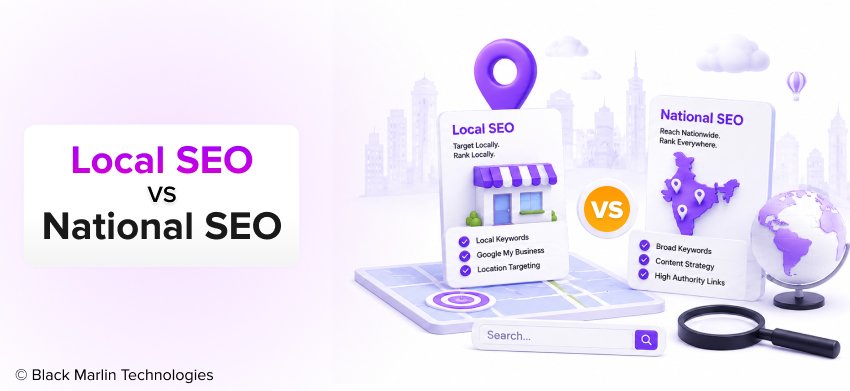 That split is the point where local SEO and national SEO really matter. Local SEO is about showing up for searches tied to a city, a neighborhood, or a specific area. It also supports visibility on Google Maps and for people looking nearby. National SEO is wider in scope. It helps a business rank for related terms across a larger region, so it can reach more customers over a broader market.
So, which strategy should your small business choose?
It is not just about how big your company is or how many people you hope to reach. There is more to it. Think about where your customers spend time. Consider how they look for things. Also look at what you offer. Finally, factor in how your business turns interest into leads or sales.
- Local SEO vs National SEO: What’s the Real Difference?
- Local SEO Focuses on Where Customers Are
- National SEO Focuses on What Customers Are Searching For
- Local SEO vs National SEO at a Glance
- Which Small Businesses Should Prioritize Local SEO?
- Brick-and-Mortar Businesses
- Local Service Businesses
- Professional Services
- Which Businesses Are Better Suited to National SEO?
- Ecommerce Brands
- SaaS & Software Companies
- Online Education & Digital Services
- Nationwide Service Providers
- Content & Media Websites
- Local SEO vs National SEO: The Strategy Is Completely Different
- Keyword Research
- Google Business Profile & Maps
- Content Strategy
- Link Building
- Local SEO vs National SEO: Which Is More Competitive?
- Local SEO: Competition Is More Focused
- National SEO: Competition Comes From a Much Wider Market
- Which SEO Strategy Gives Better ROI?
- Local SEO ROI
- National SEO ROI
- How Long Does Local SEO vs National SEO Take?
- Local SEO
- National SEO
- Which SEO Strategy Is Right for You?
- 1. Where Do Your Customers Live?
- 2. Does Location Affect the Purchase?
- 3. Do You Depend on Google Maps?
- 4. Can Anyone in the Country Become Your Customer?
- 5. Are You Expanding?
- What If Your Business Needs Both Local and National SEO?
- Multi-Location Businesses
- Ecommerce Brands With Physical Stores
- Local Businesses Planning National Expansion
- 7 Common SEO Mistakes Small Businesses Should Avoid
- How to Measure Your SEO Performance?
- Local SEO Metrics
- National SEO Metrics
- Frequently Asked Questions
- Final Thoughts
Local SEO vs National SEO: What’s the Real Difference?
Local SEO and national SEO can look similar at first. The key difference is the type of people you want to find you. With local SEO, you aim at nearby customers who are searching for a nearby option. With national SEO, you try to show up in results for a wider area, so your business can take on competition across the bigger market.
If most people look for your service in one city or nearby area, local SEO is usually the right choice. If customers can reach you from anywhere across the country, then national SEO fits better.
Let’s look at how each approach works.
Local SEO Focuses on Where Customers Are
Local SEO is designed to connect your business with people searching in a specific location. Whether someone types “coffee shop near me” or “plumber in Noida,” Google tries to show businesses that are both relevant and nearby.
Instead of competing with every business nationwide, you’re competing within your service area. That’s why location signals play a much bigger role.
A strong local SEO strategy includes:
- Google Business Profile to appear in local search results.
- Google Maps visibility so customers can easily find your business.
- Local Pack rankings for high-intent searches.
- Customer reviews that build trust and influence local rankings.
- Location-specific service pages for different cities or areas.
- Calls, direction requests, and store visits as key conversion goals.
National SEO Focuses on What Customers Are Searching For
National SEO takes a broader approach. Instead of targeting one city, it helps businesses rank for searches that people make across the country.
This strategy works well for ecommerce stores, SaaS companies, online service providers, and brands that aren’t limited by geography.
A successful national SEO strategy usually focuses on:
- Broad industry keywords with wider search demand.
- Topical authority by covering subjects in depth.
- High-quality content that answers customer questions.
- Technical SEO for a fast, crawlable, and user-friendly website.
- Authoritative backlinks from trusted industry websites.
- Online conversions, such as purchases, demo requests, or lead forms.
Local SEO vs National SEO at a Glance
To tell the two apart, start with your audience and the move you want them to make. With local SEO, the goal is to show up for searches tied to your area so people nearby find you. With national SEO, the aim is to rank across a wider region and pull in customers from a much larger market.
| Factor | Local SEO | National SEO |
| Target audience | Customers in a specific area | Customers across the country |
| Geographic focus | City, neighborhood, or service area | Nationwide market |
| Main search intent | “Near me” and location-based searches | Broad, non-location-specific searches |
| Google Business Profile | A core part of the strategy | Usually less important |
| Google Maps | Major visibility channel | Not a primary focus |
| Keywords | Location + service keywords | Broad industry and topic keywords |
| Content | Local and service-focused | Topic and industry-focused |
| Links | Local and industry-relevant links | National and industry-authority links |
| Competition | Businesses competing in the same area | Brands competing across the wider market |
| Main conversions | Calls, visits, bookings, enquiries | Sales, leads, sign-ups, demos |
| Best suited for | Clinics, restaurants, contractors, local services | Ecommerce, SaaS, publishers, online businesses |
Which Small Businesses Should Prioritize Local SEO?
Local SEO can help many businesses as long as they serve people in a specific area. If distance and convenience affect where customers go, then local search results matter. When you appear in those searches, you may reach the right people at the right time.
Brick-and-Mortar Businesses
Companies that have a store or office in a specific place can gain a lot from local SEO. Many customers type in a nearby option when they are ready to visit. A restaurant, a hair salon, a gym, a medical clinic, or an auto repair shop can show up in local results. That helps bring in people who are already searching for that kind of business nearby.
For local visibility, these businesses can use a Google Business Profile, list on Google Maps, and gather customer reviews. Keep your business details correct and consistent. Also use pages that focus on your area. The aim is simple: help people spot your location, see what you do, and move on to the next step.
Examples include:
- Restaurants
- Retail stores
- Salons
- Gyms
- Clinics
- Auto repair shops
Local Service Businesses
Local service businesses might not get much help from foot traffic. Still, they need to work with customers in a set area. If someone looks for a plumber, a roofer, an HVAC company, or an electrician, they often expect that person or business to be able to get to their location.
That is why local SEO for service companies should target the real service areas they handle, plus the exact services they offer. Build pages that match local intent. Improve visibility in local search results. Collect and manage reviews from nearby customers. Also, make sure the business profile is filled out and set up well. These steps help those searches turn into qualified enquiries.
Examples include:
- Plumbers
- Roofers
- HVAC companies
- Electricians
- Pest control companies
- Home improvement businesses
Professional Services
Professional services can do well in local search too. This is especially true when clients want someone close by. People also like working within a market they already know. For example, a customer might look for a lawyer, an accountant, a real estate agent, a consultant, or a local marketing agency may compare several providers before making contact.
For these businesses, local SEO should not be only about putting a city name on a page. Add useful service details. Show local know-how. Feature real reviews from customers. Create location pages that match what people search for. Make phone and email options easy to find. This can improve search visibility and also build trust.
Examples include:
- Lawyers
- Accountants
- Real estate agents
- Local marketing agencies
- Consultants
Which Businesses Are Better Suited to National SEO?
National SEO only works well when your customers are not tied to one city or a specific service zone. If a person can find your business, buy what you sell, or book your service from many places, you can expand your unpaid search presence. That can open up a bigger growth opportunity.
Instead of focusing mainly on location-based searches, a national SEO strategy targets the topics, products, and questions your wider audience is searching for. This often requires stronger content, technical optimization, authority building, and consistent measurement.
Ecommerce Brands
Ecommerce businesses are a natural fit for national SEO. People can look at products and buy them even if they are not in the same city. Instead of only chasing a query like “shoes in Delhi,” a store can focus on wider search terms. These terms can match product types, category pages, and common customer needs.
A solid national SEO plan can help product pages, category pages, and helpful articles. That way, the brand can show up for buyers across its main market.
SaaS & Software Companies
For SaaS and software companies, location usually isn’t a major part of the buying decision. A customer can discover the product through search, sign up for a trial, and use the platform without visiting a physical location.
Here, SEO can focus on product-related searches, problem-based queries, comparisons, use cases, and educational content that help potential customers move from research to conversion.
Online Education & Digital Services
Courses online and training through platforms let you reach people from anywhere. You can also use consulting services and other digital options the same way. Because of that, showing up in national search matters more than only chasing one city.
Local search optimization should be used only when a place really affects customer demand. Otherwise, these businesses should focus on becoming trusted in the topics their audience follows. They can write posts and pages that fit each step of the buying process.
Nationwide Service Providers
Some businesses serve customers across several states, cities, or regions. For these companies, national SEO can help build awareness beyond a single local market.
However, nationwide doesn’t always mean abandoning local SEO. A business with regional teams or physical locations may benefit from combining broader content with location-specific pages and local SEO services for individual markets.
Content & Media Websites
Publishers and blogs can draw readers from many places in the country. News sites and research platforms do the same. Content driven businesses can also bring in visitors far away. What matters most is not distance. It is how well they address the subjects people actually search for.
A solid plan can bring together detailed pages, smart internal links, technical SEO work, input from specialists, and trusted backlinks. This mix helps your site show up for many related searches.
Local SEO vs National SEO: The Strategy Is Completely Different
Picking local or national SEO is not just a matter of slipping a city into a keyword. What people want when they search can shift. The content you make may need to be different too. Your main SEO tasks can change as well. Even how you build trust online can look different, based on the audience you are trying to reach.
Keyword Research
Keyword research should start with what the customer wants, not just how many people search for a term.
Local SEO almost always starts with a place based goal. If someone searches “dentist in Noida,” they are probably trying to find a clinic near them they can call or go to. The city and area make it easier for Google to pick the businesses that fit what the searcher needs.
National SEO is different. If someone searches “best dental insurance,” the meaning is wider. They could be in any part of the country. Most of the time, they want facts, choices, or a policy. They are not mainly trying to find a nearby business.
Google Business Profile & Maps
For a local business, a Google Business Profile and Google Maps can help people discover you. If the profile is complete and up to date, visitors can quickly see key details like your business name, what you offer, where you are, your hours, customer reviews, and the ways to contact options.
Local SEO looks at more than just keywords. It also checks if the business fits the local area, how close it is to the searcher, and what people say in reviews. It also uses citations and other local location cues. Put together, these items can help a business show up in strong local search results.
If the business is nationwide and does not have a storefront or other customer-facing space, Maps is usually not the main way to grow. Most attention goes to the website, new content, technical SEO work, site credibility, and better rank in general organic search visibility.
Content Strategy
The content should match the audience you’re trying to attract.
Local SEO content can include:
- City and service pages
- Local FAQs
- Neighborhood or area guides
- Local case studies
- Location-specific service pages
- Local customer success stories
National SEO content can include:
- Pillar pages
- Topic clusters
- Industry guides
- Comparison content
- Product and category pages
- Research-driven articles
- Detailed educational resources
Link Building
Link building also needs to reflect the market you’re targeting.
For local SEO, relevant links can come from:
- Regional publications
- Local organizations
- Community websites
- Relevant local directories
- Local partnerships
- Area-specific resources
For national SEO, the focus can move toward:
- Industry publications
- Editorial backlinks
- Digital PR
- Expert contributions
- Original research
- Industry studies
A small business does not always have to chase hundreds of links from big national sites. It can do better with a smaller set of mentions that match the local area and the industry. Those targeted references often help more than lots of random links.
Also, if a well known brand is going after wide search terms, it may need more trust across the whole industry to get noticed.
Local SEO vs National SEO: Which Is More Competitive?
Competition feels different when you look at local versus national results. It is not just a case of one being “easy” and the other “hard.” Whether a keyword is hard to win depends on several things.
Local SEO: Competition Is More Focused
Local SEO usually limits competition by three things: where people are, what service they want, and the type of search they run. For instance, a dentist in Noida does not face competition from every dental clinic across India for every query. The real fight is mostly with businesses that serve the same area and provide similar services.
Targeting a specific area can help a small business show up for searches that match what people actually need. If the site has helpful location pages, real customer reviews, and a well set up Google Business Profile, it becomes easier to compete locally. Adding the right local signals also supports visibility in the same market.
The key thing is this: having fewer competitors does not mean there is zero competition. Many well known cities and common industries can still be very competitive.
National SEO: Competition Comes From a Much Wider Market
National SEO puts you in front of more websites than before. With the right keyword, you might end up facing startups. You could also see well-known brands. Sometimes it is enterprise sites. Other times it is publishers, big marketplaces, or niche specialist websites.
Broad, high-volume terms are often hard to work with. They tend to pull in companies that already have big content libraries. Those sites usually have strong domain authority too. Many also benefit from brand name recognition. On top of that, they have had more time to earn links. They also tend to rank well in search due to years of visibility.
Which SEO Strategy Gives Better ROI?
There is no single “best” SEO plan for ROI. What works depends on how your business brings in customers. If you run a local shop, smaller but very focused traffic can matter more. For a national brand, you may get stronger results from landing in front of a much larger audience.
The key is to measure SEO by business outcomes, not rankings or traffic alone.
Local SEO ROI
For a local company, SEO usually helps when people nearby search and then act right away. If someone looks up a plumber, clinic, diner, or attorney, they might be ready to call after they find the business.
That’s why local SEO performance should be measured through metrics such as:
- Phone calls generated from search
- Booking and appointment requests
- Direction requests from Google Maps
- Store or office visits
- Qualified local leads
- Map and Local Pack visibility
- Relevant customer enquiries
National SEO ROI
National SEO often leads people through a longer path before they buy. Someone could read a blog post first, then look at a few options, check a product page, and only decide later. It may take days or even weeks.
That means businesses should look beyond traffic and track:
- Organic traffic
- Non-branded organic clicks
- Qualified leads
- Ecommerce revenue
- Demo or trial requests
- Organic conversion rate
- Revenue generated from organic search
How Long Does Local SEO vs National SEO Take?
SEO has no set deadline. How long it takes to see real results can change. It depends on the level of competition, how strong the site is, the technical state of the site, how good the content is, whether the content matches what searchers want, and how much fixing and writing still needs to be done.
Local SEO can start showing results faster. The work is aimed at one clear area. National SEO often takes longer. It usually asks for more authority building, especially with tough keyword targets. Also, it helps to avoid a fixed promise for a specific ranking date. A better way is to watch for steady gains. Look for better visibility over time. Track more qualified visitors too. Then watch for more conversions as things improve.
Local SEO
Local SEO can start showing meaningful improvements after foundational issues are addressed. Optimizing the Google Business Profile (GBP), correcting inconsistent citations, encouraging genuine customer reviews, and improving local landing pages can strengthen a business’s relevance within its target area.
Local authority also matters. Mentions from relevant local organizations, publications, and businesses can help establish credibility within the market.
For a new or highly competitive local business, progress may take longer. A practical expectation is to look for early signals within a few months, while stronger and more consistent local visibility can take longer to develop.
National SEO
National SEO generally requires more time because you’re competing across a much broader search landscape. Building content depth around important topics, improving technical SEO, earning relevant backlinks, and establishing website authority all take consistent effort.
Competitive keywords can take particularly long to rank because established websites may already have strong content, links, brand recognition, and years of search history.
Rather than focusing only on when a particular keyword reaches page one, monitor improvements in organic visibility, non-branded traffic, qualified leads, rankings across topic clusters, and conversions.
Which SEO Strategy Is Right for You?
Not sure whether your business should focus on local SEO, national SEO, or both? You don’t need a complicated formula to make the decision. Start with five simple questions about your customers, sales process, service area, and growth plans.
1. Where Do Your Customers Live?
Start by looking at your actual customer base.
If most of your customers come from one city, neighborhood, or defined service area, local SEO should usually be your starting point.
If you serve multiple cities or regions, you may need a combination of local and broader SEO.
If your customers can come from anywhere in the country, national SEO may offer more potential.
2. Does Location Affect the Purchase?
Think about what happens before someone becomes your customer.
If they need to visit your location, call your team, or have a service delivered to their area, location is an important part of their decision. That’s a strong signal to prioritize local SEO.
If customers can discover your business, complete the purchase, and use your product or service entirely online, national SEO may make more sense.
3. Do You Depend on Google Maps?
For some businesses, Google Maps is one of the most important ways customers discover them.
Restaurants, clinics, salons, repair shops, and local service providers can all benefit from appearing prominently in local search and Maps.
If customers regularly search for your business type nearby, Google Business Profile optimization and local search visibility should be a priority.
4. Can Anyone in the Country Become Your Customer?
Ask yourself whether geography actually limits your market.
If someone anywhere in the country can purchase your product, book your online service, or sign up for your software, your potential audience is much broader.
In that situation, national SEO can help you target relevant searches across the wider market rather than concentrating your efforts on one location.
5. Are You Expanding?
Your SEO strategy should also reflect where your business is going not just where it is today.
If you’re currently successful in one city and planning to expand, don’t create dozens of location pages before you actually operate in those markets. Build a strong foundation first, then expand your SEO strategy as your business does.
As you enter new markets, you can develop genuine location-specific pages, local profiles, relevant content, and authority for each area.
What If Your Business Needs Both Local and National SEO?
Choosing between local SEO and national SEO isn’t always an either-or decision. Some businesses need to attract customers in specific locations while also building visibility across a much wider market. In those cases, a hybrid SEO strategy can connect local search visibility with broader organic growth.
The key is to give each part of the strategy a clear purpose rather than trying to optimize every page for every type of search.
Multi-Location Businesses
Businesses with several locations need to be visible at both the brand level and the individual location level.
For local visibility, each genuine location may need:
- Individual location pages
- Accurate Google Business Profile information
- Location-specific customer reviews
- Useful local content
- Relevant local signals and citations
At the same time, the main website can use national SEO to build broader visibility through:
- National-level content
- Product and category pages
- Industry-focused resources
- Brand authority
- Strong technical SEO
Ecommerce Brands With Physical Stores
Retail businesses with both online and offline sales have two different customer journeys.
National SEO → Online sales
National search optimization can help product and category pages reach customers across the country who are ready to research or purchase online.
Local SEO → Store visits
Local optimization can help individual stores appear when nearby customers search for products, brands, or services in their area.
This allows the same business to capture demand from customers who want delivery and online shopping as well as those who prefer to visit a physical store.
Local Businesses Planning National Expansion
Your SEO strategy should grow alongside your business.
A company that starts by serving one city doesn’t necessarily need a nationwide SEO campaign from day one. It can first build a strong local foundation, establish authority, understand which services generate demand, and then expand into new markets.
As the business grows, the strategy can gradually introduce broader content, national keywords, stronger industry authority, and location-specific optimization for new markets.
7 Common SEO Mistakes Small Businesses Should Avoid
SEO can create steady growth for a small business, but only when the strategy is aligned with the way customers actually search. Many businesses make the mistake of copying what larger brands do or focusing too heavily on rankings without considering relevance and conversions.
Here are seven common mistakes worth avoiding.
1. Chasing High-Volume Keywords That Don’t Convert
A keyword with thousands of monthly searches may look attractive, but high traffic doesn’t always mean more customers. If the search intent doesn’t match your products or services, you could spend months optimizing for visitors who never buy.
Instead, prioritize relevant, high-intent searches that connect directly with what your business offers. A smaller keyword that brings qualified leads can be far more valuable than a high-volume term that generates little business.
2. Targeting Nationwide Keywords When You Only Serve One City
If your business only serves one city, competing for broad nationwide keywords can quickly consume your time and budget.
A local business should first build visibility around the locations and services it genuinely serves. Someone searching for “plumber in Noida” is far more valuable to a Noida plumbing company than someone searching for a generic plumbing guide from another state.
3. Creating Duplicate City Pages
Creating dozens of pages with the same content and simply changing the city name isn’t a strong local SEO strategy. These pages provide little additional value to users and can make your website feel repetitive.
Instead, create location pages only where you have a genuine business presence or service area. Include useful local information, relevant services, customer needs, and genuinely different insights where appropriate.
4. Ignoring Google Business Profile
For businesses that depend on local customers, overlooking Google Business Profile can mean missing an important discovery channel.
Keep your profile accurate and complete, including your business details, categories, services, hours, photos, and other relevant information. Encourage genuine customers to leave reviews and respond professionally when appropriate.
Your website matters, but local customers may encounter your business through Maps or local search before they ever visit your website.
5. Measuring Traffic Instead of Revenue
Traffic is easy to report, but it isn’t the final business goal.
A local business should understand how organic search contributes to calls, bookings, enquiries, and visits. A national business may need to connect SEO with leads, sign-ups, sales, and revenue.
If traffic increases but qualified enquiries don’t, the strategy may need to be adjusted.
6. Building Links Without Considering Relevance
More backlinks aren’t automatically better. A large number of irrelevant or low-quality links may provide little meaningful value compared with a smaller number of relevant, credible mentions.
For local businesses, links from relevant local organizations, publications, and industry sources can strengthen the site’s local relevance. National businesses can focus on earning authoritative links from respected industry publications, experts, and relevant websites.
7. Trying to Do Local and National SEO Without a Clear Structure
Using both strategies can be effective, but trying to target everything at once can dilute your efforts.
For example, a multi-location business might optimize individual location pages for local searches while using its main website structure and content strategy to target broader national topics.
Define which pages serve local intent and which support national search visibility. Once the roles are clear, your content, keywords, internal links, and measurement become much easier to manage.
How to Measure Your SEO Performance?
SEO performance shouldn’t be judged by rankings alone. A keyword moving from page two to page one is useful, but what matters more is whether that visibility brings the right audience and contributes to real business growth.
The metrics you track should also depend on whether you’re running a local or national SEO strategy.
Local SEO Metrics
For a local business, focus on actions that show people are discovering and engaging with your business in the areas you serve.
Key metrics include:
- Local Pack visibility: How often your business appears for relevant local searches.
- Maps impressions: How frequently your business profile is discovered through Google Maps.
- Calls: The number of calls generated through local search and your business profile.
- Direction requests: A useful indicator for businesses that depend on physical visits.
- Website clicks: Visits generated from your local business profile.
- Local leads: Enquiries that come from customers within your target service area.
- Booking enquiries: Appointments, reservations, or service requests generated through search.
- Review growth: The number and quality of genuine customer reviews over time.
National SEO Metrics
National SEO typically needs a broader set of performance indicators because customers may discover your brand through different types of searches and take longer to convert.
Track metrics such as:
- Organic clicks: How many users reach your website through unpaid search.
- Non-brand traffic: Visibility generated by searches that don’t already include your brand name.
- Keyword visibility: How your website performs across relevant topics and search terms.
- Organic leads: Enquiries, sign-ups, or other valuable actions generated through organic search.
- Conversion rate: The percentage of organic visitors who complete a desired action.
- Revenue: Sales that can be attributed to or influenced by organic search.
- Backlink growth: The development of relevant and authoritative links pointing to your website.
- Topical visibility: How well your website is becoming visible across a broader group of related searches.
Frequently Asked Questions
Q1. What is the difference between local SEO and national SEO?
Ans1. – Local SEO focuses on reaching customers within a specific city, neighborhood, or service area. National SEO targets a broader audience across the country. Local strategies often emphasize Google Business Profile, Maps, reviews, and location-based searches, while national SEO focuses more on content, technical optimization, topical authority, and broader organic visibility.
Q2. Is local SEO better for small businesses?
Ans2. – Local SEO can be a better starting point when a small business depends on customers from a specific geographic area. Restaurants, clinics, plumbers, salons, and local service providers can benefit from appearing in nearby searches. However, businesses that sell nationwide or operate online may gain more from a national SEO strategy.
Q3. Can a small business use local and national SEO together?
Ans3. – Yes. A business can use both strategies when it has local customers and broader online opportunities. For example, a multi-location retailer can use local SEO to attract customers to its stores while using national SEO to promote products online. The key is to give each strategy a clear purpose.
Q4. Is local SEO cheaper than national SEO?
Ans4. – Local SEO is often more focused and may require less investment than competing nationally, but cost depends on competition, locations, website size, content needs, and authority-building requirements. A business with many locations can still have significant local SEO costs, while a small national campaign may require fewer resources.
Q5. How long does local SEO take to work?
Ans5. – There is no guaranteed timeline for local SEO. Businesses may see early improvements after optimizing their Google Business Profile, correcting citations, improving location pages, and strengthening reviews. However, competitive markets can take longer. It’s better to measure progress through local visibility, calls, enquiries, bookings, and other meaningful customer actions.
Q6. How long does national SEO take to show results?
Ans6. – National SEO can take longer to build because businesses often compete with established websites for broader, competitive keywords. Results depend on website authority, technical health, content quality, competition, and backlinks. Instead of expecting a specific ranking date, monitor improvements in organic visibility, qualified traffic, leads, conversions, and revenue.
Q7. Does every local business need a Google Business Profile?
Ans7. – For most eligible businesses that serve customers locally, Google Business Profile can be an important part of local search visibility. It helps customers discover essential business information through Google Search and Maps. However, the importance and setup will vary depending on the business type, location, and how customers interact with it.
Q8. Can a service-area business use local SEO?
Ans8. – Yes. A service-area business can use local SEO even without a traditional storefront. Plumbers, electricians, roofers, cleaners, and similar businesses can target the areas they genuinely serve. Their strategy can focus on relevant services, service areas, customer reviews, and accurate business information rather than relying only on physical foot traffic.
Q9. Which SEO strategy is best for ecommerce?
Ans9. – National SEO is generally a strong fit for ecommerce businesses because customers can purchase products from different locations. The strategy can focus on product pages, category pages, commercial keywords, buying guides, and broader informational content. However, ecommerce brands with physical stores can also use local SEO to support in-store discovery and visits.
Q10. How do I know which SEO strategy my business needs?
Ans10. – Start by asking where your customers are and whether location affects their buying decision. If customers need to visit, call, or receive services in a specific area, local SEO is likely important. If customers can buy or use your offering from anywhere, national SEO may be more appropriate. Some businesses need both.
Final Thoughts
Choosing between local SEO and national SEO isn’t about picking the strategy with the biggest reach. It’s about understanding where your customers are, how they search, and what makes them choose your business.
A local plumber, dentist, or restaurant may generate more value by becoming highly visible in its target city than by competing for broad national keywords. On the other hand, an ecommerce store or SaaS company can have a much larger opportunity by reaching customers across the country through national search.
For businesses with multiple locations, physical stores, or both online and offline sales, combining local and national SEO can create a stronger path to growth.
Ultimately, don’t build your SEO strategy around search volume alone. Build it around customer intent, your business model, and where you want the business to go next. The right visibility is more valuable than simply having more visibility.