'>
<rect width='100' height='100' fill='%23B22234'/>
<!-- stripes -->
<g fill='%23fff'>
<rect y='10' width='100' height='10'/>
<rect y='30' width='100' height='10'/>
<rect y='50' width='100' height='10'/>
<rect y='70' width='100' height='10'/>
<rect y='90' width='100' height='10'/>
</g>
<!-- blue box -->
<rect width='50' height='50' fill='%233C3B6E'/>
</g>
</svg>)
'>
<rect width='100' height='100' fill='%23fff'/>
<rect width='100' height='33.33' y='0' fill='%23FF9933'/>
<rect width='100' height='33.33' y='66.66' fill='%23138808'/>
<!-- Ashoka Chakra -->
<circle cx='50' cy='50' r='9' fill='none' stroke='%23000080' stroke-width='2'/>
<g stroke='%23000080' stroke-width='1'>
<line x1='50' y1='41' x2='50' y2='59'/>
<line x1='41' y1='50' x2='59' y2='50'/>
<line x1='44' y1='44' x2='56' y2='56'/>
<line x1='56' y1='44' x2='44' y2='56'/>
</g>
</g>
</svg>)
 info@blackmarlintechnologies.com

Imagine you are trying to find a new set of running shoes. You might notice a brand on Instagram, watch a few evaluations on YouTube, see what people are saying on Reddit, compare prices and special features on Amazon, and then ask ChatGPT which pick is the smartest. Your search does not stay in one place anymore it wanders across multiple platforms, before you make a decision.
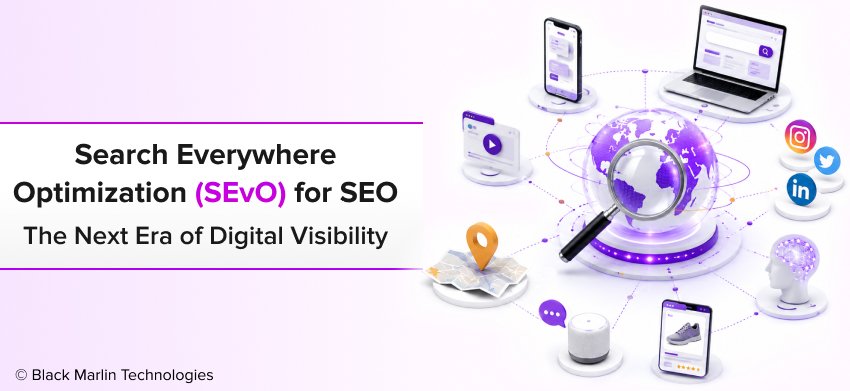
This is why Search Everywhere Optimization is becoming an important part of modern digital marketing, like seriously. Traditional SEO mainly asks, “How do I rank on Google?” However today’s customers use a whole bunch of different platforms, to look around, compare, and find brands.
SEvO is asking a bigger question, like where does my audience actually search, an ways can my brand become visible there.
A strong search everywhere optimization strategy expands past standard search engines to include AI platforms, social networks, marketplaces, communities, maps and other discovery avenues. In this way, search everywhere optimization for SEO builds on the usual traditional SEO, not replacing it. The approach also sweats AI search optimization and the wider idea of SEO everywhere, helping brands remain noticeable while user search behavior continues to change.
- What Is Search Everywhere Optimization (SEvO)?
- Why SEvO Is Becoming Important in 2026?
- Where Does Search Happen Today?
- Traditional Search Engines
- AI Search and Answer Engines
- Social Search
- Communities and Review Platforms
- Marketplaces
- Maps and Local Search
- The 6 Core Pillars of a Strong SEvO Strategy
- How to Build a Search Everywhere Optimization Strategy?
- 1: Identify Where Your Audience Searches
- 2: Find Your Money Topics
- 3: Map Keywords to Search Surfaces
- 4: Create Platform-Specific Content
- 5: Build Authority Beyond Your Website
- 6: Measure and Improve
- SEvO Metrics: How Do You Measure Search Everywhere Optimization?
- The SEvO Visibility Score
- Don’t Stop at Rankings
- Connect Visibility to Business Results
- Build a Simple SEvO Dashboard
- SEO vs AEO vs GEO vs LLMO vs SEvO
- SEO: Search Engine Optimization
- AEO: Answer Engine Optimization
- GEO: Generative Engine Optimization
- LLMO: Large Language Model Optimization
- SEvO: Search Everywhere Optimization
- Common Search Everywhere Optimization Mistakes
- Only Optimizing for Google
- Publishing the Same Content Everywhere
- Chasing Every New Platform
- Ignoring Brand Mentions
- Measuring Only Rankings
- Creating Content Without Search Intent
- Ignoring Reviews and Communities
- Treating AI Visibility as a Shortcut
- A Practical SEvO Checklist for 2026
- The Future of Search Everywhere Optimization
- AI Agents
- Conversational Search
- Multimodal Search
- Voice Search
- Social Commerce
- AI Shopping
- Personalized Search
- Zero-Click Experiences
- Search Inside Apps
- Frequently Asked Questions
- Final Thoughts
What Is Search Everywhere Optimization (SEvO)?
Search Everywhere Optimization (SEvO) is basically the act of raising a brand’s presence across many spots where people look , find out, compare, and choose not only on the usual search engines.
Search Everywhere Optimization, in simple terms, is a broader strategy for being found online. It is not only about how to rank a website on Google. Businesses also think about the places where customers actually look for answers, products, reviews, suggestions, and services.
This can include Google, Bing, AI platforms, YouTube, social media, Reddit, marketplaces Google Maps, review websites, and other useful discovery platforms.
Why SEvO Is Becoming Important in 2026?
Search behavior is changing fast. People are not staying on a single platform for every question and buying decision anymore. They can start with Google, then ask an AI tool for suggestions, watch a YouTube review, check Reddit, and finally complete the purchase on a marketplace.
Several trends are driving this change:
- AI-generated answers: AI platforms can provide direct answers and recommendations without requiring users to visit several websites.
- Zero-click searches: Search engines can answer questions directly within the results page.
- Social search: Users increasingly discover products, services, trends, and information through social platforms.
- YouTube discovery: YouTube has become an important destination for tutorials, product reviews, comparisons, and educational content.
- Marketplace search: Shoppers often search directly on Amazon and other ecommerce platforms when they are ready to compare products.
- Reddit and community research: Users turn to communities for genuine opinions, experiences, and recommendations.
- Multi-platform buying journeys: Customers can interact with a brand across several platforms before becoming a customer.
This broader approach is important for brand presence online since being noticeable in just a single search channel does not mean customers will inevitably find you in other places.
Ahrefs is reporting like a 197% year over year rise in searches for the term “search everywhere optimization”, which feels like a signal that interest in the idea is just increasing.
Where Does Search Happen Today?
Search used to feel like just a straightforward Google query, but lately it has turned into a broader discovery journey. People might look for something on Google then ask ChatGPT for the answer, after that they watch a YouTube review, and then they check Reddit for opinions. Some compare products on Amazon, others use Google Maps to locate a nearby business.
That’s why search everywhere optimization SEO doesn’t stop at normal rank checking. The idea is to grasp where your people are looking, then develop better presence across the channels that steer their choices.
Traditional Search Engines
Google, Bing, and other search engines are still a very important basis for digital visibility. Strong, traditional SEO helps those engines discover, interpret, and properly rank your website.
Key areas include:
- Technical SEO: Make your website easy to crawl, index, and use.
- On-page SEO: Optimize titles, headings, URLs, internal links, and page content.
- Content: Create useful information that matches search intent.
- Links: Earn relevant and trustworthy backlinks and mentions.
- Local SEO: Improve visibility for location-based searches.
- SERP features: Optimize for snippets, images, videos, local results, and other search features.
Traditional SEO isnt going anywhere. It will, you know, stay as the groundwork on which a broader SEvO approach can be built.
AI Search and Answer Engines
AI has put out a different way of finding information, for some people it feels easier. Rather than opening multiple search results one after another, users can just ask a conversational question and then get a synthesized answer.
Important AI search experiences include:
- ChatGPT
- Google AI Overviews and AI Mode
- Gemini
- Perplexity
- Other AI-powered answer experiences
This changes the optimization goal Businesses are no longer just focused on making a webpage rank. They also want their information to be comprehended, mentioned, and maybe cited inside AI generated answers.
This is where generative engine optimization (GEO) and SEO in AI search start to matter. For companies that are asking how to rank in AI search, they should really lean into helpful content, solid topical authority, careful and accurate info, credible sources, plus a steady brand presence.
AI visibility can then be monitored via AI visibility tracking, like brand mentions, citations competitor comparisons and the right AI generated responses.
Social Search
Social media isn’t only about posting updates and building followers anymore. People are using these platforms more and more to discover products, learn new skills, seek recommendations, and investigate brands.
Important social search platforms include:
- YouTube: Reviews, tutorials, comparisons, and educational content
- TikTok: Trends, product discovery, tips, and short answers
- Instagram: Brands, products, creators, and visual discovery
- Pinterest: Ideas, inspiration, products, and visual search
- LinkedIn: Professional information, industry insights, and business expertise
This shouldnt be treated as ordinary social media marketing. SEvO really is about how people search, and then stumble on information inside these platforms.
Communities and Review Platforms
Before making a purchase, people often want to know what real users think. That is why communities and review platforms can become important parts of the search journey.
These include:
- Quora
- Industry forums
- Review websites
- Customer communities
A customer may search Reddit for experiences with a product or look at reviews before contacting a service provider.
For SEvO the focus should be on building genuine trust and useful participation, not flooding communities with promotional content.
Helpful answers, expert contributions, good customer experiences and dependable third-party discussions can all help widen brand visibility.
Marketplaces
For ecommerce businesses, the search journey can start directly inside a marketplace.
Platforms such as Amazon, and some other ecommerce marketplaces, let people search, weigh options, check reviews, and then buy products directly, without going to a conventional search engine first.
Businesses should pay attention to:
- Product titles
- Product descriptions
- Search terms
- Product categories
- Images
- Product attributes
- Ratings and reviews
- Listing quality
Marketplace optimization is therefore an important step in search everywhere optimization SEO for ecommerce brands.
Maps and Local Search
For local businesses, customers often search for nearby options rather than general information.
They may use:
- Google Maps
- Google Business Profile
- Apple Maps
- Local directories
- Local review platforms
Businesses really should keep their business name, address, phone number opening hours, services, photos and other crucial details accurate and consistent.
Reviews also play an important role because they can influence both visibility and customer trust.
The 6 Core Pillars of a Strong SEvO Strategy
A strong search everywhere optimization approach is not about simply cranking out more content on every platform. It is more about getting what people are actually searching for, picking the most fitting platforms, and building trust, then linking visibility to real business outcomes.
Think of SEvO as a complete journey:
- Search Intent Mapping: First off, don’t just jump into keywords alone, take a second and understand what people are really looking for, and the reason they are searching.
- Platform-Specific Optimization: You should not just copy that exact wording and publish it everywhere, because each platform has its own readers, different formats, search behavior and expectations for content.
- Entity and Brand Optimization: Strong AI SEO and SEvO are not only about keywords, because search systems also have to grasp who your brand really is. like what you provide, and what you are well-regarded for.
- AI Visibility and Retrievability: As AI search grows, businesses need to consider another question. Can AI systems find understand, trust, and use information about your brand? This is where AI visibility and retrievability become important. The goal is not to manipulate AI systems. It is to build a trustworthy digital footprint that gives them reliable information to understand your brand.
How to Build a Search Everywhere Optimization Strategy?
A successful search everywhere optimization strategy i s not about trying to get ranked on every platform all at once. It begins by figuring out where your customers actually search , what they require, and which channels exert influence over their final decisions.
This six step kind of framework can help you build better search visibility across classic search, AI platforms, social channels, groups, and marketplaces.
1: Identify Where Your Audience Searches
Start by creating a simple platform map.
Where does my audience go when they need information, recommendations, reviews, or products?
Depending on your business, the answer could include:
- Google and Bing
- ChatGPT and other AI platforms
- YouTube
- TikTok and Instagram
- Reddit and Quora
- Amazon and other marketplaces
- Google Maps
- Industry websites and review platforms
2: Find Your Money Topics
Next, identify the topics that can influence a customer’s decision.
Don’t focus only on keywords with high search volume. Look for topics connected to real business value, such as:
- Products
- Services
- Customer problems
- Comparisons
- Reviews
- Alternatives
- Buying decisions
3: Map Keywords to Search Surfaces
Once you have your important topics, identify where each search need appears.
This helps you understand that one search topic can create multiple opportunities for search visibility.
4: Create Platform-Specific Content
One-size-fits-all content does not work well in Search Everywhere Optimization.
Each platform has different users, formats, and search behaviors.
This is where YouTube SEO and generative engine optimization become part of a wider SEvO strategy.
You should not aim to put the same article everywhere, really. Start with one strong subject then gently adapts the facts to each platform.
5: Build Authority Beyond Your Website
Your website is basically the lone source of information about your brand. Yet people as well as search systems also glance at what other websites and communities are saying, about you.
Build authority through:
- Digital PR
- Relevant guest posts
- Genuine customer reviews
- Expert quotes
- Community participation
- Industry mentions
- Quality backlinks
- Third-party references
For AI search optimization, this broader digital footprint can also help you form your brand expertise and credibility.
The focus should always be on quality and relevance, not collecting as many mentions or links as possible.
6: Measure and Improve
Finally, track what is actually working.
Start with visibility metrics such as:
- Google search visibility
- AI mentions and citations
- YouTube visibility
- Social discovery
- Marketplace visibility
- Brand mentions
- Referral traffic
Then connect those metrics to business outcomes:
SEvO Metrics: How Do You Measure Search Everywhere Optimization?
How do you know if your search everywhere optimization (SEvO) strategy is actually working?
Traditional SEO usually focuses on rankings, organic traffic, clicks and backlinks. Those numbers still matter, but they do not fully show the entire story anymore. A brand can be found through Google, AI answers, YouTube, Reddit, social channels, or marketplace shelves, even without getting a classic search click.
That is why SEvO needs a wider measurement framework, basically, to see the whole thing a bit more clearly. The aim is to understand exactly where your brand shows up, how frequently people encounter it, and whether this presence meaningfully pushes business growth.
The SEvO Visibility Score
You can build an illustrative SEvO Visibility Score that basically brings the various search surfaces into one single measurement framework.
This is a suggested framework, not an industry-standard formula. The percentages can be changed based on your industry, audience, and business priorities.
SEvO Visibility Score =
- 25% Traditional Search Visibility
- 20% AI Visibility
- 15% Social Search Visibility
- 15% Marketplace Visibility
- 10% Community Visibility
- 15% Brand & Authority Signals
Don’t Stop at Rankings
Rankings are useful, but they should not be the only measure of success.
Imagine your website is doing well in Google, yet customers seem to barely come across your brand through AI platforms, YouTube, social search, or marketplaces. Your regular SEO might feel strong, but your broader online presence can still have a few important gaps.
Connect Visibility to Business Results
Visibility is only the beginning, but the real goal is connect discovery with meaningful business outcomes.
A YouTube video with 10,000 views may look impressive, but if another channel produces fewer views and more qualified leads, the second channel may be more valuable.
Build a Simple SEvO Dashboard
Review your performance regularly across:
- Traditional search
- AI mentions and citations
- Social search
- YouTube
- Marketplaces
- Communities
- Brand mentions
- Referral traffic
- Leads
- Sales and conversions
Over time, this data can show which search surfaces are creating the strongest opportunities.
SEO vs AEO vs GEO vs LLMO vs SEvO
As search keeps evolving, marketers are tossing around acronyms like SEO, AEO, GEO, LLMO, and SEvO to talk about distinct ways to gain digital visibility. These things are connected, but they also point to different search environments, and different end goals.
Getting the difference can help businesses pick the more fitting route, instead of handling every search experience in the same way.
SEO: Search Engine Optimization
SEO focuses on improving a website’s visibility in traditional search engines such as Google and Bing.
It involves technical SEO, on-page optimization, producing content, plus internal linking, backlinks, local search SEO, and other related practices, that should help lift your rankings and organic traffic.
For businesses putting money into SEO services, this stays kind of an important ground work for longer term digital visibility.
AEO: Answer Engine Optimization
AEO focuses on helping content show up inside direct replies, to users questions, maybe. It looks at experiences like highlighted snippets, FAQ blocks, voice driven searching and other outcome focused search results.
The goal is to provide clear, concise information that directly satisfies search intent.
GEO: Generative Engine Optimization
GEO is about making a presence, especially within generative AI search experiences. Instead of aiming only for the old style ranking, GEO looks at how content can end up in AI generated responses.
The goal can include increasing the chances of being mentioned or cited as a useful and credible source.
LLMO: Large Language Model Optimization
LLMO focuses on how brands and information are represented within large language model experiences.
It pushes things like topical authority, factual consistency, brand recognition, and reliable information throughout the web, even if it reads a little scattered. The bigger goal is to help AI systems grasp a brand and its field of expertise.
SEvO: Search Everywhere Optimization
SEvO takes a wider view. It looks at what’s seen across search engines, AI platforms, social networks, YouTube, marketplaces, communities, maps, review platforms, and a few other avenues that help people discover things.
Common Search Everywhere Optimization Mistakes
A serious Search Everywhere Optimization (SEvO) plan is not about being in every single place. It is more about showing up in the right locations, with the correct details, at the moment your audience is ready to look things up or make a decision.
Here are some common mistakes businesses should avoid.
Only Optimizing for Google
Google is still pretty important, yet it is not the only place where customers end up looking. Some people use YouTube for reviews and checks, Reddit for judgments, Amazon for items, while others turn to AI platforms for guidance or suggestions.
If your entire strategy focuses on Google rankings, you may miss valuable discovery opportunities.
Publishing the Same Content Everywhere
Copying the same blog, caption, or message across every platform does not create the same value.
A detailed article might help on Google, but a short clip, or maybe video reel, feels better on TikTok or Instagram. For Reddit, a person often expects a useful discussion not just, promotional content.
Chasing Every New Platform
SEvO does not mean creating an account on every new platform.
Trying to maintain too many channels can waste time, stretch resources, and reduce content quality.
Ignoring Brand Mentions
Your website is only one piece in your overall online presence, right. People can get to know your company from customer reviews, articles, social posts, forums, videos, and even industry websites.
Ignoring these third-party references can create gaps in your overall online brand visibility.
Measuring Only Rankings
Rankings remain useful, but they do not show the complete picture of search visibility.
Your brand might show up in an AI answer a YouTube video, a Reddit discussion, or even a marketplace listing, without needing to climb through a standard Google ranking.
Creating Content Without Search Intent
A keyword can have a search volume, but that alone does not automatically mean it is a worthwhile content opportunity.
Think about it like this: if someone types “best running shoes” they may be running a product compare thing, like weighing which pairs are the most right. But if they search “how to clean running shoes” theyre clearly after instructions.
Ignoring Reviews and Communities
Many customers seem to want to try real experiences first before they make a call. You see, Reddit threads, review websites, discussion boards, plus customer communities can really sway trust in a big way.
Ignoring these channels means missing an important part of the search journey.
Treating AI Visibility as a Shortcut
Showing up in an AI generated answer can help a lot, but that should not be a stand-in for solid SEO really useful content, and genuine authority.
There is no reliable shortcut that guarantees a brand will be mentioned by an AI system.
A Practical SEvO Checklist for 2026
You do not really have to optimize for every platform all at once. A practical search everywhere optimization, or SEvO approach starts with the channels your audience already uses and then gradually expands your visibility.
Use this checklist to review your SEvO efforts in 2026.
- Identify your top search platforms: Figure out where your customers go looking for info, products, services, feedback, and suggestions. Think about Google, AI platforms, YouTube, social networks, Reddit, Amazon, Maps, and the relevant niche websites.
- Map important topics to platforms: Put your most valuable topics and keywords where your audience actually looks for them. If you have a product comparison, for example it often needs to show up on Google, YouTube, Reddit, AI platforms and marketplaces.
- Optimize existing website content: Go through your most important pages and give them a real tune up, think titles, headings, the overall content quality, and also the internal link choices. Try to tighten the structure, align the search intent in a clearer way, and make sure the best information is easy for visitors to grasp as well as for search systems.
- Improve AI search visibility: Create clear, accurate, authoritative content, while keeping your brand information consistent across the web. Monitor the AI responses that are relevant, to see where your brand is showing up and where visibility gaps exist
- Optimize YouTube content: Make videos around questions, issues, reviews, side by side comparisons and those topic ideas people are already searching for. Use clear, descriptive titles, write descriptions that are actually useful, add the right topics, and, most importantly, put content in that truly answers the viewer’s question.
- Improve social search discovery: Optimize relevant content for YouTube, TikTok, Instagram, LinkedIn and Pinterest, so it can actually get seen by the right people. Use natural keywords, clear topics with a steady theme, and captions that feel useful rather than forced. For each channel, match the platform format.
- Optimize marketplace listings: For ecommerce organizations, take a careful look at the product titles, descriptions, feature lists, images, categories, specific attributes, ratings, and even the written reviews. Try to make every piece of product information feel clear, practical, and actually helpful, so it improves how people find the item and also helps them make a purchase decision.
- Build credible third-party mentions: Boost your standing online with digital PR, authentic reviews, strong expert quotes, and guest contributions that actually fit. Also aim for recognition in industry publications, add quality backlinks, and stay involved through helpful community participation.
- Strengthen local visibility: Keep your Google Business Profile, the Maps details, your company information and opening hours, plus services, photos, and even those customer reviews, accurate and in sync across the relevant local platforms.
- Monitor competitor visibility: Check where competitors pop up across Google, AI platforms, YouTube, social search, forums communities, marketplaces, and also local listings. See what themes or subjects show up, especially on the places where your brand has a visibility gap.
- Track AI mentions and citations: Keep an eye on whether AI systems bring up your brand, products or services when users ask relevant questions. Whenever it is possible, also monitor the citations and the exact sources being used in AI-generated responses.
- Measure conversions, not only rankings: Connect visibility with business outcomes, track referral traffic, enquiries and leads then move to sales, assisted conversions and revenue, keep all of it alongside rankings and other visibility metrics as well.
The Future of Search Everywhere Optimization
Search is moving past just plain keywords and those blue links. People can now ask questions in an actual conversation, search using an image, discover products through video streams, compare options with AI, or grab relevant information right inside an app.
So, the future of search everywhere optimization (SEvO) will likely drift away from chasing a single, lone ranking position and lean more into being discoverable across multiple search and decision making experiences.
AI Agents
AI agents can take search one steps farther, helping users complete tasks not only locating information.
Rather than just asking, “Which laptop should I buy?” a person might ask an AI agent to lay out the comparison of laptops while looking at their budget, feature set, user reviews, and current availability.
For businesses, this is making accurate and available product, service, and company details more and more important.
Conversational Search
Search is starting to feel more conversational. People can ask one question , add a bit more context, then request a follow up, and keep refining the answer without going back to a completely new search.
Brands should therefore craft content that answers direct questions, while also touching the related questions customers will probably ask a next.
Multimodal Search
Search is no longer limited to text. Users can combine text, images, video, and voice to find what they need.
For example, someone could upload a picture of a sofa and ask where they can find a similar design.
This creates new opportunities for brands to optimize product information, images, videos, descriptions, and other searchable assets.
Voice Search
Voice search allows users to search in a more natural and conversational way.
Instead of typing “best dentist Noida,” someone may ask, “Which dentist is best near me?”
Businesses can prep are by replying to everyday questions in a clear way and keeping local information services, opening hours and contact details accurate.
Social Commerce
Social platforms are increasingly mixing discovery with shopping. A customer might spot a product in a video then check the comments, later bounce to a product page, and then make the purchase all within the same platform.
This makes social search an important piece of the buying journey. Brands will need content that supports both discovery and purchase decisions.
AI Shopping
AI can make product research happen faster, by helping shoppers compare different items, grasp the features better, and then narrow down their selection quickly.
For ecommerce businesses, this makes accurate product data, especially important. Product specifications, descriptions, reviews, pricing information, images and other dependable details can help with product discovery more effectively, because shoppers often search using those specifics.
Personalized Search
Search experiences are getting more tailored based on location , interests, what you did before, plus the broader context of the moment.
This means two users searching for the same phrase may not always receive identical results.
For brands, this makes broad authority and steady visibility more valuable than betting everything on a single ranking position.
Zero-Click Experiences
Users can increasingly get answers directly within search results or AI experiences without visiting a website.
This means businesses need to think beyond clicks. Visibility, mentions, citations, and brand recognition can also become important outcomes.
However, websites still matter because users might want a more detailed kind of information, evidence, product specifics, or a way to act right after they’ve discovered a brand.
Search Inside Apps
Search is also moving deeper into individual platforms and applications.
People may search directly within:
- YouTube
- TikTok
- Amazon
- Google Maps
Each platform has its own search behavior and content formats, making platform-specific optimization increasingly important.
Frequently Asked Questions
Q1. What is Search Everywhere Optimization?
Ans1. – Search Everywhere Optimization (SEvO) is a method for boosting brand visibility across the locations where people look, find, weigh options, and decide. It may involve Google, AI platforms, YouTube, social networks, marketplaces, communities, maps, review sites, and other pertinent channels.
Q2. What does SEvO mean in SEO?
Ans2. – SEvO is about expanding the usual SEO beyond search engines. Rather than locking in only on website rankings, it looks at the broader customer search journey across AI platforms, social media, marketplaces, communities, local search, and other discovery pathways.
Q3. How is SEvO different from traditional SEO?
Ans3. – Traditional SEO mostly aims at boosting visibility in search engines like Google, and Bing. SEvO takes a broader perspective, it also accounts for AI search, social discovery, YouTube, marketplaces, communities, maps, and other places where customers discover information.
Q4. Why is Search Everywhere Optimization important in 2026?
Ans4. – Search behavior is getting more fragmented. People can use Google AI assistants, YouTube, TikTok, Reddit, Amazon, and Maps during one decision journey, and it all feels a little less linear. In that mess SEvO helps companies build visibility across the channels that really influence their customers.
Q5. Does SEvO include AI search optimization?
Ans5. – Yes. AI search optimization is a meaningful part of SEvO, and businesses really need clear accurate, authoritative, and consistent information that AI systems can understand and maybe reference or cite, when people ask related questions.
Q6. Can SEvO help a business appear in ChatGPT?
Ans6. – SEvO can strengthen a brand overall digital presence, which may help with visibility in AI generated replies. Still, no master plan can promise a specific ChatGPT mention. Helpful content along with credible sources, topical authority, and consistent brand details are what really build the foundation.
Q7. What platforms should businesses optimize for?
Ans7. – The right platforms depend on what your audience does and what your industry looks like. Most people use Google, ChatGPT, Gemini, YouTube, TikTok, Instagram, Reddit, Amazon, Google Maps, LinkedIn, plus the proper review websites or industry places where your niche actually hangs out. Try to lead with the channels where your customers are actively searching.
Q8. How do you measure SEvO?
Ans8. – Measure SEvO across a bunch of different search surfaces. Also keep an eye on the classic search visibility side, AI mentions along with citations, and then social discovery. For completeness include YouTube performance, marketplace visibility, brand mentions, referral traffic, and of course leads, conversions, plus revenue, so you can tell the difference between what gets seen and what turns into business impact.
Q9. Is SEvO replacing SEO?
Ans9. – No. SEvO expands what SEO actually means, rather than just replacing it. The old school SEO still serves as a solid foundation for getting your website seen. SEvO then builds upon that basis, but it also pays attention to AI search, social platforms, marketplaces, communities, maps, and other channels where people encounter brands.
Q10. How can small businesses start with SEvO?
Ans10. – Pick the two or three platforms your customers use most, then streamline your website and local footprint, add useful content, gather real reviews and third party references, and keep an eye on AI as well as search visibility. After that, stretch into more platforms once you see results.
Final Thoughts
The future of SEO isn’t about abandoning Google, it’s more like realizing that Google is not the only place where discovery is happening. People now go back and forth between search engines, AI platforms, social networks, marketplaces, communities, maps and review websites. And only after all that, they tend to make a decision.
Search behavior is getting more fragmented, and also AI is reshaping how people find answers, compare alternatives, and find brands. At the same time, platforms like YouTube TikTok Instagram, and LinkedIn are becoming more important discovery, and search channels too.
Marketplaces can nudge buying decisions, and then Reddit, forums, plus various review platforms can shape whether people trust a brand. Also, these third party mentions help decide how a business is framed, understood, and seen across the larger digital ecosystem.
This means rankings alone no longer tell the full story. A brand can gain valuable visibility through an AI answer, YouTube video, a social post, a community discussion, or even a marketplace listing, without needing to hold the top position on Google.
That is where Search Everywhere Optimization (SEvO) becomes important. Businesses need a wider visibility plan that links traditional SEO with AI search, social discovery, marketplace presence, community trust, and brand authority.