'>
<rect width='100' height='100' fill='%23B22234'/>
<!-- stripes -->
<g fill='%23fff'>
<rect y='10' width='100' height='10'/>
<rect y='30' width='100' height='10'/>
<rect y='50' width='100' height='10'/>
<rect y='70' width='100' height='10'/>
<rect y='90' width='100' height='10'/>
</g>
<!-- blue box -->
<rect width='50' height='50' fill='%233C3B6E'/>
</g>
</svg>)
'>
<rect width='100' height='100' fill='%23fff'/>
<rect width='100' height='33.33' y='0' fill='%23FF9933'/>
<rect width='100' height='33.33' y='66.66' fill='%23138808'/>
<!-- Ashoka Chakra -->
<circle cx='50' cy='50' r='9' fill='none' stroke='%23000080' stroke-width='2'/>
<g stroke='%23000080' stroke-width='1'>
<line x1='50' y1='41' x2='50' y2='59'/>
<line x1='41' y1='50' x2='59' y2='50'/>
<line x1='44' y1='44' x2='56' y2='56'/>
<line x1='56' y1='44' x2='44' y2='56'/>
</g>
</g>
</svg>)
 info@blackmarlintechnologies.com

A few years ago, asking a computer a question usually meant typing words into Google and then opening a few websites. Today, millions of people just open ChatGPT, ask something, and receive an answer in seconds. Ever since it launched in November 2022, ChatGPT moved from a fresh AI chat-bot into a practical helper that people rely on for work, learning, investigation, software development, writing, organizing, and even everyday curiosities.
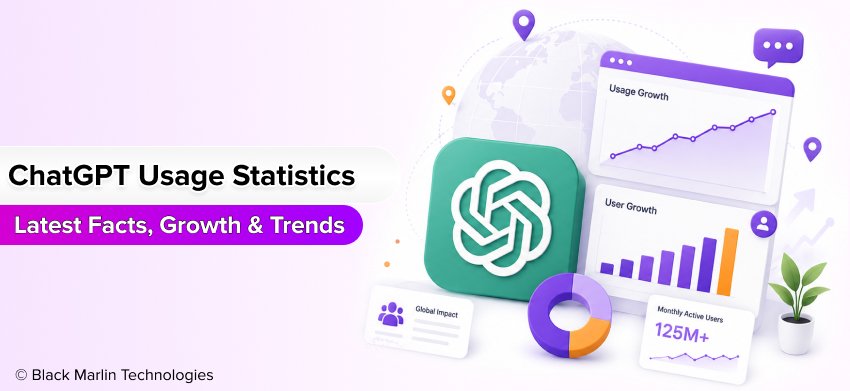 That fast escalation is also shifting the way people hunt for information online. Businesses, and marketers are now paying attention to how their content shows up inside AI produced answers, and this is raising the profile of ChatGPT SEO services, plus other AI search optimization tactics.
But, honestly how huge is ChatGPT really in 2026? Like, how many people actually use it, not just try it once, and which places are adopting it the fastest. Also what are users doing with it day to day, and how quickly the platform is expanding?
In this guide, we pull together the newest ChatGPT usage statistics, growth figures, user data, traffic numbers, demographics, business adoption, and 2026 trends. Each main statistic is connected to its own original source or the most reliable available reference, so you can see exactly where the numbers come from.
- How Many People Use ChatGPT in 2026?
- Why Do ChatGPT User Numbers Differ?
- ChatGPT User Growth Statistics: 2022–2026
- ChatGPT Website Traffic Statistics
- What About Unique Visitors?
- Why ChatGPT Traffic Is Still Important for SEO?
- What the Mobile Growth Tells Us?
- ChatGPT App Downloads
- Android vs. iOS Usage
- ChatGPT’s Mobile Ranking
- Mobile Adoption Is Changing AI Usage
- ChatGPT Users by Country
- ChatGPT Users by Age Group
- ChatGPT Users by Gender
- What Does the Gender Data Tell Us?
- What Do People Use ChatGPT For?
- Writing and Editing
- Learning and Education
- Research and Information
- Coding and Technical Work
- Advice and Everyday Questions
- Brainstorming and Creativity
- Planning and Organization
- Data Analysis
- Translation and Language Help
- Work and Business
- ChatGPT Business Usage Statistics
- What Do Businesses Use ChatGPT For?
- ChatGPT and Productivity
- ChatGPT and Small Businesses
- What This Means for Marketing and SEO?
- How Students and Teachers Use ChatGPT?
- ChatGPT Market Position Compared With Other AI Tools
- How Different Industries Use ChatGPT?
- ChatGPT and OpenAI Developer Usage
- Frequently Asked Questions
- Conclusion
How Many People Use ChatGPT in 2026?
So, how many people actually use ChatGPT in 2026? The answer sort of depends on what kind of user we are counting.
You may see one source say hundreds of millions of weekly users, and another report 1 billion monthly active app users. At first, those figures can look confusing. But they are not always contradictory because they measure different kinds of activity.
In 2026, OpenAI said that ChatGPT had more than 800 million weekly users, but Reuters, using Sensor Tower data, reported that the ChatGPT app hit 1 billion monthly active users.
This difference matters a lot when digging into ChatGPT usage statistics, because a weekly user is not the same as a monthly app user, and also a person who has created a ChatGPT account is not necessarily an active user.
Why Do ChatGPT User Numbers Differ?
Think of it like a school.
If one thousand students are registered at a school, it does not mean that all one thousand attend every day. Some might show up daily, some once a week and others really may not attend at all.
ChatGPT statistics work in a similar way.
- Registered users = people who created an account.
- Weekly active users = people who used ChatGPT during a particular week.
- Monthly active users = people who used it during a particular month.
- App users = people using ChatGPT through mobile applications.
- Web users = people accessing ChatGPT through a web browser.
Getting the hang of these differences is useful too for marketers looking into ChatGPT SEO services, since AI visibility, site traffic, and the number of ChatGPT users are separate metrics.
| User Metric | What It Means | What It Tells Us |
| Weekly active users | People who use ChatGPT at least once during a week | Shows regular usage and engagement |
| Monthly active users | People who use ChatGPT during a month | Shows the size of the active user base |
| Registered users | People who have created a ChatGPT account | Shows the number of accounts, not necessarily active users |
| App users | People who access ChatGPT through iOS or Android apps | Shows mobile adoption |
| Web users | People who access ChatGPT through a web browser | Shows website-based usage |
| Daily active users | People who use ChatGPT during a particular day | Shows how frequently people return |
ChatGPT User Growth Statistics: 2022–2026
ChatGPT’s growth has been unusually fast. When it launched in November 2022, it was mostly treated as a fresh AI chatbot that could respond to questions, draft text, and assist with simple tasks. Just a few years later, it has turned into a dependable everyday instrument for millions of people across the world.
The biggest change is not only the number of users. People are using ChatGPT more often, and in more types of work, too. What began with simple conversations has grown into writing, coding, research, study, business tasks, data analysis, organizing, and other everyday activities.
The timeline below shows how ChatGPT moved from its 2022 launch to massive global adoption in 2026.
- November 2022 — ChatGPT launches OpenAI rolled out ChatGPT to the public, bringing forward a dialogue based AI that can reply to natural language questions, and also generate text.
- 2023 — Rapid mainstream adoption ChatGPT moved past the early wave of AI users quite quickly. Students, writers, developers, marketers, businesses, and ordinary users started, experimenting with the technology.
- 2024 — Mobile and workplace expansion ChatGPT became more accessible across mobile devices and in professional environments, which i guess made it feel easier to use. New capabilities also enticed many people to rely on AI for tasks beyond simple text generation.
- 2025 — 700M+ weekly users OpenAI said that ChatGPT had reached more than 700 million weekly active users, in its research into everyday consumer use. It seemed to show that ChatGPT has turned into a kind of steady component of many people’s digital routines.
- 2026 — Billion-scale adoption The growth kept going into 2026. OpenAI later mentioned over 800 million weekly users, while Sensor Tower data, as Reuters described it, showed the ChatGPT app hitting 1 billion monthly active users.
ChatGPT Website Traffic Statistics
How much traffic does ChatGPT get in 2026? The answer is still in the billions of visits, yet the more interesting part is what happens behind that number.
According to Similar web latest available worldwide web stats for May 2026, ChatGPT logged around 5.565 billion visits, so it ends up as the fifth most visited site in that months worldwide ranking. At the same time, its portion of global generative-AI web traffic seems to have gone down, even as competing services like Gemini and Claude keep gaining ground.
This is a kind of important distinction. A falling market share does not automatically mean ChatGPT is losing users overall. ChatGPTs website traffic still grew in May, though the other AI platforms were moving up faster.
| Traffic Metric | Latest Available Figure | Measurement Period |
| Monthly website visits | 5.565 billion | May 2026 |
| Worldwide AI web traffic share | 52.7% | May 2026 |
| Previous AI traffic share | 76.4% | Around May/June 2025 |
| Gemini AI traffic share | 27.3% | May 2026 |
| Claude AI traffic share | 8.9% | May 2026 |
| Worldwide website rank | 5 | May 2026 |
| Monthly traffic growth | +0.99% MoM | May 2026 |
ChatGPT vs. Other AI Platforms
The biggest change in 2026 is competition.
Similar web on July 29, 2026 said in its AI Search report that ChatGPT’s part of worldwide generative AI web traffic dropped from about 76% down to near 53% in the previous year. Gemini kept climbing and now sits at beyond a quarter of the market, while Claude has nearly reached 9%.
| AI Platform | Approx. AI Web Traffic Share | Trend |
| ChatGPT | 53% | Share declining |
| Gemini | 27–28% | Strong growth |
| Claude | 9% | Fast growth |
| Other platforms | Remaining share | Mixed |
The key takeaway is that ChatGPT still holds the biggest share by a wide margin, but the AI search arena is growing a lot more competitive.
What About Unique Visitors?
Monthly visits and unique visitors are not the same thing.
A person might swing by ChatGPT a few times in the same month. Each visit session can add to the overall tally of visits but the person still is counted as just one monthly unique visitor.
Similar web defines monthly unique visitors as the average number of individuals showing up on a domain, and it suggests comparing that metric with total visits to get a clearer sense of repeat usage.
For this reason, it is better not to invent or blend unique visitor numbers from different sources. When a dependable, current figure is available, report its exact measurement period, and include the source.
Desktop vs. Mobile Traffic
ChatGPT’s traffic story also extends beyond the website.
People access ChatGPT through:
- Desktop browsers
- Mobile browsers
- iOS apps
- Android apps
- Other integrated experiences
This makes a regular “website traffic” total a bit incomplete when trying to estimate the whole ChatGPT usage. Web analytics tracks visits to the site, while app analytics measures actions inside mobile applications.
That’s why this article keeps website visits, mobile users, app downloads, and general ChatGPT users as separate metrics.
Average Visit Duration, Pages per Visit and Bounce Rate
These metrics can help explain how people interact with ChatGPTs website, but they should only be included when the latest source offers dependable data for the specific period.
Similar web explains that average visit duration is the average time spent on a website while a session is going on. The way it gets calculated depends on the time between a visitor first recorded action and their last recorded action.
Pages per visit measures the average number of pages viewed during one session.
Bounce rate measures the percentage of visits where users leave after viewing only one page.
For ChatGPT specifically, these metrics need extra care because a conversational AI website is not used like a normal content website. A visitor might ask one question, get an answer, then leave without opening multiple pages. So when you see a high bounce rate or a low bounce rate it should not automatically be taken as good engagement or bad engagement.
Why ChatGPT Traffic Is Still Important for SEO?
The traffic numbers show why AI platforms are becoming increasingly important for marketers.
ChatGPT is still one of the world’s most visited websites, and its AI traffic place means it plays a big part in how people find information online. Similar web also offers instruments for observing which AI engines are nudging visitors toward specific sites, including ChatGPT, Gemini, Claude, and Perplexity.
This is one reason businesses are becoming interested in ChatGPT SEO services, Generative Engine Optimization, and other AI related search approaches. The goal is no longer only to rank on a traditional Google results page, because brands also want their content to turn into a handy reference when people ask AI platforms questions.
ChatGPT Mobile App Statistics
ChatGPT is no longer just a website that people visit from a computer. The mobile app has become a major part of how people use ChatGPT, making AI available from almost anywhere. From asking quick questions to writing, learning, coding, translating, and planning, users can now access ChatGPT directly from their phones.
The growth has been especially strong since the app launched in 2023. According to Statista data from AppMagic, ChatGPT’s combined Android and iOS monthly active users increased from 72.8 million in August 2023 to 592 million in February 2026. That is more than an eightfold increase in less than three years.
The bigger milestone came in May 2026, when Sensor Tower reported that ChatGPT became the fastest mobile app to reach 1 billion monthly active users, achieving the milestone in about three years.
What the Mobile Growth Tells Us?
The numbers show that ChatGPT mobile adoption really did not grow slowly, it was like ramping up. It accelerated sharply across 2024 and also 2025.
Between August 2023 and February 2026, the monthly active mobile users went from 72.8 million up to 592 million. So, in practice, the reported MAU amount got more than eight times larger during this span.
Growth kept going even after ChatGPT went past that 500 million user mark. In August 2025 it landed on 557 million MAUs, then 571 million by November. Later, in February 2026 it hit 592 million.
The May 2026 milestone is even bigger, Sensor Tower said that ChatGPT hit 1 billion monthly active users on mobile, which made it the fastest mobile app to get to that level based on their measurement.
ChatGPT App Downloads
Downloads tell a different story from monthly active users.
A download is when someone installs the app. A monthly active user means that person really used it during the time that got measured. One person can install once and keep using it for years, while another person may install then leave it pretty quickly afterward.
AppMagic data, published by Statista, tracks ChatGPT downloads starting from May 2023, and from there it keeps going. By February 2026 the app was still racking up a substantial amount of downloads, and that keeps piling onto a large, cumulative installation base.
This distinction is important when discussing ChatGPT usage statistics. Downloads show acquisition; MAUs show ongoing activity.
Android vs. iOS Usage
ChatGPT’s mobile audience is spread across both major smartphone platforms:
- Android: Available globally through Google Play.
- iOS: Available through Apple’s App Store.
- Combined mobile MAUs: Statista’s 592 million February 2026 figure combines both platforms.
- Unique users: The combined figure should not be treated as a count of unique people because the same person could potentially use ChatGPT on more than one device or platform.
Because of this, it is safer to put it like “592 million combined Android and iOS monthly active users”, instead of just saying “ChatGPT has 592 million mobile users.”
ChatGPT’s Mobile Ranking
ChatGPT also ended up as a top AI app for mobile, in real life. According to Statistic’s February 2026 ranking, it shows ChatGPT sitting in first place for monthly active users, like the leading AI mobile application there. It stays ahead of rival AI assistants such as Gemini and Grok.
Sensor Tower’s 2026 research, shows the scale of ChatGPT mobile footprint. The company said ChatGPT hit 1 billion monthly active users in May 2026, and it did it faster than big consumer apps like TikTok, YouTube, and Instagram reached that same milestone.
Mobile Adoption Is Changing AI Usage
The rise of mobile ChatGPT changes how people interact with AI.
A desktop user might open ChatGPT for a longer work session, like usual they just go ahead and stay there. On mobile a user can ask a quick question while travelling, translate something, summarize a message, chart out a task, learn a topic, or even rely on voice features, all without sitting at a computer.
This makes mobile AI really important for businesses and the people behind marketing. As more people rely on AI from smart phones, companies are paying extra attention to how their brand image, and content, show up in AI-generated answers. This might be one of the reasons why interest in ChatGPT SEO services, in AI search optimization, and in Generative Engine Optimization is increasing.
ChatGPT Users by Country
ChatGPT isn’t focused only on a handful of countries anymore, people everywhere are using it for learning, writing, coding, research, business tasks, planning, and also for the daily “what about this” kind of questions. Still, if you try to measure ChatGPT users by country, it is not as easy as creating a list of countries then giving each of them a neat number.
The thing is, different sources measure different stuff. OpenAI might report weekly ChatGPT users, while other analytics companies may estimate website visits, traffic share, app users, or even messages per capita. So you should not mix these figures together.
One of the more clear official data points comes from India. In February 2026, OpenAI said that India has over 100 million weekly ChatGPT users, and that made the nation one of the most relevant markets for ChatGPT. OpenAI explained those users, included students, educators, developers, entrepreneurs, as well as a few other groups.
| Country | Latest Available Statistic | Measurement | Source |
| India | 100M+ | Weekly ChatGPT users | OpenAI, Feb. 2026 |
| United States | Largest established market | Country-level adoption | OpenAI Signals / third-party estimates |
| Indonesia | Growing adoption | Messages and web/app activity | OpenAI Signals / third-party estimates |
| Brazil | Rapidly growing adoption | Messages and web/app activity | OpenAI Signals / third-party estimates |
| Japan | Rising adoption | Messages per capita | OpenAI Signals |
| Mexico | Rising adoption | Messages per capita | OpenAI Signals |
| Tanzania | Rising adoption | Messages per capita | OpenAI Signals |
| Other markets | Expanding globally | Regional adoption patterns | OpenAI Signals |
ChatGPT Users by Age Group
Who is using ChatGPT the most? Well, the answer isn’t only for teenagers or younger tech users, no. ChatGPT has been pulled in by people across a range of ages, from students who reach for it for learning to professionals using it on the job and older users trying out AI for research, writing, everyday tasks.
OpenAI’s Q1 2026 Signals research shows that people under 35 kept generating the largest part of ChatGPT messages. At the same time, users age 35 and up increased their share in total usage. That means ChatGPT is slowly turning into an instrument for a broader range of age groups, and not staying mostly a young person’s technology anymore.
| Age Group | Usage Pattern | What It Suggests |
| Under 18 | Strong use for learning and school-related questions | Younger users are becoming familiar with AI early |
| 18–24 | High usage for education, writing, research and career tasks | One of the most active age groups |
| 25–34 | Strong use for work, coding, research and productivity | AI is becoming part of professional workflows |
| 35–44 | Growing usage across work and personal tasks | Adoption is expanding beyond younger users |
| 45+ | Increasing share of ChatGPT activity | Older age groups are adopting AI more actively |
ChatGPT Users by Gender
Who uses ChatGPT more, men or women? On paper this looks easy, but the gender numbers behind AI platforms really need a careful touch. Unlike things like an account’s signup date, gender is not always information that each ChatGPT user gives directly.
OpenAI s research uses names as well as other signals that are available to make an inference about gender for certain users. So these numbers should not be treated as a full demographic split across all ChatGPT users. What they actually show is the users, for whom gender could be reasonably inferred, using the same research approach and methodology.
| Metric | Latest Finding | What It Means |
| Typically feminine names | More than 50% of users where gender could be inferred | Feminine-associated names represented a majority in the analyzed group |
| Typically masculine names | Less than 50% | Masculine-associated names represented the remaining share |
| Gender directly provided by users | Not the basis for the full estimate | The research uses inferred signals rather than assuming every user reported gender |
| All ChatGPT users | Not represented by this split | Some users cannot be classified using the available signals |
OpenAI research found that people with names that are usually considered feminine made up more than half of the users for whom gender could be inferred. But this shouldn’t be read as, meaning that more than half of all ChatGPT users are women.
How Was Gender Estimated?
This is an important methodological point.
Picture a dataset with millions of users in it. Plenty of profiles carry names that are usually linked with men, others with women, and still others lack enough clues. In those cases there might not be sufficient signals to make a reasonable inference.
Researchers can analyze these signals to look at wide usage patterns, but an inferred category is not the same as a person self identified gender.
For this reason, phrases such as:
“Users with typically feminine names”
are more accurate than simply saying:
“Female ChatGPT users.”
Why This Difference Matters?
Statistics can easily become misleading when a research estimate is presented as a confirmed personal characteristic.
For example, someone may have:
- A gender-neutral name
- A nickname
- A business account
- A name that is common across multiple genders
- A name from a culture where gender cannot be reliably inferred from the name alone
These users may not be included in the gender comparison.
That means the available data should be viewed as a research-based estimate of usage patterns, not a complete demographic census of ChatGPT users.
What Does the Gender Data Tell Us?
The research provides an interesting insight into how ChatGPT adoption is changing.
Generative AI was at first often linked with people who were really into tech, especially developers and other early adapters. But ChatGPT is now being used across a much broader set of activities, like composing text, supporting study, doing inquiry, mapping out plans, improving dialogue, handling work tasks, and even answering everyday questions.
The gender related findings lean toward the wider idea that ChatGPT’s audience is getting more diverse.
This is important for businesses, because AI users are not just one single demographic. Companies making content for AI search need to consider different audiences, the kinds of questions people ask their needs, and also the various levels of technical knowledge.
Gender and ChatGPT Usage
Gender alone does not explain why someone uses ChatGPT.
A user may open ChatGPT to:
- Write an email
- Learn a new subject
- Research a product
- Plan a trip
- Analyze data
- Write computer code
- Create marketing content
- Understand a difficult topic
- Brainstorm ideas
- Solve an everyday problem
The same types of tasks can be performed by users across different demographic groups.
Therefore, it is better to treat gender statistics as one small piece of the bigger ChatGPT usage picture, next to age, country, occupation, and also user intent.
What Do People Use ChatGPT For?
When people open ChatGPT what do they do really? The answer has shifted fast. Back in the early days, a lot of folks used it just to ask questions, or see what an AI chatbot could do. Now people reach for it at work, for learning, drafting, research, software, scheduling, reasoning, and day to day tasks.
OpenAI research gives a handy glance at these patterns, though it can read a bit messy at first. In their work on 1.5 million conversations, they found that ChatGPT shows up for both practical errands and more personal interests, with threads in general landing in kinds of bins, like getting information, asking for guidance, writing, trying to learn, and doing technical work.
Writing and Editing
Writing is one of the easiest ways to understand ChatGPT’s usefulness.
People use it to make draft beginnings, help with grammar, cut those long paragraphs down, rewrite messages or emails, condense documents, and tweak the tone of the existing content.
Learning and Education
ChatGPT is also becoming a personal learning assistant.
A student can ask it to explain a challenging idea in everyday words rather than digging through a few different websites. It can also generate practice questions, point out mistakes, give illustrative examples, or split a big subject into smaller lessons that are easier to handle.
Research and Information
People also use ChatGPT to explore unfamiliar subjects.
Rather than begin with a lengthy stack of search results, users can ask a straight question, then keep going with follow up questions.
Coding and Technical Work
Developers were among the first crowds to tinker quite a bit with generative AI, and coding stays an important way people use ChatGPT for, even now.
Users can ask ChatGPT to:
- Explain code
- Find bugs
- Write functions
- Convert code between languages
- Create examples
- Explain error messages
- Generate test cases
- Understand technical documentation
For beginners this can make programming feel easier to learn, because they can ask follow up questions each time they get stuck.
Advice and Everyday Questions
Not every ChatGPT conversation is about work.
People also ask for help with everyday decisions, ideas, hobbies, routines, communication, and planning.
Brainstorming and Creativity
Sometimes people do not need a final answer they need ideas.
ChatGPT can help brainstorm:
- Blog topics
- Business names
- Social media ideas
- Marketing campaigns
- Product concepts
- Video ideas
- Story concepts
- Headlines
- Presentation topics
The user can then choose the best ideas and develop them further.
This makes AI useful as a thinking partner rather than simply an answer machine.
Planning and Organization
Another common use is turning a vague goal into a clear plan.
Someone might ask:
“I have four weeks to learn SEO. Create a study plan.”
ChatGPT can break the goal into smaller tasks, suggest a sequence, and create a checklist.
Businesses can use same prompts for project planning, meeting preparation, content calendar, marketing campaign, and workflow documentation.
Data Analysis
ChatGPT is increasingly used to make complicated information easier to understand.
Depending on the available tools and files, users can ask it to:
- Summarize datasets
- Find trends
- Explain numbers
- Create formulas
- Identify unusual results
- Build charts
- Compare performance
For a business owner, this can turn a spreadsheet full of numbers into a much easier-to-understand summary.
Translation and Language Help
ChatGPT can also help people communicate across languages.
Users can ask it to translate text, improve grammar, simplify sentences, or change wording for a particular audience.
Work and Business
ChatGPT is becoming an everyday workplace assistant for many users.
Businesses can use AI to support:
- Marketing
- Customer communication
- Sales
- Research
- Content creation
- Meeting preparation
- Data analysis
- Internal documentation
- Coding
- Business planning
OpenAI’s enterprise research shows that business use is expanding rapidly as organizations move from experimenting with AI toward integrating it into regular workflows.
ChatGPT Business Usage Statistics
ChatGPT began as a consumer AI tool, but businesses quickly found ways to use it as well. Right now, staff members use it to write emails, summarize documents, sift through information, research the markets, generate content, craft code, and finish other daily tasks.
The switch from “trying AI” to “using AI at work” is one of the largest ChatGPT tendencies in 2026. OpenAI workplace findings indicates that companies are increasingly running ChatGPT for things like writing, research, coding, analysis, customer facing tasks, and even business operations.
The scale is also growing , OpenAI said its business products have more than 7 million ChatGPT workplace seats and for enterprise usage, it is expanding rapidly too.
| Business Metric | Latest Available Figure | Period | Source |
| Enterprise revenue share | 40%+ | 2026 | OpenAI |
| U.S. people using ChatGPT for business-building | 4M+ | March 2026 | OpenAI |
| ChatGPT workplace seats | 7M+ | 2026 | OpenAI |
| Enterprise usage | Rapidly expanding | 2025–2026 | OpenAI |
| Enterprise revenue outlook | On track for consumer-revenue parity | End of 2026 | OpenAI |
| Major workplace uses | Writing, research, programming, analysis | 2026 | OpenAI |
What Do Businesses Use ChatGPT For?
The most common workplace applications can be grouped into several areas:
- Writing and communication: – Employees use ChatGPT to draft emails, reports, proposals, briefs, and other documents.
- Research: – Teams can use AI to organize information, explore markets, summarize material, and generate research starting points.
- Programming: – Developers use ChatGPT to write, explain, debug, and improve code.
- Analysis: – Businesses can use AI to understand data, identify patterns, and create summaries.
- Customer support: – AI can help teams prepare responses, summarize customer issues, and organize support information.
- Marketing: – Marketers can use ChatGPT for content ideas, campaign planning, audience research, messaging, and other repetitive tasks.
OpenAI’s workplace research identifies writing, research, programming, and analysis among the major categories of ChatGPT use at work.
ChatGPT and Productivity
Why are companies adopting ChatGPT?
One major reason is productivity.
Imagine an employee spending 30 minutes writing a routine email. ChatGPT may help create a first draft in seconds. The employee can then review it, add important details, and send the final version.
The same idea can apply to:
- Meeting summaries
- Research notes
- Reports
- Presentations
- Customer responses
- Project documentation
- Code
- Data analysis
The goal is not necessarily to replace the employee. Instead, AI can handle parts of repetitive work so employees can spend more time on tasks that require human judgment.
ChatGPT and Small Businesses
AI adoption is not limited to large corporations.
OpenAI said that in March 2026 at least 4 million people in the United States used ChatGPT for planning, launching, operating, or expanding a business.
This is an interesting statistic because it shows how AI can support people before they even have a large company.
A small-business owner could use ChatGPT to:
- Research competitors
- Write a business plan
- Create marketing ideas
- Draft customer emails
- Write website content
- Prepare social media posts
- Analyze customer feedback
- Create simple operating procedures
- Brainstorm new products
For a small team, having an AI assistant can be especially useful because one person may need to handle several different jobs.
What This Means for Marketing and SEO?
Business adoption also creates a new opportunity for digital marketers.
As employees and customers increasingly use AI to research companies, products, services, and solutions, businesses need to make their online information easy for AI systems to understand.
This has increased interest in ChatGPT SEO services, Generative Engine Optimization (GEO), Answer Engine Optimization (AEO), and AI-search optimization.
The Bigger Business Trend
The most important change is that businesses are moving from AI experimentation to AI integration.
Early adoption often looked like:
“Let’s give ChatGPT to a few employees and see what happens.”
The newer approach looks more like:
“Where can AI become part of our regular workflow?”
That second approach can lead to much deeper usage.
Employees may use AI several times a day, while organizations can build repeatable processes around research, writing, coding, analysis, customer service, and other tasks.
How Students and Teachers Use ChatGPT?
Imagine a student is stuck on some tough science question. Instead of reading through three long chapters, they can ask ChatGPT to explain the whole thing in simple words, then ask a follow-up question and request an example too, so it feels less distant. A teacher could use that same tool as well, to make a lesson plan, prepare quiz questions, or search for a more manageable way to explain a difficult topic.
Education has turned into one of those key parts of ChatGPT adoption, and honestly it feels like people are leaning into it. OpenAI’s research said that learning is among the major consumer uses, but in their education-focused work, they also see that students alongside educators are using AI for a mix of learning, plus teaching tasks.
The important point is that ChatGPT can help with education, but it should not replace a teacher, or independent thinking, or dependable academic sources.
| Use Case | Example | What the Data Shows |
| Homework | “Help me understand how to solve this math problem.” | Students use ChatGPT for learning support and problem solving. |
| Explaining difficult topics | “Explain photosynthesis like I’m 10.” | Learning and explanations are major ChatGPT use cases. |
| Writing help | “Check my essay and suggest improvements.” | Writing is one of the most common ChatGPT activities. |
| Research | “Help me understand the main points of this topic.” | Information seeking is one of the largest consumer use categories. |
| Language learning | “Practice English conversation with me.” | AI can provide interactive language practice and feedback. |
| Lesson planning | “Create a 45-minute lesson plan about climate change.” | Educators can use AI to prepare teaching materials. |
| Exam preparation | “Create 20 practice questions about biology.” | Students can use AI for practice, revision and explanations. |
ChatGPT Market Position Compared With Other AI Tools
ChatGPT is still the biggest player in the generative AI web market, but the gap is shrinking now. In 2026, Gemini and Claude have been gaining serious ground, while Perplexity, Grok and Meta AI keep pushing forward with different products, and distribution channels.
The main point is compare these platforms using basically the same measurement if possible. A website traffic percentage should not be matched directly with app downloads or total registered user counts, I mean that mix can be misleading. Similar webs latest data helps, because it keeps the platforms under one worldwide web traffic style. The report from July 2026 said ChatGPT sits at around 53% of generative AI web traffic, while Gemini is close to 27 to 28% and Claude came in at just under 9%.
| Platform | User Metric | AI Web Traffic Share | Growth | Main Strength |
| ChatGPT | 800M+ weekly users reported by OpenAI | 53% | Growing, but losing category share | General-purpose AI |
| Gemini | Large and expanding user base | 27–28% | Strong | Google ecosystem |
| Claude | Growing user base | 9% | Fastest proportional growth | Work, reasoning and coding |
| Perplexity | Latest comparable user figure varies by source | Not reliably comparable in this dataset | Growing | AI search and research |
| Grok | Latest figure varies by measurement | Not reliably comparable | Growing | Conversational AI + X ecosystem |
| Meta AI | Large distribution through Meta products | Not directly comparable | Growing | Social and messaging ecosystem |
How Different Industries Use ChatGPT?
ChatGPT is not being used in the same way across each industry, and it can look different depending on who’s doing the task. A marketer might use it for campaign ideas or messaging, while a developer may use it to debug code. A teacher could make lesson materials, and a finance professional may rely on it to research firms or examine information.
In a OpenAI workplace research from January 2026, it was found that ChatGPT is being adopted across each industry and job function, and yes, for a wide set of chores. Writing, research, programming, and analysis are mentioned as among the most frequent tasks people do at work. There also seems to be strong uptake in IT and finance, while in healthcare the pace feels more careful, mostly due to privacy concerns, and compliance requirements.
The examples below show what businesses are doing with ChatGPT not just how many people are using it.
- Marketing: – OpenAI’s workplace research found that go to market squads, including marketing, communications, sales, and customer experience, were major ChatGPT adopters, with writing , research, and media generation as some of their leading duties.
- SEO: – OpenAI says that research is used in a broad way across industries, and this includes competitive research, web research, audience analysis and even multi-step investigations.
- Education: – OpenAIs consumer research sort of found about 70% of ChatGPT usage was non-work related, with learning plus practical guidance as among the biggest consumer use cases.
- Healthcare: – OpenAI workplace research found that in healthcare, adoption is happening a bit slower compared to IT and finance, with privacy, compliance, and risk concerns holding more weight. At the same time, the specific uses for instance clinical documentation and administrative workflows are starting to grow.
- Finance: – In a recent OpenAI workplace research, finance comes up as one of the industries with a relatively high ChatGPT uptake, with IT alongside it.
- Software and Technology: – OpenAI reports that, for a lot of technical users, programming is the main task, with engineering, analytics and IT teams among the biggest users of technical capabilities.
- E-commerce: – OpenAI workplace research shows that writing, researching, and analysis are among the core tasks people do with ChatGPT at work, and they line up pretty well with a lot of e commerce activities.
- Customer Service: – OpenAI says that customer-facing teams use ChatGPT a lot for writing, research, and handling customer support work too, like putting together well considered and brand-aligned replies.
- Real Estate: – OpenAI research shows that ChatGPT is being used across different industries, for research, writing, analysis, and for information retrieval, though uptake varies by sector.
- Small Business: – OpenAI’s 2026 research seems to show that AI use is spreading beyond the big organizations, and at the same time the newer research also points at task crossover as something especially pronounced in smaller businesses. In a closer analysis of more than 800,000 U. S. ChatGPT messages, 16.8% of the work related messages, and 43.5% of the occupation specific non generic messages had tasks that were tied to another occupation.
ChatGPT and OpenAI Developer Usage
There is another side of the ChatGPT tale that a lot of statistics articles miss, developers are not only using ChatGPT they are also making with OpenAI technology.
A person can open ChatGPT and ask a question, right. A developer can go one step more and link an OpenAI model to a website, mobile application, customer support system, an internal tool, or even an automated workflow.
That difference matters. It means OpenAI’s footprint is not counted only by ChatGPT people using it. It can also be tracked by developers, the apps they ship, api calls, business tie-ins, coding agents, and those automated workflows that get built on its technology.
In 2025 OpenAI said that about 4 million developers had been building with OpenAI, and that the API platform was processing 6 billion tokens per minute.
| Metric | Latest Figure | Period | What It Shows |
| Developers building with OpenAI | 4M+ | 2025 | Size of the developer ecosystem |
| API processing | 6B tokens/minute | 2025 | Scale of API usage |
| Organizations processing 10B+ tokens | 9,000+ | 2025 | Large-scale production adoption |
| Organizations processing 1T+ tokens | Nearly 200 | 2025 | Very high-volume API adoption |
| API reasoning-token consumption | 320× increase | 12 months | Rapid growth in advanced API use |
| Codex weekly users | 4M+ | April 2026 | Growth of AI-assisted development |
| OpenAI business customers | 1M+ | 2025 | Enterprise ecosystem scale |
Frequently Asked Questions
Q1. How many people use ChatGPT in 2026?
Ans1. – OpenAI has said it has 800 million+ weekly users, and third party data is saying 1 billion monthly active app users. But yeah, these numbers are different measurements.
Q2. How many ChatGPT users are there worldwide?
Ans2. – ChatGPT has reached hundreds of millions of weekly users worldwide, with OpenAI saying more than 800 million.
Q3. How many people use ChatGPT every month?
Ans3. – Reuters, using third party Sensor Tower numbers said ChatGPT will reach 1 billion monthly active users in 2026.
Q4. How many people use ChatGPT every week?
Ans4. – OpenAI reported 800 million+ weekly users in 2026.
Q5. How many people use ChatGPT in India?
Ans5. – OpenAI reported 100 million+ weekly ChatGPT users in India in February 2026.
Q6. How fast is ChatGPT growing?
Ans6. – ChatGPT has grown from its 2022 launch to hundreds of millions of weekly users, with mobile adoption and business usage also expanding rapidly.
Q7. What percentage of people use ChatGPT?
Ans7. – There is not one single dependable global percentage, because user counts and population estimates use different dates, and various methodologies.
Q8. How many people use the ChatGPT app?
Ans8. – Statista and AppMagic said 592 million combined Android plus iOS monthly active users in February 2026, and then later Sensor Tower announced that a 1 billion monthly active user milestone was reached in May 2026.
Q9. How much traffic does ChatGPT get?
Ans9. – Similarweb estimated approximately 5.565 billion website visits in May 2026.
Q10. What is ChatGPT’s market share?
Ans10. – Similar web said that ChatGPT made up around 53% of the global generative AI web traffic, in May 2026.
Q11. Is ChatGPT still the most popular AI chatbot?
Ans11. – Yes, by Similar webs worldwide generative AI web traffic measurement, ChatGPT stayed the most used platform in 2026, even if Gemini and Claude have gained a lot of share.
Q12. What do people use ChatGPT for?
Ans12. – People mostly use ChatGPT for writing, info seeking, learning, coding, research, planning, brain storming, analysis, and daily tasks.
Q13. How many businesses use ChatGPT?
Ans13. – OpenAI reported more than 7 million ChatGPT workplace seats and more than 1 million business customers in its business reporting.
Q14. How much revenue does ChatGPT generate?
Ans14. – OpenAI doesn’t publicly share a full, ChatGPT-only income number. So, you should not present OpenAI’s overall revenue as if it were purely ChatGPT revenue.
Q15. Is ChatGPT growing faster than Gemini?
Ans15. – It depends on which metric you look at . ChatGPT is still larger in web traffic overall, but Gemini seems to be climbing faster in generative AI web traffic share.
Q16. How many downloads does ChatGPT have?
Ans16. – ChatGPT has piled up a very large amount of mobile downloads since its 2023 debut, but the exact current total should be cited from the newest AppMagic or Sensor Tower numbers.
Q17. Who uses ChatGPT the most?
Ans17. – Younger users still stay very active, however adoption is moving out across students and professionals, businesses, developers teachers and even older users.
Q18. What age group uses ChatGPT most?
Ans18. – OpenAI’s Q1 2026 research said that people under 35 were making the biggest portion of messages, while users aged 35+ were increasing their share.
Q19. Which country uses ChatGPT the most?
Ans19. – India is one of the biggest markets, you know. OpenAI said it had 100 million+ weekly users in India around February 2026, still, the rankings can shift depending on what you count, like users versus visits versus installs versus messages.
Q20. Is ChatGPT replacing Google?
Ans20. – It s not completely true, but yes ChatGPT is shifting how people look for and find information , while Google still stays a major search platform. The two are ending up being used for different kinds of questions and practical tasks.
Conclusion
ChatGPT is no longer just an AI experiment that people try out for fun, it is more like a mainstream digital tool now, and in 2026 it is used for work, education, research, coding, writing, planning, and even the everyday tasks.
The numbers kind a tell a clear story. ChatGPT now sits at 800 million+ weekly users, while mobile adoption has grown to hundreds of millions of monthly active users. In fact, India alone showed 100 million+ weekly users, as reported by OpenAI in February 2026. At the same time businesses are moving into AI at scale too, and enterprise revenue is becoming a big chunk of OpenAI’s business.
At the same time the AI market is getting more competitive, I mean you can feel it. ChatGPT still is the front runner in generative-AI web traffic, but Gemini and Claude are taking more, little by little. Similar web said that ChatGPT sits near 53% of global generative-AI web traffic, down from about 76% last year.
The next stage is probably even more important. AI agents, automation, developer tools, and advertising are expanding how AI can be used and monetize it.
For marketers, this means search is changing too. People are more and more asking AI for answers instead of only depending on standard search results, so ChatGPT SEO services, GEO, AEO, and AI search optimization are becoming increasingly relevant.