'>
<rect width='100' height='100' fill='%23B22234'/>
<!-- stripes -->
<g fill='%23fff'>
<rect y='10' width='100' height='10'/>
<rect y='30' width='100' height='10'/>
<rect y='50' width='100' height='10'/>
<rect y='70' width='100' height='10'/>
<rect y='90' width='100' height='10'/>
</g>
<!-- blue box -->
<rect width='50' height='50' fill='%233C3B6E'/>
</g>
</svg>)
'>
<rect width='100' height='100' fill='%23fff'/>
<rect width='100' height='33.33' y='0' fill='%23FF9933'/>
<rect width='100' height='33.33' y='66.66' fill='%23138808'/>
<!-- Ashoka Chakra -->
<circle cx='50' cy='50' r='9' fill='none' stroke='%23000080' stroke-width='2'/>
<g stroke='%23000080' stroke-width='1'>
<line x1='50' y1='41' x2='50' y2='59'/>
<line x1='41' y1='50' x2='59' y2='50'/>
<line x1='44' y1='44' x2='56' y2='56'/>
<line x1='56' y1='44' x2='44' y2='56'/>
</g>
</g>
</svg>)
 info@blackmarlintechnologies.com

When you ask ChatGPT “What are the best SEO agencies for my business?” you might get a list of companies, but your own business is nowhere to be seen. And here’s the surprising thing, your business may already be sitting at #1 on Google for the important keywords.
So, what happened?
This is where AEO insights companies become important, honestly. Rather than just checking Google rankings they assist businesses in understanding how their brand shows up across AI-driven answer engines such as ChatGPT, Gemini, Perplexity, and Google AI features.
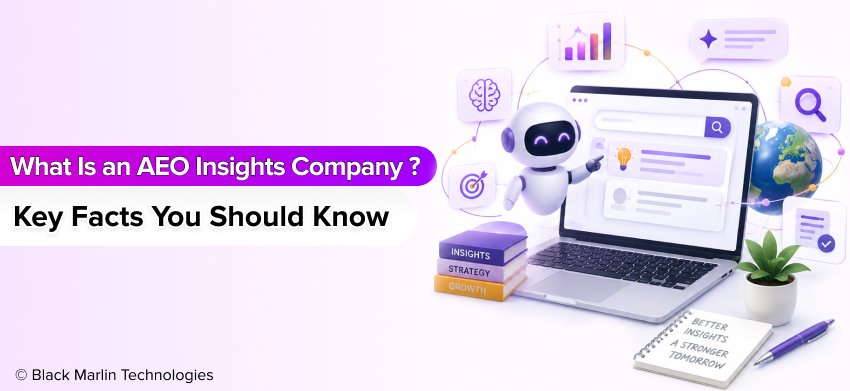 An AEO insights company tracks what AI platforms are saying about your business, your competitors, and your industry. It can show how often your brand gets mentioned, which websites are being cited, how your visibility compares to rivals, and how AI frames your brand.
It’s not only about “ranking in AI.” The point is to figure out where your brand shows up, why it shows up, what ends up influencing the AI answers, and which areas you’re still leaving uncovered. In practice, this helps businesses get useful information to refine their AEO approach and keep staying visible as search turns more conversational.
- What Is an AEO Insights Company?
- What Does an AEO Insights Company Actually Do?
- Tracks AI Brand Mentions
- Monitors AI Citations
- Measures AI Share of Voice
- Tracks Competitors
- Finds Content Gaps
- Why Are AEO Insights Important in 2026?
- What Metrics Should an AEO Insights Company Track?
- AI Visibility Rate
- Citation Rate
- AEO Insights vs Traditional SEO Analytics
- AEO Insights Company vs AEO Agency
- What Does an AEO Insights Company Do?
- What Does an AEO Agency Do?
- How Does an AEO Insights Company Work?
- 1: Define the Brand
- 2: Build Relevant Prompts
- 3: Test AI Platforms
- 4: Record Mentions and Citations
- 5: Compare Results
- 6: Turn Insights Into Actions
- What Are the Benefits of Using an AEO Insights Company?
- 1. See How AI Sees Your Brand
- 2. Find Competitor Gaps
- 3. Discover New Content Opportunities
- 4. Track AI Visibility Over Time
- 5. Identify Important Citation Sources
- 6. Improve Brand Accuracy
- 7. Support AEO Strategy With Data
- 8. Connect AI Visibility With Business Results
- What Should You Look for in an AEO Insights Company?
- What Are the Limitations of AEO Insights?
- AI Answers Can Change
- Prompt Volume Isn’t Fully Available
- AI Visibility Isn’t Revenue
- Different Tools Use Different Methods
- Results Can Vary by User and Context
- How to Improve Your AEO Insights?
- Create Direct Answers
- Add Original Information
- Build Brand Authority Beyond Your Website
- Keep Business Information Consistent
- Update Existing Content
- AEO Insights Tools You Can Use
- AEO Visibility Platforms
- SEO Platforms With AEO Features
- Analytics Platforms
- CRM Data
- AEO Insights Company: Who Needs One?
- Frequently Asked Questions
- Final Thoughts
What Is an AEO Insights Company?
An AEO insights company helps organizations understand how their brand shows up in AI-generated answers, and it can feel a bit abstract at first. In plain language, it watches what AI platforms such as ChatGPT, Gemini, Perplexity, and the Google AI experiences actually say when people ask questions tied to a business, a product, or a service.
Think of it like checking your brand’s AI report card, not just asking “Where does my website rank on Google?” You can also wonder, “Does AI mention my company?” or “Which competitor does AI recommend instead?”
An AEO insights company can track several important signals, including:
- Brand mentions: How often AI talks about your business.
- AI citations: Which websites or pages AI uses as sources.
- Competitor mentions: Which competing brands appear in similar answers.
- Share of voice: How often your brand appears compared with competitors.
- Prompt visibility: Which questions or prompts trigger your brand.
- Sentiment: Whether AI describes your brand positively, negatively, or neutrally.
- Frequently cited websites: Which sources AI regularly uses for answers.
- Content gaps: Questions where competitors appear but your brand does not.
- AI brand descriptions: How AI explains your company, products, or services.
Traditional SEO vs. AEO Insights
| Traditional SEO | AEO Insights |
| Tracks Google rankings | Tracks AI visibility |
| Measures clicks and CTR | Measures mentions and citations |
| Studies keywords | Studies prompts and questions |
| Looks at SERP competitors | Looks at AI-answer competitors |
| Focuses on organic traffic | Looks at AI visibility and downstream outcomes |
These two approaches work in tandem, not fully replacing the other. Traditional SEO helps your website get easier to discover, while AEO insights let you grasp how your brand is framed when AI is generating the answer. HubSpot also pulls out useful metrics like brand mentions, citations, and share of voice when you measure AEO performance.
What Does an AEO Insights Company Actually Do?
Knowing that your brand shows up in AI answers is useful. But that’s only the first step, really. An AEO insights company goes a bit further, and you learn not just how often your brand appears, but why it appears too. You can also see which sources affect the reply and then where the competitors are getting more attention.
Tracks AI Brand Mentions
First, it checks whether AI platforms mention your business when people ask relevant questions.
For example, you might ask:
- Does ChatGPT mention my company?
- Does Gemini recommend my services?
- Does Perplexity include my brand?
- Which competitors appear before my business?
One AI answer does not tell the whole story. If an AEO insights company keeps testing the same kind of questions, again and again, it can notice patterns in your brand visibility in a more grounded way. That way you also know if your presence is steady, or if it only shows up when people ask a few questions.
Monitors AI Citations
Being mentioned is helpful, but being cited as a source can provide another important signal.
For example:
Your brand → Mentioned
Your website → Not cited
Competitor website → Cited
This shows that AI knows your brand, but it might be pulling from other websites as supporting sources. An AEO insights company can spot these citation patterns and help you discover openings to build stronger, more helpful, and dependable content.
Measures AI Share of Voice
AI share of voice shows how often your brand appears compared with competitors.
Say 100 prompts that actually matter are tested, and your brand shows up in 20 of the replies, then your basic visibility rate is around 20%, right?
Still, there isn’t any single universal formula for AEO visibility. Different tools may run on distinct prompts, different platforms, different weighting techniques, and different ways of calculating.
Tracks Competitors
AEO insights also helps answer simple but important questions:
- Who appears more often?
- Who gets cited?
- Which sources mention competitors?
- Which questions are competitors winning?
This can reveal areas where another company has stronger AI visibility.
Finds Content Gaps
Finally, these insights can uncover content gaps.
Imagine your customers are asking like 50 key questions about your industry. Now picture it, your competitor shows up in 30 of the answers. Meanwhile, your brand is mentioned in only 10.
Those missing 20 questions are potential opportunities.
You can take these insights and use them to create fresh content, polish what is already there, answer customer questions a bit more clearly, and also build stronger authority around the crucial subjects. This is where AEO data stops being just reporting and starts acting like a real-life content strategy.
Why Are AEO Insights Important in 2026?
Search is moving way faster. A couple of years ago, someone would type a question into Google, open a handful of websites, sift through the details, and then make a call. Now, a person can ask an AI tool that same question and get a straight answer in seconds.
The journey is moving from Search → Answer → Recommendation.
This change makes AEO insights more essential for businesses. People can find a company, product, or service within an AI-generated reply before they ever land on its website. HubSpot’s 2026 AEO research talks about this shift, and it also says AI presence is a major piece of today’s brand discovery process.
Here are some reasons businesses should pay attention:
- Search is becoming conversational: People are asking complete questions instead of searching only with short keywords.
- AI answers can reduce clicks: When an AI tool provides a useful answer directly, users may not need to open multiple search results.
- Competitors can appear first: Even if your website ranks well on Google, an AI platform may recommend another company.
- AI can shape brand perception: The way an AI system describes your company can influence how potential customers understand your brand.
- Third-party sources matter: AI answers can use information from websites beyond your own, including publications, reviews, communities, and other trusted sources.
- Traditional SEO data is not enough: Google rankings and organic traffic cannot fully show whether your brand is being mentioned or recommended in AI answers.
There is also a growing focus on zero-click discoveries, or so it seems. Similarweb reported a 78% average zero-click rate for the keyword “answer engine optimization” across its worldwide dataset from December 2025 to February 2026, which is a pretty big signal. It shows why businesses need to think beyond website clicks and pay attention to what happens inside the answer itself.
AEO insights help businesses get this fresh kind of visibility and understand where they are winning, where competitors are ahead, and what they can improve.
What Metrics Should an AEO Insights Company Track?
If traditional SEO shows you where your website sits in Google, AEO metrics help you get a clearer read on how your brand pops up inside AI-generated answers. That’s why measurement is, basically, an important part of any AEO strategy.
An AEO insights company should not lock in on only one figure. It needs to watch a bunch of signals, from brand mentions and citations to competitor presence and real-world business results.
| AEO Metric | What It Tells You |
| AI Visibility | How often your brand appears in relevant AI answers |
| Brand Mention Rate | How frequently AI names your brand |
| Citation Rate | How often your website or content is cited |
| Share of Voice | How your AI visibility compares with competitors |
| Prompt Coverage | How many target questions your brand appears for |
| Competitor Visibility | Which competitors appear more frequently |
| Citation Sources | Which websites AI uses or cites as sources |
| Sentiment | How AI describes your brand |
| Position/Recommendation | Where your brand appears within an AI answer |
| Content Gap | Questions where competitors appear but your brand does not |
| Brand Accuracy | Whether AI describes your company, products, or services correctly |
| AI Referral Traffic | Website visits coming from AI platforms |
| Conversions | Leads, sales, or other business results influenced by AI discovery |
AI Visibility Rate
One of the easiest ways to understand AEO performance is to calculate your AI visibility rate.
A simple example is:
Brand appearances ÷ Total relevant prompts × 100
Suppose you test 100 relevant prompts and your company appears in 30 of the answers.
30 ÷ 100 × 100 = 30% visibility
This gives you a basic view of how often your brand appears across the prompts you are tracking.
Citation Rate
A citation tells you whether an AI platform uses your website or another page as a supporting source.
A simple way to calculate citation rate is:
Prompts citing your website ÷ Total relevant prompts × 100
AEO Insights vs Traditional SEO Analytics
SEO and AEO may sound similar, but they answer kind of different questions. Traditional SEO analytics usually show how your site performs in search engines, while AEO insights help you see how your brand appears in AI-generated answers.
Think of it this way, SEO asks, “Can people find my website?” AEO asks, “Does AI mention, recommend, or cite my brand when people ask relevant questions?”
| SEO Analytics | AEO Insights |
| Google rankings | AI answer visibility |
| Keyword positions | Prompt performance |
| Organic traffic | AI-referred discovery |
| Click-through rate (CTR) | Brand mentions |
| Backlinks | Citation sources |
| SERP competitors | AI-answer competitors |
| Search queries | Conversational prompts |
| Page performance | Citation performance |
AEO Insights Company vs AEO Agency
An AEO insights company and an AEO agency can overlap in the same space, but their main work is not the same, really. If you understand how that split happens, businesses can more easily pick which kind of support fits their AI search strategy.
What Does an AEO Insights Company Do?
An AEO insights company really mostly leans on data and measurement. It helps you understand how your brand is performing across AI-powered search and answer platforms.
Its work may include:
- Measuring AI visibility
- Monitoring brand mentions
- Tracking AI citations
- Comparing competitors
- Analyzing prompts and questions
- Creating AEO reports
- Finding content gaps
- Studying how AI describes your brand
In simple terms, it helps you answer: “What is happening to my brand in AI search?”
What Does an AEO Agency Do?
An AEO agency tends to lean harder into strategy and execution. After you understand where your brand feels sturdy or a bit frail, the agency can guide you into action.
Its services may include:
- Developing an AEO strategy
- Creating helpful content
- Improving existing pages
- Technical optimization
- Digital PR
- Building brand authority
- Updating content
- Implementing recommendations
Its main question is: “What should we do to improve our AI visibility?”
How Does an AEO Insights Company Work?
So, how does an AEO insights company really figure out if a brand shows up in AI-generated answers? It is not just about firing off ChatGPT with a single question and checking what pops back. A solid AEO approach uses a set of relevant prompts, then follows the outcomes across weeks or months, also benchmarks competitors, and finally turns all that gathered evidence into practical, forward actions.
Here is a simple six-step process.
1: Define the Brand
First, the company needs to understand the business it is tracking. This usually includes:
- Brand name
- Products
- Services
- Locations
- Main competitors
This info helps create relevant questions and makes it easier to spot when the brand or its rivals show up in AI answers.
2: Build Relevant Prompts
Next, the company creates questions that real customers might ask AI.
For example:
- “What are the best SEO agencies in India?”
- “Which SEO company is best for small businesses?”
- “What are the best AEO agencies for SaaS companies?”
These prompts should cover different topics, customer needs, products, services, and buying stages.
3: Test AI Platforms
The chosen prompts are then pushed through relevant AI-based answer engines, just to see what happens. The idea is to check how various platforms reply to the same question.
Since AI replies can shift here and there, you end up getting a better view if you track the prompts routinely, rather than checking them just once.
4: Record Mentions and Citations
The next step is to collect important information from each answer:
- Who is mentioned?
- Who is cited?
- Which URLs appear?
- Which competitors appear?
- What sources are being used?
This helps reveal how AI is discovering and presenting information about the brand.
5: Compare Results
The data that got collected can then be compared across brands and prompts, like you know, broadly. An AEO insights company might figure out visibility numbers, citation rates, and share of voice to show how a business stacks up against competitors.
6: Turn Insights Into Actions
Finally, the data should lead to action, not just another report.
Businesses can use the findings to identify:
- New content opportunities
- Existing content that needs updates
- Digital PR opportunities
- Citation-building opportunities
- Brand authority campaigns
This makes AEO measurement turn into something usable, like a practical strategy in the middle of work. HubSpot’s AEO guidance also stresses quick research, visibility tracking, citations, and competitor benchmarking, and then using those insights to steer recommendations.
What Are the Benefits of Using an AEO Insights Company?
AI search is turning into another place where people find brands, weigh choices, and make decisions, day by day. Yet just knowing your company shows up in an AI answer isn’t enough. An AEO insights company helps turn that exposure into information you can actually use, so your marketing guidance stays sharp and grounded.
Here are some of the biggest benefits.
1. See How AI Sees Your Brand
You can figure out how AI platforms talk about your company, products, and services. This may help you notice incorrect info, missing bits, or spots where your brand needs stronger visibility.
2. Find Competitor Gaps
AEO insights can help show which competitors pop up when people ask important questions. You might notice that another brand is being mentioned or even pushed in conversations around those topics where your company should really be present too.
3. Discover New Content Opportunities
AI prompt data can actually expose what people keep asking, even when your site does not really answer it well. These blind spots turn into ideas for fresh blog posts, step-by-step guides, FAQ pages, service pages, or other useful content.
4. Track AI Visibility Over Time
AI visibility can change. Regular tracking helps you notice whether your brand shows up more often, starts losing visibility, or is making gains on competitors.
5. Identify Important Citation Sources
You can notice which sites and individual pages AI often drags in as sources. These small insights can help you get a feel for what evidence supports AI responses, and where the possible authority or citation opportunities show up.
6. Improve Brand Accuracy
Sometimes AI can describe a business in the wrong way, or it can deliver info that is already outdated. Keeping an eye on these responses helps businesses spot issues sooner and then work on maintaining important brand details that stay clear and consistent across the web.
7. Support AEO Strategy With Data
Instead of guessing what might improve AI visibility, businesses can use real prompt, mention, citation, and competitor data so they can make better decisions. This helps in prioritizing content and doing more authority-building activities.
8. Connect AI Visibility With Business Results
AI visibility is not really the finished objective, it’s more like a starting signal. A brand that shows up in 100 AI answers doesn’t automatically equal it will bring in customers.
The bigger goal is to figure out if AI discovery really brings in qualified traffic, then leads, conversions, pipeline, and revenue where measurement can be trusted.
What Should You Look for in an AEO Insights Company?
Picking an AEO insights provider is not just about locating a platform that has a pleasant dashboard. You also have to check if the data is useful, transparent, and genuinely tied in with the questions your customers are asking day to day.
Before choosing a company, use this simple buyer checklist.
- Multi-Platform Tracking: Check whether the company can monitor visibility across multiple AI answer engines instead of relying on just one platform.
- Custom Prompt Tracking: You should be able to track questions that are relevant to your industry, customers, products, and services.
- Competitor Monitoring: The platform should show how your visibility compares with important competitors.
- Citation Analysis: Look for reports showing which websites and URLs are being cited in AI answers.
- Share-of-Voice Reporting: A useful platform should help you understand how often your brand appears compared with competitors.
- Sentiment Analysis: It can be helpful to see whether AI describes your brand positively, negatively, or neutrally.
- Historical Data: Historical results allow you to compare performance over time and identify meaningful changes.
- Content-Gap Analysis: Look for tools that identify questions where competitors appear but your brand is missing.
- Clear Dashboards: Reports should be easy to understand. You should not need a data scientist to know whether your visibility improved.
- Exportable Reports: The ability to export data can make it easier to share findings with marketing teams, clients, or leadership.
- Actionable Recommendations: Good insights should lead to clear next steps, such as content updates, new topics, or authority-building opportunities.
- Analytics and CRM Integration: Where available, integrations can help connect AI visibility with traffic, leads, conversions, and other business results.
What Are the Limitations of AEO Insights?
AEO insights can give businesses a better view of how they appear inside AI answers, but it’s not perfect. Like any measuring system, AEO data has a few limitations, and it’s worth knowing them. If you understand those weak spots, then a team can use the numbers properly instead of taking every AI visibility value as an exact fact.
AI Answers Can Change
AI platforms do not always give that same answer when you ask the exact same question. What you get can shift if you repeat the prompt, if the model gets updated, or if fresh information shows up somewhere. Because of that, the way you track AEO should be done often, not just after one single AI reply.
Prompt Volume Isn’t Fully Available
Traditional SEO tools can try to guess search volume for keywords. AEO feels different, though. There’s no really dependable public database that shows exactly how many people ask a specific question inside ChatGPT, Gemini, or other AI platforms.
This makes it harder to compare AEO prompts through normal search-volume data, you know. HubSpot also points at the issue of gauging search appetite for conversational AI questions.
AI Visibility Isn’t Revenue
A brand mention is useful, but it does not automatically create a customer either, you know. A business might show up again and again in AI answers, without turning into anything solid, leads or sales.
The real goal is to link AI visibility to qualified traffic, leads, conversions, and revenue where good tracking is really available.
Different Tools Use Different Methods
Not every AEO platform works out visibility in the same way. One tool’s “AI visibility score” might not be directly comparable with another tool’s score. Always try to understand the approach behind the metric.
Results Can Vary by User and Context
AI answers can end up looking different depending on stuff like where you are, the amount of personalization, which AI model is actually used, how the prompt is worded, and what information is available at that time.
Because of these limitations, AEO insights should be treated as a directional measurement tool, not an absolute score. If you track things consistently, keep the methodology clear, and look at more than a few data points, you get a much more useful picture overall.
How to Improve Your AEO Insights?
Tracking your AI visibility is only the first thing. The real worth comes when you use those signals to tune how your brand shows up inside AI-generated answers. After you understand what questions you are not getting, which rivals are being referenced, and what details the system actually draws on, you can translate all that into direct, practical steps.
Create Direct Answers
Answer the customer questions first, and do it clearly and quickly. Don’t make readers wade through a long paragraph just to find the reply.
Use clear headings, short explanations, FAQs, lists, and useful examples. If customers regularly ask a question, make sure your website provides a simple and trustworthy answer.
Add Original Information
AI systems need useful information to create better answers. Give your content something that other websites do not have.
Consider adding:
- Original research
- Surveys
- Statistics
- Expert opinions
- Case studies
- First-party data
Original information can also give other websites a reason to reference or cite your content.
Build Brand Authority Beyond Your Website
AEO is not only tied to your own website. AI systems can pull in information from many places across the wider web. So the brand’s presence matters more than what you publish on your blog and service pages.
Look for opportunities to build useful and accurate brand information through:
- Industry publications
- Customer reviews
- Reddit discussions
- YouTube
- News websites
- Business directories
- Expert websites
HubSpot notes that AI-generated answers can draw information from broader web sources, making third-party visibility an important part of modern AEO.
Keep Business Information Consistent
Make sure important information about your company is accurate across the web.
Check your:
- Company name
- Services
- Locations
- Products
- Founder and expert information
If different websites provide conflicting information, it can make your brand harder to understand.
Update Existing Content
You do not always need to create a new article.
Review your existing pages and improve them with clearer answers, fresher statistics, helpful examples, expert information, and a stronger link to the main topic. Remove outdated details and make the most important facts quick to spot and easier to find.
AEO Insights Tools You Can Use
You don’t have to lean on just one tool to really get what’s happening with your AEO performance. A solid AEO insights approach can glue together several types of tools, and each of them answers a separate question, like, “Does AI mention my brand?” then “Did that visibility actually turn into a customer?”
AEO Visibility Platforms
These tools are designed specifically to monitor how brands appear in AI-generated answers. Depending on the platform, they can help track:
- AI brand mentions
- Target prompts
- AI citations
- Competitor visibility
- Share of voice
- Changes in visibility over time
They are useful when your main goal is to understand what AI platforms are saying about your brand and competitors.
SEO Platforms With AEO Features
A lot of well-established SEO platforms are moving past plain rankings and adding features that go into AI search and answer-engine visibility.
These tools can help businesses blend traditional SEO information and more recent AI visibility signals into a wider search plan. This is useful because SEO and AEO tend to work in tandem, rather than being treated as fully separate activities or independent tracks.
Analytics Platforms
AEO visibility is only part of the story. Analytics platforms can help you make sense of what happens after somebody finds your brand via an AI platform.
Look for data such as:
- AI referral traffic
- Engagement
- Leads
- Conversions
- Landing-page performance
This helps answer an important question: Is AI visibility bringing people to my website and creating useful actions?
CRM Data
CRM data can push the measurement one step. If you are able to figure out which leads or customers were influenced by AI discovery, then you can start connecting AEO visibility with real business outcomes.
For example, you could notice that visitors who were referred by AI produce more qualified leads than some other traffic inputs.
Current AEO tooling from HubSpot has the capability for tracking prompts, AI visibility, and citations across major answer engines. But the real features, and also how the measurement is done, can change a bit between each platform.
The best approach is not to chase the biggest pool of tools. Rather, pull together AEO visibility data, plus website analytics and CRM data, so you can get a more lucid view, of how AI discovery actually supports your business goals.
AEO Metrics Dashboard Example
AEO data seems way easier to read when you keep the key numbers in just one place. An AEO metrics dashboard can help a marketing team move faster to see if AI visibility is actually improving, what competitors are doing, and whether AI discovery is adding to the business outcomes.
Here is a simple example of what an AEO dashboard could look like:
| Metric | This Month | Last Month | Change |
| AI Visibility | 32% | 25% | +7% |
| Brand Mentions | 48 | 35 | +37% |
| Citation Rate | 21% | 16% | +5% |
| Share of Voice | 18% | 13% | +5% |
| Prompts Tracked | 100 | 100 | — |
| Competitor Mentions | 64 | 70 | -9% |
| AI Referral Visits | 420 | 290 | +45% |
| AI-Assisted Leads | 28 | 17 | +65% |
AEO Insights Company: Who Needs One?
Not every business needs a dedicated AEO insights company right away. Yet if people use search engines and AI tools to dig up your products, services, or even your competitors, keeping an eye on your AI visibility can become valuable.
So the main idea is like this: can an AI recommendation really sway whether a person ends up choosing your business or not? If it does, then AEO insights might be worth looking into sooner rather than later.
- SaaS Companies: SaaS buyers tend to look at a few different tools before they land on one. With AEO insights, you can see a bit more clearly whether AI suggests your software when customers are looking for answers in your category.
- E-commerce Brands: Online shoppers often use AI to dig into products, measure capabilities, and fetch suggestions. When companies track talk about particular products and specific brands, it can help them see where they stand in e-commerce visibility.
- Agencies: SEO, marketing, design, development, and other agencies might check if AI recommends them when possible clients are asking for service providers.
- B2B Companies: B2B buying decisions usually include a bit of exploring and then comparing options. With AI visibility, businesses can get a clearer view of how they appear when buyers are in that initial research stage.
- Local Businesses: Local companies can track whether AI mentions them when people ask for services, restaurants, professionals, or businesses in a specific location.
- Healthcare and Financial Companies: People often research healthcare services and financial solutions carefully. For these businesses, accurate brand information and trustworthy sources are especially important.
- Education Companies: Schools, colleges, training providers, and online learning platforms can monitor whether AI recommends their programs or services.
- Technology Companies: Technology brands operate in highly competitive markets where AI recommendations can influence product discovery and comparison.
- Enterprise Brands: Large companies can use AEO insights to monitor brand visibility across many products, services, markets, and competitors.
Frequently Asked Questions
Q1. What is an AEO insights company?
Ans1. – An AEO insights company supports organizations in seeing how they show up in AI- generated responses. It can follow brand talk, referenced sources, rival brands, the exact prompts, visibility levels, and other signals across AI-powered answer engines. The intention is to make clear to businesses what the AI does with their brand, and where there are gaps in visibility.
Q2. What does an AEO insights company do?
Ans2. – An AEO insights company keeps track of relevant AI prompts, and it analyzes the responses. It also checks if your brand is brought up, suggested, or quoted, plus which competitors show up and what websites get used as sources. With these findings, businesses can then locate content blind spots and tighten their AEO strategy.
Q3. What is AEO in digital marketing?
Ans3. – AEO means Answer Engine Optimization, which is about making content that feels readable to answer engines and AI-based search tools. The goal is to help those systems understand what you wrote, use it correctly, and maybe even show it when someone asks a question. AEO runs alongside SEO, but it tends to land more on straight responses and AI-driven discovery
Q4. How is AEO different from SEO?
Ans4. – SEO is mainly about making your site more visible in regular search results, through rankings, keyword choices, tech optimization, content, and authority. AEO, however, is more centered on being picked up inside AI-produced answers, with things like mentions, citations, recommendations, and even prompts. They are linked, and in practice they can work together as part of one wider search strategy.
Q5. What metrics should AEO teams track?
Ans5. – With AEO teams, you can track AI visibility, brand mention rate, citation rate, share of voice, prompt coverage, competitor visibility, citation sources, sentiment, brand accuracy, AI referral traffic, and the conversions that follow. The most useful metrics will depend on the business, though the point should stay pretty direct, to link AI visibility with business outcomes.
Q6. How do you measure AI visibility?
Ans6. – AI visibility can be tracked by using one consistent set of relevant prompts, then checking how often your brand shows up in the AI responses that come back. You can compute a basic visibility rate like this: brand appearances divided by the total number of relevant prompts, then times 100. Keep in mind that each platform might lean on its own methodology.
Q7. What is AI share of voice?
Ans7. – AI share of voice is basically showing how much spotlight your brand gets versus other brands in a chosen set of AI prompts. In other words, it measures presence and mentions within those answers, across a defined group of questions.
Q8. What is an AI citation?
Ans8. – An AI citation happens when an AI-generated answer points to, or links to, a website, page, or another source that backs up the info in that response. Tracking those citations can help businesses figure out what sources their AI systems are relying on and notice openings to strengthen the authority and usefulness of their own content.
Q9. Can AEO replace SEO?
Ans9. – No. AEO is not meant to swap out SEO. Traditional SEO still has a big role for technical accessibility, overall site findability, content quality, authority building, and consistent search performance. AEO adds an extra layer, leaning into AI-generated replies and conversational discovery, you know. Companies can use both approaches side by side, and in the end that gives stronger visibility across the regular results plus AI-powered search experiences.
Q10. Do small businesses need AEO insights?
Ans10. – Small businesses might gain something from AEO insights if people use AI to dig up nearby services, products, or suggestions. Keeping a smaller set of key prompts can help spot competitors, wrong details, and neglected chances, without needing a huge AEO program or a tangled tracking system.
Q11. How often should AEO visibility be measured?
Ans11. – There isn’t one schedule that can fit every business, not really. For many companies, doing monthly tracking works as a helpful starting point, but businesses in quickly shifting markets might choose to check in more frequently. The key, however, is to keep consistent prompts, platforms, and ways of measuring, so the differences can be judged against each other over time.
Q12. What are the best AEO tools?
Ans12. – The best AEO tool depends on what exactly you need to measure, because there are differences in how it works. I would look for things like prompt tracking AI visibility monitoring, citation analysis, competitor comparisons, historical data, reporting, and connections with analytics. Rather than choosing a tool only because of its AI score, check how transparent its data and methodology are.
Final Thoughts
AI is starting to change how people find businesses, products, and services. As more folks ask AI platforms for recommendations and answers, brands need to understand what happens after traditional search results.
SEO helps you see how noticeable your website is in normal search results. Meanwhile, AEO insights show you the visibility and comprehension of your brand within AI-generated answers.
An AEO insights firm can help companies follow key signals like brand mentions, citations, AI visibility, and how rivals perform. Share of voice tells you if your brand is moving ahead, while competitor evaluation and content gap analysis can show where fresh opportunities pop up, and also what to fix.
But visibility should not be the end point, really. The larger aim is to figure out if AI discovery actually helps with qualified traffic, then leads, conversions, and revenue, where we can measure it.
Most importantly, AEO does not replace SEO. Strong technical SEO, helpful content, authority, and a well-structured website still matter.
The future of search is turning more conversational, so companies should start tracking where and how their brand shows up inside AI answers.
Want to get a feel for your brand’s AI visibility? Start with an AEO analysis to find your mentions and citations, keep an eye on competitors, and locate opportunities for improvement.