'>
<rect width='100' height='100' fill='%23B22234'/>
<!-- stripes -->
<g fill='%23fff'>
<rect y='10' width='100' height='10'/>
<rect y='30' width='100' height='10'/>
<rect y='50' width='100' height='10'/>
<rect y='70' width='100' height='10'/>
<rect y='90' width='100' height='10'/>
</g>
<!-- blue box -->
<rect width='50' height='50' fill='%233C3B6E'/>
</g>
</svg>)
'>
<rect width='100' height='100' fill='%23fff'/>
<rect width='100' height='33.33' y='0' fill='%23FF9933'/>
<rect width='100' height='33.33' y='66.66' fill='%23138808'/>
<!-- Ashoka Chakra -->
<circle cx='50' cy='50' r='9' fill='none' stroke='%23000080' stroke-width='2'/>
<g stroke='%23000080' stroke-width='1'>
<line x1='50' y1='41' x2='50' y2='59'/>
<line x1='41' y1='50' x2='59' y2='50'/>
<line x1='44' y1='44' x2='56' y2='56'/>
<line x1='56' y1='44' x2='44' y2='56'/>
</g>
</g>
</svg>)
 info@blackmarlintechnologies.com

Think about the last time you bought something online. You might have first found the brand via Google, then seen its Instagram post, visited the website, read a blog or a review, and later clicked a retargeting ad before going ahead and purchasing. This is how most customer journeys play out now they hop between different platforms, before they actually take action.
That is why companies can no longer just rely on one marketing lane. Multi channel marketing helps brands touch potential customers at different phases of their buying journey, it is not only about reach. Search engines can help people encounter a brand, social media marketing can build recognition and interaction, while email and paid advertising can nudge customers to make the next move.
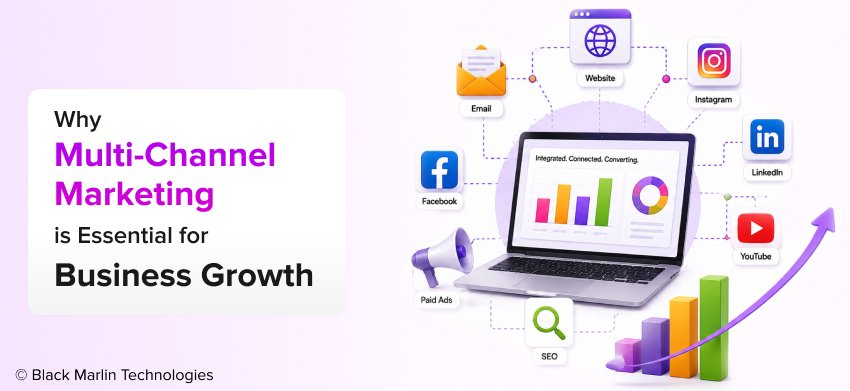 However being present on every platform is not the whole point. A successful multi channel marketing strategy is more about picking the fitting channels for the fitting audience, and tying them to a specific business goal. When these efforts work alongside each other, they start to feel like one stronger integrated marketing plan that can boost visibility, increase interaction, drive leads, and improve conversions.
- What Is Multi-Channel Marketing?
- Multi-Channel vs. Omnichannel Marketing: What’s the Difference?
- Multi-Channel Marketing
- Omnichannel Marketing
- Why Multi-Channel Marketing Is Essential for Business Growth?
- Generate More Qualified Leads
- Improve Conversion Opportunities
- Reduce Dependence on a Single Platform
- Improve Customer Retention
- Increase Marketing ROI
- The Most Important Multi-Channel Marketing Channels
- How to Build a Multi-Channel Marketing Strategy?
- Multi-Channel Marketing Metrics You Should Track
- Awareness Metrics
- Engagement Metrics
- Conversion Metrics
- Revenue Metrics
- Cross-Channel Metrics
- What Does a Successful Multi-Channel Campaign Look Like?
- Common Multi-Channel Marketing Mistakes
- Using Too Many Channels
- Sending the Same Content Everywhere
- Ignoring Customer Segmentation
- Measuring Only Last-Click Conversions
- Focusing on Vanity Metrics
- Inconsistent Branding
- Not Connecting Marketing Data
- Scaling Before Finding Product-Market Fit
- How AI Is Changing Multi-Channel Marketing in 2026?
- AI-Powered Personalization
- AI Content Repurposing
- Predictive Customer Targeting
- Automated Campaign Optimization
- AI-Assisted Attribution and Analytics
- Search + Social + AI Discovery
- How to Choose the Right Channels for Your Business?
- B2B SaaS
- E-commerce
- Local Business
- Real Estate
- Healthcare
- D2C Brand
- Professional Services
- Multi-Channel Marketing Budget: Where Should You Invest?
- Start With Your Best-Performing Channel
- Add Supporting Channels
- Test Before Scaling
- Measure CAC and Revenue, Not Just Traffic
- Review and Reallocate Your Budget
- How to Measure Whether Your Multi-Channel Strategy Is Working?
- Final Thoughts
What Is Multi-Channel Marketing?
Multi channel marketing is about using more than one platform to touch your target audience. Rather than placing all your hopes on just Google, social media, email, or some other single lane, a business mixes several channels to meet customers at different moments in the buying process.
The important point is that multi channel marketing isn’t really about being active on every single platform. It is more about picking the channels your customers genuinely use, and then giving each channel a well defined role inside the marketing strategy.
Multi-Channel vs. Omnichannel Marketing: What’s the Difference?
The terms multichannel marketing and omnichannel marketing get used kind of like the same thing, but they are not really the same no more. Both approaches rely on multiple marketing channels, yet the key difference is in how those channels collaborate together.
In a multi channel approach, a business might use SEO, social media, email, Google Ads, and other platforms to reach customers. Each channel can have its own goal, content, and method, you know, something slightly different for each place. In an omnichannel approach, those same channels are held closer together, so they work in sync to deliver a steadier customer experience.
Getting what multichannel marketing is compared to omnichannel marketing, can help businesses decide on the right path for their targets, available resources, and what customers expect.
Multi-Channel Marketing
Multi channel marketing is basically about reaching customers via several, different channels at once. Like a business can use its website together with search engines, social media too , email, paid ads, and even offline outreach, all in the same time.
Each channel can play a different role, and in the real world it is messy, you know. For example, SEO might lean into organic traffic, social media could be more about engagement while Google Ads is usually aimed at immediate conversions.
Key characteristics include:
- Uses multiple marketing channels.
- Each channel can have its own strategy and goals.
- Focuses strongly on reach, engagement, and channel performance.
- Channels may operate separately.
- Customer data is not always shared across every channel.
- It is generally easier to start and manage.
Omnichannel Marketing
Omnichannel marketing uses multiple channels too, but the point is to weave them together into one steady customer experience.
For example, a customer may see a product on social media, add it to their cart on a website, receive a personalized email, and later complete the purchase through another device. The customer experience remains connected throughout the journey.
Key characteristics include:
- Connects multiple marketing and customer touchpoints.
- Creates a more unified customer journey.
- Shares customer information and context across channels where possible.
- Keeps messaging and experiences more consistent.
- Focuses strongly on customer experience and continuity.
- Usually requires more technology, data integration, and coordination.
Why Multi-Channel Marketing Is Essential for Business Growth?
Customers do not walk down one single fixed path before buying. Someone might come upon your brand via Google, then glance at your social media, read your posts or other content, weigh up your proposal, and come back through an email before becoming an actual customer.
This is why multi channel marketing is more than just pushing your business on different platforms, you know. When the right channels work together, they can help you reach more people, bring forth better leads, boost conversions, and build sturdier customer relationships.
Here are seven ways a strong multi-channel approach can support business growth.
Generate More Qualified Leads
Multi channel marketing can help businesses move past just creating traffic. Different channels can also support different phases in the lead generation process.
Improve Conversion Opportunities
Not every visitor will convert the first time they even see your brand. They might need a bit more information, another nudge, or maybe a more convincing reason to move forward and take action.
Reduce Dependence on a Single Platform
Relying too heavily on one marketing channel can create a major business risk.
Imagine that about 80% of your leads are coming from Google search. Now, if a big algorithm shift happens, your rankings, traffic can drop pretty fast maybe. In the same spirit, when ad costs rise, or when a social media platform changes rules or layout, your results.
A multi channel method can build better marketing resilience, because it is more flexible, if one channel starts working less effective than the other channels can keep flowing traffic, prospects, and sales.
Improve Customer Retention
Business growth is not only about spotting new customers, it’s also about keeping the existing ones. When you guard those relationships properly, you can generate long-term value.
After someone makes a purchase or becomes a client, businesses can continue the relationship through:
- SMS
- Social media
- Loyalty campaigns
- Remarketing
- Educational content
- Personalized offers
Increase Marketing ROI
One of the biggest advantages of multi channel marketing is that you can understand how different channels contribute, to business results.
The channel with the cheapest click is not always the channel that creates the most revenue.
The Most Important Multi-Channel Marketing Channels
Not every marketing channel has the same purpose. Some channels help people find your brand, while others build trust, produce leads, push sales, or keep your current customers involved.
A strong multi channel marketing strategy begins by figuring out what each channel can do, and then giving it a clear part in the customer journey. You do not necessarily need to use every platform. The better method is to pick the channels that fit your audience, your ambitions, and also your budget.
- SEO and Organic Search: Search engine optimization, SEO, helps your business show up when people are actively looking for information, products, or services. It can bring steady organic traffic without you needing to pay for every single click.
- Social Media Marketing: Social media marketing helps businesses connect with audiences in the places they are every day. Platforms like Instagram, Facebook, LinkedIn, and other social networks can help brands share useful content and get discussions going, while also growing communities.
- Paid Advertising: Paid advertising helps businesses connect with defined audiences in a faster way, you know quickly. It’s especially handy when the goal is to bring in traffic, leads, sales, or general awareness within a shorter period.
- Email Marketing: Email marketing gives businesses a direct way to talk with people who already shown interest.
- Content Marketing: Content marketing supports almost every other channel. A usable blog, guide, case study, checklist, or research report can pull in visitors through search, hand over assets for social media, and back up email campaigns.
- Video Marketing: A video can help explain the complicated stuff really fast, and make a brand easier to get, remember even with all the noise. It also plays well across YouTube, Instagram, LinkedIn, on websites, and in paid ads.
- Influencer and Creator Marketing: People often end up trusting recommendations from creators they already follow, like yeah, that makes sense. Influencer and creator marketing can help companies bring a product or service in front of a relevant audience in a more natural.
- Local and Offline Marketing: Digital channels matter, yes, but offline marketing still has this big sway, especially for businesses that have physical locations or serve nearby customers.
How to Build a Multi-Channel Marketing Strategy?
A successful multi-channel marketing strategy doesn’t just happen by making accounts on different platforms, and then calling it a day. It really starts when you set a clear business goal, you understand who your audience actually is, plus you lay out a plan so each channel can gently support the customer journey.
Good news is you do not need a huge marketing team, or dozens of channels to get started right away. With a focused way, using three to five relevant channels can be easier to handle, test, track, and improve.
Here is a practical 10-step framework to build your strategy.
- Define One Clear Business Goal: First, decide what you want your marketing to do, like what it should actually achieve. If the target isn’t clear, it’s hard to choose which channels to lean on or even to check if your campaigns are working.
- Identify Your Target Audience: The best channels are the ones your customers truly use, not just the ones you guess they do. Before selecting platforms, learn who your audience is and how they make their buying decisions.
- Map the Customer Journey: Customers rarely move straight from discovering a brand, to making a purchase. So you want to map the whole journey, in a way that you know which channels help at each stage.
- Choose 3–5 Core Channels: Start with three to five channels where your target audience is already active and where your team can consistently create and manage campaigns.
- Create One Core Message: This is called content repurposing. Rather than making fully brand new material for each platform, you can grab one good idea and adapt it to different audiences plus different formats.
- Adapt Content for Every Platform: Dropping the exact same post into every channel might save time but it does not always lead to the best experience.
- Connect Your Tracking: Using multiple channels tends to pile up more data. But without careful tracking it can get a little hard to tell, exactly where your leads, and sales, are landing from.
- Automate Repetitive Tasks: Automation can save time and help your marketing team respond more consistently.
- Test and Optimize: Your first strategy will not always be your best strategy. Try different elements, and use the results to improve your campaigns.
- Scale What Produces Revenue: The final step is knowing what deserves more investment.
Multi-Channel Marketing Metrics You Should Track
When you run campaigns across multiple platforms you get more chance to reach customers, yet it also piles up more data to keep track of. Just checking likes, clicks, or traffic from each platform alone does not really tell the whole story.
A solid multi-channel marketing strategy should link the marketing activity to business outcomes, like real things you can see and not just vibes. That means keeping track of what happens from the very first interaction all the way to the last purchase, and where it’s possible, assigning the actual influence that each channel plays during the journey.
Marketers should not only ask “Which channel got the last click?” but also try to ask, “Which channels helped this customer discover, consider, and choose our brand?”
Here are the key metrics to track.
Awareness Metrics
Awareness metrics kind a show if your brand is actually reaching fresh and still relevant audiences. They are also most important right up at the top of the customer journey.
Track:
- Reach: The number of unique people who see your content or campaigns.
- Impressions: The total number of times your content or advertisement is displayed.
- Brand searches: How often people search for your brand name.
- Share of voice: How visible your brand is compared with competitors for relevant searches or conversations.
- Video views: The number of people who watch your video content.
Engagement Metrics
After people find your brand, you have to sort out if they are really engaging with your content.
Important engagement metrics include:
- Click-through rate (CTR): Shows how often people click after seeing your content or ad.
- Engagement rate: Measures interactions such as likes, comments, shares, and saves.
- Time on page: Shows how long visitors stay with your website content.
- Email clicks: Measures how many email recipients click your links or calls to action.
- Video completion rate: Shows how many viewers watch a video through to the end.
These metrics kind of help with a bigger question, like are people just noticing your content, or are they genuinely engaged enough to take an action.
Conversion Metrics
Conversion metrics link your marketing effort to particular actions, in a way that feels more tangible. For your business though it can differ; a conversion might be a sale, an enquiry, a consultation request, a demo booking, or just a form submission.
Key metrics include:
- Conversion rate: The percentage of visitors who complete a desired action.
- Leads: The number of people who show interest in your product or service.
- Sales: The number of completed purchases or closed deals.
- MQLs: Marketing-qualified leads that meet your defined qualification criteria.
- CPA: Cost per acquisition or the cost of generating a desired acquisition.
- CAC: Customer acquisition cost, which measures the cost of acquiring a new customer.
Revenue Metrics
Marketing ultimately has to help business growth, like without that it feels pointless. Revenue metrics, they let you see if the money you put into marketing is actually turning into financial value.
Track:
- ROAS: Revenue generated for the money spent on advertising.
- ROI: The return generated compared with the overall investment.
- Customer lifetime value (CLV): The estimated value a customer generates during their relationship with your business.
- Revenue per channel: The revenue associated with different marketing channels.
- Revenue per customer: The average revenue generated by each customer.
Cross-Channel Metrics
This is where cross-channel analytics can make your measurement strategy much stronger.
Customers frequently engage through various channels before any real conversion. If you only tally the final interaction, you might undercount how valuable certain channels were, the ones that prompted or influenced the customer earlier.
What Does a Successful Multi-Channel Campaign Look Like?
A successful multichannel marketing campaign is not about running ads on as many platforms as it’s possible. It’s more like, building a connected journey where each channel has a definite role, in other words a clear purpose.
When an e commerce brand introduces a fresh product, it does not really expect one single ad to summon the sale out of nothing, you know. The brand weaves together social media, search, content and even retargeting, then follows up with email to nudge the shopper from first discovery all the way to purchase and after that, beyond.
- The Customer Discovers the Product on Instagram: The customer views an Instagram Reel or a carousel that shows the product. They may not be ready yet to buy, but the content builds awareness and sparks interest.
- The Customer Searches for the Brand on Google: The customer becomes curious and goes digging for the brand name on Google, and there it is, in search results. They open the website and, also see some other relevant results.
- The Customer Reads a Product Review or Blog: Instead of buying immediately, the customer wants a bit more information first. They read a product review, a comparison article, or a buying guide.
- The Customer Visits the Product Page: After learning more, the customer kind of visits the product page to check the price, features, reviews, delivery details, and also other information that matters.
- The Customer Leaves Without Purchasing: The customer tacks the item into their cart, or they scan the product page and then wander off without finishing the purchase.
- The Customer Sees a Retargeting Ad: Later, the customer notices a retargeting advertisement that feels relevant, it reminds them about the product they had viewed.
- The Customer Receives an Abandoned-Cart Email: When the customer has added the product to their cart, and they gave their email address, the brand may send a useful reminder.
- The Customer Purchases: After several useful touchpoints, the customer returns to the website and completes the purchase.
- The Customer Receives a Post-Purchase Email: The relationship does not simply end after the sale, the brand keeps going by sending an order confirmation, the product info, usage tips, or maybe useful content.
- The Customer Receives a Loyalty Offer: After a while, the brand will send a relevant loyalty offer, or maybe a product recommendation that comes from the customers previous purchase.
Common Multi-Channel Marketing Mistakes
Using several channels can help a business bump into more customers, but just being available on a handful of platforms doesn’t automatically mean growth. A good multi channel marketing plan really needs crisp goals, messaging that match the audience, data that is connected not isolated, and routine optimization.
Here are some common mistakes businesses should avoid.
Using Too Many Channels
Trying to manage every social platform and advertising network, plus email campaign stuff and content channel efforts all at once can end up spreading the team, plus the budget too thin.
Start by picking 3 to 5 channels where your intended audience is most active. After you see what lands well, then you can slowly expand.
The goal is not to be everywhere. The goal is to be effective where your customers are.
Sending the Same Content Everywhere
Consistency is important, but consistency does not mean duplication.
A long blog article can do well on your site, yet if you just copy the whole thing into Instagram, or LinkedIn, it will not get the same impact. Instead, adapt the core idea for each platform:
Ignoring Customer Segmentation
Not every customer has the same needs, interests, or buying intent.
A new visitor might need some educational content, while an already existing customer tends to look for a loyalty offer or perk. If you treat both groups exactly the same, your campaigns can end up being less relevant.
Use customer segmentation based on factors such as:
- Demographics
- Location
- Interests
- Previous interactions
- Purchase history
- Buying intent
- Engagement level
Better segmentation can make customer journey marketing more relevant and personalized.
Measuring Only Last-Click Conversions
A common measurement mistake is giving all conversion credit to the final channel.
Consider this journey:
If email receives 100% of the credit, you may overlook the role played by Instagram, Google, and content marketing.
This is why cross channel analytics and attribution matter, a lot. They help a business see how each channel not just introduced but also nudged and ultimately converted customers.
Last-click data can still be useful, but it should not be the only way you evaluate performance.
Focusing on Vanity Metrics
Likes, followers, impressions, and clicks can look impressive, but they do not automatically create revenue.
Look beyond surface-level numbers and track:
- Qualified leads
- Conversion rate
- Customer acquisition cost
- Revenue
- ROAS
- Customer lifetime value
- Profit
The best metric depends on your business goal, but the final focus should always be on business outcomes.
Inconsistent Branding
Customers should be able to recognize your brand across different channels.
If your website sounds professional, but your social media messaging feels totally different, customers can get confused about what your brand stands for, or in other words what it truly represents.
Keep your:
- Brand voice
- Visual identity
- Core message
- Value proposition
- Offers
- Customer promises
consistent across channels.
The format can change, but the underlying brand should feel familiar.
Not Connecting Marketing Data
When each platform operates separately, it becomes difficult to understand the complete customer journey.
Use tools such as:
- GA4
- CRM
- Advertising platforms
- UTM tracking
- Conversion tracking
- Cross-channel reporting
Connected data makes it easier to identify what is working and where customers are dropping out.
Scaling Before Finding Product-Market Fit
More advertising will not fix a product or offer that customers do not want.
Before increasing your budget across multiple channels, test your:
- Product
- Offer
- Audience
- Messaging
- Landing page
- Conversion process
Start small, collect data, learn what works, and then scale.
How AI Is Changing Multi-Channel Marketing in 2026?
Artificial intelligence is changing how businesses plan, create, deliver and measure their marketing campaigns. In 2026, customers are also using AI in new manners to research products, compare options, ask questions, and make purchase decisions. Google says that AI Search is getting more conversational and multimodal too, with people often typing longer and more detailed queries instead of only leaning on short keywords.
This shift means businesses have to think past single platforms, you know. AI can help link customer data together, shape experiences more personally, push out content faster, fine tune campaigns, and even see how people actually move across various touchpoints.
Here are some of the biggest ways AI is changing multi-channel marketing in 2026.
AI-Powered Personalization
Customers expect brands to get, how they are thinking and what they need. AI can study customer behavior, earlier conversations, buy history, and engagement cues. This helps marketers craft more personal experiences.
The same approach can be applied across:
- Website
- Social media
- Paid advertising
- Product recommendations
- Customer support
This makes personalization more scalable while helping businesses deliver the right message to the right audience.
AI Content Repurposing
Making truly unique content for every channel can take quite a bit of time. AI can assist marketers turning one solid piece of content asset into multiple formats.
A detailed blog can end up as a LinkedIn thought leadership post, an Instagram carousel, a quick video script, an email newsletter, and even multiple ad variations.
Even so, AI made content should still be reviewed and remade a bit by humans. The objective is not to push the exact same writing everywhere. The point is to re-use the core thought, but adjust it so it fits each platform.
This can make a multi-channel marketing strategy faster and more efficient without sacrificing the need for original, useful content.
Predictive Customer Targeting
AI can examine huge amounts of customer data and catch patterns that are a little harder to notice by hand. Marketers can take those findings, to see which customer groups are more likely to click, convert, or come back again.
Predictive targeting can help businesses improve:
- Audience segmentation
- Lead scoring
- Product recommendations
- Retargeting
- Customer retention
- Campaign targeting
The important point is that AI should help with better decisions, not replace the marketing strategy. Businesses still need clear goals, real customer data, and suitable privacy controls.
Automated Campaign Optimization
Marketing campaigns can change really fast. Ad costs, audience behavior, creative performance, and even customer demand can move around over time.
AI can help marketers see what changed in performance, then suggest or automate a few optimizations. These days, modern marketing platforms are using AI more and more for things like audience targeting, creative tuning, bid management, performance evaluation, and even future forecasting.
AI-Assisted Attribution and Analytics
Understanding the customer journey becomes more difficult as businesses add more channels.
A customer might interact with:
AI-assisted analytics can help marketers identify patterns across these interactions and understand which touchpoints contributed to the final outcome.
Instead of looking only at last-click conversions, businesses can use broader data to evaluate:
- Assisted conversions
- Customer journey patterns
- Channel contribution
- Audience behavior
- Campaign performance
- Revenue trends
- Customer lifetime value
Some modern marketing platforms are also moving toward AI-generated explanations of why campaign performance changed, helping marketers investigate factors such as budgets, audiences, creatives, and campaign settings more quickly.
Search + Social + AI Discovery
One of the biggest changes in 2026 is that customer discovery is no longer limited to traditional search results.
People can discover brands through Google Search, social platforms, videos, online communities, and AI-powered search experiences. Google says AI Search is becoming more conversational, multimodal, and capable of handling complex questions, while customers are moving between search, social, entertainments, and shopping more fluidly.
This creates a broader visibility opportunity for brands.
Companies should make content that helps people. It should be reliable. It must be simple to follow. The same content should also work in different places where people find things.
For SEO and AI search, that means continuing to focus on:
- Helpful and original content
- Clear answers to customer questions
- Strong topical expertise
- Structured and understandable information
- Relevant product and service information
- Brand authority and trust
- Consistent information across channels
Google has also stated that its AI Search experiences continue to rely on foundational Search systems and that creating helpful content for people remains important for visibility.
How to Choose the Right Channels for Your Business?
Picking the right marketing channels is a key step in putting together a multi-channel plan. What works for one company might not bring the same results for another.
The right choice depends on your audience, buying journey, business model, budget, and marketing goals. Instead of trying to be active everywhere, start with the channels where your customers are most likely to discover, research, and purchase from your business.
B2B SaaS
B2B SaaS customers often spend time researching solutions before making a decision. SEO can attract people searching for answers, while LinkedIn can help build professional credibility.
Email can nurture leads over time, and Google Ads can capture high-intent searches from people actively looking for software solutions.
E-commerce
E-commerce businesses need to combine product discovery with conversion and retention.
SEO can attract people searching for products, while Google Ads can capture purchase-ready searches. Instagram can create product awareness and visual engagement, while email can support abandoned-cart recovery and repeat purchases.
Local Business
For businesses serving a specific location, being visible when customers search for nearby services is critical.
Local SEO can help customers discover the business in local search results, while Google Ads can capture high-intent searches. Social media can build awareness, showcase services, and maintain local engagement.
Real Estate
Real estate purchases usually involve research, comparison, and multiple conversations before a decision is made.
SEO can attract people researching properties and locations. Google Ads can target high-intent searches, while Meta Ads can create awareness and generate leads. WhatsApp can then provide a convenient way to follow up with interested prospects.
Healthcare
Healthcare customers often search for information before choosing a provider. SEO and content marketing can answer common questions and demonstrate expertise.
Local SEO helps people find nearby clinics or healthcare providers, while social media can support awareness and community engagement.
D2C Brand
D2C brands often depend on strong product discovery and direct customer relationships.
Social media can introduce products to new audiences, while creators and influencers can add social proof. Paid advertising can drive targeted traffic, and email can help convert interested visitors and encourage repeat purchases.
Professional Services
Professional service businesses often need to establish expertise before customers are ready to make contact.
SEO can capture people searching for solutions, while content marketing can demonstrate knowledge and answer customer questions. LinkedIn can build professional credibility, and email can nurture leads who need more time before making a decision.
Multi-Channel Marketing Budget: Where Should You Invest?
A multi-channel marketing strategy does not require you to spend the same amount of money on every platform. In fact, spreading your budget equally across channels can waste money if some channels are not reaching the right audience or generating meaningful results.
The better approach is to start with what already works, invest in supporting channels, test new opportunities, and move more budget toward activities that generate qualified leads, customers, and revenue.
Start With Your Best-Performing Channel
Look at your existing marketing data before deciding where to invest more money.
Identify the channels that consistently generate:
- Qualified leads
- Sales
- Strong conversion rates
- Lower customer acquisition costs
- Higher customer lifetime value
- Positive ROI or ROAS
Add Supporting Channels
Once you have identified a strong channel, add other channels that can support it.
Supporting channels can help customers move from awareness to consideration and eventually to conversion.
This also makes your marketing less dependent on a single platform and creates a stronger customer journey.
Test Before Scaling
New channels can look promising, but you should not commit a large budget before you know whether they work for your audience.
Start with a controlled test.
- Audiences
- Ad creatives
- Offers
- Landing pages
- Messages
- Content formats
- Campaign objectives
Give the test enough time and data to make a meaningful decision. Avoid increasing the budget simply because a campaign gets clicks or impressions.
Measure CAC and Revenue, Not Just Traffic
Traffic is useful, but traffic alone does not pay the bills.
A channel that generates 10,000 visitors but only two customers may be less valuable than a channel that generates 1,000 visitors and 20 customers.
Track business-focused metrics such as:
- CAC: Customer acquisition cost
- CPA: Cost per acquisition
- Conversion rate
- Revenue
- ROAS
- ROI
- Customer lifetime value
- Profit
Review and Reallocate Your Budget
Your channel mix should not remain unchanged forever.
Review performance regularly and ask:
- Which channels are generating qualified customers?
- Which channels have rising CAC?
- Which campaigns are producing revenue?
- Which channels assist conversions?
- Where are customers dropping out?
- Which experiments deserve more investment?
Then move budget based on the answers.
How to Measure Whether Your Multi-Channel Strategy Is Working?
Launching campaigns across SEO, social media, email, paid advertising, and other platforms is only the first step. To know whether your multi-channel marketing strategy is actually supporting business growth, you need to measure performance regularly.
A monthly dashboard can make this easier. Instead of checking dozens of platform reports separately, bring your most important KPIs into one place and compare them with your business goals.
The key is to measure more than traffic and clicks. Look at the complete journey from awareness to revenue and retention.
Frequently Asked Questions
Q1. What is multi-channel marketing?
Ans1. – Multi-channel marketing is a strategy where a business uses multiple channels, such as SEO, social media, email, content marketing, and paid advertising, to reach customers at different stages of their buying journey.
Q2. Why is multi-channel marketing important for business growth?
Ans2. – It helps businesses reach customers across different platforms, build brand visibility, generate qualified leads, improve conversion opportunities, and increase customer retention. It can also reduce dependence on a single marketing channel.
Q3. What are examples of multi-channel marketing?
Ans3. – A simple example is SEO → Blog → Social Media → Google Ads → Email → Purchase. Each channel has a different role but supports the same customer journey and business goal.
Q4. What channels are used in multi-channel marketing?
Ans4. – Common channels include SEO, social media marketing, Google Ads, Meta Ads, email marketing, content marketing, video marketing, influencer marketing, local SEO, and offline marketing.
Q5. What is the difference between multichannel and omnichannel marketing?
Ans5. – Multi-channel marketing uses several channels to reach customers, but those channels may operate separately. Omnichannel marketing connects multiple channels to create a more unified and consistent customer experience.
Q6. How do you create a multi-channel marketing strategy?
Ans6. – Start by defining a clear business goal and identifying your target audience. Then map the customer journey, select three to five relevant channels, create consistent messaging, adapt content for each platform, connect tracking, test campaigns, and scale the channels that generate strong business results.
Q7. How many marketing channels should a business use?
Ans7. – There is no fixed number. For most businesses, starting with three to five relevant channels can be more manageable than trying to use every platform. Choose channels based on where your audience spends time and what supports your business goals.
Q8. How do you measure multi-channel marketing success?
Ans8. – Track metrics across the complete customer journey, including reach, traffic, engagement, leads, conversion rate, CAC, ROAS, ROI, revenue, and customer lifetime value. Cross-channel analytics can also help identify how different channels contribute to conversions.
Q9. Is multi-channel marketing suitable for small businesses?
Ans9. – Yes. Small businesses can start with a few cost-effective channels instead of trying to manage everything. For example, a local business could combine local SEO, Google Business Profile, social media, and email marketing before expanding into additional channels.
Q10. How does AI improve multi-channel marketing?
Ans10. – AI can help businesses personalize customer experiences, repurpose content, identify valuable audiences, automate repetitive tasks, optimize campaigns, and analyze customer journeys. This can make multi-channel marketing faster and more data-driven while keeping human strategy and oversight important.
Final Thoughts
One channel can generate attention. Multiple well-planned channels can create a customer journey.
Today, customers move between search engines, social media, websites, email, videos, and other platforms before making a decision. A strong multi-channel marketing strategy helps businesses meet customers at these different touch points while building awareness, trust, conversions, and long-term relationships.
The key is not to be present everywhere. Choose the channels that match your audience, give each channel a clear purpose, and connect your efforts to measurable business goals. Use cross-channel analytics to understand what drives qualified leads, sales, revenue, and retention.
Start small, test what works, learn from your data, and scale the channels that create real business value.