'>
<rect width='100' height='100' fill='%23B22234'/>
<!-- stripes -->
<g fill='%23fff'>
<rect y='10' width='100' height='10'/>
<rect y='30' width='100' height='10'/>
<rect y='50' width='100' height='10'/>
<rect y='70' width='100' height='10'/>
<rect y='90' width='100' height='10'/>
</g>
<!-- blue box -->
<rect width='50' height='50' fill='%233C3B6E'/>
</g>
</svg>)
'>
<rect width='100' height='100' fill='%23fff'/>
<rect width='100' height='33.33' y='0' fill='%23FF9933'/>
<rect width='100' height='33.33' y='66.66' fill='%23138808'/>
<!-- Ashoka Chakra -->
<circle cx='50' cy='50' r='9' fill='none' stroke='%23000080' stroke-width='2'/>
<g stroke='%23000080' stroke-width='1'>
<line x1='50' y1='41' x2='50' y2='59'/>
<line x1='41' y1='50' x2='59' y2='50'/>
<line x1='44' y1='44' x2='56' y2='56'/>
<line x1='56' y1='44' x2='44' y2='56'/>
</g>
</g>
</svg>)
 info@blackmarlintechnologies.com

Getting more people to visit your online store without paying for ads can feel difficult. With so many ecommerce websites competing for attention, ranking higher on Google and attracting organic traffic is becoming more challenging every year.
This is where ChatGPT can help.
If you’re wondering how to use ChatGPT to increase ecommerce organic traffic, the good news is that you don’t need to be an SEO expert or a professional writer. ChatGPT can act like a smart assistant that helps you find keyword opportunities, create helpful content, improve product pages, and optimize your store for both traditional search engines and emerging AI search platforms.
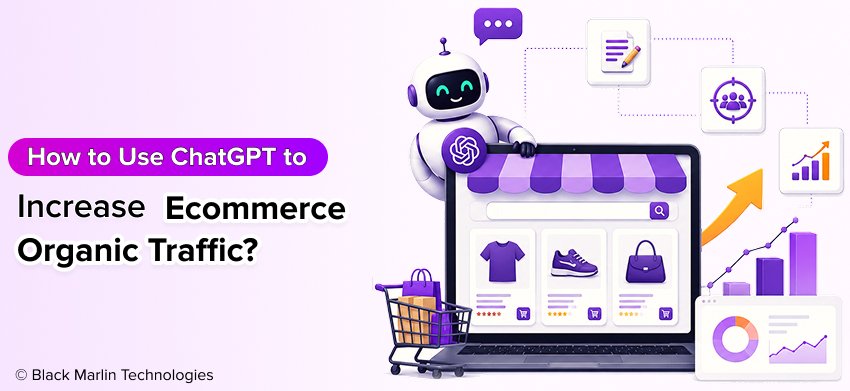 Think of it this way: ChatGPT won’t magically push your website to the top of Google overnight. However, it can help you complete many SEO tasks faster and more efficiently. Instead of spending hours researching keywords or writing product descriptions from scratch, you can use AI to streamline the process and focus on strategy.
For ecommerce businesses, this means more opportunities to create content that matches what customers are searching for, answer common questions, and improve the overall shopping experience. When combined with human expertise and a solid SEO strategy, ChatGPT can become a valuable tool for driving consistent organic traffic and increasing online visibility.
In this guide, you’ll learn practical ways to use ChatGPT for ecommerce SEO, from keyword research and content creation to category page optimization and AI search visibility. You’ll also discover the metrics that matter and the common mistakes to avoid when using AI for SEO.
- What Is Ecommerce Organic Traffic?
- Why Ecommerce Stores Depend on SEO?
- Can ChatGPT Really Increase Ecommerce Organic Traffic?
- How ChatGPT Supports Ecommerce SEO?
- Why Blog Content Matters for Ecommerce SEO?
- What Makes Content AI-Friendly?
- Clear Answers
- Structured Content
- Expert Information
- FAQ Sections
- Schema Markup
- Product Data
- Why an SEO Workflow Matters?
- Monday: Keyword Research
- Tuesday: Optimize Product Pages
- Wednesday: Create Blog Content
- Thursday: Optimize FAQ Sections
- Friday: Improve Internal Linking
- Saturday: Update Existing Content
- Sunday: Review SEO Performance
- Ecommerce SEO Metrics to Track
- Organic Traffic
- Click-Through Rate (CTR)
- Keyword Rankings
- Revenue From Organic Traffic
- Conversion Rate
- AI Referral Traffic
- Indexed Pages
- Best ChatGPT Prompts for Ecommerce SEO
- Case Study Framework: A 90-Day ChatGPT Ecommerce SEO Plan
- Conclusion
What Is Ecommerce Organic Traffic?
Before learning how to use ChatGPT to increase ecommerce organic traffic, it’s important to understand what organic traffic actually means.
Simply put, ecommerce organic traffic refers to visitors who find your online store through unpaid search results. For example, when someone searches for “best running shoes for beginners” on Google and clicks on your website without you paying for an ad, that visitor counts as organic traffic.
Think of organic traffic as earning attention rather than buying it.
Organic Traffic vs. Paid Traffic
There are two common ways to bring visitors to an ecommerce website:
Organic Traffic
- Comes from search engines like Google, Bing, and AI search platforms.
- Does not require paying for every click.
- Takes time to build, but can provide long-term results.
- Often attracts users actively searching for products or information.
Paid Traffic
- Comes from advertising platforms such as Google Ads and social media ads.
- Requires a budget for every click or impression.
- Can generate traffic quickly.
- Stops when the advertising budget runs out.
Imagine opening a new store. Paid advertising is like renting a billboard, while organic SEO is like building a reputation that helps customers find you naturally over time.
Why Ecommerce Stores Depend on SEO?
For most online stores, search engines are one of the biggest sources of customers. People use Google every day to research products, compare options, read reviews, and make purchasing decisions.
Without strong SEO, your products may never appear when potential customers are searching.
SEO helps ecommerce businesses:
- Increase website visibility
- Attract qualified shoppers
- Reduce reliance on paid advertising
- Build trust and authority
- Generate consistent long-term traffic
- Improve online sales opportunities
This is why many ecommerce brands invest in content marketing, product page optimization, category page SEO, and keyword research. The better your store matches what customers are searching for, the more organic traffic you can earn.
Cost Comparison: Organic vs. Paid Acquisition
| Channel | Cost Per Click |
| Paid Ads | High |
| Organic SEO | Low |
| AI Search Referrals | Growing |
While paid ads can deliver immediate traffic, the cost often increases as competition grows. Organic SEO typically requires an upfront investment in content and optimization, but each additional visitor doesn’t come with a direct cost per click.
The Growing Role of AI Search
Search behavior is changing.
Today, people don’t only search on Google. Many users are also asking questions in AI-powered platforms such as ChatGPT, Gemini, and Perplexity to discover products, compare options, and find recommendations.
These AI-driven search and answer engines are becoming an additional discovery channel alongside traditional search engines. As a result, ecommerce businesses need to create helpful, well-structured content that can be understood by both search engines and AI systems.
This shift makes organic visibility more important than ever and creates new opportunities for brands that combine SEO best practices with AI-powered content strategies.
Can ChatGPT Really Increase Ecommerce Organic Traffic?
ChatGPT cannot directly improve your Google rankings or send visitors to your website with the click of a button. Instead, it helps you complete important SEO tasks faster and more efficiently. When used correctly, it can save time, improve content quality, and help your ecommerce store create more opportunities to attract organic traffic.
Think of ChatGPT as a smart assistant rather than an SEO expert. It can help you brainstorm ideas, organize information, and create content drafts, but human expertise is still needed to review, edit, and optimize the final result.
How ChatGPT Supports Ecommerce SEO?
One of the biggest challenges for ecommerce businesses is the amount of work involved in SEO. From keyword research to product descriptions and blog content, creating optimized content for hundreds or even thousands of pages can take a lot of time.
This is where ChatGPT becomes valuable.
It can help by:
- Speeding up keyword research and topic discovery
- Creating blog outlines and content briefs
- Writing product description drafts
- Generating category page content ideas
- Creating FAQ sections for products and collections
- Suggesting internal linking opportunities
- Organizing content around search intent
- Supporting content optimization workflows
For example, instead of spending hours brainstorming blog topics, you can ask ChatGPT to generate content ideas based on customer questions and search trends. Similarly, if you manage a large ecommerce catalog, ChatGPT can help create unique product description drafts that can be refined by your content team.
ChatGPT Makes SEO More Efficient
Many ecommerce teams struggle with limited time and resources. ChatGPT helps reduce the time required for repetitive tasks, allowing marketers and store owners to focus on strategy, user experience, and conversion optimization.
Here’s a simple comparison:
| Task | Manual | With ChatGPT |
| Product Description | 30 min | 5 min |
| Blog Outline | 45 min | 3 min |
| FAQ Creation | 20 min | 2 min |
While the exact time savings will vary, the goal remains the same: complete more SEO tasks in less time.
ChatGPT Is a Tool, Not a Replacement
A common mistake is assuming AI can handle an entire SEO strategy on its own.
In reality, ChatGPT works best when combined with human expertise. Search engines reward content that is accurate, helpful, and genuinely useful for users. AI-generated content should always be reviewed, fact-checked, and improved before publishing.
The most successful ecommerce brands use ChatGPT to support their SEO efforts—not replace them.
By combining AI-powered workflows with strong SEO fundamentals, businesses can create more content, optimize more pages, and improve their chances of earning consistent organic traffic over time.
Use ChatGPT for Ecommerce Keyword Research
Every successful ecommerce SEO strategy starts with one thing: understanding what your customers are searching for.
If you target the wrong keywords, even the best product pages and blog posts may struggle to attract visitors. That’s why keyword research is one of the most important steps when learning how to use ChatGPT to increase ecommerce organic traffic.
Traditionally, keyword research can take hours. You need to find search terms, analyze search intent, group related keywords, and decide which topics to target first. ChatGPT helps simplify this process by generating keyword ideas, organizing them into categories, and identifying potential content opportunities.
How ChatGPT Helps With Keyword Research?
Instead of starting with a blank page, you can ask ChatGPT to generate keyword variations around a product, category, or topic.
For example, if you sell running shoes, you can use a prompt like:
Example Prompt
“Generate 50 long-tail keywords for running shoes. Group them by informational, commercial, and transactional intent.”
ChatGPT can quickly create keyword lists and organize them based on what users are trying to achieve.
Understanding Search Intent
Not all keywords have the same purpose. Some people are looking for information, while others are ready to buy.
Here’s a simple breakdown:
| Search Intent | Example Keyword | User Goal |
| Informational | best running shoes for beginners | Learn |
| Commercial | best running shoes under $100 | Compare |
| Transactional | buy running shoes online | Purchase |
By grouping keywords based on intent, you can create content that matches what customers need at each stage of their buying journey.
Use ChatGPT for Keyword Clustering
One of ChatGPT’s most useful features is keyword clustering.
Instead of targeting individual keywords, you can group similar searches together and create one comprehensive page that answers multiple related questions.
For example:
Primary Keyword
- running shoes
Related Keyword Cluster
- best running shoes for beginners
- lightweight running shoes
- running shoes for long-distance running
- affordable running shoes
- running shoe buying guide
This approach helps search engines understand your content better while reducing the risk of creating multiple pages that compete against each other.
Don’t Rely on ChatGPT Alone
While ChatGPT is excellent for brainstorming keyword ideas, it doesn’t provide real-time search volume or ranking difficulty data.
To validate keyword opportunities, combine ChatGPT with SEO tools such as:
Think of ChatGPT as the idea generator and SEO tools as the fact-checkers.
Metrics to Track
After implementing your keyword strategy, monitor these key SEO metrics:
| Metric | Why It Matters |
| Keyword Rankings | Shows how your pages perform in search results |
| Impressions | Measures how often your pages appear in searches |
| Search Volume | Indicates keyword popularity |
| Click-Through Rate (CTR) | Shows how many users click your listing |
Tracking these metrics helps you understand which keywords are driving visibility and which pages need further optimization.
The goal isn’t to rank for every keyword. The goal is to rank for the keywords your ideal customers are actually searching for. With ChatGPT, you can discover those opportunities faster and build a stronger foundation for long-term ecommerce organic traffic growth.
Create SEO-Friendly Product Descriptions
Product descriptions play a bigger role in ecommerce SEO than many store owners realize.
Unfortunately, many ecommerce websites make the same mistake: they copy product descriptions directly from manufacturers. While this may seem like a time-saving solution, it can hurt your visibility in search results because hundreds of other websites may be using the exact same content.
Search engines prefer original, helpful content that provides real value to shoppers. If your product descriptions are unique and answer customer questions, they have a better chance of ranking and attracting organic traffic.
This is where ChatGPT can help.
How ChatGPT Improves Product Descriptions?
Instead of simply listing product features, ChatGPT can help create descriptions that explain why those features matter to customers.
For example, a basic product description might say:
“Waterproof backpack with 30-liter storage capacity and adjustable straps.”
While technically correct, it doesn’t explain the benefits.
A more optimized version could say:
“Stay prepared on every adventure with this waterproof hiking backpack. Its 30-liter storage capacity provides enough space for clothing, food, and outdoor essentials, while adjustable straps help ensure all-day comfort on long hikes.”
Notice the difference?
The second version focuses on how the product helps the customer, not just what the product includes.
Example Prompt
You can use a prompt like:
“Write a unique SEO-friendly product description for a waterproof hiking backpack. Include benefits, features, FAQs, and a call-to-action.”
This allows ChatGPT to create a more complete draft that can be edited and personalized before publishing.
Focus on Search Intent, Not Just Keywords
A common SEO mistake is stuffing product descriptions with keywords.
For example:
“Best waterproof hiking backpack waterproof hiking backpack for hiking backpack users.”
This creates a poor reading experience and doesn’t help potential buyers.
Instead, focus on search intent. Ask yourself:
- What problem is the customer trying to solve?
- What questions might they have?
- What benefits are most important?
- What information would help them make a purchase decision?
When your product descriptions answer these questions naturally, they become more useful for both search engines and shoppers.
Before vs. After Optimization
| Basic Description | Optimized Description |
| Features only | Features + Benefits |
| Generic | Unique |
| Low SEO Value | Higher SEO Potential |
Additional Ways to Use ChatGPT
Beyond writing descriptions, ChatGPT can also help generate:
- Product FAQs
- Product comparison content
- Buying guides
- Product specifications
- Customer-focused benefit lists
- Call-to-action suggestions
These elements make product pages more informative and increase the chances of ranking for a wider range of search queries.
Build Better Category Pages With ChatGPT
When most ecommerce businesses think about SEO, they focus on product pages and blog posts. However, category pages are often some of the most valuable pages on an ecommerce website.
Why?
Because category pages target broad, high-volume keywords that shoppers frequently search for. For example, a category page targeting “men’s running shoes” can attract significantly more organic traffic than an individual product page.
That’s why strong category pages are a core part of any successful ecommerce SEO strategy.
Why Category Pages Matter for SEO?
A category page helps customers browse similar products in one place. It also helps search engines understand what your store offers.
Well-optimized category pages can:
- Rank for competitive keywords
- Improve website navigation
- Help customers find products faster
- Support internal linking
- Increase organic traffic
- Improve user experience
Unfortunately, many ecommerce stores leave category pages almost empty, showing only product listings with little or no supporting content.
This is a missed opportunity.
How ChatGPT Can Improve Category Pages?
Creating useful category page content for dozens or even hundreds of categories can be time-consuming. ChatGPT can help generate content ideas and first drafts that make category pages more informative and search-friendly.
You can use ChatGPT to create:
- Category introductions
- Frequently asked questions (FAQs)
- Product selection tips
- Buying guides
- Internal linking suggestions
- Category descriptions
Instead of presenting only products, you create a helpful resource that answers customer questions and supports their buying journey.
Example Prompt
Try using a prompt like:
“Create a 500-word SEO introduction for a men’s running shoes category page.”
You can also add specific instructions, such as:
- Include beginner-friendly language
- Mention key product benefits
- Answer common customer questions
- Suggest related product categories
- Include natural keyword variations
The more context you provide, the more useful the generated content will be.
Add Helpful Information Beyond Products
The best category pages do more than display products. They help customers make informed decisions.
For example, a men’s running shoes category page could include:
Category Introduction
A short overview explaining the types of running shoes available and who they are designed for.
Buying Guide
Tips on choosing the right shoe based on running style, foot type, and distance.
Frequently Asked Questions
Answers to common questions such as:
- What are the best running shoes for beginners?
- How often should running shoes be replaced?
- What’s the difference between road and trail running shoes?
Related Categories
Links to:
- Trail Running Shoes
- Marathon Running Shoes
- Running Socks
- Sports Apparel
This additional content helps both users and search engines better understand the page.
Use ChatGPT to Strengthen Internal Linking
Internal links help visitors discover related products and pages while helping search engines crawl your website more effectively.
ChatGPT can suggest logical linking opportunities between:
- Product pages
- Category pages
- Buying guides
- Blog articles
- FAQ sections
For example, a category page about men’s running shoes could link to a blog post about choosing the right running shoe size or a guide comparing different shoe types.
These connections improve the overall structure of your website and create a better user experience.
Focus on Quality, Not Quantity
Adding hundreds of words to a category page won’t automatically improve rankings.
The goal is to provide useful information that helps shoppers make decisions.
Before publishing AI-generated content, make sure to:
- Check accuracy
- Remove repetitive text
- Add brand-specific insights
- Include real product expertise
- Ensure the content matches customer needs
The best category pages combine helpful information, strong product organization, and a seamless shopping experience.
When paired with ChatGPT, this process becomes faster and easier to scale across your ecommerce website, helping you improve visibility and attract more organic traffic over time.
Generate Blog Content That Answers Customer Questions
One of the most effective ways to increase ecommerce organic traffic is by creating content that answers your customers’ questions.
Before people buy a product, they often do research. They want to compare options, learn about features, understand sizing, and find solutions to their problems. This is where blog content becomes valuable.
Google and AI search engines are designed to provide the most helpful answers to users. When your content solves real customer problems, you increase your chances of appearing in search results and attracting potential buyers to your website.
Why Blog Content Matters for Ecommerce SEO?
Many ecommerce businesses focus only on product pages. While product pages are important, they typically target customers who are already close to making a purchase.
Blog content helps you reach people earlier in their buying journey.
For example, someone searching for:
- Best running shoes for beginners
- How to choose running shoes
- Running shoe size guide
may not be ready to buy immediately. However, if your content provides helpful answers, they may discover your brand and return when they’re ready to make a purchase.
This is how content marketing supports long-term organic traffic growth.
How ChatGPT Helps Create Blog Content Faster?
Coming up with blog ideas, outlines, and article structures can take a lot of time.
ChatGPT can help you:
- Discover content ideas
- Identify customer questions
- Create article outlines
- Generate headline variations
- Build FAQ sections
- Expand content topics
- Create content clusters around products
Instead of staring at a blank screen, you can use ChatGPT to create a strong starting point and then add your expertise and brand voice.
Start With Customer Questions
A simple content strategy is to think about the questions customers ask before buying.
For example, if you sell running shoes, potential blog topics might include:
- Best Running Shoes for Beginners
- How to Choose Running Shoes
- Running Shoe Size Guide
- Road Running Shoes vs. Trail Running Shoes
- How Long Do Running Shoes Last?
- Common Running Shoe Buying Mistakes
Each article helps answer a specific question while introducing potential customers to your products.
Understand the Ecommerce Content Funnel
Not every visitor is ready to buy immediately.
Different types of content serve different stages of the customer journey.
| Funnel Stage | Content Type |
| Awareness | Blog Posts |
| Consideration | Buying Guides |
| Decision | Product Pages |
Here’s how it works:
Awareness Stage
Customers are looking for information.
They may search for:
- How to choose running shoes
- Running tips for beginners
- Best shoes for daily running
Helpful blog posts attract these visitors and build trust.
Consideration Stage
Customers begin comparing options.
They may search for:
- Best running shoes for flat feet
- Running shoe comparison guide
- Lightweight vs. cushioned running shoes
Buying guides and comparison articles help them evaluate products.
Decision Stage
Customers are ready to purchase.
They search for:
- Buy running shoes online
- Nike running shoes size 10
- Best price for running shoes
Product pages help convert these visitors into customers.
Create Topic Clusters With ChatGPT
Instead of publishing random blog posts, create related content around a central topic.
For example:
Main Topic: Running Shoes
Supporting Articles:
- Best Running Shoes for Beginners
- Running Shoe Size Guide
- How to Clean Running Shoes
- How Often Should You Replace Running Shoes?
- Running Shoes for Flat Feet
This approach helps search engines understand your expertise and can improve your visibility for a broader range of keywords.
Focus on Helping First
The goal of blog content isn’t to sell immediately.
The goal is to help.
When your content genuinely answers questions and provides useful information, visitors are more likely to trust your brand, explore your products, and return when they’re ready to buy.
By using ChatGPT to streamline content creation and focusing on customer needs, ecommerce businesses can build a steady flow of organic traffic that supports every stage of the buying journey.
Use ChatGPT to Create FAQ Sections
Have you ever visited a product page and still had questions before making a purchase?
Maybe you wanted to know about sizing, shipping, durability, compatibility, or product features. If those questions weren’t answered, you might have left the website and looked elsewhere.
That’s exactly why FAQ sections are so important.
A well-written FAQ section helps customers find answers quickly, improves the user experience, and gives search engines more context about your products and content.
Why FAQs Matter for Ecommerce SEO?
FAQs are useful because they address the specific questions customers are already asking.
When someone searches for:
- Are trail running shoes waterproof?
- How long do trail running shoes last?
- Can I use trail running shoes on roads?
Google and AI search engines look for pages that provide clear, direct answers.
By including relevant FAQs on your product pages, category pages, and blog articles, you increase the chances of matching those searches and attracting qualified visitors.
FAQs Help More Than Just Customers
A strong FAQ section benefits multiple audiences.
Users
Customers get quick answers without needing to contact support or leave your website.
Search Engines
Google gains a better understanding of your products, categories, and content topics.
AI Search Engines
Platforms such as ChatGPT, Gemini, and Perplexity often look for clear, structured information when generating answers. FAQ content can help AI systems better understand and reference your website’s information.
This makes FAQs a valuable part of both traditional SEO and emerging AI search optimization strategies.
How ChatGPT Helps Create FAQs?
Researching customer questions manually can take time.
ChatGPT can quickly generate lists of potential questions based on your products, categories, and target audience.
For example, you could use a prompt like:
“Generate 20 customer questions about trail running shoes.”
Within seconds, ChatGPT can provide dozens of question ideas that can be reviewed, refined, and added to your content.
Example FAQ Topics
If you sell trail running shoes, ChatGPT may generate questions such as:
- What are trail running shoes?
- Are trail running shoes good for beginners?
- Can trail running shoes be used on pavement?
- How do I choose the right trail running shoe size?
- Are trail running shoes waterproof?
- How often should trail running shoes be replaced?
These questions represent real concerns that potential customers may have before making a purchase.
Where to Add FAQ Sections
Many ecommerce businesses only use FAQs on support pages. However, FAQ content can be added throughout your website.
Consider adding FAQs to:
- Product pages
- Category pages
- Buying guides
- Blog posts
- Comparison articles
- Resource centers
This approach helps create more comprehensive content and provides additional opportunities to rank for long-tail search queries.
Focus on Real Customer Questions
The best FAQ sections aren’t created solely for SEO.
They are created to help people.
Before publishing FAQ content, review:
- Customer support tickets
- Live chat conversations
- Product reviews
- Social media comments
- Sales team feedback
Combining real customer insights with ChatGPT-generated ideas often produces the most valuable results.
Keep Answers Simple and Helpful
When writing FAQ answers:
- Use clear language
- Answer the question directly
- Avoid unnecessary jargon
- Keep responses concise
- Update information regularly
Remember, customers aren’t looking for complicated explanations. They simply want quick and trustworthy answers.
By using ChatGPT to generate FAQ ideas and structured content, ecommerce businesses can improve discoverability, support customers throughout the buying journey, and strengthen their overall SEO strategy. Small additions like FAQs can often make a big difference in both user experience and organic traffic growth.
Step 6: Optimize for AI Search (ChatGPT, Perplexity, Gemini)
For years, ecommerce SEO has focused on one goal: ranking higher on Google.
While Google remains incredibly important, the way people search for information is changing. More users are now turning to AI-powered search platforms like ChatGPT, Perplexity, and Gemini to research products, compare options, and get recommendations.
This shift is creating a new opportunity for ecommerce businesses.
Instead of only optimizing for search engine rankings, brands now need to think about how their content can be understood, referenced, and recommended by AI systems.
Traditional SEO vs. AI Search
Understanding the difference between traditional search and AI search is the first step.
Traditional SEO
In traditional search, users enter a query into Google and receive a list of webpages.
For example, if someone searches:
“Best running shoes for beginners”
Google displays multiple search results, and the user chooses which page to visit.
In this model:
- Google ranks pages
- Users compare results
- Websites compete for clicks
AI Search
With AI-powered search, the experience is different.
Instead of showing only a list of links, AI platforms often generate direct answers based on information gathered from multiple sources.
For example, a user may ask:
“What are the best running shoes for beginners?”
ChatGPT, Gemini, or Perplexity may provide a summarized answer, highlight recommended products, and reference trusted sources.
In this model:
- AI engines recommend answers
- Users receive information faster
- Content quality becomes even more important
This is why ecommerce businesses should start preparing for both traditional search engines and AI-powered discovery platforms.
What Makes Content AI-Friendly?
AI systems prefer content that is easy to understand and well-organized.
The good news is that many AI optimization practices also improve traditional SEO.
Focus on creating:
Clear Answers
Answer questions directly and avoid unnecessary complexity.
Instead of making users search through long paragraphs, provide concise and helpful explanations.
Structured Content
Use headings, bullet points, tables, and logical page organization.
Structured content helps both users and AI systems find information quickly.
Expert Information
Share practical knowledge, product expertise, and real-world insights whenever possible.
Content backed by experience is more likely to build trust.
FAQ Sections
Frequently asked questions provide direct answers to common customer concerns and make information easier for AI systems to understand.
Schema Markup
Structured data helps search engines understand information about products, reviews, prices, FAQs, and other important page elements.
Product Data
Accurate product details, specifications, pricing, and availability information improve visibility across both traditional and AI-driven search experiences.
Understanding AEO and GEO
You may have started hearing new terms such as:
AEO (Answer Engine Optimization)
and
GEO (Generative Engine Optimization)
While traditional SEO focuses on ranking webpages, AEO and GEO focus on helping AI systems understand and surface your content as trusted answers.
The goal is simple:
Create content that provides clear, structured, and reliable information that AI platforms can easily interpret and reference.
Fortunately, if you’re already creating helpful content, optimizing product pages, and building strong FAQ sections, you’re moving in the right direction.
How ChatGPT Can Help With AI Search Optimization?
ChatGPT can help ecommerce businesses create content that is easier for AI systems to understand.
You can use it to:
- Generate FAQ sections
- Improve content structure
- Create concise answer blocks
- Build buying guides
- Organize product information
- Identify missing customer questions
The result is content that serves both human readers and AI-powered search platforms.
Metrics to Track
As AI search continues to grow, it’s important to monitor performance beyond traditional keyword rankings.
Track these metrics:
| Metric | Why It Matters |
| AI Referral Traffic | Measures visitors arriving from AI platforms |
| Brand Mentions | Shows how often your brand is referenced online |
| Citation Visibility | Indicates whether AI systems reference your content |
| Organic Sessions | Tracks overall organic traffic growth |
While these metrics are still evolving, they can help ecommerce businesses understand how their visibility changes across both traditional search engines and AI-powered platforms.
The Future of Ecommerce SEO
SEO is no longer just about ranking pages.
Today, success means creating content that can be discovered through Google, referenced by AI systems, and trusted by customers.
Businesses that combine traditional SEO best practices with AI search optimization will be better positioned to attract organic traffic, build authority, and stay competitive as search behavior continues to evolve.
By starting now, ecommerce brands can prepare for a future where visibility depends not only on rankings, but also on becoming a trusted source of information for both search engines and AI assistants.
Build a Complete ChatGPT Ecommerce SEO Workflow
By now, you’ve seen how ChatGPT can help with keyword research, product descriptions, category pages, blog content, FAQs, and AI search optimization.
But here’s the challenge:
Many ecommerce businesses use ChatGPT occasionally rather than as part of a consistent SEO process.
The stores that see the best results don’t use ChatGPT randomly. They build a repeatable workflow that helps them create, optimize, and improve content every week.
Think of ChatGPT as your SEO assistant. Instead of trying to do everything at once, you can assign specific tasks to different days of the week and create a system that steadily improves your ecommerce website.
Why an SEO Workflow Matters?
SEO is not a one-time task.
Search trends change, competitors publish new content, products get updated, and customer questions evolve over time.
A structured workflow helps you:
- Stay consistent
- Publish content regularly
- Optimize existing pages
- Discover new keyword opportunities
- Improve website organization
- Track SEO performance
Small improvements made every week can lead to significant organic traffic growth over time.
Example Weekly ChatGPT Ecommerce SEO Workflow
Here’s a simple workflow that ecommerce businesses can follow:
| Day | Task |
| Monday | Keyword Research |
| Tuesday | Product Pages |
| Wednesday | Blog Creation |
| Thursday | FAQ Optimization |
| Friday | Internal Linking |
| Saturday | Content Update |
| Sunday | Reporting |
Let’s break down what each day could look like.
Monday: Keyword Research
Start the week by finding new opportunities.
Use ChatGPT to:
- Generate long-tail keyword ideas
- Group keywords by search intent
- Create topic clusters
- Identify content gaps
This helps you build a content plan based on what customers are actively searching for.
Tuesday: Optimize Product Pages
Review and improve your product pages.
Use ChatGPT to:
- Rewrite product descriptions
- Highlight customer benefits
- Generate product FAQs
- Improve product page structure
Even small improvements can make product pages more helpful and search-friendly.
Wednesday: Create Blog Content
Focus on attracting potential customers at the awareness stage.
Use ChatGPT to:
- Generate article ideas
- Create content outlines
- Expand blog topics
- Draft educational content
Helpful blog posts can bring new visitors to your website and support your overall ecommerce SEO strategy.
Thursday: Optimize FAQ Sections
Customer questions change over time.
Use ChatGPT to:
- Generate new FAQs
- Improve existing answers
- Add FAQs to category pages
- Expand product support content
This helps both users and search engines better understand your content.
Friday: Improve Internal Linking
Internal links connect your website’s content and improve navigation.
Use ChatGPT to identify linking opportunities between:
- Blog posts
- Product pages
- Category pages
- Buying guides
- FAQ content
A strong internal linking strategy helps search engines discover content and keeps visitors engaged longer.
Saturday: Update Existing Content
Creating new content is important, but updating existing content can be just as valuable.
Use ChatGPT to:
- Refresh outdated information
- Add new FAQs
- Improve readability
- Expand thin content
- Update product recommendations
Regular updates signal that your content remains relevant and useful.
Sunday: Review SEO Performance
Before starting a new week, review your results.
Track important metrics such as:
- Organic traffic
- Keyword rankings
- Click-through rate (CTR)
- Conversions
- AI referral traffic
- Top-performing pages
Use these insights to decide where to focus your efforts next week.
Consistency Beats Perfection
One of the biggest SEO mistakes is trying to do everything at once.
Instead, focus on building a simple process that you can repeat consistently.
Even spending 30 to 60 minutes per day on SEO improvements can have a significant impact over time.
The combination of ChatGPT, a structured workflow, and regular optimization helps ecommerce businesses scale their SEO efforts without dramatically increasing workload.
The Real Goal
The purpose of this workflow isn’t just to create more content.
The goal is to create better content, improve customer experience, and increase organic visibility across search engines and AI-powered platforms.
When used consistently, ChatGPT can become an essential part of your ecommerce SEO workflow, helping you attract more qualified traffic and build sustainable long-term growth.
Ecommerce SEO Metrics to Track
Creating content, optimizing product pages, and using ChatGPT for SEO are all important. But how do you know if your efforts are actually working?
The answer is simple: track the right metrics.
Many ecommerce businesses spend time on SEO but only look at rankings. While rankings are important, they tell only part of the story. A page can rank well and still fail to generate traffic, leads, or sales.
That’s why successful ecommerce brands track multiple SEO metrics to understand what’s driving growth and where improvements are needed.
Think of these metrics as a scorecard for your SEO strategy.
Key Ecommerce SEO Metrics to Monitor
| Metric | Why It Matters |
| Organic Traffic | Growth |
| Click-Through Rate (CTR) | SERP Performance |
| Rankings | Visibility |
| Revenue From Organic | Business Impact |
| Conversion Rate | Sales Quality |
| AI Referral Traffic | Future Growth |
| Indexed Pages | Coverage |
Let’s look at each metric in more detail.
Organic Traffic
Organic traffic measures the number of visitors who find your website through unpaid search results.
This is often the first metric businesses monitor because it shows whether SEO efforts are increasing visibility.
A steady increase in organic traffic usually indicates that your content, product pages, and category pages are performing well.
Ask yourself:
- Are more visitors finding your website each month?
- Which pages generate the most organic traffic?
- Which content attracts new users?
Click-Through Rate (CTR)
Getting impressions is good, but getting clicks is even better.
CTR measures how often people click your website after seeing it in search results.
For example:
- 1,000 impressions
- 50 clicks
Your CTR would be 5%.
A low CTR may indicate that your:
- Page title needs improvement
- Meta description isn’t compelling
- Search intent isn’t being matched
Even small CTR improvements can lead to significant traffic gains without improving rankings.
Keyword Rankings
Keyword rankings show where your pages appear in search results.
Tracking rankings helps you understand:
- Which keywords are improving
- Which pages are losing visibility
- What content deserves additional optimization
However, rankings should never be viewed in isolation.
A keyword ranking in position #1 is valuable only if it drives relevant traffic and potential customers.
Revenue From Organic Traffic
This is one of the most important metrics for ecommerce businesses.
At the end of the day, SEO should contribute to business growth—not just website visits.
Track:
- Sales generated from organic traffic
- Revenue from SEO-driven customers
- Top-converting landing pages
This helps connect SEO performance directly to business results.
Conversion Rate
Traffic alone doesn’t pay the bills.
Conversion rate measures how many visitors complete a desired action, such as:
- Making a purchase
- Signing up for a newsletter
- Downloading a guide
- Requesting more information
For ecommerce stores, conversion rate helps determine the quality of your organic traffic.
A page with fewer visitors but a higher conversion rate may be more valuable than a page generating thousands of visits with no sales.
AI Referral Traffic
As AI search platforms become more popular, this metric is becoming increasingly important.
AI referral traffic measures visitors arriving from platforms such as:
- ChatGPT
- Perplexity
- Gemini
- Other AI-powered discovery tools
While still a relatively new traffic source, many businesses are beginning to see AI-generated referrals contribute to website visibility and customer acquisition.
Monitoring this trend today can help you prepare for the future of search.
Indexed Pages
If a page isn’t indexed, it can’t appear in search results.
Indexed pages show how many pages on your website are recognized by search engines.
Regularly checking index coverage helps you identify issues such as:
- Missing pages
- Crawl errors
- Duplicate content
- Technical SEO problems
A healthy index ensures that your content has the opportunity to rank and attract traffic.
Best ChatGPT Prompts for Ecommerce SEO
One of the biggest advantages of using ChatGPT for ecommerce SEO is speed.
Instead of spending hours brainstorming keywords, creating content outlines, or building FAQ sections, you can use well-crafted prompts to generate ideas in seconds.
The quality of your output often depends on the quality of your prompt. The more specific your instructions, the more useful and relevant the results will be.
To help you get started, here are some practical ChatGPT prompts that ecommerce businesses can use throughout their SEO workflow.
Keyword Research Prompts
1. Generate Transactional Keywords
“Generate 50 transactional keywords for [product category]. Group them by purchase intent.”
2. Find Long-Tail Keywords
“Create a list of long-tail keywords related to [product] that customers might search before making a purchase.”
3. Identify Question-Based Keywords
“Generate 30 questions people might ask about [product].”
4. Create Keyword Clusters
“Group these keywords into topical clusters and suggest a primary keyword for each cluster.”
5. Discover Related Search Topics
“Suggest related topics and semantic keywords for [main keyword].”
Product Page SEO Prompts
6. Write Product Descriptions
“Write a unique SEO-friendly product description for [product]. Include benefits, features, FAQs, and a call-to-action.”
7. Generate Product Benefits
“List the top customer benefits of [product] and explain why they matter.”
8. Create Product FAQs
“Generate 20 frequently asked questions about [product] with concise answers.”
9. Improve Product Content
“Review this product description and suggest SEO improvements.”
10. Generate Product Comparison Content
“Compare [product A] vs. [product B] and highlight key differences for buyers.”
Category Page SEO Prompts
11. Write Category Page Copy
“Create a 500-word SEO introduction for a [category] page.”
12. Generate Category FAQs
“Create 15 FAQs related to [category name].”
13. Create Buying Guide Content
“Write a beginner-friendly buying guide for customers shopping for [category].”
14. Suggest Internal Links
“Recommend internal linking opportunities for this category page.”
Blog Content Prompts
15. Generate Blog Ideas
“Suggest 30 blog post ideas related to [product category].”
16. Create Article Outlines
“Create a detailed SEO blog outline for the keyword [target keyword].”
17. Expand Existing Content
“Suggest additional sections to make this article more comprehensive.”
18. Generate FAQ Sections
“Create a FAQ section for a blog post targeting [keyword].”
19. Find Content Gaps
“Identify content gaps competitors may be missing in articles about [topic].”
20. Internal Linking Prompts
21. Create Internal Linking Opportunities
“Analyze these page titles and suggest internal linking opportunities.”
22. Build Topic Relationships
“Show how these blog posts, product pages, and category pages should link together.”
23. Create Anchor Text Suggestions
“Generate natural anchor text variations for linking to [page].”
AI Search Optimization Prompts
24. Generate AI-Friendly Answers
“Create concise answers that could appear in AI-generated search results for [topic].”
25. Improve Content Structure
“Rewrite this content using clear headings, bullet points, and answer-focused sections.”
26. Create Featured Snippet Opportunities
“Generate short answer blocks that could appear in featured snippets.”
Schema and Structured Data Prompts
27. Generate Schema Ideas
“Suggest schema markup opportunities for a product page selling [product].”
28. Create FAQ Schema Questions
“Generate FAQ questions suitable for FAQ schema markup.”
29. Improve Product Data Structure
“Recommend structured data elements that should appear on this product page.”
Content Strategy Prompts
30. Build a Topical Cluster
“Create a complete topical cluster strategy around [main keyword], including supporting content ideas.”
31. Create a 90-Day SEO Content Plan
“Build a 90-day ecommerce SEO content calendar focused on increasing organic traffic for [industry].”
Case Study Framework: A 90-Day ChatGPT Ecommerce SEO Plan
By now, you’ve learned how ChatGPT can help with keyword research, product descriptions, category pages, blog content, FAQs, and AI search optimization.
The next question is:
How do you put all these strategies together into a practical SEO plan?
The answer is to focus on one area at a time.
Many ecommerce businesses expect immediate results from SEO, but sustainable organic traffic growth happens through consistent improvements over time. A structured 90-day plan helps you stay focused and ensures you’re building a strong SEO foundation before moving on to advanced optimization.
Here’s a simple framework that combines ChatGPT with proven ecommerce SEO practices.
| Month | Focus |
| Month 1 | Keywords |
| Month 2 | Content |
| Month 3 | Optimization |
Conclusion
Learning how to use ChatGPT to increase ecommerce organic traffic isn’t about replacing SEO experts or automating every part of your marketing strategy. Instead, it’s about using AI as a tool to work smarter, save time, and scale your SEO efforts more efficiently.
Throughout this guide, we’ve explored how ChatGPT can support every stage of an ecommerce SEO strategy from keyword research and content creation to product page optimization, FAQ generation, and AI search visibility.
ChatGPT can generate ideas, organize information, and create first drafts, but successful SEO still requires strategic thinking, industry knowledge, fact-checking, and a deep understanding of customer needs. The businesses seeing the best results today are not relying entirely on AI—they are combining AI-powered efficiency with human creativity and experience.
As search continues to evolve, ecommerce brands must also prepare for a future where visibility extends beyond traditional Google rankings. Platforms like ChatGPT, Gemini, and Perplexity are changing how people discover products and information online. Creating helpful, structured, and trustworthy content will become increasingly important for both search engines and AI-powered answer engines.
The good news is that the fundamentals remain the same: understand your audience, create valuable content, and continuously improve your website.
Whether you’re managing a small online store or a large ecommerce brand, ChatGPT can help streamline your SEO workflow and free up more time to focus on growth.
The businesses that embrace AI-assisted SEO while maintaining high-quality standards are likely to gain a significant competitive advantage over the next few years. Start with one area—such as keyword research, product descriptions, or content creation and gradually build a repeatable process that supports long-term organic traffic growth.