'>
<rect width='100' height='100' fill='%23B22234'/>
<!-- stripes -->
<g fill='%23fff'>
<rect y='10' width='100' height='10'/>
<rect y='30' width='100' height='10'/>
<rect y='50' width='100' height='10'/>
<rect y='70' width='100' height='10'/>
<rect y='90' width='100' height='10'/>
</g>
<!-- blue box -->
<rect width='50' height='50' fill='%233C3B6E'/>
</g>
</svg>)
'>
<rect width='100' height='100' fill='%23fff'/>
<rect width='100' height='33.33' y='0' fill='%23FF9933'/>
<rect width='100' height='33.33' y='66.66' fill='%23138808'/>
<!-- Ashoka Chakra -->
<circle cx='50' cy='50' r='9' fill='none' stroke='%23000080' stroke-width='2'/>
<g stroke='%23000080' stroke-width='1'>
<line x1='50' y1='41' x2='50' y2='59'/>
<line x1='41' y1='50' x2='59' y2='50'/>
<line x1='44' y1='44' x2='56' y2='56'/>
<line x1='56' y1='44' x2='44' y2='56'/>
</g>
</g>
</svg>)
 info@blackmarlintechnologies.com

AI Search Is Changing the Rules
For years, website owners and SEO professionals have been leaning on stuff like Robots.txt, XML sitemaps, and structured data, just to help search engines get a grip on and actually index their pages. Still, search keeps moving fast. These days, people are increasingly tapping AI driven platforms, like ChatGPT, Gemini, Claude, and Perplexity, to pull up answers, compare items and features, and to surface unfamiliar brands.
 The numbers basically tell the whole story here. Google handles more than 8.5 billion searches each day, yet somehow over 60% of searches now stop with out a click because people get what they need right on the search results page. Meanwhile AI search tools are turning into a larger source of site discovery and referral visits. In fact Gartner predicts that classic search traffic might drop by 25% by 2027, as more users lean on AI assistants for information.
This shift is creating new challenges, and also fresh opportunities for businesses. While Robots.txt is still important for keeping search engine crawlers in check, newer standards like AI.txt and LLMs.txt are getting more attention, as ways to talk to AI crawlers and large language models. Figuring out how LLMs.txt differs from Robots.txt and AI.txt is becoming a must for modern AI search optimization, for ChatGPT SEO, and for Generative Engine Optimization GEO strategies.
- Why AI Crawlers Need New Website Standards?
- What Is Robots.txt?
- What Is AI.txt?
- What Is LLMs.txt?
- LLMs.txt vs Robots.txt vs AI.txt: Quick Comparison
- How AI Search Engines Use These Files?
- Which File Matters Most for AI Visibility?
- The Rise of Generative Engine Optimization (GEO)
- The Evolution of Search Optimization
- AEO (Answer Engine Optimization)
- GEO (Generative Engine Optimization)
- How LLMs.txt Supports GEO Strategies?
- Better Content Discovery
- Easier Source Attribution
- Stronger Brand Mentions
- Improved AI Understanding
- Increased Citation Opportunities
- Should Every Website Create an LLMs.txt File?
- Good Candidates for LLMs.txt
- SaaS Companies
- Marketing Agencies
- Publishers and Media Websites
- Ecommerce Brands
- Educational Websites
- Lower Priority Websites
- Small Brochure Websites
- Single-Page Websites
- AI Search Optimization Checklist for 2026
- Technical SEO Foundation
- AI Optimization Checklist
- Common Mistakes Businesses Make
- Blocking AI Crawlers Accidentally
- Thinking Robots.txt Controls AI Understanding
- Ignoring Brand Mentions
- No Structured Data
- Not Building Topical Authority
- Future of AI Search: What Happens Next?
- AI-Native Indexing
- Real-Time Content Retrieval
- Agentic Search
- Personalized AI Assistants
- What Will Websites Optimize for by 2027?
- Search Engines
- AI Assistants
- Autonomous Agents
- Conclusion:
- Frequently Asked Questions (FAQs)
Why AI Crawlers Need New Website Standards?
For more than two decades now, search engines like Google and Bing have been leaning on established website standards to help locate , crawl , and then index the web pages. Website owners also lean on tools like Robots.txt, XML Sitemaps, and Schema Markup, to help search engines decide what pages should be explored and how the content should show up in search results.
These standards work well for traditional search engines because their primary goal is to index pages and rank them based on relevance and authority. For example:
- Robots.txt tells crawlers which pages they can or cannot access.
- XML Sitemaps help search engines discover important pages faster.
- Schema Markup provides structured information about products, services, organizations, reviews, and other content.
However, AI-powered search tools operate differently.
Platforms like ChatGPT, Gemini, Claude, and Perplexity do more than just index pages, they analyze content and summarize it, then generate responses using information gathered from many sources. Instead of putting a neat list of blue links in front of you, these AI systems try to deliver direct replies, useful recommendations, and compact summaries.
Because of this shift, AI systems need additional information beyond what traditional SEO standards provide. They need:
- Content Understanding: AI models need a clear understanding of what your website is about, which pages are the most important, and how the various topics relate together. With this they can build more accurate responses and give better recommendations.
- Source Attribution: As AI search becomes more common, businesses want proper credit when their content is used. Source attribution helps AI platforms pin down the original publisher and, maybe cite or reference it in the generated answers.
- AI-Specific Instructions: Many website owners want more control over how AI systems use their content, like what exactly is allowed and what is not. For instance should AI models be permitted to train on the material? Can they summarize it, and if yes should they also provide attribution or some referencing. Old school SEO files were not made for those kinds of issues, not really to answer these questions.
This is why new standards are emerging alongside traditional SEO tools. The three most discussed files today are:
- Robots.txt: The long-established standard that controls crawler access to website content. It remains essential for search engines and some AI crawlers.
- AI.txt: A newer concept designed to communicate content usage preferences and permissions to AI systems, helping website owners define how their content can be used.
- LLMs.txt: A file created specifically for large language models (LLMs), helps AI systems quickly get a sense of what a website is about. It outlines the most significant content, key resources, and the main areas of expertise, which makes it easier for AI assistants to locate, and then cite, the most relevant information.
Together these files represent the next step in AI Search Optimization, ChatGPT SEO, and Generative Engine Optimization (GEO). While they do different purposes, understanding how each one works can help businesses improve both search engine visibility and AI search visibility in the years ahead.
What Is Robots.txt?
Robots.txt is one of the oldest and most important technical SEO file, more or less. It is a simple text file placed in the root directory of a website and it gives instructions, to search engine crawlers, about which pages, or sections, they are allowed to access.
Think of Robots.txt as some kind of traffic controller for website crawlers. Instead of letting bots just crawl every page, it helps to steer them toward the important content that matters, while also keeping the unnecessary or more private areas restricted.
Purpose of Robots.txt
Robots.txt has the main goal to manage crawler access. In practice website owners can use it to permit or prevent search engine bots from visiting certain pages, directory paths, or other resources.
A basic Robots.txt rule looks like this:
User-agent: *Disallow: /private/
In this example:
- User-agent: * applies the rule to all crawlers.
- Disallow: /private/ prevents crawlers from accessing pages inside the private folder.
Search engines such as Google and Bing regularly check the Robots.txt file before crawling a website.
Benefits of Robots.txt
When used correctly, Robots.txt offers several important SEO benefits:
- Crawl Budget Management: Big websites can end up with thousands of pages more or less. Robots.txt guides search engines to use their crawl budget on the more meaningful pages, rather than consuming time and resources on duplicate, filtered or low value content.
- Block Sensitive Pages: Website owners can limit bot or crawler access to admin spaces, staging environments, internal search outcomes, or other sections that simply should not show up in search results.
- Search Engine Guidance: Robots.txt helps search engines understand what parts of your website really matter, and also which sections can be ignored. in a real way this leads to more efficient crawling and the right indexing.
- Common Use Cases: Many businesses use Robots.txt to block:
- Login pages
- Shopping cart pages
- Admin directories
- Internal search result pages
- Test or staging environments
- Duplicate content sections
Limitations of Robots.txt
Even if Robots.txt is still an essential SEO tool, it was built for classic search engines, not for today ai systems.
- Doesn’t Explain Content: Robots.txt can tell crawlers where they can go, but it cannot explain what a page is about or why it is important.
- Doesn’t Help AI Understand Pages: AI platforms such as ChatGPT, Gemini, Claude, and Perplexity need context, relationships, and content summaries. Robots.txt provides none of this information.
- Doesn’t Improve AI Citations: If your goal is to boost visibility in answers that are made by AI, using Robots.txt only will not really help. It does n ot improve source attribution, it does n ot improve comprehension of the content, and it does not create better citation chances inside AI search platforms.
What Is AI.txt?
As artificial intelligence becomes a big part of how people locate information online, website owners are searching for better ways to talk with AI systems. I n a way this is where AI.txt starts showing up and it comes into the picture.
AI.txt is an emerging idea set up to give directions, mostly for AI crawlers, large language models LLMs, and AI-powered search platforms. While robots.txt is about restricting crawler access, AI.txt is more about what AI systems can do with your content after they access it.
Think of AI.txt as a sort of guidelines set for AI platforms, and yeah it helps website owners say, in plain terms, what can be done with their content. Like, whether their pages may be used for training, for summarizing, for making citations, or for other AI related tasks, purposes.
Purpose of AI.txt
The primary goal of AI.txt is to provide AI-specific instructions that traditional SEO files cannot handle.
As AI search continues to grow, businesses want more transparency and control over how their content is used. AI.txt aims to address questions such as:
- Can AI systems train on this content?
- Can AI platforms generate summaries from it?
- Should the original source receive attribution?
- Are there restrictions on content usage?
These instructions help create a clearer relationship between content creators and AI platforms.
Example AI.txt Structure
A simple AI.txt file might include instructions such as:
- Allow: Summary permits AI systems to summarize the content.
- Allow: Citation encourages attribution to the original source.
- Disallow: Training restricts the content from being used for AI model training purposes.
While there is currently no universal standard adopted by all AI companies, the concept reflects the growing need for content governance in the AI era.
Benefits of AI.txt
As AI search platforms continue to evolve, AI.txt offers several potential benefits for publishers, businesses, and content creators.
- AI Content Governance: AI.txt provides greater control over how content is accessed and used by AI systems. Instead of leaving decisions entirely to AI platforms, website owners can communicate their preferences directly.
- Brand Protection: Businesses put in a lot of time and resources into crafting meaningful content. With AI.txt, you can put up some boundaries around how that content is used, which helps lower fears about unlicensed AI training or content misuse
- Content Licensing Support: Publishers and organizations exploring content licensing deal agreements might use AI.txt in a wider strategy, to define what is ok for using the content. It can also help enable later licensing, proper credit, and collaboration prospects inside the AI ecosystem.
What Is LLMs.txt?
As AI-powered search keeps growing, website owners are looking for better ways to help AI systems absorb their content. This is where LLMs.txt comes in.
LLMs.txt is a proposed file made especially for Large Language Models (LLMs) like ChatGPT, Gemini, Claude, Perplexity, and other AI assistants. It is meant to give a clear, structured recap of a website’s most important details, so those systems can understand what the site is about fast and also where the key resources show up, exactly.
A simple way to think about it is:
LLMs.txt is like a sitemap written for AI instead of search engines.
While an XML sitemap helps search engines find pages, LLMs.txt sort helps AI models read what’s on the site, the general expertise, products, services, and those key resources.
Purpose of LLMs.txt
The primary goal of LLMs.txt is to improve content understanding for AI systems.
Modern AI assistants dont just crawl pages. They analyze the content, identify relationships between topics and generate answers based on what they understand. For all this to work effectively AI systems need a clear overview of a website structure and areas of expertise.
LLMs.txt can help by providing:
- Key business information
- Core products and services
- Important website sections
- High-value content resources
- Brand expertise and topical authority
This allows AI models to process website information more efficiently.
Example LLMs.txt Structure
A basic LLMs.txt file might look like this:
- Company Information Our Services:- SEO- PPC- Web Development
- Important Resources:- AI SEO Guide- GEO Checklist
Benefits of LLMs.txt
As AI search evolves, LLMs.txt offers several potential benefits for businesses and publishers.
- Better Content Discovery: AI systems can quickly locate important pages, resources, and topic clusters. This reduces the effort required to understand large websites and helps surface key content more efficiently.
- Improved Content Understanding: Unlike Robots.txt, which is really about access control LLMs.txt goes for context. It helps AI models get a clearer idea of what your business does, what subjects you cover and which resources are most valuable.
- Stronger AI Search Visibility: When AI platforms have a clearer understanding of what you put out, they might be more likely to pull in relevant pages while generating answers. This can back broader AI Search Optimization, and also Generative Engine Optimization (GEO) strategies.
- Better Source Attribution Opportunities: AI systems often try to find, authoritative and well- organized information. If the important resources are shown clearly and in a kind of orderly way LLMs.txt can make it easier for AI tools, to spot and then cite the original source.
- Supports Topical Authority: Businesses that post content across a few related topics can use LLMs.txt to show what they know, and where they’re strong. This kind of thing helps AI systems grasp the site’s main areas of interest, plus the subject matter authority.
LLMs.txt vs Robots.txt vs AI.txt: Quick Comparison
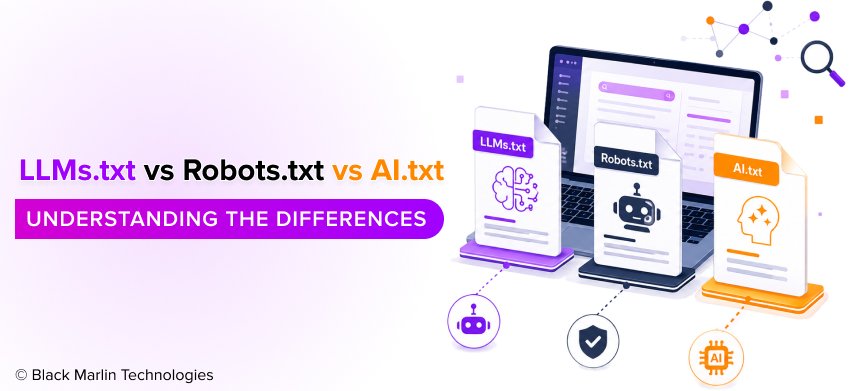
Now that we ve looked at each file individually, it’s easier to see that Robots.txt, AI.txt, and LLMs.txt are made for different aims. Even though people tend to talk about them together in AI SEO talks, in practice they are solving different problems.
- Robots.txt focuses on crawler access and website management.
- AI.txt focuses on content permissions and AI usage policies.
- LLMs.txt focuses on helping AI systems understand website content and expertise.
Instead of just replacing each other, these files can work together, as part of a more modern AI Search Optimization strategy.
Comparison Table
| Feature | Robots.txt | AI.txt | LLMs.txt |
| Controls Crawlers | Yes | Yes | No |
| Controls AI Usage | No | Yes | Partial |
| Helps AI Understand Content | No | No | Yes |
| Improves AI Citations | No | Limited | Yes |
| Supports GEO | No | Partial | Strong |
| Search Engine Focus | Yes | No | No |
| AI Search Focus | Low | Medium | High |
How AI Search Engines Use These Files?
Not all AI search platforms interact with websites in the same way. Traditional search engines mainly push crawling and indexing pages, but modern AI systems also need to grasp the content, assess authority, and then craft accurate answers.
This is why files like Robots.txt, AI.txt, and LLMs.txt are getting more attention lately. Various AI companies run distinct crawlers and retrieval systems, so how your website talks to AI platforms might be different.
Let’s look at how some of the most popular AI search tools may interact with website content.
- ChatGPT: OpenAI uses several systems to discover and retrieve information from the web.
- GPTBot: GPTBot is OpenAI’s web crawler , and well… it can be allowed or restricted by site owners through Robots.txt rules. GPTBot might be used for collecting publicly available information, this can help improve AI systems and the related services.
Search Retrieval Systems
ChatGPT can also work with retrieval based search systems, to pull in fresher information from the web when it is making answers. In these situations the platform tends to hunt down relevant and trustworthy content.
How the files may help:
-
- Robots.txt can control GPTBot access.
- AI.txt may communicate content usage preferences.
- LLMs.txt can help AI systems better understand important website content and resources.
- Claude: Developed by Anthropic, Claude uses its own web crawler known as ClaudeBot.
- ClaudeBot: ClaudeBot helps discover publicly available web content that may be used to improve content understanding and retrieval systems.
Website owners can typically manage ClaudeBot access through Robots.txt directives.
How the files may help:
-
- Robots.txt controls crawler access.
- AI.txt may provide content usage guidance.
- LLMs.txt can offer structured information about website expertise and important resources.
- Perplexity: Perplexity has become one of the fastest-growing AI search platforms because it combines AI-generated answers with source citations.
- PerplexityBot: PerplexityBot crawls and retrieves web content to support answer generation and source attribution.
How the files may help:
-
- Robots.txt helps manage crawler access.
- AI.txt can communicate content permissions.
- LLMs.txt may improve content discovery and understanding, potentially increasing citation opportunities.
- Gemini: Google’s AI ecosystem includes Gemini and several AI-powered search experiences.
- Google-Extended: Google introduced Google Extended, which helps site operators deciding if their content can be used for certain AI adjacent purposes.
How the files may help:
-
- Robots.txt continues to support traditional crawling and indexing.
- AI.txt aligns closely with content usage and permission concepts.
LLMs.txt may help organize information for AI understanding, although Google’s primary focus remains on high-quality content, structured data, and strong E-E-A-T signals.
Which File Matters Most for AI Visibility?
After comparing LLMs.txt vs Robots.txt vs AI.txt, one question remains:
Which file is the most important?
The answer depends on your goal. Each file serves a different purpose, and no single file can handle every aspect of traditional SEO and AI search optimization.
If your objective is better Google rankings, content governance, or visibility in AI-generated answers, the file that matters most will vary.
Let’s break it down.
The Real Winner: A Combined Strategy
While it’s tempting to choose a single winner, the reality is that these files work best together.
| Goal | Most Important File |
| Google Rankings | Robots.txt |
| Crawl Management | Robots.txt |
| AI Content Permissions | AI.txt |
| Content Licensing | AI.txt |
| AI Understanding | LLMs.txt |
| ChatGPT Visibility | LLMs.txt |
| GEO Strategy | LLMs.txt |
The most effective websites will not rely on just one file. Instead, they will combine traditional SEO best practices with emerging AI search optimization techniques.
The Rise of Generative Engine Optimization (GEO)
Search is moving a lot faster than ever before. For years, companies tried to tune up their websites for standard search engines like Google and Bing. But now AI powered tools, for example ChatGPT , Gemini, Claude, and Perplexity, are changing how people find information online.
Instead of clicking through a bunch of search results, users can now get direct answers from AI assistants in just a few seconds. This change is basically birthing a new optimization discipline called Generative Engine Optimization (GEO).
To understand GEO, it helps to look at how search optimization has evolved over time.
The Evolution of Search Optimization
Traditional SEO
Goal: Rank on Google
Traditional Search Engine Optimization basically aims to push a website’s visibility in the search engine results pages (SERPs).
Success is typically measured by:
- Higher keyword rankings
- Increased organic traffic
- More clicks from search results
- Better website engagement
For years, the primary objective was simple: get your website onto the first page of Google.
AEO (Answer Engine Optimization)
Goal: Answer Questions
As search engines became more sophisticated, they started prioritizing direct answers.
This led to the rise of Answer Engine Optimization (AEO), where businesses optimized content to appear in:
- Featured snippets
- People Also Ask sections
- Voice search results
- Knowledge panels
- AI Overviews
The focus shifted from simply ranking pages to providing clear and concise answers to user questions.
GEO (Generative Engine Optimization)
Goal: Become the Source AI Uses
Generative Engine Optimization takes things one step further.
Instead of trying to rank some webpage, or win a featured snippet GEO focuses on making your content the source that AI assistants reference when they generate answers.
The objective is no longer just:
“How do I rank?”
The new question is:
“How do I become the trusted source AI systems choose?”
This is especially important as AI assistants increasingly influence purchasing decisions, brand discovery, and information research.
How LLMs.txt Supports GEO Strategies?
As Generative Engine Optimization (GEO) keeps getting more important, businesses are looking for ways to make their content more accessible and easier to read for AI systems. This is where LLMs.txt can play a valuable role.
Unlike Robots.txt, which leans on crawler access or AI.txt which is about content permissions, LLMs.txt is setup to help AI systems quickly get the gist of a website’s most important information.
Think of LLMs.txt as a bit of a roadmap for AI assistants, it points to the key pages and some important resources, plus the core expertise areas too. This helps it be easier for AI models to find their way around and interpret what’s on the website content.
While a LLMs.txt file on its own won’t exactly promise visibility in AI generated responses, it can still aid wider AI Search Optimization, ChatGPT SEO, and GEO efforts.
Better Content Discovery
Large websites often contain hundreds or even thousands of pages. AI systems may not always identify the most valuable resources immediately.
LLMs.txt can help by directing AI models toward:
- Core service pages
- High-value blog content
- Resource hubs
- Product information
- Industry guides
By highlighting important content, businesses can make it easier for AI systems to discover pages that demonstrate expertise and authority.
Easier Source Attribution
One of the biggest challenges in AI search is ensuring that original content creators receive proper recognition.
When AI systems can clearly identify the essential resources and content groupings, source attribution becomes way easier. With well organized information, the AI platform can understand where specific information originated.
As AI searching evolves, source attribution going to be more and more important for publishers, brands, and content creators.
Stronger Brand Mentions
AI assistants frequently reference brands when answering user questions.
For example, if a company consistently publishes content around topics such as:
- SEO
- AI SEO
- GEO
- Content Marketing
AI systems can begin associating that brand with those subject areas.
LLMs txt can help reinforce these relationships by clearly communicating a website’s expertise, services, and key resources, so readers see the value faster . That in turn can build stronger brand recognition across AI generated answers.
Improved AI Understanding
AI systems work best when content is organized and easy to interpret.
A well-structured LLMs.txt file helps AI models understand:
- What the business does
- Which topics the website covers
- Important products or services
- Core areas of expertise
- Relationships between content categories
This additional context can help AI systems build a more accurate understanding of a website and its authority within a particular niche.
Increased Citation Opportunities
One of the primary goals of GEO is to become a source that AI assistants trust and reference.
Websites that provide:
- High-quality content
- Strong E-E-A-T signals
- Clear topical authority
- Well-organized information
are often in a stronger position to earn citations and references within AI-generated answers.
By helping AI systems locate and understand important resources, LLMs.txt may improve the likelihood that valuable content is considered during answer generation.
Should Every Website Create an LLMs.txt File?
As discussions around LLMs.txt, AI Search Optimization, and Generative Engine Optimization (GEO) continue to grow, many website owners are asking the same question:
Does every website need an LLMs.txt file?
The short answer is not necessarily.
While LLMs.txt can help AI systems understand website content more efficiently, its value depends on how big your site is, how much content you publish, and what your aims are for AI search visibility.
For some businesses, adding an LLMs.txt file might provide real advantages, but for other companies it may not be a pressing concern right now.
Good Candidates for LLMs.txt
Websites with a lot of content, multiple topic areas or strong AI visibility goals are likely to benefit the most.
SaaS Companies
Software companies often publish:
- Product pages
- Feature documentation
- Knowledge bases
- Tutorials
- Industry guides
An LLMs.txt file can help AI systems quickly identify important resources and understand the company’s expertise.
Marketing Agencies
Agencies frequently create content around:
- SEO
- PPC
- Social Media Marketing
- Web Development
- AI Search Optimization
LLMs.txt can help organize these resources and strengthen topical authority signals for AI assistants.
Publishers and Media Websites
News websites, blogs, and online publishers often manage thousands of articles across multiple categories.
LLMs.txt can help AI systems identify:
- Core topics
- Authoritative resources
- Editorial content hubs
- High-value evergreen content
This may improve content discovery and citation opportunities.
Ecommerce Brands
Large ecommerce websites often contain:
- Product pages
- Buying guides
- Category pages
- FAQs
- Resource centers
LLMs.txt can help AI systems understand product categories, brand expertise, and informational content that supports customer decisions.
Educational Websites
Educational platforms, training providers, universities, and online learning websites typically have extensive content libraries.
Because AI systems frequently answer educational and informational questions, these websites may benefit from making their content easier to discover and understand.
Lower Priority Websites
Not every website needs to rush into implementing LLMs.txt.
For some businesses, other SEO and GEO initiatives may provide greater value first.
Small Brochure Websites
A simple website with:
- 5–10 pages
- Basic company information
- Limited content
may not gain significant benefits from LLMs.txt.
In these cases, focusing on:
- Technical SEO
- Local SEO
- Structured data
- E-E-A-T signals
is usually a higher priority.
Single-Page Websites
Single-page websites already present all information in one location.
Since AI systems can easily understand the available content, an additional LLMs.txt file may offer limited value.
AI Search Optimization Checklist for 2026
As AI powered search keeps shifting, businesses really cannot lean on usual SEO plays only, not anymore. Sure, showing up strong in Google still matters, but the reach you get through places like ChatGPT, Gemini, Claude, and Perplexity is turning more and more valuable.
The good news is that a lot of the foundations of traditional SEO still really matter. But if you want to do successful AI Search Optimization, ChatGPT SEO, and also Generative Engine Optimization (GEO), you usually need a wider playbook, one that blends technical SEO, strong content quality, reputation building, and AI-friendly website structures.
Use this checklist to prepare your website for the future of search.
Technical SEO Foundation
Before you put attention on AI visibility, make sure your website does the technical SEO stuff right, like it should. AI systems often lean on the very same signals that search engines use to discover content.
1. Robots.txt: A properly configured Robots.txt file helps search engines and approved AI crawlers access important website content while restricting unnecessary or sensitive sections.
Best Practice:
- Avoid blocking valuable content.
- Review crawler permissions regularly.
- Ensure important pages remain crawlable.
2. XML Sitemap: An XML sitemap helps search engines discover and index your most important pages more efficiently.
Best Practice:
- Include all key pages.
- Remove outdated URLs.
- Update automatically as content grows.
3. Schema Markup: Structured data helps search engines and AI systems better understand the meaning and context of your content.
Common schema types include:
- Organization
- Article
- FAQ
- Product
- Local Business
- Review
Best Practice:
Implement schema wherever possible to improve content understanding.
4. Fast Website: Website speed impacts both user experience and search visibility.
Studies consistently show that users are more likely to leave slow-loading websites, reducing engagement and conversion opportunities.
Best Practice:
- Optimize images.
- Minify code.
- Use caching.
- Improve Core Web Vitals.
5. Mobile-Friendly Design: With most web traffic now coming from mobile devices, responsive design is essential.
AI systems and search engines prioritize websites that provide a strong user experience across all devices.
Best Practice:
Ensure your website is fully responsive and easy to navigate on smartphones and tablets.
AI Optimization Checklist
Technical SEO helps search engines find your content. AI optimization helps AI systems understand, trust, and potentially reference it.
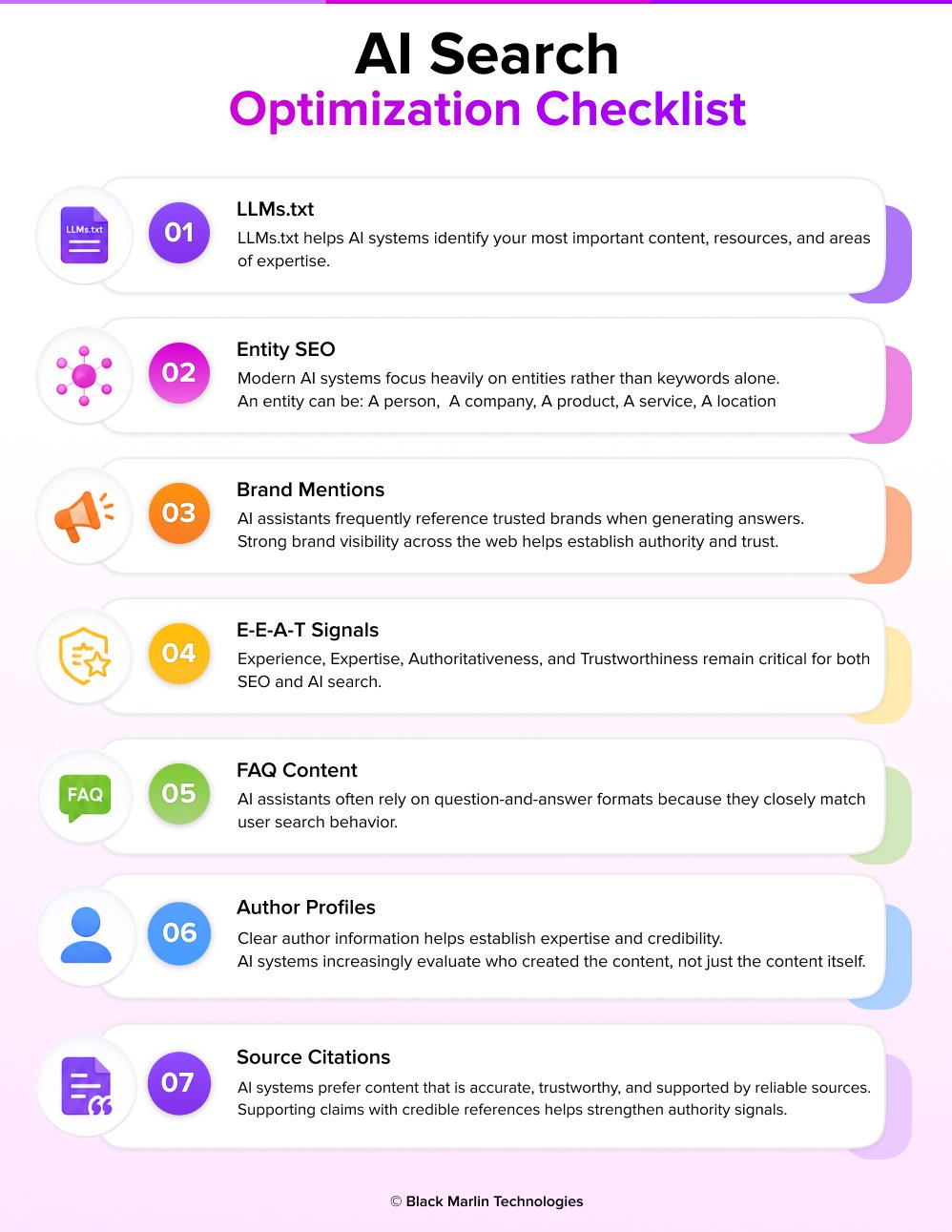 1. LLMs.txt
LLMs.txt helps AI systems identify your most important content, resources, and areas of expertise.
For content-rich websites, it can improve content discovery and support broader GEO strategies.
Best Practice:
Highlight:
- Key service pages
- Resource hubs
- Educational content
- Topic clusters
2. Entity SEO
Modern AI systems focus heavily on entities rather than keywords alone.
An entity can be:
- A person
- A company
- A product
- A service
- A location
The clearer your entity relationships, the easier it is for AI systems to understand your expertise.
Best Practice:
Build content around clearly defined topics and related entities.
3. Brand Mentions
AI assistants frequently reference trusted brands when generating answers.
Strong brand visibility across the web helps establish authority and trust.
Best Practice:
Increase mentions through:
- Digital PR
- Guest posting
- Industry publications
- Podcasts
- Expert contributions
4. E-E-A-T Signals
Experience, Expertise, Authoritativeness, and Trustworthiness remain critical for both SEO and AI search.
Websites that demonstrate credibility are more likely to be trusted by search engines and AI systems.
Best Practice:
Include:
- Expert authors
- Real-world experience
- Accurate information
- Transparent business details
5. FAQ Content
AI assistants often rely on question-and-answer formats because they closely match user search behavior.
Well-structured FAQ content can improve discoverability and increase the chances of being referenced in AI-generated responses.
Best Practice:
Answer real customer questions using simple, direct language.
6. Author Profiles
Clear author information helps establish expertise and credibility.
AI systems increasingly evaluate who created the content, not just the content itself.
Best Practice:
Include:
- Author bios
- Professional credentials
- Industry experience
- Social profiles when relevant
7. Source Citations
AI systems prefer content that is accurate, trustworthy, and supported by reliable sources.
Supporting claims with credible references helps strengthen authority signals.
Best Practice:
Cite:
- Industry studies
- Government sources
- Research reports
- Trusted publications
Common Mistakes Businesses Make
As AI search keeps evolving, a lot of businesses are rushing to adopt fresh approaches like LLMs.txt, AI Search Optimization, and Generative Engine Optimization (GEO). Even if trying out new tech is important, many website owners end up making small missteps that can quietly cap their visibility in traditional search engines, and also in AI powered platforms.
Getting a grasp on these everyday errors can help you avoid expensive SEO complications, and make a steadier groundwork for what’s next in AI search success.
Blocking AI Crawlers Accidentally
One of the most common mistakes is unintentionally blocking AI crawlers through Robots.txt or other access restrictions.
Many website owners block bots without realizing that some AI systems use specific crawlers such as:
- GPTBot
- ClaudeBot
- PerplexityBot
- Google-Extended
While some businesses intentionally restrict AI access, others accidentally prevent AI systems from discovering valuable content.
This can reduce opportunities for:
- AI search visibility
- Content discovery
- Brand mentions
- Potential citations
Thinking Robots.txt Controls AI Understanding
Another common misconception is that Robots.txt helps AI systems understand website content.
It doesn’t.
Robots.txt is designed to control crawler access. It can tell bots where they can go, but it cannot explain:
- What your business does
- Which pages are most important
- Your areas of expertise
- Relationships between topics
Many web site owners assume that since AI systems can access their content, they automatically understand it. But really, AI platforms lean on content structure, named entities, topical authority, and contextual signals.
Ignoring Brand Mentions
Traditional SEO has usually focused really a lot on backlinks. While backlinks stay valuable, AI search systems also take note of brand mentions and authority signals across the web.
If your brand is mentioned very rarely anywhere beyond your own website, AI systems can end up with fewer signals to link your business to particular topics or industries.
Strong brand mentions can come from:
- Industry publications
- News websites
- Guest articles
- Podcasts
- Interviews
- Expert contributions
The more frequently a brand is associated with a topic, the easier it becomes for AI systems to recognize that expertise.
No Structured Data
Many businesses still overlook structured data, even though it plays a critical role in helping search engines and AI systems understand content.
Without schema markup, AI platforms may have to work harder to interpret information about:
- Products
- Services
- Organizations
- Reviews
- FAQs
- Authors
Structured data provides additional context that improves content interpretation and supports better search visibility.
Not Building Topical Authority
Perhaps the biggest mistake businesses make is focusing on isolated keywords instead of building topical authority.
AI systems increasingly evaluate expertise at the topic level rather than individual pages.
For example, publishing one article about AI SEO is unlikely to establish authority. Publishing a complete content cluster around:
- AI SEO
- ChatGPT SEO
- GEO
- AI Search Optimization
- LLMs.txt
- Entity SEO
creates a much stronger signal of expertise.
Websites that consistently cover related topics are more likely to be viewed as trusted resources by both search engines and AI assistants.
Future of AI Search: What Happens Next?
The search industry is moving into one of its biggest transformations since the launch of Google, and it is kind of hard to notice at first. For more than two decades, people looked for information by typing keywords, then clicking website links. Now, AI powered platforms are shifting the whole experience in a different way, by delivering direct answers, offering recommendations, and even wrapping up tasks for users.
As technologies such as ChatGPT,Gemini, Claude and Perplexity keep evolving, the future of search probably is going to appear quite unlike what we know today.
For businesses, this means preparing not only for search engines but also for AI assistants and intelligent agents.
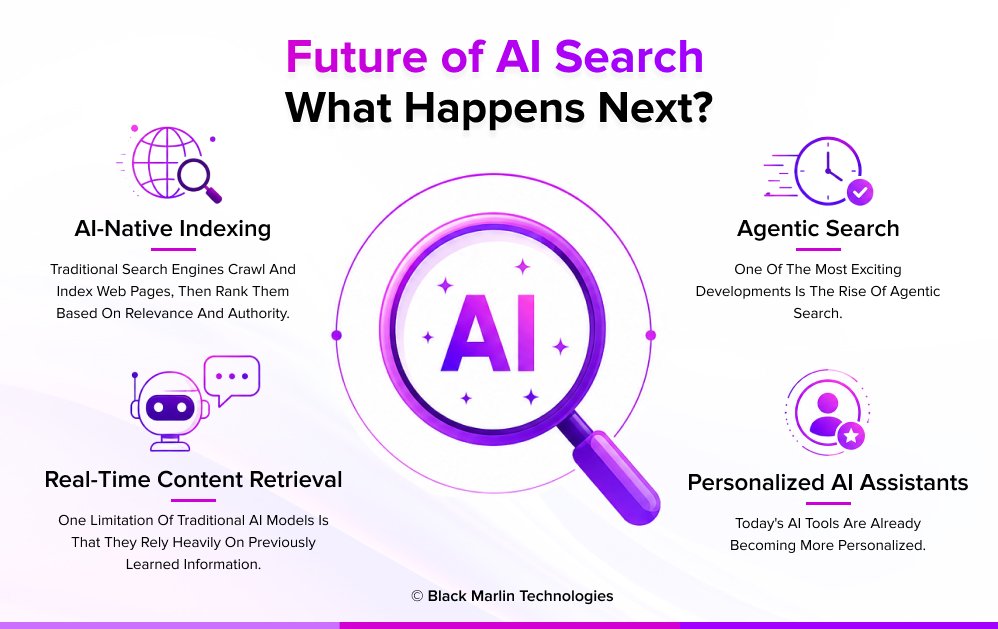
AI-Native Indexing
Traditional search engines crawl and index web pages, then rank them based on relevance and authority.
Future AI systems may move toward AI-native indexing, where content is analyzed, organized, and understood specifically for AI-generated responses rather than traditional search rankings.
Instead of asking:
“Which webpage should rank first?”
AI systems may increasingly ask:
“Which source provides the most trustworthy and complete answer?”
This shift places greater importance on:
- Content quality
- Entity relationships
- Topic expertise
- Source credibility
- Structured information
Websites that clearly demonstrate expertise and authority are likely to have an advantage in AI-driven search experiences.
Real-Time Content Retrieval
One limitation of traditional AI models is that they rely heavily on previously learned information.
However, modern AI platforms are increasingly combining language models with real-time content retrieval systems.
This allows AI assistants to:
- Access fresh information
- Verify facts
- Retrieve current data
- Reference recent content
As this trend grows, websites that regularly publish accurate and up-to-date content may become more valuable sources for AI-generated answers.
For businesses, this means content freshness could become even more important than it is today.
Agentic Search
One of the most exciting developments is the rise of Agentic Search.
Instead of simply answering questions, AI agents will increasingly perform actions on behalf of users.
For example, future AI systems may:
- Compare products
- Book appointments
- Research vendors
- Schedule meetings
- Plan trips
- Generate reports
- Complete online purchases
In this environment, businesses will need content and website structures that are not only understandable to humans but also actionable for AI agents.
This could fundamentally change how customers discover and interact with brands online.
Personalized AI Assistants
Today’s AI tools are already becoming more personalized.
Future AI assistants may understand:
- User preferences
- Search history
- Purchase behavior
- Business needs
- Industry interests
Instead of showing the same results to everyone, AI assistants could generate highly personalized recommendations for each individual user.
This means businesses will need to build stronger authority and trust signals so they can be recommended across a variety of user contexts.
What Will Websites Optimize for by 2027?
For years, SEO focused primarily on search engines.
In the future, optimization may expand far beyond traditional search.
By 2027, many businesses may need to optimize simultaneously for:
Search Engines
Google, Bing, and other search engines will continue to drive significant traffic and visibility.
Traditional SEO fundamentals such as:
- Technical SEO
- Content quality
- Backlinks
- User experience
will remain important.
AI Assistants
Platforms such as ChatGPT, Gemini, Claude, and Perplexity are already influencing how users discover brands and information.
Businesses will increasingly focus on:
- AI Search Optimization
- GEO
- Entity SEO
- Brand authority
- AI citations
Autonomous Agents
Future AI agents may make decisions and complete tasks on behalf of users.
Websites that provide clear information, structured content, and trusted signals may have a greater chance of being selected by these systems.
Conclusion:
The ascent of AI powered search is changing how websites are found, grasped, and suggested online. As platforms like ChatGPT , Gemini, Claude, and Perplexity keep reshaping user behavior, businesses should consider more than just traditional SEO. They also need to prep for what is coming with AI driven search.
When comparing LLMs.txt vs Robots.txt vs AI.txt, it is important to remember that each file serves a different purpose.
- Robots.txt controls crawler access and helps search engines discover content efficiently.
- AI.txt focuses on content permissions and communicates how AI systems can use website content.
- LLMs.txt helps AI models understand website structure, expertise, and important resources.
Rather than competing with one another, these files complement each other.
A common mistake is thinking that one file can solve every task related to SEO AI visibility, and content governance. In realty none of these files replaces the other ones. Each has its own part to play, helping websites speak with search engines and AI systems.
As AI Search Optimization, ChatGPT SEO, and Generative Engine Optimization (GEO) continue to evolve, businesses should focus on creating an AI-ready website built on:
- Strong technical SEO foundations
- High-quality, helpful content
- Clear site architecture
- Structured data
- E-E-A-T signals
- Brand authority
- Topical expertise
Files such as Robots.txt, AI.txt, and LLMs.txt can support these efforts, but they are only part of the bigger picture.
Frequently Asked Questions (FAQs)
Q1. What is LLMs.txt?
Ans1. – LLMs.txt is a file designed to help AI models like ChatGPT, Gemini, and Claude understand a website’s most important content, services, and resources. Think of it as a guide that helps AI systems quickly identify what your website is about.
Q2. How is LLMs.txt different from Robots.txt?
Ans2. – Robots.txt controls whether crawlers can access specific pages on a website. LLMs.txt does not control access; instead, it helps AI systems understand content, expertise, and important website sections.
Q3. Does LLMs.txt improve ChatGPT rankings?
Ans3. – LLMs.txt is not a confirmed ranking factor. However, it may help AI systems better understand your content, which could support AI visibility and citation opportunities.
Q4. What is AI.txt used for?
Ans4. – AI.txt is used to communicate content usage preferences to AI systems. It may specify whether content can be used for AI training, summarization, or citations.
Q5. Should every website have an LLMs.txt file?
Ans5. – Not necessarily. Websites with extensive content, educational resources, blogs, or multiple service pages are more likely to benefit than small brochure-style websites.
Q6. Does Google use LLMs.txt?
Ans6. – Google has not officially confirmed that it uses LLMs.txt. However, Google continues to prioritize high-quality content, structured data, and E-E-A-T signals.
Q7. Can AI.txt block AI training?
Ans7. – The goal of AI.txt is to communicate content usage preferences, including AI training restrictions. Whether those instructions are followed depends on the AI platform.
Q8. Is LLMs.txt a ranking factor?
Ans8. – No, LLMs.txt is not currently a direct ranking factor for Google or AI search platforms. Its main purpose is to improve content understanding.
Q9. How do AI crawlers read websites?
Ans9. – AI crawlers access public web pages, XML sitemaps, structured data, and other website signals. They analyze content, entities, and relationships to understand information.
Q10. What is GEO in SEO?
Ans10. – GEO stands for Generative Engine Optimization. It focuses on helping websites become trusted sources for AI-generated answers rather than just ranking in search engines.
Q11. Can ChatGPT crawl websites directly?
Ans11. – ChatGPT can access web content through retrieval systems and technologies such as GPTBot. Website owners can manage crawler access through Robots.txt.
Q12. Which file is most important for AI search?
Ans12. – Each file serves a different purpose. Robots.txt controls access, AI.txt manages permissions, and LLMs.txt helps AI systems understand website content.
Q13. How do I create an LLMs.txt file?
Ans13. – You can create a simple text file that lists your company’s services, important pages, resource hubs, guides, and areas of expertise to help AI systems understand your website.
Q14. Does Robots.txt affect AI search visibility?
Ans14. – Yes. If AI crawlers are blocked through Robots.txt, they may not be able to access and analyze your content, which could reduce AI visibility.
Q15. What is the future of AI SEO?
Ans15. – The future of AI SEO will focus on GEO, entity SEO, E-E-A-T, structured content, brand authority, and making content easy for both search engines and AI assistants to understand.