'>
<rect width='100' height='100' fill='%23B22234'/>
<!-- stripes -->
<g fill='%23fff'>
<rect y='10' width='100' height='10'/>
<rect y='30' width='100' height='10'/>
<rect y='50' width='100' height='10'/>
<rect y='70' width='100' height='10'/>
<rect y='90' width='100' height='10'/>
</g>
<!-- blue box -->
<rect width='50' height='50' fill='%233C3B6E'/>
</g>
</svg>)
'>
<rect width='100' height='100' fill='%23fff'/>
<rect width='100' height='33.33' y='0' fill='%23FF9933'/>
<rect width='100' height='33.33' y='66.66' fill='%23138808'/>
<!-- Ashoka Chakra -->
<circle cx='50' cy='50' r='9' fill='none' stroke='%23000080' stroke-width='2'/>
<g stroke='%23000080' stroke-width='1'>
<line x1='50' y1='41' x2='50' y2='59'/>
<line x1='41' y1='50' x2='59' y2='50'/>
<line x1='44' y1='44' x2='56' y2='56'/>
<line x1='56' y1='44' x2='44' y2='56'/>
</g>
</g>
</svg>)
 info@blackmarlintechnologies.com

Running an ecommerce business right now is more challenging than ever. Thousands of online stores compete for customer attention , which makes it harder to stand out, pull in buyers, and lift sales. At the same time, customers want shopping experiences that are tailored to them , they also expect immediate support, quick shipping, and suggestions that match what they’re actually looking for. Trying to manage all of that by hand can become time consuming, and it is also expensive in a way that adds up.
According to industry reports, companies using AI based personalization can raise their revenue by as much as 15% while automation can lower their day to day operational costs by up to 30%. Those figures show why more brands are putting money into AI ecommerce automation, so they can remain competitive and grow faster .
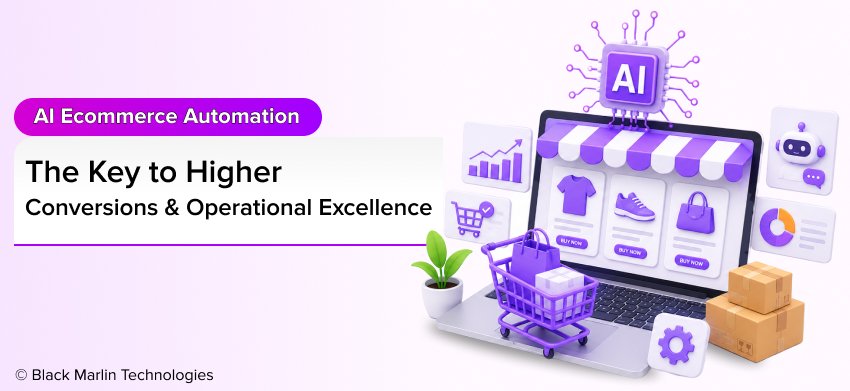 Many ecommerce businesses still lean on manual routines for things like inventory oversight, customer support, email campaigning, and order handling. At the beginning this can work just fine, but later it becomes a bit hard to manage, especially as the company expands. Team members end up spending precious minutes on the same repetitive work, small errors become more frequent, and chances to connect with customers in a timely way are missed.
This is where AI automation for ecommerce really makes a significant difference. By using artificial intelligence, and smart workflows it helps businesses automate everyday operations, deliver tailored shopping experiences, and take data guided decisions in real time. Instead of spending hours managing repetitive chores, teams can focus on strategy, innovation, and customer relationships.
From AI-enabled product suggestions and conversational agents to future minded inventory forecasting and automatic promo outreach, Ecommerce automation lets companies work smarter, not harder. The outcome is more consistent conversion rates, stronger day to day operations, smoother customer experiences, and steady, sustainable business growth.
In this guide we ll look at how AI ecommerce automation runs, what good it brings, and which practical approaches businesses can use best to boost sales, reduce friction in everyday operations, and deliver outstanding customer experiences.
- What Is AI Ecommerce Automation?
- Why AI Automation Matters for Modern Ecommerce Businesses?
- AI Ecommerce Automation Statistics You Should Know
- What These Statistics Mean for Ecommerce Businesses?
- 8 Powerful Ways AI Automation Increases Ecommerce Conversions
- 1. Personalized Product Recommendations
- 2. AI-Powered Search Functionality
- 3. Smart Chatbots and Virtual Assistants
- 4. Automated Cart Recovery
- 5. Dynamic Pricing Optimization
- 6. Predictive Customer Behavior Analysis
- 7. AI Email Marketing Automation
- 8. AI-Driven Customer Segmentation
- How AI Automation Improves Ecommerce Operations?
- Inventory Management Automation
- Order Processing Automation
- Supply Chain Optimization
- Fraud Detection and Security
- How AI Enhances Ecommerce Customer Experience?
- Personalized Shopping Journeys
- Faster Customer Support
- Omnichannel Customer Engagement
- Top AI Tools for Ecommerce Automation in 2026
- AI Ecommerce Automation ROI Calculator Framework
- 5 Step-by-Step AI Ecommerce Automation Implementation Plan
- Step 1: Audit Your Current Processes
- Step 2: Set Clear Business Goals
- Step 3: Choose the Right AI Tools
- Step 4: Integrate and Test
- Step 5: Measure Results and Optimize
- Key Ecommerce Automation Metrics to Track
- Common AI Ecommerce Automation Mistakes to Avoid
- 1. Using Too Many AI Tools at Once
- 2. Ignoring Data Quality
- 3. Over-Automating Customer Interactions
- 4. Failing to Measure ROI
- Future Trends of AI Ecommerce Automation
- Generative AI Shopping Assistants
- Hyper-Personalization
- Predictive Commerce
- Voice Commerce
- Autonomous Inventory Management
- AI-Powered Visual Search
- Conclusion
- FAQ
What Is AI Ecommerce Automation?
Imagine running an online store where product suggestions pop in automatically, client questions are answered instantly, the stock counts shift in real time, and promo emails go out right on schedule. That is the clout of AI ecommerce automation.
In simple terms, AI ecommerce automation is the use of artificial intelligence and smart software to manage repeat work without needing constant human attention. Rather than manually dealing with every piece of an ecommerce business, AI reviews data, picks up patterns from customer behavior and then makes decisions automatically. It helps companies save time, lower mistakes, and create more satisfying shopping experiences.
Modern AI automation for ecommerce can help in a bunch of different spots inside an online store. Like, an AI system can suggest products based on what a customer was viewing before, power chatbots that answer questions 24/7, and even forecast future stock needs so the shelves stay full. It can also run automated email campaigns, plus fine tune pricing depending on real time market demand. These automated steps let businesses move more efficiently while raising customer satisfaction.
Some common examples of ecommerce automation include:
- Product recommendations based on customer interests
- AI chatbots that provide instant customer support
- Inventory forecasting to prevent stock shortages
- Automated email marketing campaigns
- Dynamic pricing that responds to market trends
At its core, Ecommerce automation follows a simple process:
Input Data → AI Analysis → Automated Action → Better Results
For example, when a customer visits an online store, AI gathers browsing data, assesses preferences, and suggests fitting products, which in turn boosts the chance of a purchase. All of this unfolds within seconds, making the entire shopping run smoother, while also aiding the business in producing more sales.
Since e-commerce keeps growing, AI driven automation is turning into a crucial thing for companies who want to boost conversions, raise day to day efficiency, and serve more tailored experiences at scale.
Why AI Automation Matters for Modern Ecommerce Businesses?
The ecommerce industry is growing fast, yet so is the rivalry. Every day, new online storefronts pop up in the market, and it gets harder for businesses to bring in customers, and keep steady expansion. Buyers now want rapid help, personalized suggestions, a smooth checkout journey, and immediate replies when they ask something. Trying to meet all that manually can feel unmanageable, especially once an ecommerce business starts scaling up.
Many online stores struggle with challenges that directly impact sales, customer satisfaction, and profitability. Tasks such as managing inventory, responding to customer inquiries, recovering abandoned carts, and running marketing campaigns require significant time and resources. Without the right technology, these processes can become inefficient and costly.
This is where AI eCommerce automation becomes a real game changer, because it can automate those repetitive tasks, and then use data driven insights which helps businesses run smoother. You end up with better efficiency, improved customer experiences and more sensible decisions, even if things get busy. Instead of just reacting when a problem already happened, AI helps ecommerce brands anticipate upcoming trends, tune daily operations, and lift conversion rates.
AI Ecommerce Automation Statistics You Should Know
Numbers usually tell the story better than words. Once more companies put money into AI ecommerce automation, industry research keeps reporting measurable wins in sales, efficiency, and customer experience. Those figures show why AI is quickly getting to be one of the most valuable instruments for everyday ecommerce businesses.
Whether it’s delivering personalized shopping experiences, automating customer support, or improving inventory planning, AI helps businesses make smarter decisions and achieve better results. The following metrics demonstrate the real-world impact of AI automation for ecommerce and why companies of all sizes are adopting these technologies.
Key AI Ecommerce Automation Metrics
| Metric | Impact |
| Personalized Product Recommendations | Up to 30% higher conversion rates |
| AI Chatbots | 24/7 customer support availability |
| Inventory Automation | Up to 50% improvement in forecasting accuracy |
| Email Marketing Automation | Higher open rates and increased conversions |
| Customer Segmentation | Better marketing ROI and audience targeting |
These numbers show how ecommerce automation can help in nearly every stage of the client journey, honestly it feels pretty broad. For example, personalized product suggestions help shoppers stumble upon items they are more likely to buy, which raises both conversion rates and the average order total. Meanwhile, AI chatbots give immediate answers to customer questions, so companies can offer help 24/7 without raising staffing costs.
Inventory automation is another big perk, honestly. When AI looks at sales trends and seasonal demand ,plus how customers behave, it can estimate next inventory needs more precisely. That helps lower the chance of stock shortages as well as having too much excess inventory. In the end, businesses get smoother operations and better customer satisfaction.
Email automation plus customer segmentation also play a crucial part, in pushing revenue forward. Instead of blasting the same note to every customer, AI can craft personalized outreach using interest signals, what they look at while browsing, and their purchase record.
Result: communication feels more relevant, the bond with customers gets stronger, and marketing returns end up higher.
What These Statistics Mean for Ecommerce Businesses?
The data is clear; businesses that embrace AI can answer quicker, market smarter, and run things more efficiently. With customer expectations still evolving, AI powered solutions add a competitive edge by offering tailored experiences while cutting down on manual workloads
Organizations that invest in AI-driven ecommerce automation today are better set up to lift conversions, enhance day to day operational performance, and gradually form enduring customer loyalty in a more and more competitive digital market place.
Industry Research Sources
Many of these insights are supported by research and industry reports from:
These organizations consistently highlight the growing role of AI in helping ecommerce businesses improve sales performance, streamline operations, and enhance customer experiences.
8 Powerful Ways AI Automation Increases Ecommerce Conversions
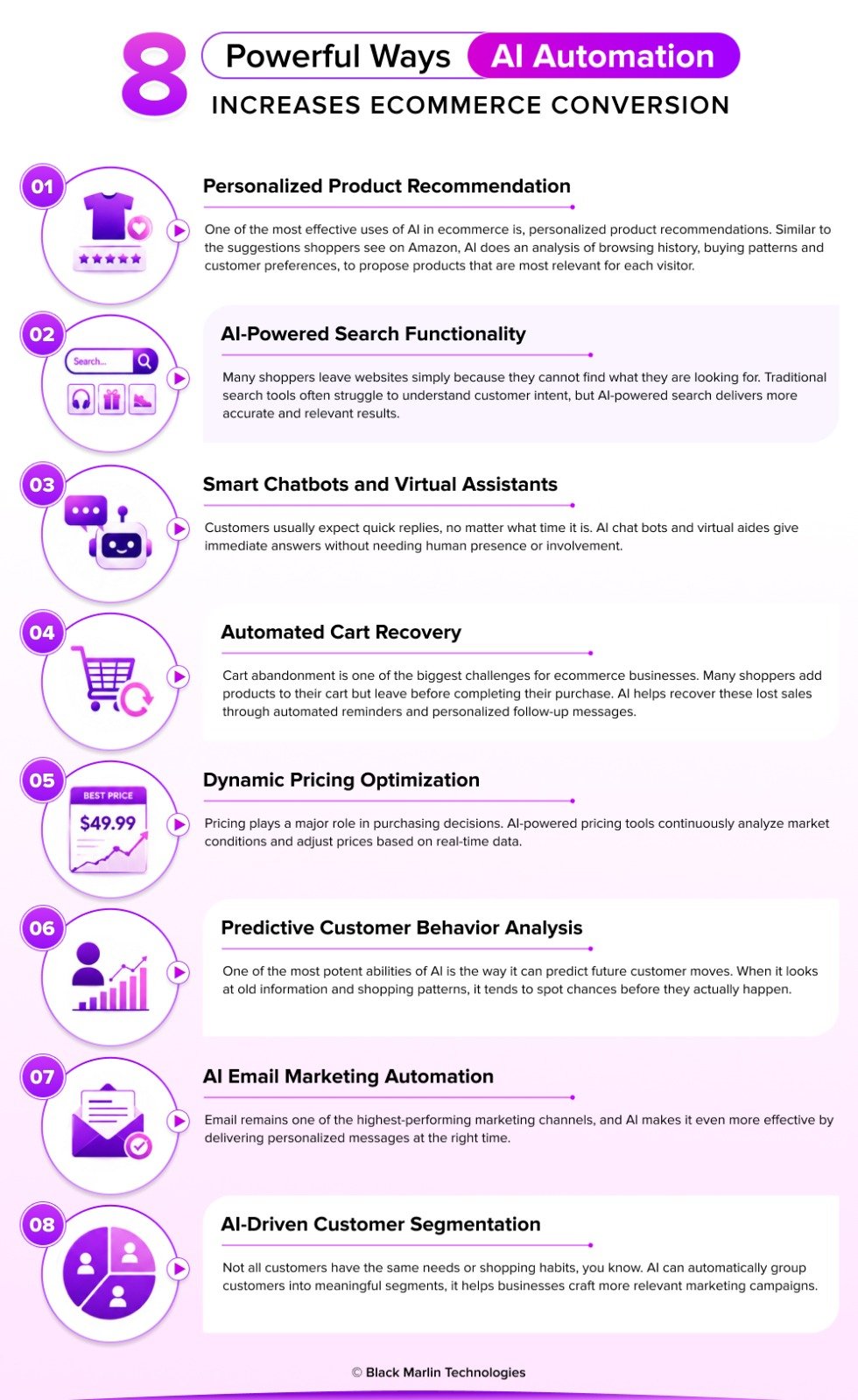
Getting people to your online store is only half the trouble. The bigger challenge is turning those visitors into paying customers and yeah that part matters. This is where AI ecommerce automation brings its most value, because it can read customer behavior and then automate the key steps. In turn it supports businesses in building a smoother shopping experience, which tends to increase purchases, and also helps with better customer satisfaction.
Let’s explore eight powerful ways AI automation for ecommerce can help increase conversions and drive business growth.
1. Personalized Product Recommendations
One of the most effective uses of AI in ecommerce is personalized product recommendations. Similar to the suggestions shoppers see on Amazon, AI does an analysis of browsing history, buying patterns and customer preferences, to propose products that are most relevant for each visitor.
AI also supports:
- Cross-selling related products
- Upselling premium alternatives
- Recommending complementary items
2. AI-Powered Search Functionality
Many shoppers leave websites simply because they cannot find what they are looking for. Traditional search tools often struggle to understand customer intent, but AI-powered search delivers more accurate and relevant results.
Benefits include:
- Better product discovery
- Faster buying decisions
- Improved user experience
- Reduced bounce rates
3. Smart Chatbots and Virtual Assistants
Customers usually expect quick replies, no matter what time it is. AI chat bots and virtual aides give immediate answers without needing human presence or involvement.
They can help with:
- Answering common questions
- Tracking orders
- Recommending products
- Assisting during checkout
4. Automated Cart Recovery
Cart abandonment is one of the biggest challenges for ecommerce businesses. Many shoppers add products to their cart but leave before completing their purchase.
AI helps recover these lost sales through automated reminders and personalized follow-up messages.
Cart Recovery Workflow
Customer Leaves Cart
↓
AI Sends Reminder Email
↓
Personalized Discount Offer
↓
Customer Returns to Store
↓
Purchase Completed
By automatically engaging customers at the right moment, businesses can recover revenue that would otherwise be lost.
5. Dynamic Pricing Optimization
Pricing plays a major role in purchasing decisions. AI-powered pricing tools continuously analyze market conditions and adjust prices based on real-time data.
AI can help with:
- Competitor price monitoring
- Demand forecasting
- Profit optimization
- Seasonal pricing adjustments
6. Predictive Customer Behavior Analysis
One of the most potent abilities of AI is the way it can predict future customer moves. When it looks at old information and shopping patterns, it tends to spot chances before they actually happen.
AI can predict:
- Which visitors are most likely to purchase
- Which customers may stop buying
- Which products customers are most likely to need next
These insights allow businesses to create targeted marketing campaigns that improve conversion rates and customer retention.
7. AI Email Marketing Automation
Email remains one of the highest-performing marketing channels, and AI makes it even more effective by delivering personalized messages at the right time.
Common examples include:
- Welcome email sequences
- Cart abandonment reminders
- Re-engagement campaigns
- Personalized product recommendations
- Exclusive promotional offers
Instead of sending the same email to everyone, AI customizes content based on each customer’s behavior and interests, leading to higher engagement and more conversions.
8. AI-Driven Customer Segmentation
Not all customers have the same needs or shopping habits, you know. AI can automatically group customers into meaningful segments, it helps businesses craft more relevant marketing campaigns.
AI segments customers based on:
- Purchase history
- Product preferences
- Browsing behavior
- Engagement levels
- Demographics
How AI Automation Improves Ecommerce Operations?
While pushing sales is crucial, keeping an ecommerce operation running efficiently is just as important for long-term success. As order volumes climb, the task of handling inventory, processing orders, lining up suppliers, and stopping fraud can become more tangled. When teams rely on manual work, it often causes slowdowns, expensive missteps, and day to day operational inefficiencies.
This is where AI ecommerce automation helps businesses streamline day to day operations, because it keeps things moving even when they are a bit chaotic. When repetitive tasks are automated and real time insights show up fast, AI helps ecommerce brands run smoother, cut down on costs and craft better customer experiences.
Inventory Management Automation
Having to manage inventory by hand can get difficult, particularly when product demand shifts quite often. If you order too much stock, capital gets tied up too quickly, however if you order too little, it may lead to missed sales opportunities and then customers become unhappy.
AI powered stock management helps enterprises make smarter decisions through analyzing sales trends, customer behavior and seasonal demand patterns.
Benefits of Inventory Automation
- Avoid stock shortages and lost sales
- Reduce excess inventory and storage costs
- Improve demand forecasting accuracy
- Optimize purchasing decisions
- Maintain healthy inventory levels
Example
Without AI:
Businesses manually track inventory levels and estimate future demand based on limited information.
With AI:
The system continuously analyzes sales data and automatically predicts future demand, helping businesses maintain the right amount of stock at the right time.
This proactive approach improves efficiency while reducing inventory-related risks.
Order Processing Automation
As ecommerce businesses grow, processing hundreds or thousand orders by hand can get time-consuming, and a bit error prone too. Using AI can help, it automates important order management jobs, making fulfillment faster with better accuracy.
Benefits of Order Processing Automation
- Faster order fulfillment
- Reduced human errors
- Improved workflow efficiency
- Better customer satisfaction
- Lower operational costs
Supply Chain Optimization
A sturdy supply chain is essential for ecommerce wins. When suppliers stall, demand is planned wrongly, or the shipping routes are inefficient, everything gets slowed down and then customer satisfaction slips, and profitability too.
AI helps businesses optimize their supply chains by providing data-driven insights and predictive analytics.
AI Can Help Businesses:
- Predict future product demand
- Monitor supplier performance
- Identify potential disruptions
- Optimize shipping and delivery routes
- Improve warehouse efficiency
Fraud Detection and Security
Online stores handle huge quantities of orders every single day, so security is a top priority, for sure. Fraudulent requests, pilfered card information, and chargeback disputes can cause serious financial setbacks.
AI-powered fraud detection systems continuously monitor transactions and identify suspicious activity in real time.
Benefits of AI Fraud Detection
- Real-time transaction monitoring
- Reduced chargebacks and fraud losses
- Faster threat identification
- Improved customer trust
- Safer online transactions
How AI Enhances Ecommerce Customer Experience?
In today’s competitive ecommerce landscape, customer experience can make the difference between a one-time visitor and a loyal customer. Nowadays shoppers expect personalized suggestions, immediate help, and steady interactions across various touch points, and if an online store messes this up even slightly customers can easily jump ship to a competitor.
This is where AI powered ecommerce automation plays a vital role. By looking at customer behavior and automating personalized interactions, AI helps businesses create seamless shopping experiences that boost satisfaction, build trust, and drive repeat purchases.
Personalized Shopping Journeys
Every customer is unique, and AI helps businesses deliver experiences tailored to individual preferences. Instead of showing the same content to everyone, AI uses browsing history, purchase behavior, and customer interests to personalize the shopping journey.
Some common examples include:
- Product recommendations based on previous purchases
- Personalized discounts and special offers
- Tailored homepage content for returning visitors
- Customized product suggestions during checkout
- Personalized email campaigns
Faster Customer Support
Customers expect to get answers quickly, even when they ask about products, delivery, refunds, or the latest order status. If people have to wait for hours, or even days, just to hear back it can create real irritation and in the end, lost sales.
AI-powered chatbots and virtual assistants provide immediate support by handling common customer inquiries automatically.
Benefits of AI-Powered Customer Support
- 24/7 availability
- Instant responses
- Reduced wait times
- Faster issue resolution
- Improved customer satisfaction
Omnichannel Customer Engagement
Today customers interact with brands across several platforms before they decide to buy. They can spot a product on social media first, then maybe wander over to the site, afterward get an email promotion, and finally finish the purchase through a mobile app.
AI helps businesses connect these interactions into one seamless customer experience.
AI Supports Customer Engagement Across:
- Websites
- Email campaigns
- Social media platforms
- SMS marketing
- Mobile applications
Top AI Tools for Ecommerce Automation in 2026
Putting AI ecommerce automation into action feels a lot easier once businesses pick the right kind of tools. Right now, there are AI driven platforms made to handle a wide range of tasks, including content creation, customer support, email marketing personalization, and also inventory management.
The best AI tools help ecommerce businesses save time, reduce manual work, improve customer experiences, and increase conversions. Whether you run a small online store or a large ecommerce brand, these solutions can help streamline operations and support business growth.
Leading AI Ecommerce Automation Tools
| Tool | Primary Purpose |
| Shopify Magic | AI-Powered Content Generation |
| ChatGPT | Customer Support & Content Assistance |
| Klaviyo | Email Marketing Automation |
| Jasper | Product Content Creation |
| HubSpot | CRM & Marketing Automation |
| Zendesk AI | Customer Service Automation |
| Dynamic Yield | Ecommerce Personalization |
| Bloomreach | AI-Powered Search & Discovery |
AI Ecommerce Automation ROI Calculator Framework
The best AI tools help ecommerce businesses save time, reduce manual work, improve customer experiences, and increase conversions. Whether you run a small online store or a large ecommerce brand, these solutions can help streamline operations and support business growth.
The good news is that figuring out the value of AI Ecommerce automation is pretty straightforward. If you measure the extra revenue produced by automation with the cost of rolling out and keeping those AI tools running, then companies can figure their return on investment, ROI.
Example ROI Calculation
Let’s assume an ecommerce store implements AI-powered product recommendations, email automation, and customer support chatbots.
| Metric | Value |
| Additional Revenue Generated | $20,000 |
| AI Automation Cost | $5,000 |
| ROI | 300% |
5 Step-by-Step AI Ecommerce Automation Implementation Plan
Implementing AI for ecommerce automation does not really need to be complicated. A lot of businesses think AI means a big budget, complicated tools, or a dedicated technical team, but that’s often mistaken. Honestly the brands that perform best usually begin small, focus on one or two particular problems, then expand those automations slowly over time
The key is, to follow a structured approach that matches AI tools with business objectives. If you take one step at a time, organizations can reduce risks, amplify outcomes and make sure the shift from manual workflows into intelligent automation stays smooth.
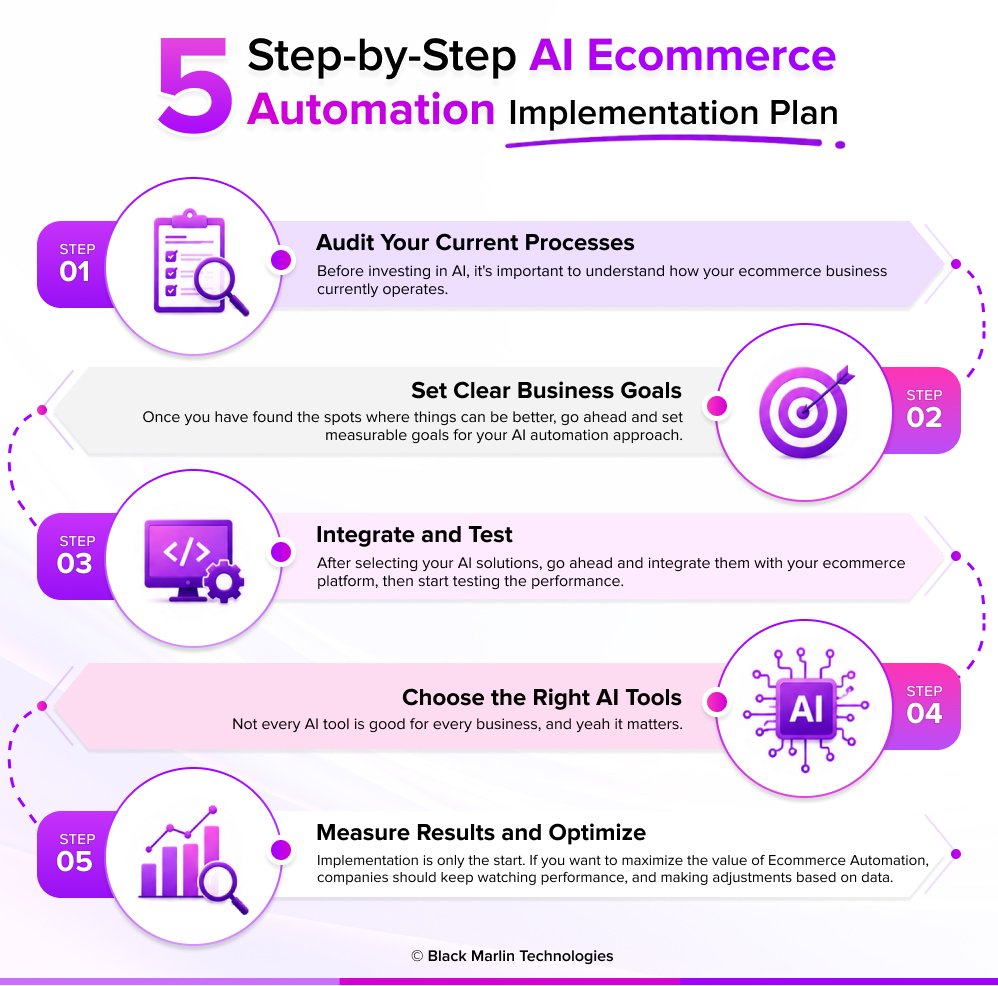
Step 1: Audit Your Current Processes
Before investing in AI, it’s important to understand how your ecommerce business currently operates. Start by identifying tasks that consume significant time, require repetitive manual effort, or frequently lead to errors.
Ask questions such as:
- Which tasks are performed repeatedly every day?
- Where do delays occur in operations?
- What processes create the most workload for employees?
- Which areas impact customer satisfaction the most?
Common opportunities for automation include:
- Customer support inquiries
- Product recommendations
- Inventory management
- Email marketing
- Order processing
- Cart abandonment recovery
A thorough audit helps identify where AI automation for ecommerce can create the greatest impact.
Step 2: Set Clear Business Goals
Once you have found the spots where things can be better, go ahead and set measurable goals for your AI automation approach. If the objectives are clear, it becomes easier to pick the right instruments and later evaluate whether it’s working, not just guess.
Examples of ecommerce automation goals include:
- Increase conversion rates
- Improve customer retention
- Reduce operational costs
- Decrease cart abandonment
- Improve customer support efficiency
- Increase average order value
Step 3: Choose the Right AI Tools
Not every AI tool is good for every business, and yeah it matters. In my view the most effective approach is to look at what directly supports your goals and addresses those specific challenges you are facing.
For example:
| Business Goal | Recommended AI Solution |
| Increase Conversions | Product Recommendation Engines |
| Improve Customer Support | AI Chatbots |
| Enhance Email Marketing | Marketing Automation Platforms |
| Reduce Inventory Issues | AI Forecasting Tools |
| Improve Personalization | Customer Experience Platforms |
Step 4: Integrate and Test
After selecting your AI solutions, go ahead and integrate them with your ecommerce platform, then start testing the performance. Rather than deploying automation across the whole company right away, set up a pilot project first.
Examples of pilot campaigns include:
- AI-powered cart recovery emails
- Product recommendation widgets
- Automated customer support chatbots
- Personalized email campaigns
Testing helps businesses spot little issues, collect feedback, and improve overall performance before they push forward with more automation efforts.
A successful pilot reduces risk while providing valuable insights into how AI can improve operations and customer experiences.
Step 5: Measure Results and Optimize
Implementation is only the start. If you want to maximize the value of Ecommerce Automation, companies should keep watching performance, and making adjustments based on data.
Track key performance indicators (KPIs) such as:
- Conversion Rate
- Customer Retention Rate
- Average Order Value
- Cart Abandonment Rate
- Customer Satisfaction Score
- Email Open Rate
- Revenue Growth
- Return on Investment (ROI)
Regularly reviewing these metrics helps businesses understand what’s working, identify opportunities for improvement, and ensure AI investments continue delivering measurable results.
Key Ecommerce Automation Metrics to Track
Implementing AI eCommerce automation is only the very first step. To get a clear view of whether your automation strategy is delivering genuine business value, you need to measure performance consistently, yeah. Tracking the proper metrics helps businesses see what is actually working, discover less obvious areas for refinement and stretch the return on their AI investments.
Without proper measurement, it’s hard to tell if those AI tools are really raising conversions, enhancing customer experiences, or lowering operational costs. That is why thriving ecommerce businesses lean on key performance indicators (KPIs) to judge how effective their automation efforts.
Essential Ecommerce Automation KPIs
| KPI | Why It Matters |
| Conversion Rate | Measures sales effectiveness |
| Cart Abandonment Rate | Identifies checkout issues |
| Customer Lifetime Value (CLV) | Measures long-term profitability |
| Average Order Value (AOV) | Tracks revenue growth |
| Customer Retention Rate | Evaluates customer loyalty |
| Email Conversion Rate | Measures marketing performance |
| Support Resolution Time | Assesses customer service efficiency |
| Inventory Turnover | Evaluates operational efficiency |
Common AI Ecommerce Automation Mistakes to Avoid
Even if AI ecommerce automation brings clear advantages, actually making it work takes careful planning, and then continuing attention. Lots of teams jump in too fast, thinking everything will pay off right away, but then they realize weak setup or sloppy follow through can slow things down, and it may even cut the return on investment.
The good news is that most AI automation problems are avoidable. If you get how the most common missteps happen and you take a focused plan, ecommerce businesses can push the returns from their automation work and end up with better long-term results.
1. Using Too Many AI Tools at Once
One of the most common mistakes businesses make is taking on multiple AI platforms at once, without a clear strategy behind it. Even if each tool promises impressive features, adding too many solutions in the same stretch can create unnecessary complexity.
2. Ignoring Data Quality
Artificial intelligence leans on data, to make decisions. If the dataset is incomplete, already outdated, or plainly inaccurate. then AI systems they wont deliver results that are dependable.
3. Over-Automating Customer Interactions
Automation can improve efficiency, yet customers still want that human, support for when questions are complex or when issues feel sensitive.
A lot of businesses do something not quite right, they lean on chatbots and automated systems, way too much ,so customers can’t quite get to a real person when it matters.
4. Failing to Measure ROI
A lot of businesses jump into AI automation for ecommerce, but they do not really follow up and see if the automation is bringing tangible results.
Without performance measurement, it becomes difficult to determine:
- Which tools are effective
- Which campaigns are generating revenue
- Where improvements are needed
- Whether AI investments are profitable
Key Metrics to Monitor
- Conversion Rate
- Customer Lifetime Value (CLV)
- Average Order Value (AOV)
- Cart Abandonment Rate
- Customer Retention Rate
- Return on Investment (ROI)
Future Trends of AI Ecommerce Automation
Ecommerce world is evolving very rapidly, and artificial intelligence is now playing a major role in shaping its future. What began as basic automation and simple product suggestions has expanded into more clever systems, that can foresee what customers might need, and also take care of complex operations, while building a shopping experience that feels deeply personalized for each person.
As technology keeps moving forward, AI ecommerce automation will get even stronger, helping businesses boost their efficiency, push up conversions, and deliver truly exceptional customer experiences. Knowing these emerging trends, and how they play out in practice, can keep ecommerce brands ahead of their competitors, while they ready themselves for the next generation of online shopping.
Generative AI Shopping Assistants
Generative AI is changing the way customers engage with online stores, like a more fluid, sort of guided experience. Rather than scrolling through dozens of items yourself, shoppers can just put into words what they want, then get personalized suggestions right away, instantly.
Future AI shopping assistants will be able to:
- Answer complex product questions
- Compare multiple products
- Recommend personalized solutions
- Provide buying advice
- Assist customers throughout the purchasing journey
Hyper-Personalization
Personalization is already common in ecommerce, but the future is more about hyper-personalization, right. Not just suggesting products from past purchases, instead the AI will read the real-time behavior, and weigh preferences, location, browsing routines, customer intent also.
Future hyper-personalized experiences may include:
- Customized homepages
- Real-time product recommendations
- Personalized pricing and promotions
- Tailored content and messaging
- Individualized shopping journeys
As AI automation for ecommerce becomes more advanced, every customer interaction will feel uniquely designed for that individual.
Predictive Commerce
Predictive commerce uses artificial intelligence to anticipate customer needs before customers even realize them themselves.
By analyzing large amounts of data, AI can predict:
- Future purchases
- Product demand trends
- Customer churn risks
- Seasonal buying patterns
- Inventory requirements
Voice Commerce
Voice search is becoming increasingly popular as consumers use smart speakers and voice assistants to find information and shop online.
In the future, voice commerce will allow customers to:
- Search for products using voice commands
- Receive personalized recommendations
- Add items to shopping carts
- Track orders
- Complete purchases hands-free
Autonomous Inventory Management
Inventory management is one of the most important operational challenges for ecommerce businesses. Future AI systems will move beyond forecasting and become increasingly autonomous.
Autonomous inventory management will be capable of:
- Predicting future demand
- Monitoring stock levels continuously
- Automatically placing supplier orders
- Preventing stock shortages
- Reducing excess inventory
AI-Powered Visual Search
Visual search is changing the way customers discover products online. Instead of describing a product with keywords, shoppers can upload an image and allow AI to identify similar products instantly.
Future visual search capabilities will enable customers to:
- Upload photos of products they like
- Find similar items in seconds
- Discover alternative styles and designs
- Improve product discovery experiences
Conclusion
The ecommerce industry is becoming more competitive every year, and businesses can no longer rely solely on manual processes to meet growing customer expectations. Shoppers want personalized experiences, instant support, fast delivery, and seamless interactions across every touchpoint. To keep up with these demands while maintaining efficiency, businesses need smarter solutions.
This is where AI ecommerce automation really brings value in, because it handles the repetitive chores, it watches customer behavior in the background and then gives data-backed recommendations. In that way AI supports more conversion lift, better day to day operations, and it also helps craft customer experiences that feel more personal, not only transactional.
Throughout this guide, we’ve seen how AI automation for ecommerce can support nearly every part of an online business. From personalized product suggestions, and smart chatbots to inventory forecasting and predictive analytics, AI helps ecommerce brands work smarter, scale faster.
FAQ
Q1. What is AI Ecommerce Automation?
Ans1. – AI ecommerce automation is basically the use of artificial intelligence to take over routine jobs like customer support chats, product suggestions, stock control, email promotion, and order handling. It lets ecommerce companies save time, boost efficiency, and push sales higher, while still giving shoppers a customer experience.
Q2. How does AI automation improve ecommerce conversions?
Ans2. – AI improves conversions by analyzing customer behavior and delivering personalized experiences. Features such as product recommendations, smart search, cart recovery emails, and personalized marketing campaigns help customers find relevant products and complete purchases more easily.
Q3. Is AI Ecommerce Automation suitable for small businesses?
Ans3. – Yes. A lot of AI powered ecommerce tools are made for small to medium sized businesses, not really, the big ones only. The companies can begin with reasonably priced options like AI chatbots, email automation, and product recommendation engines first, and then later expand their overall automation strategy.
Q4. What are the biggest benefits of AI Automation for Ecommerce?
Ans4. – Some of the biggest benefits include:
- Higher conversion rates
- Improved customer experiences
- Reduced operational costs
- Better inventory management
- Faster customer support
- Increased customer retention
- Scalable business growth
Q5. Can AI replace human customer support teams?
Ans5. – No. AI is designed to support customer service teams, not completely replace them. AI chatbots can handle routine questions and simple tasks, while human agents can focus on complex issues that require empathy, problem-solving, and personalized assistance.
Q6. What types of ecommerce tasks can be automated with AI?
Ans6. – AI can automate many ecommerce functions, including:
- Product recommendations
- Customer support
- Inventory forecasting
- Order processing
- Email marketing
- Customer segmentation
- Dynamic pricing
- Fraud detection
Q7. How does AI help with inventory management?
Ans7. – AI looks at past sales records, customer behavior, and wider market shifts to project what demand might be ahead. That process, lets a business steer clear of inventory shortages, limits too much stock that just sits around, and makes forecasting more accurate in practice.
Q8. What is predictive commerce?
Ans8. – Predictive commerce uses AI systems and data analytics to see ahead, guess future buyer moves. With those tools it can forecast purchasing behavior, spot which shoppers are most likely to churn, and suggest items customers may need before they even go out and look for them.
Q9. How can AI-powered chatbots improve customer experience?
Ans9. – AI chatbots give immediate help every hour of the day by answering frequent questions, monitoring shipments and order status, suggesting products, and supporting customers during their shopping journey. This cuts down on delays and also boosts customer satisfaction.
Q10. What is hyper-personalization in ecommerce?
Ans10. – Hyper-personalization goes past simple suggestions, it uses live customer information, browsing patterns, likes and dislikes, plus buying history to craft quite tailored shopping experiences per user, like for each person specifically.
Q11. How do I measure the success of AI Ecommerce Automation?
Ans11. – Businesses can measure success by tracking key performance indicators (KPIs), including:
- Conversion Rate
- Cart Abandonment Rate
- Customer Lifetime Value (CLV)
- Average Order Value (AOV)
- Customer Retention Rate
- ROI (Return on Investment)
- Support Resolution Time
These metrics help determine whether automation is improving business performance.
Q12. What are the most popular AI tools for ecommerce automation?
Ans12. – Some widely used AI ecommerce tools include:
Each tool focuses on different areas such as content generation, customer support, marketing automation, personalization, and search optimization.
Q13. Is AI Ecommerce Automation expensive to implement?
Ans13. – The cost changes depending on the tools and the business requirements. A lot of ecommerce platforms provide reasonably priced AI capabilities, that can bring solid returns for you through higher sales, fewer labor expenses, and better day to day operational efficiency.
Q14. What are the common mistakes businesses make with AI automation?
Ans14. – Common mistakes include:
- Using too many AI tools at once
- Ignoring data quality
- Over-automating customer interactions
- Failing to track ROI and KPIs
- Implementing automation without clear business goals
Avoiding these mistakes can improve automation success and maximize results.
Q15. What is the future of AI Ecommerce Automation?
Ans15. – The future of ecommerce automation includes:
- Generative AI shopping assistants
- Hyper-personalized customer experiences
- Predictive commerce
- Voice commerce
- Autonomous inventory management
- AI-powered visual search