'>
<rect width='100' height='100' fill='%23B22234'/>
<!-- stripes -->
<g fill='%23fff'>
<rect y='10' width='100' height='10'/>
<rect y='30' width='100' height='10'/>
<rect y='50' width='100' height='10'/>
<rect y='70' width='100' height='10'/>
<rect y='90' width='100' height='10'/>
</g>
<!-- blue box -->
<rect width='50' height='50' fill='%233C3B6E'/>
</g>
</svg>)
'>
<rect width='100' height='100' fill='%23fff'/>
<rect width='100' height='33.33' y='0' fill='%23FF9933'/>
<rect width='100' height='33.33' y='66.66' fill='%23138808'/>
<!-- Ashoka Chakra -->
<circle cx='50' cy='50' r='9' fill='none' stroke='%23000080' stroke-width='2'/>
<g stroke='%23000080' stroke-width='1'>
<line x1='50' y1='41' x2='50' y2='59'/>
<line x1='41' y1='50' x2='59' y2='50'/>
<line x1='44' y1='44' x2='56' y2='56'/>
<line x1='56' y1='44' x2='44' y2='56'/>
</g>
</g>
</svg>)
 info@blackmarlintechnologies.com

Imagine you search for “How can I improve my website’s SEO?” A few years back, Google would usually show a list of websites, and then users clicked one to get answers. Now, with Google AI Search, it can write a full summary right up top in the search results, pulling details from multiple sources.
This feature, known as AI Overviews, is changing how people deal with search engines. Instead of going to several websites, users can often grab quick answers straight from Google’s AI-generated results. So, as a result, businesses can no longer rely just on classic SEO rankings to pull in visitors.
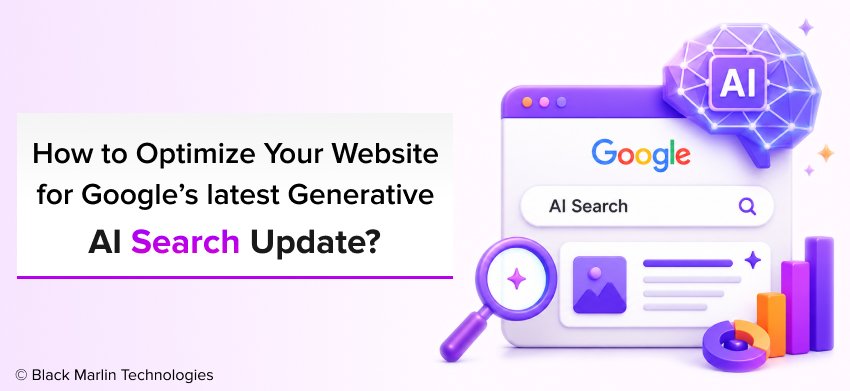 The rise of Generative Engine Optimization, aka GEO and AI Search Optimization, has created a new sort of challenge for website owners. Your content has to do more than just land on the first page, it must also feel credible and reliable enough for Google’s AI systems to bring it up and cite it in their answers.
The good news is that the basics of SEO still matter, like for real. High-quality content, real expertise, fast-loading pages, and a decent user experience still play a big part. But, Google’s latest generative AI search update really pushes it further, with more weight on topical authority, deeper coverage, brand credibility, and clear responses to user questions.
Businesses that adapt to these changes early will have a better chance of appearing in AI Overviews. It can help them get more visibility, too, and keep organic traffic steady as search keeps evolving.
- What Is Google’s Generative AI Search?
- AI Overviews
- AI Mode
- Generative Search
- Conversational Search
- Why Traditional SEO Alone Is No Longer Enough?
- The Rise of Zero-Click Searches
- The New SEO Reality
- Key Challenge for Businesses
- How Google AI Chooses Content?
- Understanding the New Ranking Signals
- AI Looks for Answers, Not Keywords
- 12 Ways to Optimize Your Website for Google AI Search
- 1. Build Topical Authority Instead of Publishing Random Content
- 2. Focus on E-E-A-T More Than Ever
- 3. Answer Questions like a Human
- 4. Create Entity-Rich Content
- 5. Add FAQ Sections
- 6. Use Structured Data Everywhere
- 7. Publish Original Data and Statistics
- 8. Improve Content Readability
- 9. Strengthen Internal Linking
- 10. Optimize for Conversational Search
- 11. Build Strong Brand Signals
- 12. Update Content Frequently
- GEO vs SEO vs AEO – What’s the Difference?
- How to Use the AI SEO Checklist for 2026?
- Metrics to Track for AI Search Success
- AI Overview Visibility
- Branded Search Growth
- Engagement Rate
- Time on Page
- Returning Visitors
- Entity Mentions
- Share of Voice
- Common Mistakes That Prevent AI Overview Visibility
- 1. Keyword Stuffing
- 2. Publishing Thin AI Content
- 3. Ignoring E-E-A-T
- 4. No Schema Markup
- 5. Publishing without a Topical Strategy
- 6. No Author Information
- 7. Chasing Rankings Instead of Authority
- Future of SEO in the AI Search Era
- 1. AI Overviews Will Continue to Expand
- 2. AI Mode Will Become More Conversational
- 3. Brand Authority Will Matter More Than Ever
- 4. Experience-Driven Content Will Outperform Generic Content
- 5. GEO and SEO Will Continue Merging
- Conclusion
- Frequently Asked Questions (FAQs)
What Is Google’s Generative AI Search?
Google Search is evolving away from a basic search engine that only lists websites and toward something more like an answer engine, where it helps you reach the information faster.
With the launch of Google’s Generative AI Search, people can get AI-made summaries, suggestions, and thorough responses right inside the search results. Instead of having to open many websites and keep jumping between them for info, Google makes use of artificial intelligence to study the material from several reputable sources and show a short answer up at the very top of the page.
This shift is changing the way people look things up online and how companies deal with SEO. Lately, website owners need to think past the usual standings and pay attention to AI Search Optimization, so they can improve their odds of being included in AI-generated responses.
AI Overviews
AI Overviews are AI-generated summary bits that show up at the very top of Google Search results. They aim to give fast answers to questions by pulling together information from several web pages, and they often include links to where the info came from, you know, the sources used.
For example, when a person searches “How to improve website SEO for AI search?” Google might show a quick recap with some key optimization tactics first, and then, after that, you still get the usual, natural search results.
AI Mode
AI Mode is Google’s advanced conversational search vibe. It does not make you ask just one question, you can keep talking with follow-up questions, almost like you are chatting with an AI assistant.
This creates a bit more natural search journey and lets people go deeper into topics without having to start a fresh search every time.
Generative Search
Generative Search refers to Google’s ability to create fresh, original replies based on information gathered from multiple sources. Instead of only showing page links and nothing else, Google forms a personalized answer for the user’s query.
This means content that is accurate, well-structured, and authoritative has a better chance to be referenced in AI-generated answers.
Conversational Search
Conversational Search lets people do searches with natural language rather than short keyword phrases.
For example:
- Traditional Search: “best SEO company.”
- Conversational Search: “Which SEO company is best for a small business with a limited budget?”
As AI-powered search becomes more conversational, businesses need to craft content that really answers genuine user questions and gives out clear and helpful information.
The rise of AI Overviews, AI Mode, Generative Search, and Conversational Search signals a major shift in SEO, and honestly, it feels like a big change is happening fast. Sites that emphasize know-how, credibility, topical authority, and content that’s built for the reader will be in a stronger position to get seen in Google’s AI-powered search results.
Why Traditional SEO Alone Is No Longer Enough?
For years, the goal of SEO was kinda simple: rank higher on Google, get more clicks, and turn visitors into customers. While rankings are still important, Google’s newest Generative AI Search update is shifting how people interact with search results.
Today, a lot of users end up spotting the information they need right inside AI Overviews without having to visit any website. Google’s AI-generated summaries offer fast responses, helpful recommendations, and short explanations right at the top of the search results, so people are less likely to click through multiple pages.
As a result, businesses have to rethink their SEO strategy a bit, not just what they do for normal search. Getting to page one is no longer the lone target. Your content still needs strong optimization for AI search, too, so the chances go up that Google will actually reference and cite your website in those AI-generated answers.
The Rise of Zero-Click Searches
A zero-click search happens when someone finds the needed details right on the search results page, without actually clicking through to any website.
This trend has been growing for years, through featured snippets, knowledge panels, and local packs, you know. However, Google AI Overviews have pushed this shift further by giving more comprehensive answers right in the search results.
For users, this makes everything a bit quicker and more handy when searching. For businesses, it introduces a fresh little dilemma, how do you stay visible when fewer people are actually clicking through to the websites?
What This Means for Website Owners
The traditional customer journey looked something like this:
Before AI Search
Google Search → Website Visit → Lead or Conversion
Today, the journey often looks different:
After AI Search
Google Search → AI Overview → Brand Visibility → Possible Website Visit → Conversion
The New SEO Reality
Modern SEO does not feel like it’s only about ranking for keywords anymore. It is more about turning into a reliable reference that Google’s AI systems can, with confidence, lean on when they create answers.
This means businesses should focus on:
- Creating helpful, people-first content
- Building topical authority
- Demonstrating expertise and experience
- Publishing original insights and research
- Structuring content for easy AI interpretation
- Strengthening brand credibility across the web
Key Challenge for Businesses
One of the biggest changes that Generative Search brings is that traffic alone is not really the primary measure of SEO success anymore.
While website visits remain important, businesses should also track:
- AI Overview visibility
- Brand mentions in AI-generated answers
- Search impressions
- Engagement metrics
- Conversion rates
- Topical authority growth
The websites that do well in the AI search era will be the ones that manage to optimize not only for rankings, but also for being picked up inside Google’s AI-generated answers. In other words, SEO going forward is about gaining presence wherever people consume information, whether they actually click your site or not.
How Google AI Chooses Content?
One of the biggest misconceptions about Google’s Generative AI Search is that it works just like regular search algorithms, but it does not. Sure, keywords still matter, but the AI systems are getting much better at reading what’s actually meant in the content, not only lining up word matches on a page.
When generating AI Overviews and answers powered by AI, Google checks a bunch of sources and picks the information that seems most aligned with what the user is actually trying to do. So yes, pages that offer reliable, clear, and well-organized content tend to get a better chance at showing up in those AI-generated responses.
Instead of asking, “Which page contains this keyword?” Google’s AI is getting more and more like it is asking, “Which source provides the most helpful and reliable answer?”
Understanding the New Ranking Signals
To figure out which content deserves a bit more visibility in AI Search, Google looks at a mix of important things, beyond just traditional keyword optimization.
Content Quality
High-quality content still counts as one of the strongest ranking signals. Google tends to prefer pages with original writing, a broad coverage of the topic, high accuracy, and truly helpful value for users.
Content that just repeats what is already out there online, in open-access pages, is much less likely to stand apart in AI-generated search results.
Expertise
Google wants to show what people and organizations really know about a subject, even if it feels a bit harder to explain. When you demonstrate expertise using deep content, solid professional credentials, industry know-how, and authoritative, well-considered insights, you can improve your chances of being mentioned or cited by AI systems.
Experience
First-hand experience has become more and more important, with Google’s E-E-A-T framework. Content that holds real examples or case studies and personal insights, plus practical knowledge, tends to carry more value than generic articles.
Trustworthiness
Trust is one of the most critical factors in AI search optimization, because Google is looking for signals that show your website is dependable, open, and credible.
These signals may include:
- Author information
- Business details
- Customer reviews
- Reliable citations
- Secure website connections (HTTPS)
- Consistent brand presence
Entity Relationships
Google’s AI also checks how topics, brands, people, products, and concepts kinda hook up with each other. Those linkages are called entities, and they help search engines get a clearer picture of the situation around your content.
For example, an article about SEO might link up with things like Google Search, AI Overviews, E-E-A-T, technical SEO, content marketing, and search rankings.
User Intent Match
Perhaps the most important factor is whether your content satisfies the user’s search intent.
Google wants to deliver answers that line up with what users are actually reaching for, whether they’re looking for information, a product suggestion, a direct comparison, or a step-by-step solution.
The closer your content matches what the user wants, the more it can show up in those AI-generated search experiences.
AI Looks for Answers, Not Keywords
Traditional SEO used to focus a lot on exact match keywords. Sure, keywords still help Google get a sense of the topic, but modern AI systems are way more sophisticated.
Instead of looking for repeated keyword phrases, Google’s Generative AI attempts to understand:
- The context of the content
- The meaning behind the information
- The expertise of the source
- The relevance to the user’s question
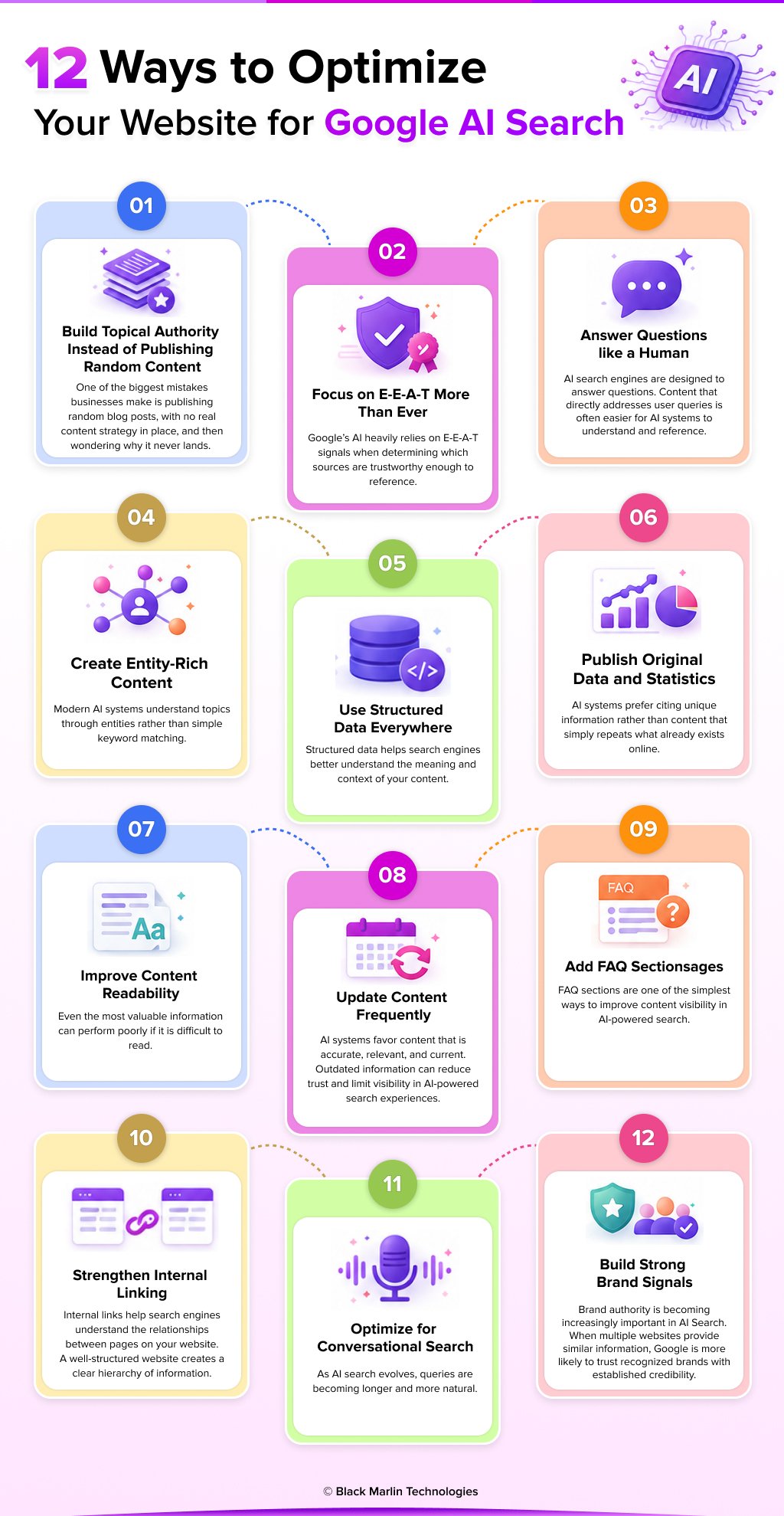
12 Ways to Optimize Your Website for Google AI Search
Showing up in traditional search results is not enough anymore. If you want your content to get picked for Google AI Overviews, AI Mode, and other AI-powered search experiences, you need to write content that Google’s AI can read, grasp quickly, and trust, then reference.
The good news is that many of the ideas behind AI Search Optimization rest on solid SEO fundamentals. The difference is that AI systems put extra weight on expertise, the surrounding context, authoritativeness, and real user value, instead of focusing only on keyword usage.
Here are 12 proven ways to optimize your website for Google’s latest Generative AI Search update.
1. Build Topical Authority Instead of Publishing Random Content
One of the biggest mistakes businesses make is publishing random blog posts, with no real content strategy in place, and then wondering why it never lands. Google’s AI tends to favor websites that show real, deep expertise across a whole subject area.
Rather than creating a single article about SEO, build a complete content ecosystem around the topic.
Instead of creating:
- SEO Guide
Create a topic cluster:
- SEO Basics
- Technical SEO
- Local SEO
- E-commerce SEO
- AI SEO
- Link Building
This approach helps Google understand that your website is an authoritative source on the subject rather than just another website targeting keywords.
2. Focus on E-E-A-T More Than Ever
Google’s AI heavily relies on E-E-A-T signals when determining which sources are trustworthy enough to reference.
E-E-A-T stands for:
- Experience
- Expertise
- Authoritativeness
- Trustworthiness
The more evidence you provide that your content comes from knowledgeable and credible sources, the more confidence Google has in displaying your information.
Optimization Checklist
- Real author profiles
- Industry credentials
- Company information
- External references
- Original insights
- First-hand experience
3. Answer Questions like a Human
AI search engines are designed to answer questions. Content that directly addresses user queries is often easier for AI systems to understand and reference.
Less Effective Approach
Long introductions that delay the answer.
Better Approach
Question → Direct Answer → Detailed Explanation
4. Create Entity-Rich Content
Modern AI systems understand topics through entities rather than simple keyword matching.
What Is Entity SEO?
Entities are clearly identifiable people, places, brands, products, or concepts.
Examples include:
- SEO
- AI Overviews
- Search Engine Optimization
- Generative AI
- E-E-A-T
When discussing a topic, naturally include related entities that help provide context.
5. Add FAQ Sections
FAQ sections are one of the simplest ways to improve content visibility in AI-powered search.
They help Google understand common user questions and provide concise answers that can be incorporated into AI-generated summaries.
Useful FAQ Examples
- What are Google AI Overviews?
- How do AI Overviews affect SEO?
- Can websites rank in AI Search?
- What is Generative Engine Optimization (GEO)?
- How does AI Search differ from traditional search?
6. Use Structured Data Everywhere
Structured data helps search engines better understand the meaning and context of your content.
Adding schema markup provides additional signals that make it easier for Google AI to identify authors, organizations, reviews, and content topics.
Important Schema Types
- Article Schema
- FAQ Schema
- Organization Schema
- Author Schema
- Review Schema
7. Publish Original Data and Statistics
AI systems prefer citing unique information rather than content that simply repeats what already exists online.
Publishing original research can significantly improve your authority within a niche.
Examples of Original Content
- Customer surveys
- Industry reports
- Research studies
- Internal data analysis
- Case studies
Original insights provide value that cannot easily be replicated by competitors.
8. Improve Content Readability
Even the most valuable information can perform poorly if it is difficult to read.
Google’s AI prioritizes content that is clear, organized, and easy for users to understand.
Follow the 5th Grade Rule
- Use short paragraphs
- Write in simple language
- Include clear examples
- Add bullet points
- Break up large text blocks
Ideal Content Structure
- H2 Headings
- H3 Subheadings
- Lists
- Tables
- Images and Visuals
9. Strengthen Internal Linking
Internal links help search engines understand the relationships between pages on your website.
A well-structured website creates a clear hierarchy of information.
Example Topic Cluster Structure
Pillar Page
↓
Supporting Articles
↓
Related Guides
This approach distributes authority throughout your website while reinforcing topical relevance.
10. Optimize for Conversational Search
As AI search evolves, queries are becoming longer and more natural.
Traditional Search Query
Conversational Search Query
“Which SEO agency is best for local businesses in India?”
Create content that mirrors how people naturally ask questions rather than focusing solely on short keywords.
11. Build Strong Brand Signals
Brand authority is becoming increasingly important in AI Search.
When multiple websites provide similar information, Google is more likely to trust recognized brands with established credibility.
Ways to Strengthen Brand Signals
- Collect customer reviews
- Earn media mentions
- Invest in digital PR
- Showcase social proof
- Participate in industry events
- Publish expert content
12. Update Content Frequently
AI systems favor content that is accurate, relevant, and current.
Outdated information can reduce trust and limit visibility in AI-powered search experiences.
Update Regularly
- Statistics
- Research findings
- Industry trends
- Screenshots
- Examples
- Best practices
A good rule is to review and refresh important content every 3 to 6 months.
GEO vs SEO vs AEO – What’s the Difference?
As AI-powered search keeps evolving, new terms like SEO, AEO, and GEO are getting mentioned more and more in digital marketing conversations. They are related but not perfectly aligned, each one has its own emphasis on how search visibility works.
Getting how things differ can really help companies put together a better, more useful strategy for both traditional search engines and these AI-made search experiences.
| Factor | SEO | AEO | GEO |
| Goal | Rankings | Answers | AI Citations |
| Focus | Search Engine Results Pages (SERPs) | Featured Snippets & Direct Answers | AI Overviews & AI Search |
| Success Metric | Organic Traffic | Visibility in Answer Boxes | Mentions & Citations in AI Responses |
| Optimization Focus | Keywords, Links, Technical SEO | Question-Based Content | Authority, Context & Trust |
| User Journey | Search → Click → Website | Search → Answer | Search → AI Summary → Website |
How to Use the AI SEO Checklist for 2026?
At this point, it’s pretty obvious that ranking in Google’s AI-powered search results needs more than the usual SEO tricks. If a site wants to show up in AI Overviews, AI Mode, and other generative search experiences, it has to lean on authority, trust, quality of content, and user intent.
Imagine this checklist as a health report for how ready your website is for AI search. In other words, the more boxes you can truly check, without wincing, the better you are set up so your content can show up in AI-generated search results.
- E-E-A-T Optimization: Ensure your content demonstrates real-world experience, expertise, authority, and trustworthiness. Add author profiles, credentials, references, and company information where appropriate.
- Structured Data Implementation: Use schema markup to help search engines understand your content more effectively. Prioritize Article, FAQ, Organization, Author, and Review Schema whenever relevant.
- FAQ Sections Added: Include question-and-answer sections throughout your content. FAQs align naturally with how AI systems generate responses and often improve visibility for conversational searches.
- Entity SEO Optimization: Strengthen content by naturally incorporating relevant entities such as brands, products, technologies, people, and industry concepts. This helps AI understand relationships between topics.
- Internal Linking Strategy: Connect related content across your website to establish topical authority and improve content discovery for both users and search engines.
- Topic Cluster Creation: Build comprehensive content ecosystems around core subjects instead of publishing isolated articles. Topic clusters help establish expertise and improve AI trust signals.
- Conversational Keyword Targeting: Optimize content for natural-language questions and longer search queries that reflect how people interact with AI-powered search tools.
- Brand Mentions & Authority Building: Invest in digital PR, customer reviews, industry recognition, and authoritative mentions across the web to strengthen your brand’s credibility.
- Regular Content Updates: Review and refresh important pages every 3 to 6 months by updating statistics, examples, research, screenshots, and industry trends.
Metrics to Track for AI Search Success
For years, SEO success was measured mostly by keyword standings and organic traffic. If your website showed up on the first page of Google, and visitors kept increasing, then your search optimization strategy was seen as successful.
However, Google’s generative AI Search is already shifting how people stumble upon information online. With AI Overviews expanding, an AI Mode appearing more often, and a lot of zero click searches happening, businesses really need to look past those old ranking numbers.
Today, success in AI Search Optimization is not only about where you rank. It is more about how often your brand, your content, and your know-how show up inside AI-generated answers.
Beyond Rankings: What Should You Measure?
As search keeps evolving, marketers will need a wider set of KPIs to see how visibility and authority are doing in AI-driven search experiences.
These metrics can help you tell if your content is actually getting traction in the AI search ecosystem.
AI Overview Visibility
One of the most important emerging metrics is how frequently your content appears in Google AI Overviews.
Track:
- Pages cited in AI Overviews
- Keywords triggering AI citations
- Visibility across informational queries
- Competitor citation frequency
Branded Search Growth
Branded searches occur when users search specifically for your company, products, or services.
Examples:
- Black Marlin Technologies
- Black Marlin Technologies SEO Services
- Black Marlin Technologies Reviews
An increase in branded searches often indicates growing awareness and trust.
Engagement Rate
Traffic alone doesn’t tell the whole story.
Monitor how users interact with your content after they arrive on your website.
Key engagement signals include:
- Scroll depth
- Page interactions
- Click-through behavior
- User engagement rate
Time on Page
Time on page measures how long visitors spend consuming your content.
Longer engagement often suggests that users find the content valuable and relevant.
A high-quality article that keeps readers engaged for several minutes typically sends stronger quality signals than content that users abandon quickly.
Returning Visitors
Not every visitor converts during their first visit.
Tracking returning users helps measure trust and brand recognition.
Monitor:
- Repeat visits
- Returning user percentage
- Direct traffic growth
- Subscriber growth
Entity Mentions
AI systems rely heavily on entities to understand relationships between brands, topics, products, and concepts.
Track mentions of:
- Your brand name
- Key products
- Industry experts
- Company leadership
- Important service categories
Share of Voice
Share of Voice (SOV) measures how visible your brand is compared to competitors across search results and AI-generated responses.
Monitor:
- Organic search visibility
- AI Overview appearances
- Brand mentions
- Topic ownership
- Competitive rankings
Common Mistakes That Prevent AI Overview Visibility
Many businesses are excited about the opportunities made by Google AI Overviews, but they often fixate on the wrong optimization tactics. Some websites still use outdated SEO routines that once felt reliable years back but are far less helpful in today’s AI-powered search environment.
Google’s generative AI systems are built to pick out what is most trustworthy, helpful, and authoritative content that is available. If your site lacks credibility, depth, or actual relevance, it may have trouble showing up in those AI-generated answers even when you have decent rankings.
To improve your chances of being featured in AI Overviews, avoid these common mistakes.
1. Keyword Stuffing
One of the oldest SEO mistakes is still surprisingly common.
Keyword stuffing occurs when content repeatedly uses the same keyword in an unnatural way in an attempt to improve rankings.
Example
Bad:
“AI SEO is the best AI SEO strategy because AI SEO helps AI SEO rankings.”
Good:
Use keywords naturally while focusing on providing useful information and context.
Modern AI systems understand topics, intent, and entities far better than simple keyword repetition.
2. Publishing Thin AI Content
AI tools can help speed up content creation, but publishing generic, low-value content is a major mistake.
Thin content often:
- Lacks depth
- Provides little original insight
- Repeats information found elsewhere
- Offers no real expertise
Google increasingly rewards content that includes unique perspectives, first-hand experience, case studies, and practical examples.
3. Ignoring E-E-A-T
E-E-A-T (Experience, Expertise, Authoritativeness, and Trustworthiness) has become one of the most important factors in modern SEO.
Many websites publish content without demonstrating who created it, why they are qualified, or how users can trust the information.
Missing Trust Signals
- No author profile
- No credentials
- No references
- No company information
- No evidence of experience
4. No Schema Markup
Structured data helps search engines understand the meaning and context of your content.
Without schema markup, Google may have a harder time identifying important information about your pages, authors, products, and organization.
Important Schema Types
- Article Schema
- FAQ Schema
- Organization Schema
- Author Schema
- Review Schema
5. Publishing without a Topical Strategy
Many websites create content based solely on trending keywords without building expertise around a specific topic.
For example, publishing one article about SEO, another about fitness, and another about cryptocurrency does little to establish authority.
Instead, focus on building topic clusters that cover a subject comprehensively.
Better Approach
Create content ecosystems around:
- Technical SEO
- Local SEO
- AI SEO
- Link Building
- Content Marketing
6. No Author Information
Users and search engines want to know who created the content.
Anonymous articles can make it difficult for Google to assess expertise and trustworthiness.
A strong author profile should include:
- Full name
- Professional background
- Industry experience
- Credentials
- Social or professional profiles
7. Chasing Rankings Instead of Authority
Perhaps the biggest mistake is focusing only on rankings.
Traditional SEO often emphasized ranking for as many keywords as possible. In the era of AI Search, authority matters more than ever.
Instead of asking:
“How can I rank for this keyword?”
Ask:
“How can I become the most trusted source on this topic?”
Websites that build authority through expertise, research, original insights, and brand recognition are more likely to earn AI citations.
Future of SEO in the AI Search Era
SEO has evolved a lot over the last two decades, first we had keyword stuffing and link building; then mobile optimization plus user experience came in, and yeah, every major Google update seemed to shift the way websites compete for visibility.
The rise of Google’s Generative AI Search, AI Overviews, and AI Mode feels like the next big evolution of search. And yeah, lots of marketers worry that AI will replace the usual SEO approach, but honestly, the reality looks quite different.
SEO is not disappearing it is becoming smarter, more user-focused, and more authority-driven.
Businesses that adapt early to these changes will be in a better posture to keep visibility, draw qualified traffic in a steady way, and establish enduring authority in an increasingly AI-powered search landscape.
1. AI Overviews Will Continue to Expand
Google has rolled out AI Overviews to billions of users worldwide now, and you can see their presence in search results continuing to grow.
In the future, AI-generated summaries are expected to show up across a lot more industries, for search queries, and within user journeys.
This means users will increasingly receive answers directly within search results before visiting websites.
What does this mean for Businesses?
- More competition for AI citations
- Greater importance of content quality
- Increased focus on topical authority
- Stronger need for AI Search Optimization
Websites that become trusted information sources will benefit the most from this shift.
2. AI Mode Will Become More Conversational
Search is gradually becoming more like a conversation.
Instead of entering short keyword phrases, users are increasingly asking detailed questions and following up with additional queries.
Example
Traditional Search:
“best CRM software”
Future AI Search:
“Which CRM software is best for a small business with under 20 employees and a limited budget?”
This trend will encourage businesses to create content that answers real-world questions in a natural, conversational way.
What does this mean for Businesses?
- Focus on user intent
- Create question-based content
- Optimize for long-tail queries
- Improve answer-focused content structures
The websites that best understand their audience’s questions will gain a competitive advantage.
3. Brand Authority Will Matter More Than Ever
As AI systems evaluate multiple sources before generating answers, trust becomes increasingly important.
When several websites provide similar information, Google is more likely to reference brands that demonstrate expertise, credibility, and industry recognition.
Strong Brand Signals Include
- Positive reviews
- Media mentions
- Industry awards
- Expert authors
- Consistent online presence
- Thought leadership content
In many cases, brand authority may become just as important as traditional ranking signals.
4. Experience-Driven Content Will Outperform Generic Content
AI tools can generate large amounts of content quickly. As a result, generic information is becoming easier to produce and less valuable.
Google’s AI systems increasingly favor content that demonstrates real-world experience and unique expertise.
Examples of Experience-Driven Content
- Case studies
- Customer success stories
- Original research
- Industry insights
- First-hand experiences
- Expert opinions
This type of content is difficult to replicate and provides genuine value to users.
5. GEO and SEO Will Continue Merging
Many marketers view Generative Engine Optimization (GEO) and traditional SEO as separate strategies.
However, the line between them is becoming increasingly blurred.
The same factors that help content perform well in search results also improve visibility in AI-generated answers.
These include:
- High-quality content
- E-E-A-T signals
- Topical authority
- Technical SEO
- Structured data
- Strong user experience
Rather than replacing SEO, GEO is becoming an extension of it.
Conclusion
Google’s latest Generative AI Search update is, honestly, reshaping the way people find and then consume information online. And yeah, with the rapid growth of AI Overviews, AI Mode, and those more conversational search experiences, it’s getting harder to lean only on old school keyword rankings for visibility and traffic.
Success in this AI search era needs a wider approach, not just a narrow keyword plan. Sites that put money into topical authority, solid E-E-A-T signals, entity SEO, structured data, and content that actually helps the reader are more likely to gain trust from Google’s AI systems and show up in AI-generated answers. Meanwhile, adding original takeaways, strengthening brand authority, and explaining answers in a clear way will become more and more important as competitive advantages.
The future of SEO is not only about making things easier for algorithms, but it’s also about becoming the most dependable source of information in your industry. As Google keeps expanding AI-powered search experiences, the sites that keep delivering expertise, rightness, and useful value will have the best chance to earn visibility.
By applying the strategies described in this guide, companies can boost their visibility in both older search results and in AI-made search experiences, so they stay on the map, relevant, and competitive in the changing landscape of AI Search Optimization and Generative Engine Optimization (GEO).
Frequently Asked Questions (FAQs)
Q1. What is Google AI Overview?
Ans1. – Google AI Overview is an AI-generated recap that shows up at the top of specific search results, where it looks like a quick cheat sheet. It mixes material from a bunch of reputable sources and then gives users a fast answer, without them needing to jump around multiple websites. These AI Overviews are also tied to Google’s wider push to make search feel more conversational and helpful.
Q2. How Do I Get My Website Featured in Google AI Overviews?
Ans2. – There isn’t a real, direct submission process for Google AI Overviews. If you want better odds of getting referenced, concentrate on publishing excellent content, showing E-E-A-T (Experience, Expertise, Authoritativeness, and Trustworthiness), adding structured data, increasing topical authority, and responding to user questions in a clear, precise way.
Q3. Does Traditional SEO Still Work for AI Search?
Ans3. – Yes, traditional SEO still matters a lot. Things like content quality, page experience, backlinks, technical SEO, and keyword relevance keep affecting where pages show up. But with AI search, the whole system leans much harder on topical authority, meaning-based relevance, user intent, and content trustworthiness.
Q4. What Is Generative Engine Optimization (GEO)?
Ans4. – Generative Engine Optimization, or GEO, is the activity of tuning content so it gets a better shot at being referenced and cited by AI-based search engines and generative AI systems. GEO is largely about making material feel authoritative, well-organized, and tied to the surrounding topic, so the AI models can interpret it cleanly and also trust it.
Q5. How Important Is E-E-A-T for AI Rankings?
Ans5. – E-E-A-T is one of the more important factors for AI search visibility. Google’s AI systems favor content from credible sources that show real-world experience, expertise, authority, and trust, you know, the whole stack. Websites that display expert authors, precise information, and a solid brand reputation are more likely to show up in AI-generated answers.
Q6. Does Schema Markup Help With AI Search Visibility?
Ans6. – Yes, schema markup helps search engines understand the context and the layout of your content. When you implement types like Article, FAQ, Organization, Author, and Review schema, it can make the meaning clearer to crawlers. That clarity then boosts the chance that your pages get referenced in AI-generated search results.
Q7. Can AI-Generated Content Rank in Google AI Overviews?
Ans7. – AI-generated content can rank, if it brings real value, stays accurate, and feels fresh in a way that matters. Google is mostly looking at content quality, not specifically how it was made. Still, if the writing shows weak expertise, shaky facts, or just no human oversight, it is much less likely to do well in search results or show up in AI Overviews.
Q8. What Type of Content Gets Cited Most Often by AI Overviews?
Ans8. – AI Overviews often pull from material that actually gives direct answers, plus original research, industry numbers, expert viewpoints, real case studies, step-by-step guidance, and broader explanations. Anything that shows authority and matches the users’ intent clearly tends to get referenced more.
Q9. How Is AI SEO Different From Traditional SEO?
Ans9. – Traditional SEO mostly aims at pushing rankings higher in search engine results pages, and it can be pretty straightforward. AI SEO goes a step further, though, by tailoring the content for AI-produced answers and more conversational search journeys. Instead of leaning so much on exact match keywords.
Q10. What Are the Best Tools for Tracking AI Search Visibility?
Ans10. – Several SEO platforms now also give AI visibility tracking features. Some of the more used ones are Semrush, Ahrefs, BrightEdge, SE Ranking, Similarweb, and Google Search Console. These setups help you keep an eye on keyword performance, brand presence, search impressions, and the actual appearances in AI-prompted search experiences.
Q11. Does Google AI Overview Reduce Website Traffic?
Ans11. – In some cases, AI Overviews can reduce clicks for info queries because people may find the answer right inside the search results. Yet the sites that get cited within these AI Overviews often gain more brand visibility and perceived authority, plus better-qualified visits from users who want deeper information.
Q12. How Often Should I Update Content for AI Search Optimization?
Ans12. – The content should be checked and refreshed every three to six months, especially when the subject tends to change often. By updating numbers, examples, screenshots, research outcomes, and industry shifts, you keep things accurate, you make it more relevant, and you also boost the possibility of staying visible in regular search and in AI-powered results.