'>
<rect width='100' height='100' fill='%23B22234'/>
<!-- stripes -->
<g fill='%23fff'>
<rect y='10' width='100' height='10'/>
<rect y='30' width='100' height='10'/>
<rect y='50' width='100' height='10'/>
<rect y='70' width='100' height='10'/>
<rect y='90' width='100' height='10'/>
</g>
<!-- blue box -->
<rect width='50' height='50' fill='%233C3B6E'/>
</g>
</svg>)
'>
<rect width='100' height='100' fill='%23fff'/>
<rect width='100' height='33.33' y='0' fill='%23FF9933'/>
<rect width='100' height='33.33' y='66.66' fill='%23138808'/>
<!-- Ashoka Chakra -->
<circle cx='50' cy='50' r='9' fill='none' stroke='%23000080' stroke-width='2'/>
<g stroke='%23000080' stroke-width='1'>
<line x1='50' y1='41' x2='50' y2='59'/>
<line x1='41' y1='50' x2='59' y2='50'/>
<line x1='44' y1='44' x2='56' y2='56'/>
<line x1='56' y1='44' x2='44' y2='56'/>
</g>
</g>
</svg>)
 info@blackmarlintechnologies.com

Imagine you ask a robot, “Can you book me a train ticket?”
The robot quickly, like in one breath, tells you the train timings, and then asks you to visit the booking website. Helpful right? But now picture another robot it scans the trains that are available, compares ticket prices, secures your preferred seat, handles the payment with your permission, and then emails the ticket to you. You didn’t need to do anything else.
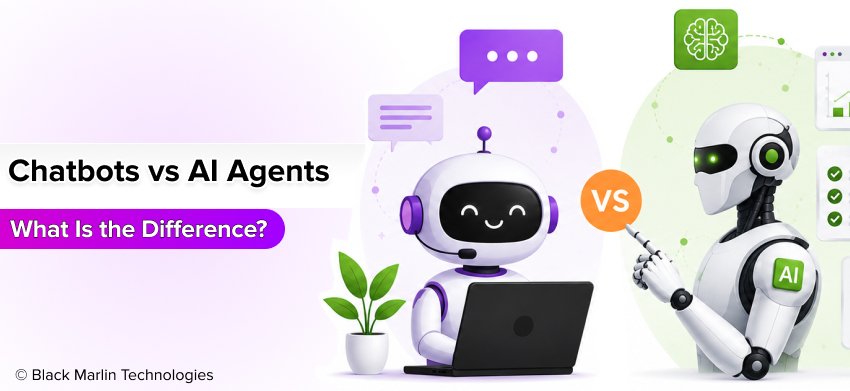 Both robots use artificial intelligence, but they operate in totally different ways. The first one is a chatbot that answers your questions, without much further fuss. The second one is more like an AI agent, meaning it can plan, make decisions, and finish tasks from start to finish.
This is why Chatbots vs AI Agents has turned into one of the hottest topics in the AI world. Businesses are moving beyond simple chatbots because they want AI that can do more than just answer questions. With AI agents, they can automate work, use various instruments, remember prior conversations, and deal with intricate tasks with minimal human effort.
What Is a Chatbot?
A chatbot is a computer program that talks with people by text, or sometimes by voice. It is meant to answer questions, give useful information, and help users finish simple tasks. You might see chatbots on websites, in mobile applications, on WhatsApp, and also on customer support pages.
Think about a chatbot as a helpful digital helper. When you ask something like “Where is my order?” or “What are your business hours?”, the bot quickly digs through its knowledge base or it follows pre-set rules to deliver the best answer. In practice, many chatbots are made to deal with everyday questions and repetitive chores, which makes customer support quicker and also available 24/7.
Modern AI-powered chatbots can get the gist of natural language better than earlier rule-based bots. They can keep a piece of the conversation in mind, handle follow-up questions, and give more suitable answers. Still, they often lean toward replying to requests, not really taking initiative by themselves, or completing full-on complex tasks without a human pushing them.
How Does a Chatbot Work?
A chatbot follows a simple process to understand your question and provide a reply.
Simple Chatbot Flow
Customer
↓
Asks a Question
↓
Chatbot Understands the Request
↓
Searches Its Knowledge Base or Rules
↓
Finds the Best Answer
↓
Replies to the Customer
What Is an AI Agent?
Unlike a chatbot, an AI agent doesn’t just answer questions; it can think, plan, make decisions, use different tools, and complete tasks with very little human assistance. Instead of only giving you information, an AI agent works toward reaching a goal.
Think of an AI agent as a smart digital assistant that can do several small steps to finish the job. Like if you ask an AI agent, “ Plan my weekend trip to Jaipur ”, it won’t merely throw ideas at you about places to see. It can look up trains or flights, compare hotel prices, suggest tourist attractions, and then lay out a full travel itinerary. After that, it may even book tickets or reserve a hotel room, but only once you approve it. The main point is, it tries to complete the whole mission, not just answer one question.
AI agents use tech such as Large Language Models (LLMs), memory, reasoning, and other external tools to interpret your request and decide what to do next. They can also remember prior conversations, adjust with new information, and tackle more involved tasks than standard chatbots.
How Does an AI Agent Work?
An AI agent follows a step-by-step process to achieve a goal instead of simply replying to a question.
Simple AI Agent Workflow
Goal
↓
Understands the Task
↓
Creates a Plan
↓
Uses Tools and Data
↓
Makes Decisions
↓
Completes the Task
Chatbots vs AI Agents: Key Differences
At first glance, chatbots and AI agents can look similar, because both use artificial intelligence to interact with people. Still, they are made for different purposes, and it shows when you look closer. A chatbot is mostly built to answer questions and help with simpler chores or routine requests. An AI agent, however, can grasp objectives, form a plan, involve different tools and then finish thornier work with minimal human input, which is why it often feels more capable than a plain conversation bot.
The table below highlights the main differences between chatbots vs AI agents in a simple and easy-to-understand way.
| Feature | Chatbot | AI Agent |
| Purpose | Answers questions and provides information. | Completes tasks and achieves a specific goal. |
| Learning Ability | Limited learning, often follows predefined rules or trained responses. | Learns from interactions and adapts to new situations over time. |
| Memory | Usually remembers only the current conversation or very little context. | Can remember previous conversations and user preferences for better assistance. |
| Understanding Context | Understands simple requests but may struggle with complex conversations. | Understands context, intent, and follow-up requests more accurately. |
| Uses APIs & External Tools | Limited or no access to external tools unless specifically integrated. | Connects with APIs, databases, calendars, CRMs, payment systems, and other software. |
| Multi-Step Tasks | Best for handling one question or one task at a time. | Can break large tasks into multiple steps and complete them automatically. |
| Autonomy | Waits for user instructions before responding. | Can work independently once a goal is assigned. |
| Tool Usage | Mostly provides answers using stored information. | Uses multiple tools to search, calculate, book, schedule, or automate tasks. |
| Decision Making | Does not make decisions; simply responds based on rules or training. | Evaluates options and makes decisions to complete the assigned task. |
| Personalization | Offers basic personalization, such as using your name or previous queries. | Delivers highly personalized responses by remembering preferences and past interactions. |
| Speed | Provides instant replies to common questions. | May take a little longer because it plans, analyzes, and performs multiple actions before responding. |
| Complexity | Easy to build and manage for simple customer interactions. | More advanced and requires AI models, memory, tools, and workflow automation. |
| Human Support | Often transfers complex issues to a human support agent. | Can solve many complex problems on its own but may still involve humans for approvals or sensitive decisions. |
| Best For | FAQs, customer support, appointment booking, order tracking, and lead generation. | Business automation, research, coding, travel planning, marketing, sales, HR, and data analysis. |
| Cost | Lower development and maintenance costs. | Higher initial investment due to advanced AI capabilities and integrations. |
When Should You Use a Chatbot?
A chatbot is the best choice when your business needs to answer regular questions, give fast support, and help customers with simple tasks. It works twenty-four seven, and it replies instantly, which eases the overall pressure on your customer support team. If most customer requests follow the same rhythm, a chatbot can manage them efficiently with no human involvement.
If you operate an online store, a healthcare clinic, a bank, or a service-based business, chatbots can help boost the customer experience by giving quick and precise answers. In many cases, they are cost-effective, relatively simple to roll out, and great for organizations that aim to automate those repetitive interactions.
- Answer Frequently Asked Questions (FAQs): Customers often come back with the same questions, like what your business hours are, the pricing, the return policy, or the shipping details. Instead of making your team answer that again and again, a chatbot can respond right away, at any time through the day.
- Order Tracking: For eCommerce businesses, people very often ask about the status of their orders. A chatbot can swiftly look up order details and deliver current, live updates without keeping customers in a waiting line for a support agent.
- Lead Generation: A chatbot might gather customer information like names, email addresses, phone numbers, and specific business needs. This helps your sales team see which people could be potential customers, then follow up faster with the right leads.
- Appointment Booking: Businesses such as hospitals, salons, coaching centers, and consultancies can use chatbots to arrange appointments in a smooth way, automatically. Clients can pick a date and a time right away without having to call or email.
- Customer Support: Chatbots are pretty common for taking care of everyday customer support requests. They respond to frequent questions, guide people through basic troubleshooting actions, and send the more complicated issues to a real support agent when it becomes necessary.
- Product Search and Recommendations: Online stores use chatbots to help customers find the right products, pretty quickly. If the bot pays attention to a customer’s preferences, budget, or needs, it can then make good suggestions and guide people to suitable items. In this way, the whole shopping experience feels smoother and less time-consuming.
When Should You Use an AI Agent?
An AI agent may be the right move when your work is more than just giving simple answers. Unlike a chatbot, an AI agent can take in a goal, build a plan, use various tools, and push through multiple steps to finish what you started. That is why AI agents can be a strong fit for businesses that need to automate intricate workflows, save time, and boost productivity.
From small startups to huge enterprises, many orgs are using AI agents for repetitive tasks, information analysis, and basically supporting employees when they need to make better choices. Instead of handling one single request at a time, these AI agents can steer entire workflows with only minimal human involvement.
- Research and Information Gathering: Research usually means reading a bunch of websites, comparing different data points, and then making a kind of summary. An AI agent can gather material from multiple sources, sort the findings around, and then share the results in an easy-to-understand way within minutes.
- Coding and Software Development: Developers can use AI agents to write code, to catch bugs, explain programming concepts, and even to test applications. It kind of speeds up the whole software development process and helps teams focus on solving more complex problems instead.
- Sales Support: AI agents kind of help sales teams by seeking likely customers, checking who is really worth talking to, sending follow-up emails, and keeping the CRM systems updated, while also helping draft personalized sales proposals. That way, the sales professionals can spend more time on building those actual customer relationships.
- Human Resources (HR): HR teams can use AI agents to sift through resumes, set up interviews, reply to employee questions, and help with the onboarding of new hires. This cuts down on a lot of the tedious manual work and makes the hiring process move faster.
- Marketing: Marketing professionals often use AI agents to come up with content ideas, sift through campaign performance data, organize social media posts, do keyword investigation, and then draft those kinds of summary reports. And honestly, these AI agents can also nudge along new tactics, based on customer habits and wider market trends.
- Business Automation: Lots of businesses now use AI agents to do the more repetitive stuff, like sending invoices, updating databases, processing customer requests, and handling day-to-day operations. It tends to make things faster, more efficient, and it also lowers those human mistakes.
- Business Workflows: AI agents can link together several business tools, like email, CRM software, calendar schedules, project management platforms, and cloud storage. They sort out various tasks in a kind of orchestrated way, so the overall workflow runs smoothly from one step to the next.
- Data Analysis and Reporting: Businesses generate a lot of data every day, and you know it adds up fast. AI agents can then look through that data sort of like a quiet assistant, spotting patterns or trends. Afterwards, they prepare briefings and even offer recommendations that are actually actionable for managers to make better decisions.
Benefits of Chatbots
Chatbots have basically become a crucial tool for businesses that want to make customer service better, without raising costs too much. They can answer common questions, assist customers right away, and deal with thousands of conversations at the same time. And yeah, whether you manage a small business or a big corporation, chatbots seem to help provide quicker, more steady customer support.
Here are the biggest benefits of using a chatbot.
- Lower Cost: Hiring and training a big customer support crew can end up being pretty costly. A chatbot can manage lots of everyday conversations on its own, cutting down operational expenses, so human agents can spend more time on the more complicated matters.
- Faster Replies: Customers tend not to like having to wait for answers. With chatbots, replies come in a few seconds or so, and that gives instant, almost immediate information whenever someone asks a question. These fast responses usually make customers happier and also help cut down on the overall waiting time.
- 24/7 Customer Support: Unlike human agents, chatbots never really get a break. They work around the clock, always there to assist customers during weekends, holidays, and even late at night.
- Easy to Deploy: Most modern chatbot platforms can work with websites, mobile apps, WhatsApp, Facebook Messenger, and other communication channels too. In other words, businesses can roll out a chatbot pretty fast, without needing to build an advanced AI system from scratch.
- Great for Repetitive Tasks: A lot of customer questions come back every single day. Chatbots are really good at dealing with those day-to-day talks in a steady way, always the same, without getting bored or causing silly mistakes.
Benefits of AI Agents
AI agents kind of go past just answering questions; they can grasp the goals, sketch out a strategy, use several tools, and finish those harder tasks with hardly any human involvement. As companies keep automating more processes, these agents are turning into pretty useful helpers, boosting speed and helping teams work in a smarter way.
Here are the key benefits of using an AI agent.
- Saves Hours of Work: AI agents can do jobs that, usually, would take employees several hours, maybe even more. They are able to gather information, arrange data sort of neatly, and finish workflows automatically too, so the teams end up with extra time. And then that time can be spent on more strategic work.
- Automates Repetitive Tasks: AI agents can mostly automate the everyday business stuff like sending emails, updating databases, generating reports, setting up meetings, and handling customer requests.
- Better Decision Making: AI agents analyze huge amounts of data first, then they’ll suggest the best way to go, usually in a much faster rhythm. This approach lets companies make smarter and more informed decisions.
- Handles Multiple Tools: Unlike the more traditional chatbots, AI agents can hook up with calendars, CRM software, email platforms, payment systems, cloud storage, and a bunch of other business tools. That means they’re able to finish end-to-end workflows without always hopping between different systems.
- Learns Over Time: Lots of AI agents get better by going through continual chats and little back-and-forths. They keep track of what people tend to like, then they read the context more clearly, and they can give more tailored help over time as they collect more experience.
- Improves Productivity: When repetitive work keeps happening and complex tasks need extra help, AI agents quietly assist, so employees get more done in less time. That means the team can keep their attention on creativity, strategy, and real problem-solving rather than getting stuck on manual work, and all that usual busy work.
Challenges of Chatbots
Chatbots work pretty well for automating customer conversations, but they still are not all that great, know, they have edges. They can answer the usual questions fast, like right away, yet once the talks get more involved or need human judgment, they may start to wobble a bit. If a business understands these limits, then it gets easier to tell when a chatbot is sufficient, and when a more advanced AI agent is required.
Here are the main challenges of using chatbots.
- Limited Understanding: Most chatbots are designed to handle specific questions and common requests. If a customer asks something unusual or uses unclear language, the chatbot may not fully understand the request.
- Fixed Responses: Many chatbots rely on predefined rules or a limited knowledge base. This means they often provide the same responses, even when a customer needs a more personalized solution.
- Cannot Plan Complex Tasks: Chatbots are designed to respond to questions, not complete multi-step tasks. They cannot create plans, compare different options, or perform several actions to achieve a goal.
- No Reasoning or Decision Making: Chatbots don’t really think the way humans do. They can’t actually assess a situation, balance different options, or make a self-directed decision on their own. Instead, they just answer from what they learned during training, what they’ve been given as rules, or what information is available in front of them.
Challenges of AI Agents
AI agents feel way more powerful than chatbots, yet they also have their own headaches. Because they can make decisions, hook into multiple tools, and run those tangled workflows automatically, businesses should sort things out in advance before they actually deploy them.
Here are the main challenges of using AI agents.
- Higher Cost: Building and maintaining an AI agent tends to be more expensive than simply deploying a chatbot. In many cases, businesses may end up needing more sophisticated AI models, plus cloud infrastructure, software integrations, and of course, ongoing maintenance.
- Security Concerns: AI agents often tap into touchy business systems like email, CRM platforms, financial utilities, and internal databases. But if there are no solid guardrails, then unauthorized access or misuse could bring real hazards, not just small problems.
- Requires Human Monitoring: Even if AI agents can sort of work on their own, they shouldn’t be totally unsupervised, you know. A person still has to look over what matters, review the key decisions, okay approve any sensitive moves, and keep an eye on the result quality.
- Complex Setup: Getting an AI agent going is, you know, more complicated than just installing a chatbot. Usually it means you have to connect several business tools, set up the operational flows, train the AI models a bit, and then test out different scenarios
- Data Privacy: AI agents often process customer information, employee records, and general business data, like day-to-day stuff. In the same breath, organizations have to follow privacy regulations and make sure sensitive information is kept and dealt with securely.
AI Agent vs Chatbot Examples
Understanding the difference between a chatbot and an AI agent gets a bit easier once you see it in real-world situations. Even though both of them use artificial intelligence to help users, they end up aiming at different purposes.
A chatbot mostly lives in answering questions, nudging users along, and doing customer support stuff. An AI agent, instead, in a way, can grasp the actual goals, plan a bunch of little steps, reach out to external tools and then finish the task end to end with pretty much minimal human involvement.
The table below shows some common examples of both technologies.
| Product / Example | Type | What It Does |
| Website FAQ Bot | Chatbot | Answers common questions like business hours, pricing, return policy, and shipping information. |
| WhatsApp Support Bot | Chatbot | Responds to customer queries, shares order updates, and provides basic support through WhatsApp. |
| Bank Support Bot | Chatbot | Helps customers check account information, card status, branch locations, and frequently asked banking questions. |
| Customer Service Bot | Chatbot | Assists customers with order tracking, refunds, password resets, and general support requests. |
| ChatGPT with Actions | AI Agent | Can connect with external tools, complete multi-step tasks, and perform actions beyond answering questions. |
| AutoGPT | AI Agent | Plans tasks, performs research, uses tools, and works toward completing a goal with minimal human guidance. |
| OpenAI Codex | AI Agent | Assists developers by writing code, fixing bugs, explaining programming concepts, and automating coding tasks. |
| Travel Planner Agent | AI Agent | Searches flights, compares hotels, creates travel itineraries, and helps book trips based on user preferences. |
Frequently Asked Questions (FAQs)
Q1. What is an AI agent?
Ans1. – An AI agent is a pretty advanced AI system that can grasp a target or goal, craft a rough plan, then make choices, use various tools, and finish tasks with very little human help, if any at all. It’s not like a chatbot that mostly just answers questions. Instead, an AI agent tends to focus on getting a specific result, like reserving a trip, producing a report, or handling automation for a business process.
Q2. Is ChatGPT an AI agent?
Ans2. – By itself, ChatGPT is mostly an AI helper that generates language and answers questions. But once it’s linked up with external stuff, like tools APIs, or whole workflows that let it do things, say booking appointments or adjusting documents, then it starts to act more like an AI agent system.
Q3. Which is better: a chatbot or an AI agent?
Ans3. – Neither is universally better, it really depends on what you need. A chatbot tends to work best when you’re answering FAQs, giving customer support, or managing a relatively simple chat. An AI agent is usually better for more complex jobs where you need a bit of orchestration, like planning, reasoning, automating steps, and also using multiple tools at once.
Q4. Are AI agents expensive?
Ans4. – AI agents usually end up costing a bit more than chatbots, because they lean on more advanced AI models, extra software integrations, and yes, also ongoing care and maintenance. Even so, they often cut down the amount of hands-on work, raise productivity, and deliver a kind of long-term advantage for companies that really need automation.
Q5. Can AI agents replace chatbots?
Ans5. – Not completely, though. For simple customer conversations and frequently asked questions, chatbots are still the best option in general, you know. But AI agents tend to work better when things get more complicated, like for elaborate workflows or business automation. Many companies end up using both at the same time, so they can deliver a smoother customer experience.
Q6. How do AI agents work?
Ans6. – AI agents work by basically understanding the goal in mind, then making up a plan, gathering information, using linked tools or APIs, making those decisions, then finishing the task that’s required. They can also keep a bit of context stored and tweak how they answer depending on what happened in previous conversations.
Q7. Can small businesses use AI agents?
Ans7. – Yes. Small business owners can lean on AI agents for stuff like customer support, handling email, setting appointments and scheduling, doing content creation, managing leads, plus workflow automation too. A lot of modern AI tools have cheaper plans, kind of tailor-made for small teams who are still growing.
Q8. What industries benefit the most from AI agents?
Ans8. – AI agents can improve efficiency across many industries, including:
- eCommerce
- Healthcare
- Banking and Finance
- Education
- Real Estate
- Travel and Hospitality
- Customer Support
- Marketing and Advertising
- Human Resources
- Software Development
These industries benefit from faster automation, better decision-making, and improved customer experiences.
Q9. Do AI agents require coding?
Ans9. – Not always; honestly, many modern AI platforms give no-code or low-code options, so businesses can set up AI agents without programming know-how. Still, if you want a more advanced custom AI agent, it usually ends up needing coding too, especially for integrations, task automation, and those specialized capabilities.
Q10. Are AI agents secure?
Ans10. – AI agents can be fairly secure if they’re made on trusted platforms and wrapped up with suitable protections like authentication, encryption, access controls and routine monitoring. In addition, businesses should really keep an eye on data privacy rules, because they do matter, and review AI-generated actions from time to time, when it is needed.
Q11. Can AI agents use APIs?
Ans11. – Yes. One of the biggest advantages of AI agents is that they can sort of link up with APIs and outside applications. This means they are able to grab business software, calendars, CRMs, payment gateways, cloud storage, databases, and lots of other utilities, so the work gets done in a more automatic fashion for those complex tasks.
Q12. Will AI agents replace customer support?
Ans12. – AI agents are supposed to automate a lot of routine customer support stuff, but they probably won’t replace human support teams completely. Like, human agents still matter a bunch for dealing with delicate cases, tough troubleshooting, bargaining, and those moments that need empathy and personal judgment. So the future of customer support will most likely end up being a mix of AI agents plus human know-how, in order to get faster responses and better service overall.
Final Thoughts
The whole talk about Chatbots versus AI Agents, it’s not really about picking just one thing over the other, more like finding the right tool for the right job, you know. Both of them run on artificial intelligence, yes, but they serve different roles.
If what you really want is to answer customer questions, give instant support, track orders, book appointments, or manage other recurring chats, then a chatbot is the best route. It’s relatively low cost, pretty simple to put in place, and it allows businesses to deliver quick 24/7 customer service.
On the other hand, if you want AI to really think, plan, make decisions, use several tools and finish complex tasks, an AI agent is usually the better solution. It can handle a lot of stuff, from automating business workflows and doing research all the way to analyzing data and steering projects around. In general, AI agents save time that you would otherwise lose, and they boost productivity overall.
As AI technology continues to evolve, many businesses are combining chatbots and AI agents to create smarter customer experiences and more efficient operations. Chatbots handle routine conversations, while AI agents take care of advanced tasks behind the scenes.