'>
<rect width='100' height='100' fill='%23B22234'/>
<!-- stripes -->
<g fill='%23fff'>
<rect y='10' width='100' height='10'/>
<rect y='30' width='100' height='10'/>
<rect y='50' width='100' height='10'/>
<rect y='70' width='100' height='10'/>
<rect y='90' width='100' height='10'/>
</g>
<!-- blue box -->
<rect width='50' height='50' fill='%233C3B6E'/>
</g>
</svg>)
'>
<rect width='100' height='100' fill='%23fff'/>
<rect width='100' height='33.33' y='0' fill='%23FF9933'/>
<rect width='100' height='33.33' y='66.66' fill='%23138808'/>
<!-- Ashoka Chakra -->
<circle cx='50' cy='50' r='9' fill='none' stroke='%23000080' stroke-width='2'/>
<g stroke='%23000080' stroke-width='1'>
<line x1='50' y1='41' x2='50' y2='59'/>
<line x1='41' y1='50' x2='59' y2='50'/>
<line x1='44' y1='44' x2='56' y2='56'/>
<line x1='56' y1='44' x2='44' y2='56'/>
</g>
</g>
</svg>)
 info@blackmarlintechnologies.com

Most businesses focus on positioning for high-volume keywords, because more traffic feels like the quickest method to expand. Many companies put a lot of resources into SEO services too, to boost web visibility and bring in more visitors from search engines.
But traffic alone does not generate revenue.
A website can receive thousands of visitors each month and still struggle to generate leads, sales, or inquiries.
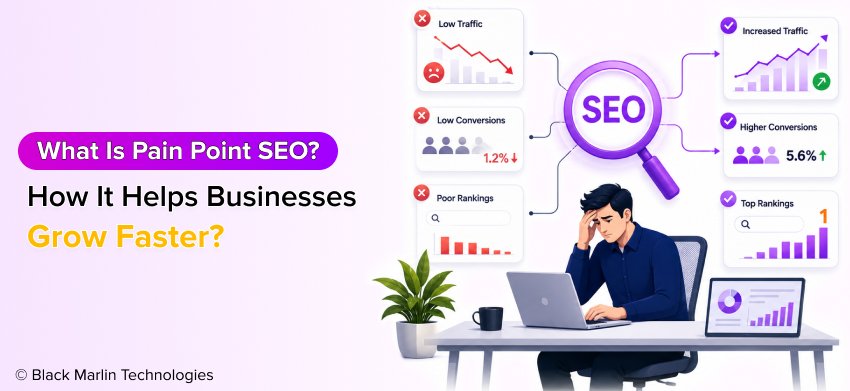 This is where Pain Point SEO becomes different.
Instead of going after those keywords with the highest search volume, Pain Point SEO is really about the pain issues customers are actively trying to fix. The best SEO services get the real customer intent and then make content that helps with specific challenges rather than just chasing rankings.
When someone searches for a solution to a specific challenge, they are often much closer to making a buying decision.
As a result, pain point-driven pieces of content often make higher conversion rates than the classic traffic-focused SEO stuff. In industry case studies, it shows that a few high-intent pages convert a few times better than top funnel content, even though they are getting less traffic.
In this guide, you’ll end up seeing what Pain Point SEO is about, why it really works, and how businesses can apply it alongside SEO services, so you can pull in more qualified leads, raise conversions, and grow even faster.
- What Is Pain Point SEO?
- Why Traditional SEO Often Fails to Generate Leads?
- Why Search Intent Matters More Than Traffic?
- Why Pain Point SEO Helps Businesses Grow Faster?
- Attracts High-Intent Visitors
- Generates More Qualified Leads
- Improves Conversion Rates
- Makes Ranking Easier
- Builds Trust Faster
- The 4 Types of Pain Points Every SEO Strategy Should Target
- Financial Pain Points
- Productivity Pain Points
- Process Pain Points
- Support Pain Points
- How to Find Customer Pain Points for SEO?
- 1: Talk to Your Sales and Customer Support Teams
- 2: Analyze Customer Reviews
- 3: Use SEO and Keyword Research Tools
- 4: Monitor Communities
- Pain Point SEO Keyword Framework
- Awareness Stage: Problem-Based Searches
- Consideration Stage: Solution-Based Searches
- Decision Stage: Buyer-Focused Searches
- High-Converting Pain Point Content Formats
- Comparison Pages
- Alternatives Pages
- Best Tools and Software Lists
- Pricing Pages and Cost Guides
- Case Studies and Success Stories
- Problem-Solution Guides
- Pain Point SEO Framework (P.A.I.N.)
- P – Pinpoint the Problem
- A – Analyze Search Intent
- I – Implement Solution Content
- N – Nurture the Conversion
- Pain Point SEO Success Metrics to Track
- Organic Leads
- Conversion Rate
- Demo Requests
- Contact Form Submissions
- Sales Qualified Leads (SQLs)
- Revenue from Organic Search
- Common Pain Point SEO Mistakes to Avoid
- Chasing Search Volume Over User Intent
- Ignoring Customer Research
- Writing Generic Content
- Using Weak or Missing CTAs
- Not Tracking Conversions
- The Future of Pain Point SEO in the AI Search Era
- Why AI Search Favors Pain Point SEO?
- User Intent Is Becoming More Important Than Keywords
- How Businesses Can Prepare for AI-Driven Search?
- Pain Point SEO and E-E-A-T
- Competitive Advantage in the AI Era
- Conclusion
- Frequently Asked Questions (FAQs)
What Is Pain Point SEO?
Have you ever wondered why certain websites get thousands of visitors but still can’t pull in leads or sales, even when the numbers look great? A lot of the time, the reason is the kind of keywords they aim for. Most businesses chase high-volume search phrases to boost visibility, yet not every visitor is truly prepared to buy.
Pain Point SEO has taken a slightly different approach. Instead of hunting down keywords with the biggest search volume, it leans into the precise problems, hurdles, and questions that potential customers keep typing in search. The aim is to craft genuinely helpful content that offers clear solutions and also connects with the people who are already actively looking for answers.
This strategy is becoming increasingly important for businesses that are investing in SEO services because it brings in visitors with stronger buyer intent. When your content actually covers real customer pain points, you are more likely to pull in qualified leads, improve conversion rates, and achieve better ROI from your SEO efforts.
Traditional SEO vs Pain Point SEO
| Traditional SEO | Pain Point SEO |
| Focus on traffic | Focus on conversions |
| High-volume keywords | High-intent keywords |
| Broad audience | Qualified audience |
| Awareness stage | Consideration & decision stage |
| More visitors | More leads |
Example of Pain Point SEO
Instead of targeting a broad keyword like:
“SEO tools”
A business using Pain Point SEO may target:
“Best SEO tool for small businesses with limited budgets”
Why Traditional SEO Often Fails to Generate Leads?
Many businesses pour resources into SEO to better rank, boost website traffic, and gain broader visibility online. Even if those aims sound solid, they do not always turn into real growth for the business. A site can end up ranking for hundreds of keywords and pull in thousands of visitors every month, but still remain stuck when it comes to turning that attention into qualified leads or sales.
The problem is that the usual SEO approach often leans too much on search volume, not really on search intent. Companies aim for wide keywords because they look compelling on paper, but a lot of those visitors just want knowledge, and they don’t have any immediate intention to become customers.
The Traffic Trap
Many companies celebrate metrics such as:
- More rankings
- More clicks
- More impressions
- Higher organic traffic
However, they often overlook the metrics that truly impact revenue:
- Qualified leads
- Sales opportunities
- Customer inquiries
- Revenue growth
Why Search Intent Matters More Than Traffic?
Not every website visitor brings the same worth to the table. A person looking up a general topic is usually in that investigation phase, while the one searching for a particular solution is often nearer to the point of purchase decision.
This is why companies that use SEO services should really focus on drawing in the right kind of audience rather than chasing the biggest audience, because more isn’t always better in the end. A smaller count of highly focused visitors can often bring in more leads than a large pile of untargeted traffic.
The Formula for SEO Success
A simple way to understand this concept is:
Traffic × Intent = Revenue Potential
Traffic brings visitors to your website, but intent is what decides if those people will actually do something. If the intent is weak, that traffic just becomes a vanity metric, looks great in reports, and looks impressive, yet it gives your business almost nothing in terms of growth.
The most successful SEO strategies blend discoverability with real user intent and make sure the content shows up for people who are actually looking for answers, goods, or offerings. That is pretty much why Pain Point SEO has turned into such a strong method for companies trying to draw in more leads and get better ROI from their SEO efforts.
Why Pain Point SEO Helps Businesses Grow Faster?
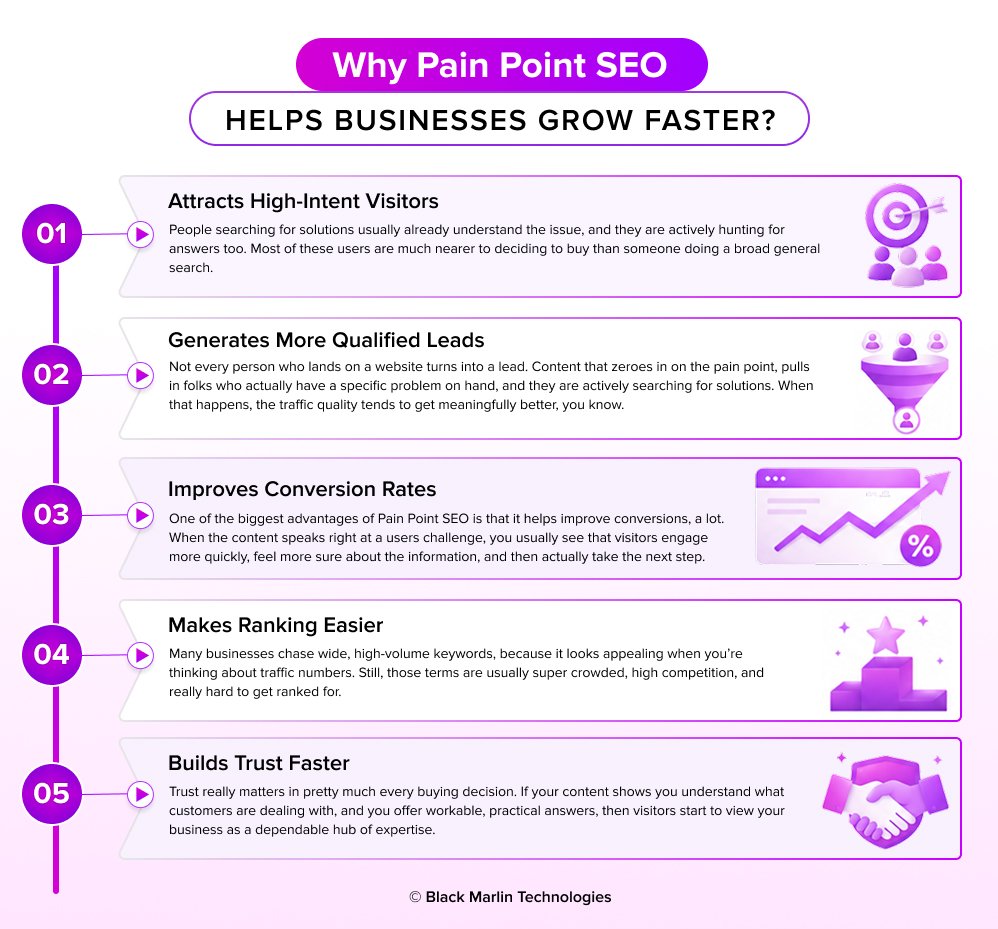
Many businesses think that more traffic automatically means more sales, and that is that. But in real terms, business growth comes from pulling in the right people, not only adding more eyeballs. This is basically where Pain Point SEO comes in, and it really stands out. By zeroing in on the customer challenges and building solution-centered content, companies can attract high-intent visitors who are more likely to turn into leads and customers.
Let’s explore why Pain Point SEO is becoming an essential part of modern SEO services and digital marketing strategies.
Attracts High-Intent Visitors
People searching for solutions usually already understand the issue, and they are actively hunting for answers too. Most of these users are much nearer to deciding to buy than someone doing a broad general search.
For example:
- Best CRM for small teams
- Shopify SEO agency
- How to reduce cart abandonment
- Affordable project management software
These searches show, pretty clearly, a real need, and usually they also point to strong buying intent. Instead of pulling in random visitors, Pain Point SEO helps companies connect with likely customers who are actively looking for solutions.
Generates More Qualified Leads
Not every person who lands on a website turns into a lead. Content that zeroes in on the pain point, pulls in folks who actually have a specific problem on hand, and they are actively searching for solutions. When that happens, the traffic quality tends to get meaningfully better, you know.
Consider this example:
Scenario A
- 1,000 visitors
- 3% conversion rate
- 30 leads
Scenario B
- 10,000 visitors
- 0.1% conversion rate
- 10 leads
Although Scenario B gets ten times the traffic, Scenario A pushes out three times as many leads. So it shows why aiming at customer pain points can really turn into better business outcomes than just chasing bigger traffic numbers.
Improves Conversion Rates
One of the biggest advantages of Pain Point SEO is that it helps improve conversions a lot. When the content speaks right at a user’s challenge, you usually see that visitors engage more quickly, feel more sure about the information, and then actually take the next step.
Whether the goal is filling out a contact form, booking a consultation, requesting a demo, or making a purchase, it’s that kind of content that helps with real problems, naturally, tends to push conversion results higher. So Pain Point SEO becomes a solid tactic for companies that care about lead generation and revenue growth.
Makes Ranking Easier
Many businesses chase wide, high-volume keywords because it looks appealing when you’re thinking about traffic numbers. Still, those terms are usually super crowded, highly competitive, and really hard to get ranked for.
Pain Point SEO focuses on specific customer challenges, which often means targeting less competitive keywords.
Benefits include:
- Lower keyword competition
- Faster ranking opportunities
- More targeted traffic
- Higher return on investment (ROI)
By targeting niche customer problems, businesses can often achieve rankings faster while attracting visitors who are more likely to convert.
Builds Trust Faster
Trust really matters in pretty much every buying decision. If your content shows you understand what customers are dealing with, and you offer workable, practical answers, then visitors start to view your business as a dependable hub of expertise.
So, for example, when somebody goes looking for an answer to a particular problem and then they stumble on a detailed, really useful guide on your site, they are more likely to place trust in your brand, rather than in a competitor who just throws out general information.
This trust often leads to:
- More inquiries
- More consultation requests
- More product demos
- More sales opportunities
Over time, consistently solving customer problems through content helps establish authority, strengthen brand credibility, and create long-term business growth.
The 4 Types of Pain Points Every SEO Strategy Should Target
To succeed with Pain Point SEO, businesses have to understand the troubles their target audience deals with every single day. People search online because they want to solve a problem, and they need to save time. They also try to cut expenses, and yes, they are looking for a more solid solution.
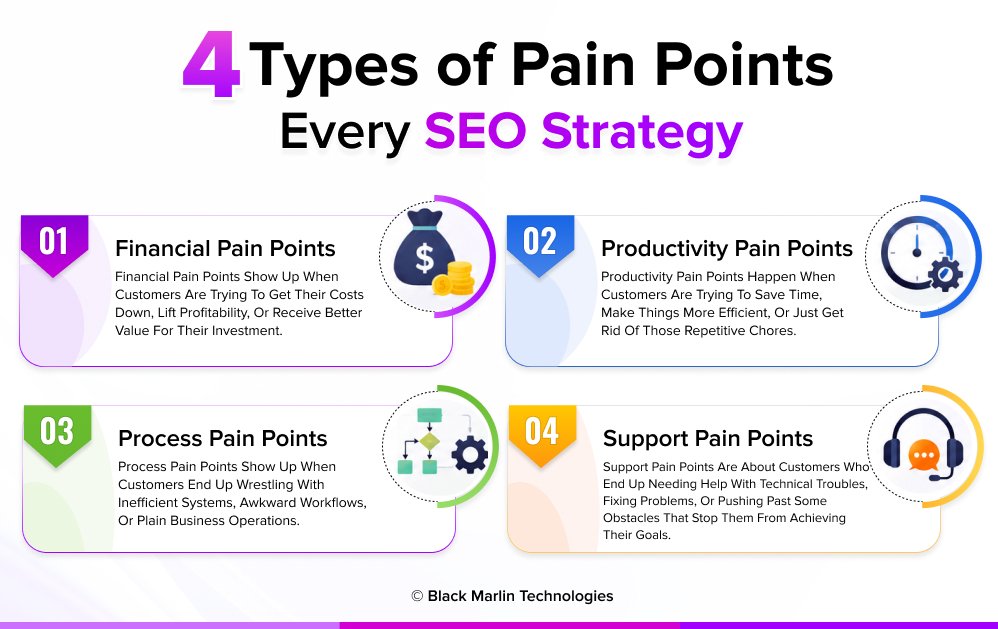
By spotting these pain points and building content around them, businesses can pull in visitors that are actually well qualified, who are more likely to click, engage, and convert. Most customer difficulties seem to fall into four big buckets: Financial, Productivity, Process, and Support Pain Points.
Financial Pain Points
Financial pain points show up when customers are trying to get their costs down, lift profitability, or receive better value for their investment. Cost is usually among the heaviest factors in purchasing decisions.
People who are looking for ways around financial troubles are usually weighing possibilities and also checking out the return on their investment.
Examples:
- Affordable SEO agency
- Reduce Google Ads cost
- Low-cost CRM software
- Budget-friendly marketing tools
For example, a business owner looking for an “affordable SEO agency” isn’t only seeking information. They are actively hunting for a reasonably priced resolution, which makes them a very valuable prospect.
Productivity Pain Points
Productivity pain points happen when customers are trying to save time, make things more efficient, or just get rid of those repetitive chores. In this rapid business world, companies are constantly hunting for ways to do more with fewer resources.
Content aimed at productivity frustrations tends to do well because folks are usually searching for tools, software, or tactics that make their work easier.
Examples:
- Best project management software
- How to automate reporting
- Time-saving marketing tools
- Improve team productivity
When businesses make content around those productivity-related searches, they tend to pull in users who are already hunting for answers, like ways to boost performance and streamline daily operations.
Process Pain Points
Process pain points show up when customers end up wrestling with inefficient systems, awkward workflows, or plain business operations. In practice, these users already sense something is off in the current process, so they keep looking for better ways to produce results.
This type of content works particularly well because it focuses on solving specific operational challenges.
Examples:
- Improve the lead generation process
- Website conversion optimization
- Sales funnel optimization
- How to improve customer onboarding
For instance, a company searching for “website conversion optimization” might actually be aiming at more leads and sales, so that makes them a pretty strong match as a potential customer for SEO Services, CRO, or digital marketing solutions.
Support Pain Points
Support pain points are about customers who end up needing help with technical troubles, fixing problems, or pushing past some obstacles that stop them from achieving their goals.
These searches often indicate urgency because the user is actively looking for assistance.
Examples:
- Fix slow website speed
- Recover from a negative SEO attack
- Resolve Google indexing issues
- Website security troubleshooting
People who are searching for support solutions are usually pretty motivated to act fast, so this category becomes quite valuable for lead generation and also for customer acquisition.
How to Find Customer Pain Points for SEO?
The success of Pain Point SEO really hinges on grasping what your customers are dealing with in the moment. When you understand those challenges, their questions, and even the little frustrations, you can craft content that speaks straight to what they actually need. This does more than boost search visibility, it also pulls in visitors who are more prone to turn into leads and customers.
The good news is that customer pain points are often pretty easy to pick up on, if you know where to look at first glance. Here are four effective ways you can uncover useful clues for your SEO strategy.
1: Talk to Your Sales and Customer Support Teams
Your sales and customer support teams talk with prospects and customers every day. They hear the same kinds of questions, objections, and worries again and again, and that can turn into pretty valuable content topics later.
Ask questions such as:
- What questions do prospects ask most often?
- What challenges prevent customers from buying?
- What objections appear repeatedly during sales calls?
- Which services or solutions are customers most interested in?
For instance, if prospects keep asking, “How long does SEO take to show results?” that question might turn into a blog post, or a FAQ page, or even a service page section.
By working alongside your in-house teams, you can surface actual customer worries that might not show up in ordinary keyword research tools.
2: Analyze Customer Reviews
Customer reviews give direct insight into what people enjoy, what they dislike, and what they struggle with. Most times, reviews show recurring issues that your audience really wants handled and solved.
Look for patterns on platforms such as:
- Google Reviews
- G2
- Trustpilot
- Capterra
- Facebook Reviews
Pay attention to comments about:
- Cost concerns
- Service quality
- Technical challenges
- Customer support issues
- Desired features or improvements
For instance, if several customers bring up slow site performance, this might nudge you toward making content around web speed tuning, technical SEO related fixes, or even Core Web Vitals improvements.
3: Use SEO and Keyword Research Tools
SEO tools can help dig up the exact terms and phrases that real people type when looking for solutions online. That lets you spot hidden pain points and content opportunities that might not be obvious at first glance.
Some of the best tools include:
- Semrush
- Ahrefs
- AnswerThePublic
- Google Search Console
- Google Trends
These platforms help identify:
- Problem-based searches
- Question keywords
- Long-tail keywords
- Emerging trends
- User intent patterns
For example, a keyword like “why is my website traffic dropping” clearly signals a trouble that visitors want to fix. Making content around those questions can pull in very targeted traffic.
4: Monitor Communities
Many customers openly talk about their frustrations and challenges in online communities, and honestly, it feels like it comes up everywhere. These spaces give unfiltered views on what your audience is thinking.
Explore communities such as:
- Quora
- LinkedIn Groups
- Facebook Groups
- Industry forums
Look for:
- Frequently asked questions
- Common complaints
- Product comparisons
- Industry challenges
- Requests for recommendations
For example, a Reddit thread that talks about struggles with lead generation could lead to a few different blog topics, step-by-step guides, plus little case studies aiming at that same pain point.
Pain Point SEO Keyword Framework
One of the biggest mistakes businesses make in SEO is going after the same kind of keywords for every stage of the customer journey, and that sounds neat on paper, but it usually fails in practice. People search in a different way depending on where they are in the buying process.
Someone who has just discovered a problem uses different search terms than someone who is ready to purchase a product or hire a service provider.
A successful Pain Point SEO strategy lines up keywords with each stage of the buyer journey. It helps companies produce content that matches what people need, builds credibility over time, and steers possible customers toward conversion.
Awareness Stage: Problem-Based Searches
At the awareness stage, users understand they have a problem, but they may not know what the best solution really is. They end up seeking information, education, and answers to their questions.
The goal at this stage is to make helpful content that explains the problem a bit and then brings in a few possible solutions.
Examples:
- Why is my website traffic dropping?
- Why are conversions low?
- Why is my website not ranking on Google?
- Why is my bounce rate high?
People searching those keywords are usually looking to figure out what exactly is causing their problem, not just reading generic info. Things like educational blog posts, step-by-step guides, checklist styles, and how-to articles tend to work best for these searches.
Content Goal: Build awareness and establish trust.
Consideration Stage: Solution-Based Searches
At this stage, users really understand what they are up against, and they are actively researching a few possible solutions. They go through options, check service providers, and try to figure out the most proper approach to solve that specific challenge.
This is where businesses can try to show up as experts by offering detailed comparisons, service pages, case studies, and solution-focused content.
Examples:
- Best SEO agency
- SEO consultant near me
- Best SEO tools for small businesses
- SEO company for e-commerce websites
Users at this stage have stronger intent than awareness-stage searchers because they are actively exploring available solutions.
Content Goal: Demonstrate expertise and showcase your solution.
Decision Stage: Buyer-Focused Searches
The decision stage is the moment where users are closest to becoming customers. They already figured out their preferred solution, and now they are scanning for final information before they move on and actually make a purchase decision.
These searches often include pricing, reviews, comparisons, testimonials, and service-specific terms.
Examples:
- SEO agency pricing
- SEO services reviews
- Best SEO company for small business
- SEO packages and pricing
Users searching these keywords often have the highest conversion potential because they are evaluating vendors and preparing to take action.
Content Goal: Drive inquiries, consultations, demos, or sales.
High-Converting Pain Point Content Formats
Not all content generates the same results. Some blog posts pull in big traffic, but they end up with very few leads. Other posts, they might bring in less footfall overall, yet they manage to drive noticeably more conversions.
The difference often comes down to user intent.
People searching for comparisons, other options, cost breakdowns, or remedies for particular headaches are usually already much nearer to making the purchase decision. That is why these types of content and formats tend to keep performing well in a Pain Point SEO strategy.
If your goal is to generate qualified leads, not just bump up traffic, you might want to push a few specific content types.
Comparison Pages
Comparison content helps users measure two or more products, services, or solutions before they decide. These searches often suggest a high commercial intent, because people are actively weighing their options.
Examples:
- Semrush vs Ahrefs
- Shopify vs WooCommerce
- HubSpot vs Salesforce
- Google Ads vs Facebook Ads
Comparison pages work well because they give users the right bits of information so they can decide, without feeling lost. When a business makes these comparisons balanced and informative, it often pulls in very high-quality visitors who are already in the weighing stage of the buying journey.
Why It Converts: Users are actively comparing solutions and are often close to purchasing.
Alternatives Pages
A lot of users start looking for alternatives when they are not happy with what they are using now, or when they want a better option. These searches often show a strong wish to change their product or services.
Examples:
- Alternatives to HubSpot
- Alternatives to Mailchimp
- Alternatives to Shopify
- Alternatives to Semrush
Alternative pages let businesses frame their product or service as a credible substitute, while pointing out its distinct features and advantages.
Why It Converts: Users are actively seeking a new solution and often have purchase intent.
Best Tools and Software Lists
“Best” list articles still seem to be one of the most effective kinds of content formats for pulling in people who are searching for answers and then weighing different options.
Examples:
- Best CRM for Small Business
- Best SEO Tools for Agencies
- Best Project Management Software
- Best Email Marketing Platforms
These articles help users narrow down their choices while giving businesses an opportunity to put on display their expertise and provide recommendations.
Why It Converts: Users are evaluating solutions and are often preparing to invest in a product or service.
Pricing Pages and Cost Guides
Pricing-related content pulls in some of the most high-intent visitors in search results. When people search for price details, they’re usually weighing whether a solution works with their budget.
Examples:
- SEO Pricing Guide
- E-commerce SEO Cost
- PPC Management Pricing
- Website Development Cost
Sharing transparent pricing details helps build trust, and it also answers one of the most common questions that potential customers have before they make a purchase.
Why It Converts: Users are assessing affordability and are often close to making a buying decision.
Case Studies and Success Stories
Case studies show real-world results, and they kind of indicate how a product or service was used to fix some particular issue. Instead of only claiming, they offer tangible proof that your solution really works. Plus, they help reduce buyer uncertainty.
Examples:
- How We Increased Leads by 200%
- SEO Case Study: 150% Growth in Organic Traffic
- How a SaaS Company Reduced Customer Acquisition Costs
- E-commerce Growth Success Story
Case studies are particularly effective because they combine storytelling with measurable outcomes.
Why It Converts: Prospects can see proven results and visualize similar success for their own business.
Problem-Solution Guides
This problem solution stuff directly taps into customer challenges and gives usable guidance, you know, practical steps, not theory. So it matches really well with the main ideas behind Pain Point SEO.
Examples:
- How to Recover From Negative SEO
- How to Fix Slow Website Speed
- How to Improve Conversion Rates
- How to Increase Organic Traffic
When people search these topics, they are, you know, actively trying to get help. If businesses answer with solid, practical solutions, they can earn real trust and begin to position themselves as true industry specialists.
Why It Converts: Content directly solves a problem the user is experiencing right now.
Pain Point SEO Framework (P.A.I.N.)
Finding customer pain points is really just the first step, after that you need to turn that knowledge into actual qualified traffic, lead generation, and sales. Many businesses try to jump ahead without a solid, structured process. This is where the P. A. I. N. Framework can help.
The P. A. I. N. Framework gives a straightforward and pretty effective way to craft content that matches what customers need and how ready they are to buy. Rather than just zeroing in on rankings, it leans on ironing out difficulties and ushering people toward action.
Let’s break down each step.
P – Pinpoint the Problem
The base of every successful Pain Point SEO strategy is understanding what your customers are struggling with. If you don’t know their challenges, it becomes hard to craft content that really resonates.
Start by identifying:
- Common customer frustrations
- Frequently asked questions
- Buying objections
- Industry-specific challenges
- Problems discussed in reviews and online communities
For example, a business offering SEO services may discover that potential clients frequently ask:
- Why is my website traffic dropping?
- Why am I not getting leads from SEO?
- How long does SEO take to show results?
These questions represent real customer pain points and can become valuable content opportunities.
Goal: Identify the problems your target audience wants solved.
A – Analyze Search Intent
Once you have pinpointed a pain point, the next step is getting a feel for what users truly want when they search.
Not all searching is the same intent, really. Some users need information, others are weighing alternatives or trying to clinch a purchase.
Ask yourself:
- Are users seeking information?
- Are they looking for a solution?
- Are they comparing providers?
- Are they ready to buy?
For example:
Keyword: “Why is my website traffic dropping?”
Intent: Educational and problem-focused.
Keyword: “Best SEO agency for small business”
Intent: Commercial and solution-focused.
Understanding intent helps you create content that matches user expectations and improves the chances of conversion.
Goal: Create content that aligns with the user’s stage in the buying journey.
I – Implement Solution Content
Once you recognize the issue and get a read on search intent, then it’s time to craft content that hands you a clear, actionable remedy.
The best Pain Point SEO content doesn’t just describe a problem it helps users solve it.
Effective content formats include:
- Step-by-step guides
- Blog articles
- Case studies
- Comparison pages
- Checklists
- Tutorials
- Service pages
For example, if users are searching for “How to improve website conversions,” your content should explain the causes of low conversions and provide practical steps to improve results.
Focus on:
- Clear explanations
- Actionable advice
- Real-world examples
- Data and insights
- Easy-to-follow solutions
Goal: Deliver valuable content that solves customer problems.
N – Nurture the Conversion
Many businesses make helpful content, but they skip, like, actually pointing visitors to the next step, and that’s where conversion optimization becomes essential.
Once users find value in your content, give them a clear path to take action.
Effective conversion elements include:
- Strong Calls-to-Action (CTAs)
- Case Studies
- Customer Testimonials
- Free SEO Audits
- Consultation Requests
- Contact Forms
- Product Demos
For example, after reading a guide on enhancing organic traffic, a visitor might get curious about a complimentary SEO audit or a quick consultation to spot oddities on their own website.
By nurturing visitors with trust-building elements and with relevant offers, you can turn organic traffic into quite qualified leads.
Goal: Convert visitors into prospects, leads, and customers.
Pain Point SEO Success Metrics to Track
One of the biggest advantages of Pain Point SEO is that the success can be gauged beyond rankings and traffic numbers. Traditional SEO often spends most of its effort on things like impressions, clicks, and keyword positions. Sure, those figures matter, but they do not always tell you if SEO is actually feeding business growth.
The real goal of Pain Point SEO is to pull in qualified visitors who are more willing to become leads and customers. That is why businesses should keep an eye on performance indicators that directly touch revenue and return on investment ROI.
Here are the most important Pain Point SEO metrics to monitor.
Organic Leads
Organic leads are those potential customers who find your website via search engines, then do what you want, like filling out a form, asking for a quote, or reaching out to your business.
This is one of the most important metrics because it shows whether your SEO strategy is attracting people who are genuinely interested in your products or services.
Why It Matters:
- Measures lead generation performance
- Indicates content relevance
- Connects SEO efforts to business growth
Example:
If your website receives 5,000 monthly visitors and generates 100 qualified leads, your SEO strategy is creating measurable business value.
Conversion Rate
Conversion rate measures the percentage of visitors who complete a desired action on your website.
Pain Point SEO often produces higher conversion rates because the content is designed around user challenges and buying intent.
Formula:
Conversion Rate (%) = (Conversions ÷ Total Visitors) × 100
Why It Matters:
- Indicates traffic quality
- Measures content effectiveness
- Helps identify high-performing pages
For example, a page targeting a specific customer pain point may convert at 3%–5%, while a general informational article may convert at less than 1%.
Demo Requests
If your business offers software, professional services, or consultations, demo requests are a strong indicator of purchase intent.
Visitors requesting a demo are often evaluating solutions and are much closer to making a buying decision.
Why It Matters:
- Signals high buying intent
- Measures sales readiness
- Helps identify high-value content
The more demo requests generated from organic search, the more effectively your content is attracting potential customers.
Contact Form Submissions
Contact forms are one of the most common lead generation tools on business websites.
When visitors submit a contact form, they are expressing interest in learning more about your services or discussing their needs.
Why It Matters:
- Measures lead generation success
- Indicates visitor engagement
- Tracks inquiry volume from SEO traffic
Businesses investing in SEO services should closely monitor which pages generate the most contact form submissions.
Sales Qualified Leads (SQLs)
Not all leads are equal. Some visitors may download a resource or submit a form without any intention of becoming a customer.
Sales Qualified Leads (SQLs) are prospects who have been evaluated and determined to have a genuine interest in purchasing.
Why It Matters:
- Measures lead quality
- Aligns SEO with sales goals
- Helps calculate SEO ROI
Tracking SQLs helps businesses understand whether their SEO strategy is attracting decision-makers rather than casual visitors.
Revenue from Organic Search
Ultimately, the most important SEO metric is revenue.
Revenue from organic search shows how much income your business generates from visitors who arrive through search engines.
Why It Matters:
- Demonstrates business impact
- Measures return on investment
- Connects SEO directly to profitability
For example, if organic traffic generates ₹10 lakh in annual revenue and your SEO investment is ₹2 lakh, the value of your SEO strategy becomes clear.
Common Pain Point SEO Mistakes to Avoid
Pain Point SEO can be one of the most effective ways to pull in qualified leads and push conversions higher. But many businesses don’t get the results they expect, mostly because they chase the wrong metrics, they miss customer insights, and they end up producing content that does not really touch on what users need.
Getting a grip on these frequent mistakes can actually help you craft a more efficient SEO strategy and maximize the return on what you put into your content investment.
Chasing Search Volume Over User Intent
One of the biggest mistakes in SEO is choosing keywords just because they show high search volume. Sure, those words might bring people in, but they don’t always lead to visitors who are really prepared to take action.
For example:
- “Digital Marketing” may attract a broad audience.
- “Best Digital Marketing Agency for Small Businesses” attracts users looking for a specific solution.
The second keyword could have lower search volume, but it often shows stronger buyer intent and also a higher conversion potential.
Successful Pain Point SEO is mostly about solving the customer’s problem in a clear way, not just chasing the largest traffic opportunities.
The Mistake: Prioritizing traffic over conversions.
The Solution: Focus on high-intent keywords that align with customer challenges and business goals.
Ignoring Customer Research
Many companies end up producing content from assumptions, rather than real customer insights. Then it goes like they publish articles that are well written, but they miss the exact questions and concerns their audience actually has.
Customer research is the foundation of Pain Point SEO.
Businesses should regularly gather insights from:
- Sales teams
- Customer support teams
- Reviews and testimonials
- Surveys and feedback forms
- Online communities and forums
When you actually understand your audience’s real challenge, you can make content that hits their needs in a resonant way and gives meaningful solutions.
The Mistake: Guessing what customers want.
The Solution: Use customer research to identify genuine pain points and content opportunities.
Writing Generic Content
The internet is filled with generic pieces that repeat information already available somewhere else. Stuff like that rarely makes a strong appearance in search results and often does not manage to build real trust with readers.
For example, an article titled:
“SEO Tips for Businesses”
is much less compelling than:
“How Small Businesses Can Increase Organic Leads Without Increasing Their Marketing Budget”
Pain Point SEO works best when the content is specific, practical, and directly tied to a customer problem.
To improve content quality:
- Use real examples
- Include actionable steps
- Share case studies
- Provide data and insights
- Address specific challenges
The Mistake: Creating broad, surface-level content.
The Solution: Publish detailed content that offers practical solutions and unique value.
Using Weak or Missing CTAs
Lots of businesses pour time and resources into making helpful content, but then they basically forget to nudge visitors toward the next step.
Even if a visitor finds your content useful, they might still walk away if there is no clear call to action CTA. Effective CTAs may include:
- Request a free consultation
- Get a free SEO audit
- Schedule a demo
- Download a guide
- Contact our team
A strong CTA helps convert website visitors into leads and customers.
The Mistake: Assuming visitors will know what to do next.
The Solution: Include relevant and compelling CTAs throughout your content.
Not Tracking Conversions
A lot of companies track SEO success by rankings, impressions, and traffic only. This is handy, sure, but it does not really tell you if SEO is feeding revenue growth.
Without conversion tracking, it becomes difficult to identify:
- Which pages generate leads
- Which keywords drive sales
- Which content produces the highest ROI
Important metrics to track include:
- Organic leads
- Conversion rates
- Contact form submissions
- Demo requests
- Sales qualified leads
- Revenue from organic search
Tracking these metrics lets organizations make data-driven decisions and continuously improve their SEO performance.
The Mistake: Measuring traffic without measuring business outcomes.
The Solution: Focus on lead generation, conversions, and revenue metrics.
The Future of Pain Point SEO in the AI Search Era
Search is changing even faster than it ever did before. Traditional search engines are, honestly, no longer the only route people use to find information online. These days, users are leaning more and more on AI-powered search setups that deliver direct answers, rather than just showing a list of websites.
With the rise of technologies such as:
- Google AI Overviews
- ChatGPT Search
- AI-powered search engines
- Generative AI assistants
- Voice and conversational search
Businesses must rethink how they approach SEO.
The good news is that Pain Point SEO is perfectly aligned with the direction search is heading.
Why AI Search Favors Pain Point SEO?
AI search engines are built to catch what a person is really trying to find and then give the most helpful response for a particular question or issue. Rather than pay attention only to the keywords, these AI systems look at whether the content actually answers the users’ needs.
For example, when someone searches:
“Why is my e-commerce store getting traffic but no sales?”
AI-powered search engines look for content that:
- Clearly explains the problem
- Identifies potential causes
- Provides actionable solutions
- Demonstrates expertise and credibility
This is exactly what Pain Point SEO aims to achieve.
Companies that craft problem-solving content tend to gain more visibility across classic search results and also in AI-generated responses.
User Intent Is Becoming More Important Than Keywords
For many years, SEO was heavily about keyword optimization. Still, keywords matter, but in more recent times, search engines increasingly care about the purpose behind a search query.
AI systems can interpret:
- User goals
- Search context
- Conversational queries
- Follow-up questions
- Problem-solving intent
That goes for content that speaks straight to customer challenges, it will have more chance of showing up in AI-generated answers.
Instead of asking:
“What keyword should I target?”
Businesses should start asking:
“What problem is my customer trying to solve?”
That mindset is at the heart of Pain Point SEO.
The Rise of Conversational Search
Users are increasingly searching in a more natural and conversational way.
For example:
Traditional Search: SEO agency
Conversational Search: Which SEO agency is best for a small ecommerce business?
Traditional Search: CRM software
Conversational Search: What is the best CRM for a startup with a limited budget?
These longer, problem-focused searches fit the whole Pain Point SEO idea pretty well and they often show more direct buying intent.
Businesses that are making content around real customer questions will be better positioned for the future of search.
How Businesses Can Prepare for AI-Driven Search?
To stay competitive, businesses should focus on creating content that:
- Solves real customer problems
- Answers specific questions
- Demonstrates expertise and experience
- Includes practical examples
- Provides actionable recommendations
- Uses clear and easy-to-understand language
In addition, content should be structured with:
- Clear headings and subheadings
- FAQ sections
- Step-by-step explanations
- Case studies
- Statistics and supporting evidence
These elements make it easier for both search engines and AI systems to understand and reference your content.
Pain Point SEO and E-E-A-T
As AI search evolves, Google’s E-E-A-T principles continue to play an important role:
- Experience
- Expertise
- Authoritativeness
- Trustworthiness
Content that solves real-world problems while showing genuine expertise is more likely to be trusted by both users and search engines.
This is another reason why Pain Point SEO is becoming more and more valuable for businesses that are investing in long-term SEO growth.
Competitive Advantage in the AI Era
Many companies still focus on search volume and rankings mostly. Yet businesses that understand customer pain points and end up building very relevant content can get a real advantage.
Benefits include:
- Higher-quality organic traffic
- Better engagement rates
- Increased conversions
- Improved AI search visibility
- Stronger brand authority
- Sustainable long-term growth
As AI keeps shifting how people find information, businesses that place the customer’s needs first will be in a better position to stand out.
Conclusion
In today’s competitive digital environment, just producing more traffic isn’t enough anymore. Companies require visitors who are genuinely interested in their products, services, or the answers they offer. This is the place where Pain Point SEO makes a big difference. Rather than only chasing high-volume keywords, it leans into the true difficulties, the ongoing questions, and even those everyday frustrations customers are actively trying to solve.
By creating content that speaks to certain pain points, businesses can pull in high-intent visitors, boost conversion rates, get more qualified leads, and generate a better return on their SEO investment. This more customer-centered method helps close the distance between traffic and revenue, making sure the SEO work actually feeds business growth.
As search engines keep evolving into AI-powered experiences like Google AI Overviews and ChatGPT Search, understanding what people actually want will become even more important. Businesses that invest in solution-driven content and focus on giving their audiences a path to success will be in a stronger position to earn visibility, build trust, and stay ahead of competitors.
Ultimately, Pain Point SEO is not just an SEO strategy it is a long-term growth plan that helps businesses attract the right audience, address real issues, and turn organic traffic into measurable business results.
Frequently Asked Questions (FAQs)
Q1. What is Pain Point SEO?
Ans1. – Pain Point SEO is an SEO strategy that leans into finding real customer challenges and then making content that offers help, like a clear remedy. Rather than chasing only high-volume keywords, it pays attention to subject matter that actually tackles what people struggle with. With this method, businesses can draw in visitors with stronger intent who are more likely to turn into leads and later customers.
Q2. How is Pain Point SEO different from traditional SEO?
Ans1. – Traditional SEO mostly works by pushing for more traffic via high-volume keywords and trying to win rankings. But Pain Point SEO is more about understanding what customers actually need, solving the concrete problems they have, and pulling in visitors who already show stronger buying intent. The aim is not only extra visits, but it is also better, higher-quality traffic that ends in conversions and revenue.
Q3. Why does Pain Point SEO generate more leads?
Ans1. – Pain Point SEO is aimed at people who are actively searching for answers to their own issues. Since these users are already aware of what is wrong, they tend to be later in the purchase path. That usually means stronger engagement, better conversion rates, and more qualified leads than what you would get from broad informational content.
Q4. How do you identify customer pain points?
Ans1. – Businesses can identify customer pain points by talking with sales and support teams, then looking at customer reviews, running surveys, using keyword research tools, and also keeping an eye on online communities, like Reddit, Quora, LinkedIn Groups, and industry forums. All those inputs give useful perspectives into the usual customer obstacles and concerns.
Q5. What are high-intent keywords?
Ans1. – High-intent keywords are search phrases that show a user is actively looking for an answer, product, or service. Like “best SEO agency”, “SEO consultant near me” and “SEO pricing”. These terms usually get less search volume than wider queries, but in return, they often bring higher conversion rates.
Q6. Does Pain Point SEO work for local businesses?
Ans1. – Yes. Pain Point SEO is really good for local businesses, it helps pull in customers who are actively looking for a precise solution in a certain area. Like, you can build content aimed at searches such as “best plumber for water leak repair” or “local SEO services for small businesses” and that can bring in very qualified leads nearby.
Q7. Is Pain Point SEO effective for SaaS companies?
Ans1. – Absolutely. SaaS organizations can use Pain Point SEO in order to catch people who are actively typing searches about software-related problems, like they need a fix right now. If the content zooms in on productivity friction, workflow enhancements, automation, lowering operating costs, and software head-to-head comparisons, it tends to pull in the decision makers who are already assessing tools and platforms.
Q8. What tools help find pain point keywords?
Ans1. – Several tools can help uncover customer pain points and keyword opportunities, including:
- Semrush
- Ahrefs
- AnswerThePublic
- Google Search Console
- Google Trends
- AlsoAsked
- Quora
These tools help identify common questions, problems, and search trends that can be turned into valuable content topics.
Q9. How do I measure Pain Point SEO success?
Ans1. – The success of Pain Point SEO should be measured using business-focused metrics rather than traffic alone. Key performance indicators include:
- Organic leads
- Conversion rate
- Contact form submissions
- Demo requests
- Sales qualified leads (SQLs)
- Revenue from organic search
These metrics provide a clearer picture of how SEO contributes to business growth.
Q10. Can Pain Point SEO improve conversion rates?
Ans1. – Yes. Because Pain Point SEO makes the content match real user intent, visitors are more likely to stick around, engage with it, and then take action. When you focus on distinct customer challenges and give fitting, useful solutions, the business gains more trust, drives stronger lead generation, and reaches higher conversion rates than the usual traffic-first SEO strategies.