'>
<rect width='100' height='100' fill='%23B22234'/>
<!-- stripes -->
<g fill='%23fff'>
<rect y='10' width='100' height='10'/>
<rect y='30' width='100' height='10'/>
<rect y='50' width='100' height='10'/>
<rect y='70' width='100' height='10'/>
<rect y='90' width='100' height='10'/>
</g>
<!-- blue box -->
<rect width='50' height='50' fill='%233C3B6E'/>
</g>
</svg>)
'>
<rect width='100' height='100' fill='%23fff'/>
<rect width='100' height='33.33' y='0' fill='%23FF9933'/>
<rect width='100' height='33.33' y='66.66' fill='%23138808'/>
<!-- Ashoka Chakra -->
<circle cx='50' cy='50' r='9' fill='none' stroke='%23000080' stroke-width='2'/>
<g stroke='%23000080' stroke-width='1'>
<line x1='50' y1='41' x2='50' y2='59'/>
<line x1='41' y1='50' x2='59' y2='50'/>
<line x1='44' y1='44' x2='56' y2='56'/>
<line x1='56' y1='44' x2='44' y2='56'/>
</g>
</g>
</svg>)
 info@blackmarlintechnologies.com

Imagine you wrote this great book, but then forgot to put a title and a summary on the cover. Even when the story inside is truly amazing, people might not ever grab it because they do not have a clear idea, of what the whole thing is about.
The same thing kinda happens with websites. Search engines like Google need clear info to understand a webpage first, before showing it to people. That info is metadata. It acts like a label that tells search engines what your page holds, and why it is useful for a particular search query.
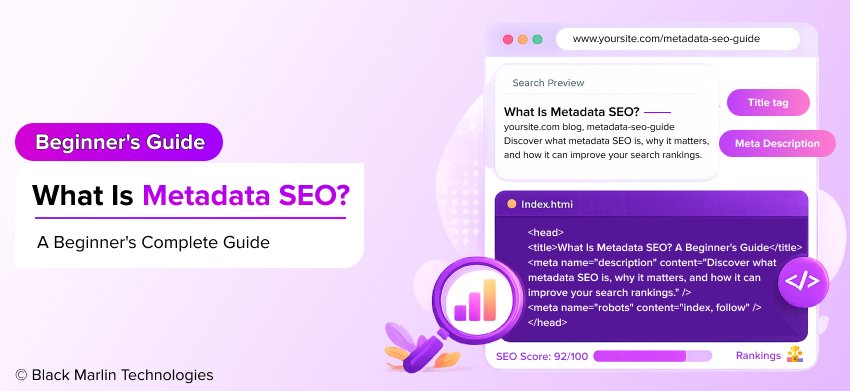 Metadata has things like title tags, meta descriptions, robots tags, and structured data. Visitors usually do not see any of it straight on the page, but search engines do use it, to grasp what the content is about and to show better search results, plus it helps the overall user experience.
Good metadata helps boost visibility and pull in more clicks, while also improving organic traffic. Meanwhile, if metadata is missing , or only weakly optimized, even really high quality content can struggle to land in front of the right audience.
In this beginner friendly guide you will learn what metadata is, why it matters for SEO, what the various types of metadata are, which common mistakes to avoid, and which best practices to use for optimizing metadata in 2026.
- What Is Metadata SEO?
- Why Is Metadata Important for SEO?
- Helps Search Engines Understand Content
- Improves Click-Through Rate (CTR)
- Supports Better User Experience
- Helps AI Search Engines Understand Your Content
- Types of Metadata in SEO
- Meta Title Tag
- Meta Description
- Robots Meta Tag
- Meta Viewport Tag
- Schema Markup (Structured Data)
- Common Metadata Mistakes to Avoid
- Duplicate Title Tags
- Missing Meta Descriptions
- Keyword Stuffing
- Titles That Are Too Long
- Misleading Meta Descriptions
- Metadata SEO Best Practices for 2026
- Write for Humans First
- Use Natural Keywords
- Optimize for Click-Through Rate (CTR)
- Match Search Intent
- Add Structured Data
- Monitor Search Console Performance
- Update Old Metadata Regularly
- How Metadata Helps AI Search Engines and ChatGPT?
- Clarifies Page Topics
- Improves Content Categorization
- Supports Structured Data Interpretation
- Enhances Content Discoverability
- Frequently Asked Questions
What Is Metadata SEO?
Metadata is, really , the simplest way to see it is like thinking of it as data about data. Basically it gives additional bits of detail that help both people and search engines grasp what something is about before they actually look at it.
When it comes to websites, metadata in SEO is basically hidden info that gets tucked into a webpage’s HTML code. Visitors usually do n’t notice it directly on the page, because it does n’t show up in the normal view. Still, search engines like Google use that data to better understand what the page is about, judge its relevance, and figure out how it should appear in search results.
Think of metadata as a tag that sits on your webpage. Like a label on a file folder that tells you what is inside without opening it, metadata tells search engines what your page holds before they review the whole content. So it helps them sort things more easily, and then place your site into the right results for relevant searches.
In this example:
- The Meta Title acts like the book’s title and tells searchers what the page is about.
- The Meta Description works like a short summary that encourages people to learn more.
- The Robots Tag gives instructions to search engines about how to crawl and index the page.
- Schema Markup helps search engines understand the content type and important details on the page.
Why Is Metadata Important for SEO?
Now that you understand what metadata is, you may be curious about why it matters so much for SEO. After all, if visitors cannot see most metadata directly on a webpage, does it really make a difference?
The answer is yes.
Metadata acts like a communication bridge between your website, search engines,and users. It helps search engines interpret what’s on the page, boosts how your pages get presented in search results, and may affect whether people decide to click through to your site. Well crafted metadata might not secure a top ranking, yet it gives search engines usable context that can strengthen your visibility and the whole search performance.
Let’s look at some of the biggest benefits of metadata in SEO.
Helps Search Engines Understand Content
Search engines crawl billions of webpages every day, and metadata gives clear signals that help them grasp quickly what the page is about, really.
For example, if a webpage talks about email marketing strategies, the meta title and the meta description can tell Google, pretty clearly, what people will get once they land there. This makes it easier for search engines to match your content with relevant search queries and show it to the right audience.
Without proper metadata, search engines may have trouble figuring out what your page is for, and then your page may be seen less in search results.
Improves Click-Through Rate (CTR)
Getting your page shown in Google is only half the battle, after that there is the next hurdle , getting people to actually click it.
A strong meta title and meta description really can make your listing stand out, you know, among competitors. When people spot a description that is clear, aligned, and slightly captivating, they are more likely to actually go to your website.
For example, compare these two search results:
- Generic Title: SEO Guide
- Optimized Title: Beginner’s SEO Guide: 15 Easy Tips to Improve Rankings in 2026
Most users are more likely to click the second choice, since it clearly describes the value of the content. When the click-through rate goes up, you usually get more traffic, and then you see stronger involvement on your website.
Supports Better User Experience
Metadata doesn’t only help search engines it also helps users.
Well written metadata gives visitors a clear view of what to expect before they click on a page. it reduces confusion a bit and helps people locate the information they need more quickly.
Plus, some metadata elements are still really important in helping web pages render well on different devices browsers, and operating systems. Since mobile users now represent a big chunk of online searches, it becomes crucial to make sure your content appears correctly on phones and tablets, which is an important part of providing a good user experience.
Helps AI Search Engines Understand Your Content
Search is evolving past the old-school search engine stuff. AI-powered tools, like ChatGPT, Google AI Overviews and other generative search platforms, use a mix of signals to sort of grasp the meaning of content, then later give back a summary.
Metadata helps these systems figure out what the webpage is about, the intention behind it , and also the surrounding context more accurately. Things like meta titles, meta descriptions, and structured data do give useful cues, so AI systems can interpret the content better and then craft responses.
As AI driven search keeps growing having clear, and well optimized metadata can help increase the chances that your content gets understood, referenced, and pulled into relevant search experiences.
Types of Metadata in SEO
Not all meta data serves the same purpose. In fact, different kinds of meta data give different signals to search engines, helping them figure out, arrange, and show your content correctly. Some meta data affects how your page looks in search results, while other types are more for search engine crawlers, or they add extra context about the content itself.
Let’s explore the most important types of metadata in SEO and how each one contributes to better search visibility.
Meta Title Tag
The meta title tag is that clickable headline thing people see in search engine results. It is often the first bit people notice when they are deciding whether to go to a webpage, so it becomes one of the most crucial elements for on-page SEO.
A good title tag sort helps search engines grasp what your page is really about, while it also invites people to click on your listing. Since it shows up prominently in search results, the title should plainly explain the page content, and include useful keywords.
Best Practices for Meta Title Tags
- Keep titles under 60 characters when possible.
- Include your primary keyword naturally.
- Make the title clear and easy to read.
- Focus on user intent and relevance.
- Avoid keyword stuffing or repeating the same phrase unnecessarily.
- Use action words or numbers when appropriate to improve engagement.
A strong meta title can improve visibility, attract more clicks, and help search engines better understand your content.
Meta Description
The meta description is a brief summary, that shows up just under the title tag in search results, you know. It is mostly there to give readers a quick view of what they will find once they enter the page.
Meta descriptions are not a direct ranking factor, but they can genuinely impact click-through rates, a lot. A good, slightly persuasive snippet can lead people to pick your result instead of competing pages.
Best Practices for Meta Descriptions
- Keep descriptions between 150 and 160 characters.
- Include the target keyword naturally.
- Clearly explain the page’s value.
- Add a call-to-action when appropriate.
- Ensure the description matches the actual page content.
- Make it engaging and relevant to search intent.
Think of the meta description as a short advertisement for your webpage. The better it explains the value of your content, the more likely users are to click.
Robots Meta Tag
The robots meta tag gives guidance to search engine crawlers about how they should behave when they reach a webpage. It lets website owners set the boundaries for whether a page makes it into search results, and also if the links on that page should be followed.
For example, some pages may contain private information, duplicate content, or temporary content that should not be indexed by search engines.
Common Robots Tag Examples
index, follow
This tells search engines to index the page and follow its links.
noindex, follow
This tells search engines not to display the page in search results while still allowing crawlers to follow the links on the page.
The robots tag is an important technical SEO tool because it gives website owners greater control over how content is crawled and indexed.
Meta Viewport Tag
The meta viewport tag helps webpages display properly on different screen sizes, especially mobile devices.
Today, people access websites using smartphones, tablets, laptops, desktop computers too. If viewport settings are missing or wrong, then a webpage can look too tiny, hard to reach and scroll, or poorly arranged on mobile screens.
The viewport tag ensures that content automatically adjusts to fit the user’s device, creating a better browsing experience.
Schema Markup (Structured Data)
Schema markup, also called structured data, gives extra details about a webpage. This, helps search engines understand the content and its context a bit more clearly.
Unlike standard metadata, schema markup gives search engines detailed information about specific elements on a page, such as products, reviews, recipes, events, and frequently asked questions.
Common Schema Markup Examples
- Product pages
- Customer reviews
- FAQ sections
- Articles and blog posts
- Events
- Local business information
- Recipes
For example, if you publish a product page, schema markup can tell search engines the product name, price, rating, and availability. This information may appear directly in search results as rich snippets, making your listing more noticeable and informative.
Common Metadata Mistakes to Avoid
Making metadata is, honestly, a big deal but just slapping in a title and description is not enough. A lot of site owners make tiny metadata blunders and it can reduce search visibility, lower click through rates, and also create a less pleasant experience for visitors.
The good news is that most of these issues are kind of easy to fix once you know what to look for, it’s not like rocket science. Below are some of the most common metadata problems and how they can end up affecting your SEO results.
Duplicate Title Tags
One of the most common SEO problems is using the same title tag on multiple pages.
On every page of your website, you want a unique title that kind of mirrors what’s actually there. If you end up reusing the same title on multiple pages, search engines can get confused, and well, they don’t always know how to tell the pages apart. That situation may end up making it tougher for the page you care about to rank for the right, relevant searches.
Missing Meta Descriptions
Some websites publish pages without adding a meta description. When this happens, search engines may automatically generate a description using page content.
While Google can create its own snippet, it may not always highlight the most relevant information or encourage users to click.
Keyword Stuffing
Keywords are important for SEO, but using them too many times can do more harm than good.
Keyword stuffing happens when website owners repeatedly insert the same keyword into titles or descriptions in an unnatural way.
Titles That Are Too Long
Your title tag should be informative, but it should also be concise.
When titles are too long, search engines may cut them off in search results. This is known as title truncation.
Misleading Meta Descriptions
Your meta description should accurately reflect the content of the page.
Some websites use exaggerated or misleading descriptions simply to attract clicks. While this may increase initial traffic, it often leads to disappointed visitors who leave the page quickly.
Metadata SEO Best Practices for 2026
Metadata has been an important part of SEO for quite a few years now, but honestly the way search engines read and assess content keeps shifting. By 2026, doing “good” metadata optimization is not only about dropping keywords into title tags and descriptions. Search engines, plus AI powered search tools, are getting much better at picking up context, matching user intent, and judging content quality, even when the exact phrase isn’t repeated.
To maximize visibility and, honestly, improve user engagement your SEO metadata should be pretty accurate, concise relevant, and matched up with what is actually on the page. If you follow the best practices below it can help your site do better in both classic search engines and newer AI driven search experiences.
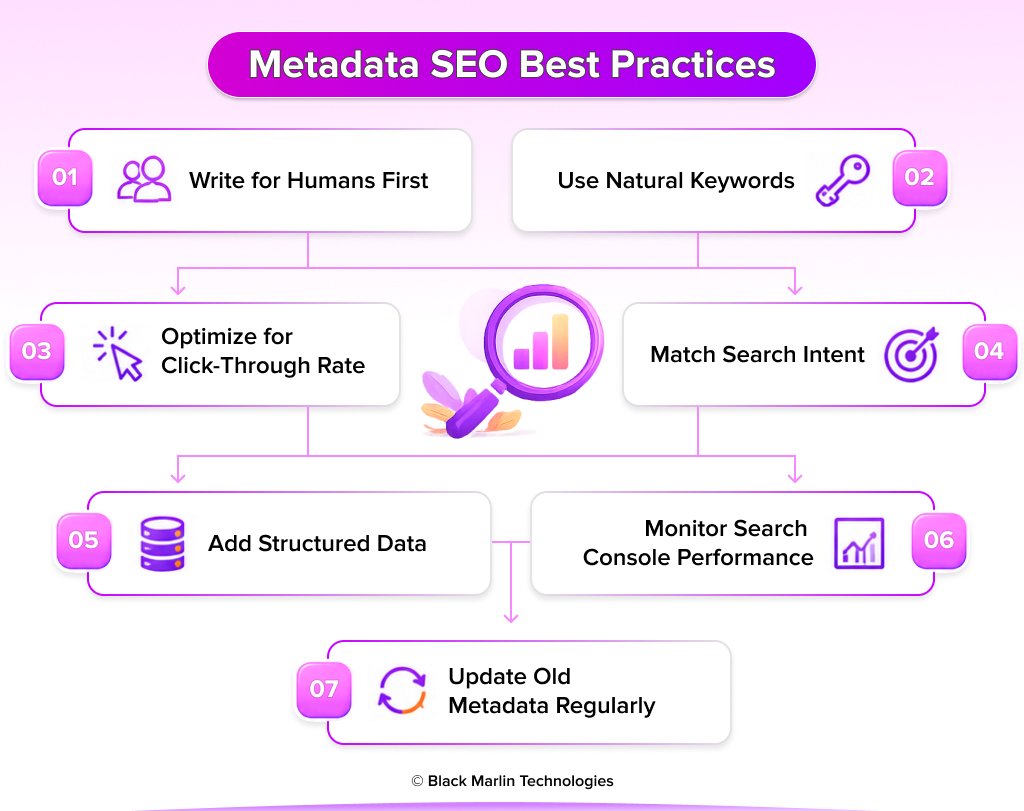
Write for Humans First
The primary purpose of metadata is more or less to help users grasp what a webpage offers. While keywords are still important, your titles and descriptions should always be written with actual people in mind, not just search systems.
Use Natural Keywords
Keywords help search engines understand page topics, but they should fit naturally within your metadata.
Rather than keep saying the same phrase, sprinkle in keywords where they naturally fit. Write with readability in mind, not that repetition, you know? Most modern search engines can grasp context, plus the adjacent related terms, so going for keyword stuffing doesn’t work the way it used to.
Optimize for Click-Through Rate (CTR)
Ranking on the first page of Google is valuable, but earning clicks is equally important.
Your metadata should encourage users to choose your result over competing pages. A compelling title and description can significantly improve click-through rates and drive more organic traffic.
Match Search Intent
One of the most important SEO principles in 2026 is understanding search intent.
Search intent refers to the reason behind a user’s query. Some users want information, while others want to compare products, solve a problem, or make a purchase.
Your metadata should clearly match the intent of the page and the expectations of the searcher.
Add Structured Data
Structured data, also known as schema markup, provides additional information that helps search engines understand content more accurately.
Schema can identify important details such as:
- Articles
- Products
- Reviews
- FAQs
- Events
- Recipes
- Local businesses
Adding structured data can increase the chances of earning enhanced search features, such as rich snippets, review stars, FAQ dropdowns, and other visual enhancements.
As AI-powered search engines continue to grow, structured data also helps machines understand relationships between topics, entities, and content elements more effectively.
Monitor Search Console Performance
Metadata optimization should not stop after publishing a page.
Regularly reviewing performance data helps you understand how users interact with your search listings and identify opportunities for improvement.
Tools such as Google Search Console allow you to track:
- Impressions
- Clicks
- Click-through rate (CTR)
- Average ranking position
- Search queries
If a page receives many impressions but very few clicks, updating the title or meta description may improve performance.
Small metadata changes can often lead to noticeable increases in organic traffic.
Update Old Metadata Regularly
SEO is constantly changing, and metadata should evolve with it.
Older pages may contain outdated keywords, incomplete descriptions, or titles that no longer match current search trends. Reviewing metadata periodically helps keep content relevant and competitive.
Consider updating metadata when:
- Search trends change.
- New keywords emerge.
- Content is expanded or revised.
- CTR begins to decline.
- Industry information becomes outdated.
Adding the current year, improving descriptions, or refining title tags can often refresh a page’s search performance without changing the core content.
How Metadata Helps AI Search Engines and ChatGPT?
Search is changing, rapidly, honestly. Traditional search engines like Google still lean on metadata to get a sense of what a webpage is about, but modern AI powered search tools are pushing content discovery to a whole other level. Stuff like ChatGPT, Google AI Overviews, Microsoft’s Copilot, and other generative search engines are basically digesting massive amounts of information, then they deliver a direct answer instead of just showing a list of links.
To get content right, these AI systems lean on lots of little signals, like the actual page text, the headings , structured details, links, and also metadata. Even if metadata by itself isn’t enough to promise visibility, it still kind of gives useful context , so AI systems can better understand what the webpage is truly about.
Let’s explore how well-optimized metadata supports AI-powered search experiences.
Clarifies Page Topics
One of the biggest challenges for AI systems is understanding the main topic of a webpage quickly and accurately.
Metadata gives fairly solid signs about what the page is talking over before the AI actually reads everything on it. Things like title tags and meta descriptions, kind of act like a quick recap , they summarize the page and make it easier to figure out the real main focus.
Improves Content Categorization
AI search engines organize information into categories and topics to deliver more relevant responses.
Metadata helps classify content correctly by providing concise descriptions of what a page covers. This allows AI systems to determine whether the content belongs to categories such as:
- SEO
- Digital Marketing
- Content Marketing
- E-commerce
- Web Development
- Technical SEO
Accurate categorization increases the likelihood that your content will be surfaced when users search for related topics or ask AI-powered assistants specific questions.
Supports Structured Data Interpretation
Metadata works even better when combined with structured data, also known as schema markup.
Structured data provides detailed information about content elements such as:
- Articles
- FAQs
- Products
- Reviews
- Events
- Organizations
AI systems use this information to understand relationships between topics, entities, authors, products, and other important content elements.
Enhances Content Discoverability
Good metadata makes content easier to discover across search engines and AI-powered platforms.
When metadata clearly describes the page topic, users and machines can quickly determine whether the content matches a specific query. This improves the chances of your page appearing in:
- Traditional search results
- AI-generated summaries
- Featured snippets
- Knowledge panels
- Voice search results
- Generative search experiences
Well-optimized metadata acts as a roadmap that guides search systems toward understanding and presenting your content to the right audience.
As AI search technology continues to evolve, discoverability becomes increasingly important for maintaining online visibility.
Frequently Asked Questions
Q1. What is metadata in SEO?
Ans1. Metadata in SEO is information added to a webpage’s HTML code that helps search engines understand the page content. It provides details such as the page title, description, indexing instructions, and content type, making it easier for search engines to display relevant results to users.
Q2. Does metadata affect Google rankings?
Ans2. Metadata can influence SEO performance, but not all metadata elements directly affect rankings. Title tags help search engines understand page topics, while well-written meta descriptions can improve click-through rates. Together, these elements can increase visibility and attract more visitors from search results.
Q3. What is a meta title?
Ans3. A meta title, also known as a title tag, is the clickable headline displayed in search engine results. It summarizes the page content and helps both users and search engines understand what the webpage is about before they visit it.
Q4. What is a meta description?
Ans4.A meta description is a short summary that appears below the title tag in search results. Its purpose is to explain the page content and encourage users to click on the result. A clear and engaging description can improve click-through rates and enhance the search experience.
Q5. Are meta keywords still important?
Ans5. No. Major search engines such as Google no longer use the meta keywords tag as a ranking factor. Because the tag was frequently abused through keyword stuffing, search engines stopped relying on it for ranking purposes. Today, website owners should focus on high-quality content, optimized title tags, and descriptive meta descriptions instead.
Q6. How often should metadata be updated?
Ans6. Metadata should be reviewed regularly to ensure it remains accurate and relevant. A good practice is to audit your metadata every few months or whenever significant content updates are made. Updating outdated titles and descriptions can improve click-through rates, align content with current search trends, and support better SEO performance.
Q7. Can a page rank without metadata?
Ans7. Yes, a page can still rank without custom metadata, but it may not perform as well as a fully optimized page. Search engines may generate their own titles and descriptions, which might not accurately represent the content or encourage users to click. Optimized metadata provides greater control over how your page appears in search results.
Q8. What is the ideal length for a meta title and meta description?
Ans8. For best results, meta titles should generally stay under 60 characters, while meta descriptions should remain between 150 and 160 characters. Keeping metadata within these limits helps prevent truncation in search results and ensures users can see the complete message.
Q9. Why is metadata important for AI-powered search engines?
Ans9. AI-powered search tools use metadata as one of several signals to understand webpage topics and context. Clear metadata can help improve content categorization, support structured data interpretation, and make information easier for AI systems to analyze and surface in relevant search experiences.
Q10. What is the difference between metadata and schema markup?
Ans10. Metadata provides general information about a webpage, such as the title and description. Schema markup is a type of structured data that gives search engines more detailed information about specific content elements, such as products, reviews, FAQs, events, and articles. Both work together to improve content understanding and search visibility.