+1-(646) 362-1414
 +91 8826683820
 info@blackmarlintechnologies.com

Google Search is changing very fast, and Google AI Overviews are a key reason for that. Instead of just displaying a list of blue links, Google utilizes artificial intelligence to summarize the most relevant answer directly at the top of the search results page. These AI-generated summaries make it simpler for users to receive quick and clear answers rather than having to pull up multiple websites.
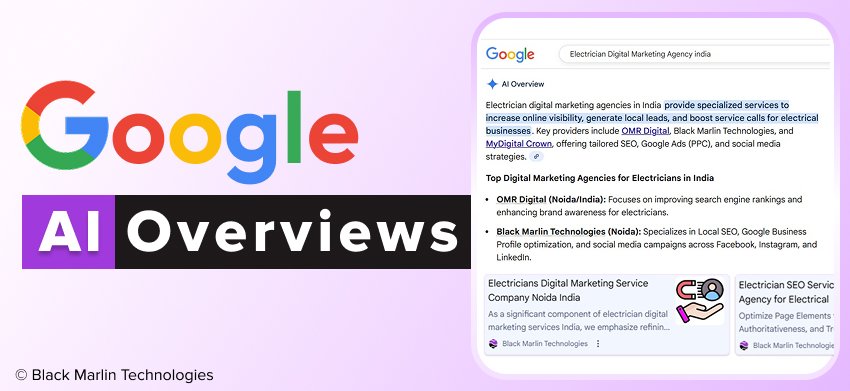 According to the shift, one thing becomes most important: the standard SEO alone would not suffice anymore. In the broad theme of the hierarchy of needs, ranking for keywords can still be valuable, but the AI of Google has now gone one further. It has begun to address search intent, content clarity, topical authority, and trust—and not just mere presence of a given set of keywords. If your content does not clearly answer questions, the AI of Google might just skip right over it.
This is where AI SEO optimization can give extra support. By building content that is cognitively accessible to AI, using plain wording, and addressing real questions posed by users, any firm might extend its appearance in both search results and AI Overviews. Companies that are ready to commit to AI-driven SEO solutions and professional SEO services will be able to take steps toward solid and enduring success when it comes to AI SEO in this changing landscape of search.
- What Are Google AI Overviews?
- What Do AI Overviews Show in Search Results?
- How Does Google Select Content for AI Summaries?
- AI Overviews vs Normal Search Rankings
- Why Ranking in AI Overviews Matters for SEO Success
- How Google AI Chooses Content Key Ranking Signals
- Step-by-Step SEO Strategies to Rank in Google AI Overviews
- On-Page AI SEO Optimization Checklist
- Content Types That Perform Best in AI Overviews
- Common SEO Mistakes That Prevent AI Overview Visibility
- Importance of AI SEO Services in Google AI Overviews
- Why Manual SEO Is No Longer Enough
- How an AI SEO Agency Uses Data and Automation
- Benefits of Professional AI SEO Services
- AI SEO vs Traditional SEO: Quick Comparison
- How Long Does It Take to Rank in Google AI Overviews?
- Future of SEO with Google AI Overviews
- FAQ
- Conclusion
What Are Google AI Overviews?
Google AI Overview is an AI-generated summary that, instead of displaying links to websites, uses artificial intelligence to put together essential information from multiple trustworthy sources into short and concise, point-blank answers. It is key for a user to understand a topic quickly rather than go on to look for it across a series of pages.
What Do AI Overviews Show in Search Results?
AI Overviews usually include:
- A clear summary answering the search query
- Bullet points or short paragraphs
- Important facts, steps, or explanations
Links to source websites used by Google
This means your content can be featured even if it’s not ranked #1 in the traditional results.
How Does Google Select Content for AI Summaries?
Google chooses content that is:
- Easy to understand and well-structured
- Highly relevant to the search intent
- Factually accurate and trustworthy
- Written by authoritative and reliable sources
Pages optimized with AI SEO optimization techniques are more likely to be selected.
AI Overviews vs Normal Search Rankings
Traditional rankings focus on link positions, though the optimal primary goal of an AI Overview is to find the best answer. Regardless of how SEO ranks pages, a focus on extracting value will make clarity and intention the most important concerns.
Why Ranking in AI Overviews Matters for SEO Success
Google’s AI overviews can greatly improve your SEO effort even if your website does not reach the #1 position. And since an AI overview appears at the very top of the search, it grasps minute attention immediately – adding that little more visibility to the brand without the need for the top ranking in the traditional sense of regular appearances, thus allowing one to tap into a newer and better-faster audience.
Another aspect of importance is trust and authority. When Google AI selects your content for its summary, it implies a whole lot that your information is truthworthy, accurate, and useful. One tends to trust AI Overviews, which means your brand is conferred trust ancestrally. Trust in AI thereby helps support long-term success in AI SEO by increasing the overall online authority.
Most importantly, an AI Overview ranking can make the foundation of a future-proof SEO strategy. A shift to AI-empowered and AI-driven mechanisms in the sphere of search will be tended to by companies that put all their efforts into targeting clarity, intent, and value. By optimizing for AI Overviews, one usually ensures that their regular SEO activities will remain highly effective in the times to come, even when Google keeps improving and modifying its search engine.
How Google AI Chooses Content Key Ranking Signals
Google’s AI does not arbitrarily present an AI Overview; instead, it follows particular quality signals to ascertain the content that provided the best and fairest answers. Understanding these signals is essential for better visibility and consistent AI SEO success.
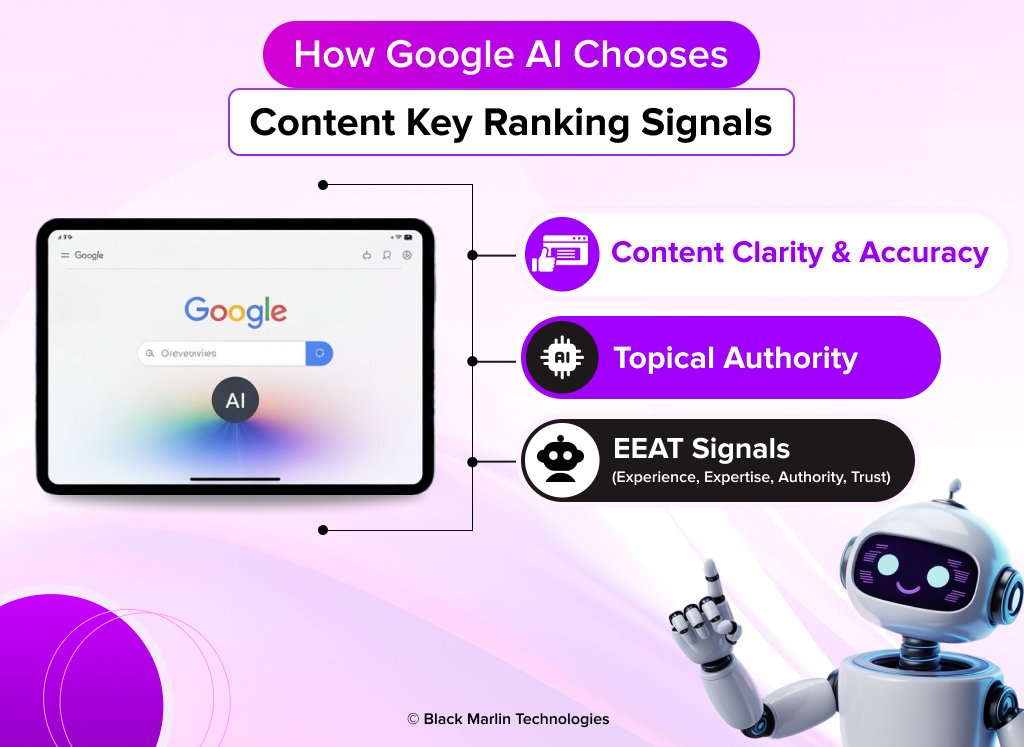
- Content Clarity & Accuracy – Google AI wants content that is straightforward, simple, and easy to understand. Pages with simpler language always do better than those with tons of technical jargon. AI also scrutinizes as to whether an answer is factually based and accurate against any “why,” “who,” and “how”-type search enquiries. Clear explanations help AI to quickly comprehend and summarize the content you provide.
- Topical Authority – Ranking in AI Overviews is over-targeting a single keyword. Google picks websites that provide complete coverage of a topic. Then you need multiple sets of associated items to explain different aspects of the same subject. So when this site is built and has great topical authority, Google AI finds the site to be a good source rather than just a keyword-specific page.
- EEAT Signals (Experience, Expertise, Authority, Trust) – The quality of content is heavily determined by the EEAT signals in Google AI. Real-life experience, expertise has a major role to play in brand trustworthiness; that established, brand trustworthiness avouches to an author from a specified clear scope of intelligent insight, which is largely why their content likely appears in AI Overviews.
Step-by-Step SEO Strategies to Rank in Google AI Overviews
Ranking at Google AI overviews inherently needs a different dealing than general SEO. There must be no chase after keyword-thus, focusing must be clear in delivering answers, organization, and intentions. This list compiles methods perfected for getting picked by Google’s AI.
Step 1: Focus on Search Intent, Not Keywords
Google AI is searched for content based on user questions. Instead of repeating the primary keywords, explain the why, how, and what in a clear and simple manner. The text needs at least one direct answer in each section to its designated question. When the intention seems to be fulfilled to perfection, AI will easily understand and summarize what has been stated.
Step 2: Create an AI-Friendly Content Structure
Structure plays a huge role in AI SEO optimization. Use:
- Short paragraphs
- Bullet points for key details
- Clear headings (H2 and H3)
This format helps Google AI scan, understand, and extract information faster for AI Overviews.
Step 3: Write Like You’re Explaining to a 10-Year-Old
Simple language wins. Avoid jargon and complex terminology, and, where possible, try using everyday language and clear examples to explain your ideas. If this can be understood by a beginner, then the AI of Google will understand, too enhancing your chances of AI SEO success.
Step 4: Build Topic Clusters (Not Single Blogs)
Instead of writing one standalone article, create:
- One main pillar page
- Multiple supporting articles around the same topic
This shows topical authority and helps Google AI trust your website as a reliable source.
Step 5: Optimize for Featured Snippets & AI Answers
AI Overviews favor content that is easy to summarize, such as:
- Clear definitions
- Step-by-step guides
- Tables and lists
These formats increase visibility and improve selection for AI-generated answers.
On-Page AI SEO Optimization Checklist
Strong on-page SEO optmization is the cornerstone of gaining ranks in Google AI Overviews. Even if the content is great, the AI tends to ignore it if it’s not easy to understand. To attain the objective of SERP visibility, the following checklist will help ensure your pages are well optimized for AI SEO and long-term visibility.
- Proper H-Tag Structure – Use headings correctly to organize your content. Ensure that one clear H1 for the main topic is enough, with an H2 and an optional H3 subheading for subtopics. This organization allows Google AI to quickly identify the main topic of discussion and what sections answer specific questions.
- Schema Markup (FAQ & How-To) – Schema markup application gives the search engine more context when going through the webpage. The addition of FAQ or How-To schema helps to leverage Google AI’s ability to contextualize the provision of answers, guide steps, and defining things. Lots of AI-based SEO tools rely on proper schema instruction for improving search visibility in AI Overviews.
- Internal Linking – Connecting related pages together creates an impression of depth concerning a topic. The internal linking helps Google AI see how different pieces of content relate, bolstering topical authority, hence, improving crawlability on your website.
- Fast Page Speed – Google AI always favours faster loading pages. Poor user experience, chucked by slow websites, reduces the ability of pages to be ranked properly in AI Summaries. Beforehand ensures that the images are optimized, scripts are minimized, and performance allegedly is improved by good hosting.
- Mobile-Friendly Design – Mobile users generate the bulk of AI searches. Ensuring that your content is easy and intuitive for mobile users to read and access makes for the most search-engine-friendly design, which keeps your rankings up and offers stronger AI SEO results.
Content Types That Perform Best in AI Overviews
Not all content formats are considered equally beneficial to Google AI Overviews, as Google’s AI prefers clear, structured content that is easily summarized. From my experience, such content formats consistently perform better on AI-driven search results.
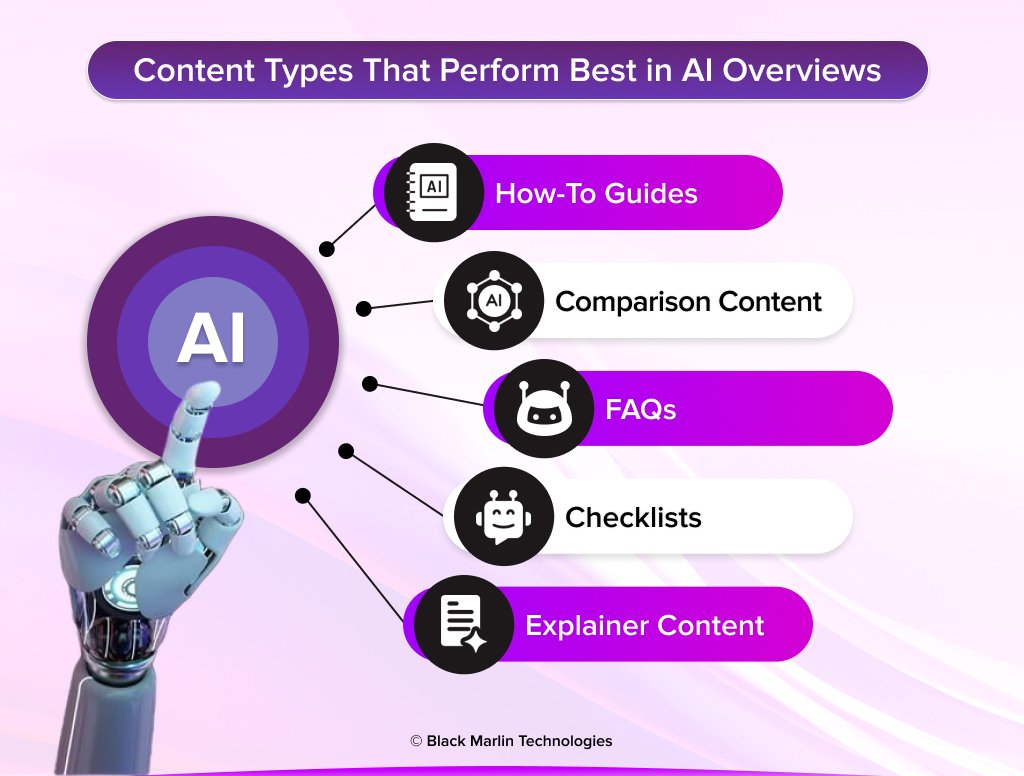
- How-To Guides – How-to guides are an effective way to offer remedies to a certain problem right from the exact steps themselves. When instructions are given properly in precise order, Google AI scan then assimilate them for shows as succinct statements in AI Overviews.
- Comparison Content – Comparison articles help users make decisions more rapidly. Content that contrasts different tools, services, or options in an easy and sil facile manner is often picked by the Google AI because it presents direct utility and clarity in one place.
- FAQs – FAQ-style content answers common questions clearly and concisely. As AI Overviews are meant to respond to user queries, FAQ sections make it easier for Google AI to pull up accurate, short answers.
- Checklists – Checklists divide the information into simple, point-by-point terms bent on assisting the Google AI in retrieving and specifying prescribed action parameters, which goes well to show its effectiveness in an AI Overview.
- Explainer Content – Explainer content unpacks lengthy or complex thoughts into manageable concepts that may be easily understood. When written in plain language it serves as a signal for Google’s AI to pick content for presenting as a trusted summary.
Common SEO Mistakes That Prevent AI Overview Visibility
A lot of websites can’t seem to appear in Google’s AI Overviews—Not that they have chosen a wrong topic, but the approach they use for SEO is in vogue. Steering clear of these errors can enhance your likelihoods of eventually being chosen by Google’s AI.
- Keyword Stuffing – Constant repetition of keywords will not help with AI ToC. The algorithm tries to identify coherency, not necessarily the repetitions of keywords. Overdoing keywords makes the content harder to read as well as easily ignored by AI.
- Thin Content – AI Overviews tend to neglect short pages with almost insignificant utility. Google appreciates a content that wholly clarifies a theme, answers all possible questions questions, and promises worth to the reader. This text betokens versed detachment and low authority.
- No Real Answers – Content that needs to be assumed or implied to be about a topic and does not directly provide answers is often getting skipped. Google AI is bent upon selecting the pages that contain direct and clear answers to the users’ questions; if users still do not feel clear about a concept, the AI artificially selects their help.
- Ignoring User Intent – Focusing on rankings at the expense of users’ interests is the biggest mistake anyone can do. Here, intent is king according to Google’s AI. The reasons why someone searched for something, what he intends to know, and how he expects the answer. Matching the intent is indispensable to maximizing AI Overview’s visibility.
Importance of AI SEO Services in Google AI Overviews
With the increasing reliance of Google search on AI, manual SEO strategies have become insufficient. Any written piece or content without data-driven insight is either pale or slow and not consistent. Intent, structure, accuracy, and topic depth in Google AI are assessed on an industrial scale- things that are hard for manual efforts to deal with efficiently.
Why Manual SEO Is No Longer Enough
In traditional SEO practices, guesswork and static optimization are what they are founded on. Of course, they will soon be revolutionized with changes in AI Overview and behavior of search, while the optimization they bring remains static. But it is difficult to keep content aligned with what Google AI prefers without automation and real-time analysis.
How an AI SEO Agency Uses Data and Automation
An agency for AI in SEO is harnessing the intellect of human beings in combination with data and automation and employs AI tools to examine search intent, content gaps, and performance patterns. Automation will help get the structure optimized, improve internal linking, and adjust quicker, which aids in making it easy for Google AI to understand and trust the site.
Benefits of Professional AI SEO Services
Professional AI SEO services help brands scale up faster and keep improving in terms of precision and consistency. AI SEO offers visibility and authority elevation and helps businesses with AI SEO into a long-term success in an ever-changing landscape of search.
AI SEO vs Traditional SEO: Quick Comparison
SEO has moved beyond the days of rankings; it’s more about providing logical, intent-specific responses. Knowing how traditional SEO stands apart from AI SEO can give firms a head start should they want to rapidly devise an efficient and forward-looking strategy.
| Traditional SEO | AI SEO |
| Focuses mainly on keywords | Focuses on user intent and meaning |
| Aims for higher rankings | Aims to provide the best answers |
| Optimized for blue-link results | Optimized for AI Overviews and summaries |
| Relies on manual updates | Uses AI-driven optimization |
| Keyword density matters | Clarity and accuracy matter |
Traditional SEO is good for basic recognition, however, it struggles in search results driven by AI. SEO AI, on the other hand, attempts to help and create a structure through which Google may understand context, content, intent, and value. Brands that switch from traditional, rank-based approaches to answer-based optimization create visibility and improve their chances of making it into Google’s AI Overviews.
How Long Does It Take to Rank in Google AI Overviews?
There is no fixed timeline for Google AI ranking overviews. Several significant factors affect the timeline; thus, instead of just posting content and waiting, most of the time realistic would be something like 3-6 months-unless high-quality optimization is performed consistently.
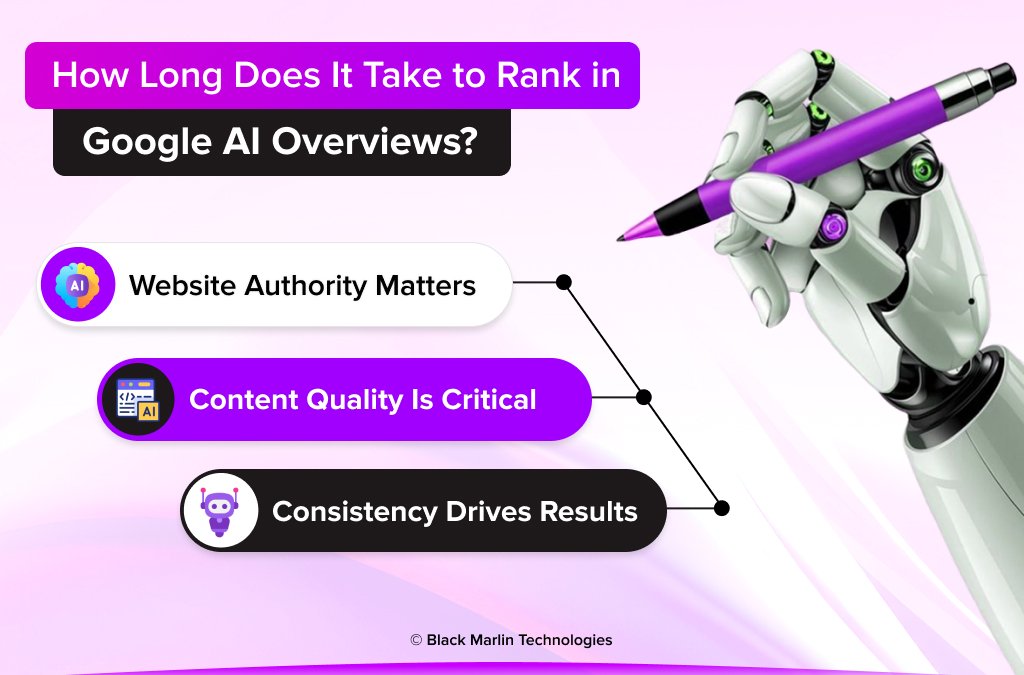
- Website Authority Matters – Websites with high authority and trustworthy history are usually chosen quite quickly. If you have a new website, Google’s AI may perceive it as a slower process before the new site is confirmed as a reliable source.
- Content Quality Is Critical – Google AI prefers pages that are clear, accurate and helpful. By answering the user’s query with full deliberation, supporting their questions and following the AI-friendly structure, the page has a much better chance of appearing on the AI Overviews.
- Consistency Drives Results – Publishing often and developing fresh content exhibits the site owner’s commitment to the subject matter. A central message which Google AI truly appreciates is that the website is still being actively tended to and deemed trustworthy.
In short, AI Overview rankings cannot happen overnight but the right strategy, a little patience and good hard work will land some site’s AI SEO success within only 3-6 months.
Future of SEO with Google AI Overviews
The future of SEO is a definite move towards an answer-first search environment wherein rather than searching and clicking various links, users now want direct and clear answers there and then. This is exactly why Google AI Summaries have been put in place; to answer in a nutshell by extracting the most important information right into the search results.
As we see AI driven search grow, trust and correctness have never been more necessary. Google’s quest process elevates quality content above all, even content that is commonly fact-checked and whose authors’ expertise is not in doubt. In the long term, websites providing clear explanations and radical truth will become more and more visible, while low-quality or deceptive content will be completely ignored.
AI has reshaped the execution of SEO Services as well. The standard SEO techniques are not enough anymore. The SEO service providers are forced to adapt to apply AI and select intent-based optimization methods and content strategies. Companies that use and spend on AI-focused SEO services will have a competitive advantage, allowing them to keep attuned to Google’s changing search environment and maintain visibility.
FAQ
Q1: Can new websites rank in Google AI Overviews?
Yes. New websites can rank if their content is clear, accurate, and focused on search intent. Google AI values quality and usefulness more than domain age.
Q2: Is keyword research still important for AI SEO?
Yes, keyword research still matters—but intent matters more than keyword density. Google AI looks for meaning and context, not repeated keywords.
Q3: Does schema help with AI Overviews?
Yes. Structured data like FAQ and How-To schema helps Google AI understand your content better and extract accurate answers for AI Overviews.
Q4: Are AI SEO Services worth it?
Yes. Professional AI SEO Services help businesses scale faster, adapt to AI-driven search changes, and achieve long-term SEO growth.
Q5: What type of content is best for AI Overviews?
Content that clearly answers questions works best. How-to guides, FAQs, checklists, and explainer content are easier for Google AI to summarize.
Q6: Do backlinks still matter for AI SEO?
Yes, but quality matters more than quantity. Trusted, relevant backlinks support authority, which helps Google AI trust your content.
Q7: Can one page rank in both AI Overviews and normal search results?
Yes. Well-structured, intent-focused content can perform in both traditional rankings and AI Overviews at the same time.
Q8: How often should content be updated for AI SEO?
Content should be reviewed and updated regularly. Fresh, accurate updates signal reliability and improve AI Overview visibility.
Conclusion
Google’s AI overviews very much influence how SEO works. Search can no longer be just about rankings! It now much has to do with providing clear, accurate answers that users can trust. The sites that may only focus on traditional SEO tactics will have difficulties keeping their visibility as Google keeps favoring AI generated summaries.
To succeed in this new search scenario, brands must emphasize onclearness, trustworthiness as well as search intent. The contentshould be simple, structured, and truly of service to the user. When combined with intelligent AI SEO optimization, this approach willhelp Google’s AI to recognize your content as reliable and useful.
For long-term growth, also with the most basic provisions of SEO, businesses must have more. By partnering with an expert AI SEO Agency- one that is at the front line of this augmented environment-change-includes proper steps to follow. The right expertise and approach towards AI search simplifies the mode of cowboy-ride visibility right to lasting AI SEO Success.