'>
<rect width='100' height='100' fill='%23B22234'/>
<!-- stripes -->
<g fill='%23fff'>
<rect y='10' width='100' height='10'/>
<rect y='30' width='100' height='10'/>
<rect y='50' width='100' height='10'/>
<rect y='70' width='100' height='10'/>
<rect y='90' width='100' height='10'/>
</g>
<!-- blue box -->
<rect width='50' height='50' fill='%233C3B6E'/>
</g>
</svg>)
'>
<rect width='100' height='100' fill='%23fff'/>
<rect width='100' height='33.33' y='0' fill='%23FF9933'/>
<rect width='100' height='33.33' y='66.66' fill='%23138808'/>
<!-- Ashoka Chakra -->
<circle cx='50' cy='50' r='9' fill='none' stroke='%23000080' stroke-width='2'/>
<g stroke='%23000080' stroke-width='1'>
<line x1='50' y1='41' x2='50' y2='59'/>
<line x1='41' y1='50' x2='59' y2='50'/>
<line x1='44' y1='44' x2='56' y2='56'/>
<line x1='56' y1='44' x2='44' y2='56'/>
</g>
</g>
</svg>)
 info@blackmarlintechnologies.com

Lots of companies really work hard to get better on SEO but continue to get traffic just from one country. You might be getting traffic from India, but what about visitors from the US, UK, or some other market? The problem with most businesses springs around this issue they miss out on selling to international customers even when their services or products could be required anywhere around the world.
 The truth is simple: as all cultures prefer content in their own native tongue, studies have shown that close to 75% percent of users are browsing in their native language, whilst the rest of you are missing tremendous opportunities if your website is not set up country-wise.
This is the exact spot where the foundation of International SEO stands at. A strong International SEO strategy ensures that you website gets exposure in many different countries, targets various languages, and reaches the audiences you intend to target globally. By so doing, you won’t limit your growth to just one market but will attract traffic that comes from worldwide audiences, where leads generated having an external origin will also be well-ahead in global business.
This guide makes it as simple and easy to follow along as international SEO can get. So, by means of this understanding, you can begin to extend your reach outward and join the global-business phenomenon.
- What is International SEO?
- Why International SEO is Important in 2026?
- How International SEO Works?
- Step-by-Step International SEO Strategy
- Common International SEO Mistakes
- International SEO Metrics
- Tools to Track Performance
- International SEO Tips for 2026
- International SEO Services for Global Growth
- FAQ’s
What is International SEO?
International SEO techniques are a recognized method to work on your website for it to appear in search results from different countries and languages. In short, they help your business in reaching people from multiple locations, across the globe.
Normally, when optimizing for search engines, your website will achieve a good ranking domestically as per the respective country. However, an advanced International SEO strategy may push it to help reach users based in countries like India, the USA, the UK, and even more. This means that when people search for your business in another country, your website may appear on the results list.
You can serve the audience searching from the USA or the UK if a company operates in India. You can also establish languages that these populations patronize; this encourages them to feel one with the company and to trust in its website.
The kind of search engines such as Google will tend to exhibit the version of your website in terms of its user behavior, location the user is in at the moment, and language used. Therefore, the 2026 International SEO professional would usually target appropriate audiences with search-item anchor text.
The International SEO channel opens worldwide markets for you, thereby raising global visibility more than that just checking the box of a translation, with enhanced popularity and higher revenue.
Why International SEO is Important in 2026?
The online world has never been bigger than it will be in 2026. For example, at least five billion individuals are exploiting the internet today to search the internet, buy things, or educate themselves. If your business is only catering for one country, you are missing out on the global audience.
More currently visible, cross-border eCommerce has shown a rapid increase in handling, while customers have now taken it for granted to buy goods and services from other nations. When looked at with reasonable perspective, your potential clientele no longer includes your immediate neighborhood; they can now hail from all points on the globe.
This is why it is important to have an effective International SEO strategy that helps your website meet users from different countries, with their respective languages, and at the best time. If done correctly, International SEO 2026 could mean new opportunities for expanding business.
Key Benefits You Can Expect:
- Increase in Global Traffic: Your website is now attracting visitors from more than just one part of the world. With an effective international SEO strategy, you can draw potential clients from areas where your competitors have not even started targeting and reach a wider global audience with more opportunities to grow.
- Higher Revenue from New Markets: More traffic from different regions implies more opportunities for generating leads and sales. Targeting the right countries with the most appropriate keywords can therefore help the business to move outside its barriers and enter new markets, creating supplementary income streams.
- Better Brand Visibility Worldwide: Your brand becomes known and trusted across various countries and cultures. Seeing your website in search results repeatably builds up trust, even in unexplored markets.
- Better Conversion Rates with Localized Content: When the language and culture of your target audience match your site’s content, they are remembered and more likely to take action. Added to translation is localization for greater user experience and higher conversion possibilities.
- Competitive Advantage in Global Markets: International SEO companies is what many firms are still not conscious of. Doing this will present a competitive advantage, even a lead capture that rival companies will likely ignore.
- Improved User Experience Across Regions: International SEO makes it possible for visitors to see the most pertinent version of your website considering their geographic location and language. This difference affects experience in a more profound manner, leading to higher retention and engagement.
In a simple definition, international SEO does not only increase traffic but also allows one to reach the appropriate public, build a strong, worldwide presence, and increase conversions.
How International SEO Works?
Optimizing internationally might sound like a complicated process, but the process works just fine. This is just a way of encouraging search engines to present the correct website version for the right user, according to their country and language. A perfect International SEO strategy has the potential of making a website reachable to people worldwide in a much more precise and effective way.
Here are the key steps explained in an easy way:
- Country Targeting: The process involves telling search engines which country you are going to target. For example, if a website is destined for the USA, UK or India, it is well optimized for visitors from these places. Search engines like Google decide how to show search results by taking into account signals like domain, content, and user location.
- Language Targeting: People prefer browsing in their language. This is why content created in different languages sometimes helps to relate to users. Examples include English for the USA and the United Kingdom or Hindi for India. This serves to reinforce trust, thereby enhancing relations.
- URL Structure:
Your website structure plays a big role. You can use:
- Subfolders (example.com/us/)
- Subdomains (us.example.com)
- Country domains (example.us)
A clear structure helps search engines understand your target audience.
- Geo Targeting: Geo targeting, in other words, is showing content based on a user’s location, so that they see the most relevant version of your website. Hence, it brings good user experience and increases the possibility of conversion.
- Technical SEO Signals: Search engines are keen informants to measure the efficiency of your site on the global stage; from that breed, hreflang tags, site speed, and mobile-friendliness are highly significant components. These are the signals that help them decide which page to show in different countries.
- Content Localization: Content is not just translation because it needs to be adapted to reflect the culture, currency, and user behavior in the country and locality. This would make your content even more useful and relevant.
In straight forward language, International SEO has to do with making sure translations are of the right quality and are made available to the right public worldwide, which helps organizations increase in traffic, leads, and international growth
Step-by-Step International SEO Strategy
When you are ready to take your business to the global stage, you need to set up an international SEO strategy in a structured, clear fashion. Many businesses try and target a global audience but do not achieve that global targeting through a systematized architecture. Yet the good news is international SEO does not appear insurmountable once it is made concrete into systematic steps. It is only about understanding who your audience is, working outside of the correct countries, and deploying them to produce an engaging piece of content throughout the regions.
A strategic effort to reach out to global users and get leads from various geographies can result in a bnch of dollar increase. Understanding the market, using country-specific keywords, leading website structure, and localized content are essentials to bring the very qualitative traffic from international SERPs onto the site. Search algorithms thoroughly proritize relevant and user-friendly websites, so these principals come first to lead the audience to reach business globally.
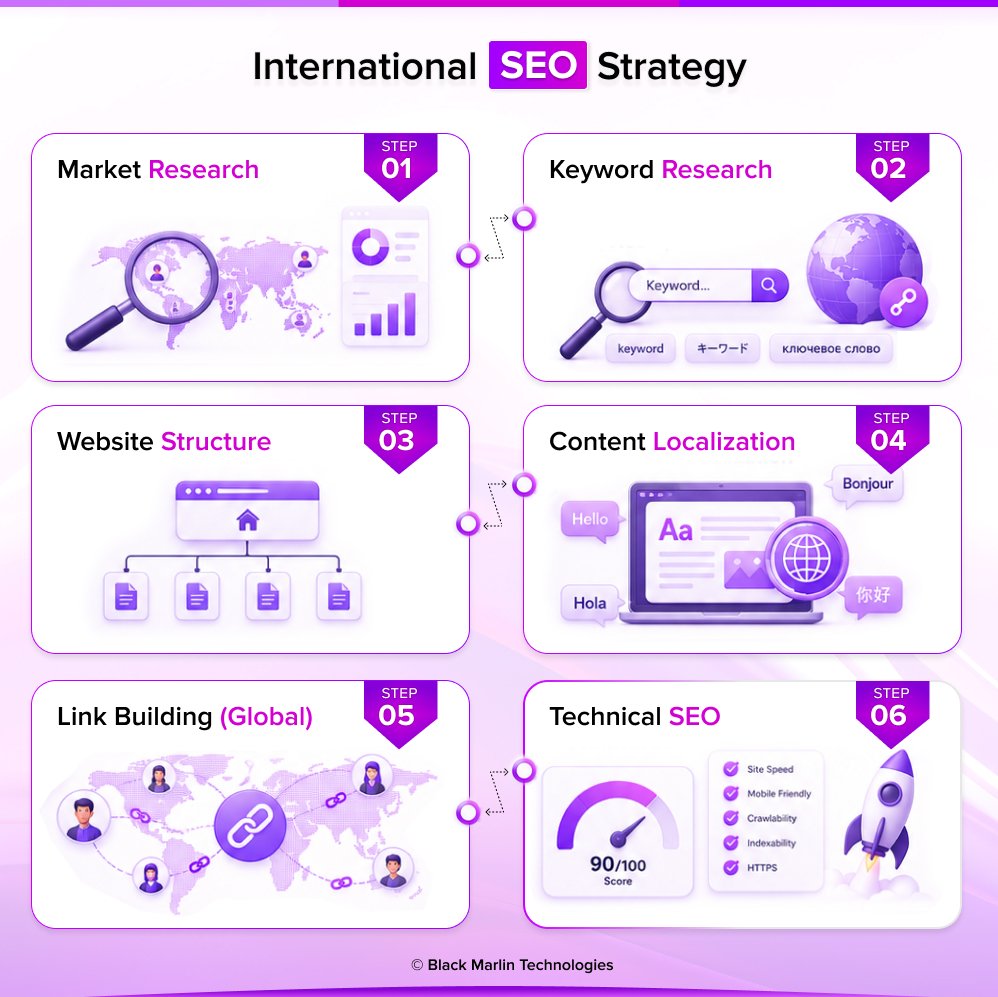
Step 1: Market Research: Figure out first of all those countries that have splendid demand for your product or service. Not every nation is lucrative, but concentrates on those where people search hard. There are big tools like the Google Keyword Planner tool for checking demand and trends. You even decide this way which markets are good for you prior to spending your time and effort.
Step 2: Keyword Research (Global): Keywords are different everywhere. For example, people from the USA and UK do searches differently for the same service. Therefore, you need to search for country-specific keywords to target the right audience. Therefore this constitutes a key segment of any successful international SEO strategy for 2026.
Step 3: Website Structure
Your website structure tells search engines which audience you are targeting. You can choose:
● Subfolder (example.com/us/)
● Subdomain (us.example.com)
● Country domain (example.us)
A clear structure makes it easier for search engines like Google to understand your website.
Step 4: Hreflang Tags: Hreflang tags play a vital role for the search engines to understand the language and country of each page, and thereby to serve the right version of the website to the right users.
Step 5: Content Localization: It’s not about just translating your content: you need to adapt your content to be local, so far as language, currency, and other cultural references are concerned, to make it more relatable and lead to a higher conversion rate.
Step 6: Technical SEO: A fast website that works on mobile devices is expected. This is because low-ranking websites that are not mobile-friendly will frustrate the user in terms of ranking results and visits.
Step 7: Link Building (Global): Building backlinks from locales of your target countries will increase your authority as well as bring you closer to your end goal of local ranking.
In simple terms, a detailed international SEO plan will help you connect to the right global audience and convert that traffic into real business growth.
Common International SEO Mistakes
When companies step into International SEO, several mistakes usually codify that can harm ongoing traffic and positions. One main flaw in the operation stems from the idea that what could be done in the US market can easily be replicated and applied to other markets around the world. This idea is highly mistaken. Other nations take pride in their languages, research behaviors, and user expectations; accordingly, your strategy must be appropriately adjusted, or your website won’t be able to reach your audiences.
A further prevalent issue is simply discounting the technical and UX side of things, which can be particularly risky in global business. After all, search engines are committed to delivering only the most pertinent and, above all, user-friendly results. And so, as long as you have the wrong focus, poor structuring, or not optimized for mobile devices, it would affect your global presence. The first important thing would be to identify such blunders and clean them up, thereby setting up a strong international SEO strategy for 2026 that generates traffic, leads, and actual business growth.
- Wrong Hreflang Tags: Hreflang tags give search engines information about your website, so they will show the right language version to the right country (visitors). If added incorrectly, like every other meta tag or any other type, it could lead to unwanted behavior. For instance, the US version is not meant for any UK users. Wrong lang tags could leave visitors puzzled, with many abandoned pages thus attracting no increased organic clicks or whatsoever. Always double-check your hreflang setup to ensure each page targets the correct audience.
- Duplicate Content: If the same content is used for multiple countries without proper optimization, duplicate content issues can be created. It can be a headache for search engines to decide which version to rank, and quite possibly neither does very well. Instead of copying content, it would be better to just substitute some small variations in currency, examples, and local references to prevent each page from looking the same and being relevant.
- No Local Keywords: A universal use of keywords will have no purpose when we consider search behavior in other jurisdictions. A keyword that is useful in the market in India may not be just as useful in the US or UK. Without good local keyword research, the company’s website will alert search engines to overlook itself in the global market and will not be able to benefit from such traffic.
- Ignoring Mobile Users: Browsing websites through a mobile phone has become a trend; if the website is slow, or if it lacks a mobile-friendly experience, it will make the user leave once he is on the page and the website’s bounce rate will keep rising while not-so-positive signals will be sent to the search engine, jeopardizing your global ranking.
- Poor Website Structure: Search engines may get confused with a website not defining countries or languages with correct URLs and folders. The presence of a clear map helps to understand which content is referred to which audience.
- Lack of Local Backlinks: Links targeted to the text country are the most important to view if one’s is in all-zone links that are positioned on a given area, making it difficult to rank on the other website. Thus, the benefit of having links coming out from locally situated sites are trust and authority.
In simpler terms, here are some mistakes to avoid while building a properly strong International SEO strategy in 2026: enhance user experience as well as to ensure a better ranking in global markets, more user traffic flows, and optimum conversions.
International SEO Metrics
A good International SEO strategy starts by adopting proper metrics and tracking methods that establish the real performance of your website in different countries and help identify the areas that need improvement, which attended to will aid you in expanding abroad. Absence of proper tracking implies all decisions to optimize a website are merely guesses and you are not actually using structured data to grow your business globally.
By monitoring performance regularly, you can clearly see the countries where traffic, leads, and sales come from. You can also detect which keywords rank well and in what markets more emphasis is needed. Search engines, such as Google, prefer to repay those websites that generate user-friendly and relevant experience, therefore tracking is a good way to keep oneself aligned to what users want.
By analyzing the right data, you can improve your strategy step by step. You can optimize content, fix weak areas, and focus on high-performing regions. In simple terms, tracking International SEO metric samples will help you turn traffic into real outcomes like lead generations, conversions, and long-term global growth.
Key Metrics You Should Track:
- Organic Traffic by Country: It tells people the number of people visiting from diverse countries. If your International SEO is working, you should see traffic increasing from your target regions.
- Keyword Ranking in Different Regions: In any given country, your keywords may end up ranking differently. Keeping track of your rankings helps you to gauge which markets are doing well and what areas need better optimization effort.
- Conversion Rate (Leads/Sales): Traffic is fine, but the actual conversion rate needs to be the pivot point to measuring this conversion of traffic to qualified leads and customers in each country.
- Bounce Rate: Bounce rate describes one’s chances of turning away from your website in favor of something else. A high bounce rate usually signifies that the content is not of value or relevant to that target group or language.
- Backlinks from Global Sites: In target countries, backlinks help serve to improve the standing and ranking of the referenced website. More local backlinks = more trust within that region.
Tools to Track Performance
Accurate measurement of your international SEO metrics depends on the right tools. These tools help you observe the way visitors from the different nations interact with your site and how your pages are performing on search engines. With proper tracking in place, you can make wiser decisions and improve the global SEO strategy in incremental steps.
- Google Analytics – The purpose of this tool is to let you know where your traffic is coming from, how different countries are performing, and user behavior analysis. You can track sessions, bounce rates, and conversions, which are very important level for the measurement of success.
- Google Search Console – This is a tool that will let you analyze how well your website is performing in search results. By employing it, you can also track the rankings of your keywords or determine the number of impressions and clicks as well as revealing any SEO issues that can impact upon its visibility in other countries.
Combining these tools gives you additional insight on various factors such as the region viz., about the keywords bringing traffic from such region, and whether the users of that region are converting well or not. Just a plain picture-the tool works for analyzing international service performance.
International SEO Tips for 2026
If you want to be good at global search, you need to consider updating your international SEO strategy as well. SEO is changing at a fast pace, what worked before would be meaningless in 2026, whereas now the focus is on new and improved instruments, better user experiences, and more personalized content for individual countries.
- Use AI for Keyword Research: AI-driven tools can help you obtain better keywords faster by analyzing the search trends, user behavior, and competition across various countries. With such findings, the tool can then help uncover suggestions that you would not have tapped into via manual research.
- Focus on Voice Search Globally: An increasing number of individuals are turning to voice search through mobile devices and smart assistants with voice searches typically being longer and more conversational. Consequently, content should be natural-language-oriented and question-based to match how people speak.
- Optimize for Local Culture: All countries have differing preferences, language styles, and cultural values. Instead of translation of contents, endeavour to adapt them into the local culture, thus establishing trust and improved audience engagement.
- Build Country-Specific Landing Pages: Generating a different independent landing page for each of the countries targeted, you can have country-specific content, keywords, and currencies with which to work. This form of geographic targeting would also improve Google’s ability to identify the concept of targeting country-specific audiences.
One way or another, adhering to such International SEO tips for 2026 will help in keeping you competitive, reaching the right audience globally, and lucratively turning traffic into leads and sales.
International SEO Services for Global Growth
If one wants genuine results from their International SEO strategy, hiring expert services would help them to a great extent. Several enterprises have been struggling just because they have lacked the right plan or technical knowhow to target multiple countries effectively. International SEO services, when undertaken professionally, help you establish a solid foothold and, at the same time, help you grow faster in global markets.
- Strategy Planning: Experts sit down and analyze for you the businesses of competitors and target locations in order to define a clear cut vision so as to avoid shortlisting themselves in order to spend time and budget effectively.
- Technical SEO: Technical SEO, which includes website structure and hreflang implementation, pertains to covering all the aspects that ensure that search engines like Google can promptly recognize and rank your website globally.
- Localization: This is what localization could bring advance in the content of demo content, typically in the marketing genius to command faith and increase conversions!
- Link Building (Global): Establishing backlinks from websites in the country you are targeting helps boost clout and SEO rankings in that region.
FAQ’s
Q1: What is International SEO?
Ans. 1- International SEO is the process of optimizing your website so it can rank in different countries and languages. It helps your business reach a global audience and attract traffic from multiple regions.
Q2: How long does International SEO take?
Ans. 2- International SEO is a long-term strategy. You may start seeing results in 3 to 6 months, but strong growth usually takes 6 to 12 months depending on competition and target countries.
Q3: Is International SEO expensive?
Ans. 3- The cost depends on your goals, number of countries, and level of competition. While it may require investment, it often delivers high returns by bringing global traffic, leads, and sales.
Q4: Which countries should I target first?
Ans. 4- Start with countries where there is high demand for your product or service. Use data and tools to find markets with good search volume and lower competition.
Q5: Do I need different websites for each country?
Ans. 5- Not always. You can use subfolders, subdomains, or country-specific domains depending on your strategy. The goal is to clearly target each country while keeping your website easy to manage.