+1-(646) 362-1414
 +91 8826683820
 info@blackmarlintechnologies.com

Search is changing faster than ever. A few years ago, people used search engines to find a list of websites and then clicked on the one that looked helpful. The current situation shows a different reality from past times. AI search engines currently provide direct answers to users instead of displaying only website links.
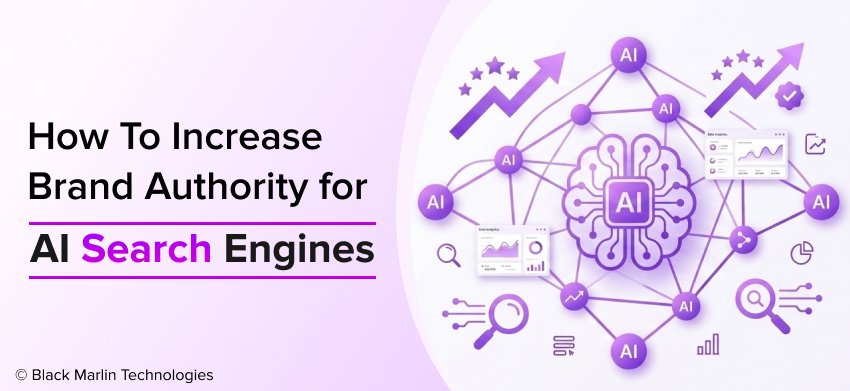 The tools ChatGPT and Google AI Overviews and Gemini and Perplexity enable users to ask questions which the systems will answer with brief summaries. users can read the AI-generated response without needing to navigate multiple websites.
Because of this shift, brand authority for AI search engines has become extremely important.
When AI tools create answers, they choose which websites to include in their responses. They typically select reputable brands and trustworthy sources which demonstrate their expertise and credibility. Content from your brand will appear in AI search results when your brand achieves recognition as an industry authority.
The growth of AI search is happening very quickly. According to industry reports, AI search traffic has increased by more than 527% in the last year, showing how rapidly people are adopting AI-powered search tools. Experts also predict that AI search could surpass traditional search by 2028 as more users rely on conversational answers instead of browsing multiple links.
This change means businesses can no longer focus only on traditional SEO rankings. Modern search requires companies to establish brand authority and produce expert content and enhance their AI search engine presence.
- What Are AI Search Engines?
- Why Brand Authority Matters in AI Search
- How AI Search Engines Decide Which Brands to Mention
- 8 Proven Ways to Increase Brand Authority for AI Search
- Metrics to Measure AI Brand Authority
- Future of Brand Authority in AI Search
- Step-by-Step AI SEO Strategy to Build Brand Authority
- FAQs
- Conclusion
What Are AI Search Engines?
AI search engines are changing the way people search for information on the internet. The systems provide direct answers to user questions instead of displaying an extensive list of website links.
For example, when someone asks a question, an AI search engine reads information from many websites and then creates a clear summary or response. The system enables users to obtain information more quickly because they do not need to access multiple web pages.
Some popular AI search engines and AI-powered tools include:
- ChatGPT
- Google AI Overviews
- Perplexity
- Gemini
These tools use artificial intelligence to make sense of questions, thus providing any handy solutions in easy-to-understand conversational format.
AI Search vs Traditional Search
The primary objective of SEO in traditional search engines such as Google was to increase your website’s position in search results. Users would click on a link and visit the website to read the content.
But AI search works differently.
Traditional SEO
- Focuses on ranking web pages
- Users click links to visit websites
- Search engines display a list of results
AI Search
- Focuses on generating answers
- Users often get information directly in the search result
- AI mentions or cites trusted brands as sources
Because of this change, brand authority has become a key factor in AI search visibility.
AI systems analyze several signals before mentioning a brand in their answers. These signals often include:
- Content quality and expertise
- Online reputation and credibility
- Brand mentions across the internet
- Trust signals from authoritative websites
Brands that produce useful and well-founded information on a consistent basis will have a better chance of being referenced as a source by search engines when creating answers.
Why Brand Authority Matters in AI Search
As AI search engines become more popular, brand authority has become one of the most important factors that determines online visibility. AI search tools display one specific answer which relies on a limited number of trusted sources, unlike traditional search engines that show multiple website links.
This means that AI systems are supposed to make judgment calls on the credibility of brands and websites worthy of being included in their responses.
To make this decision, AI search engines analyze different trust signals from across the internet. These signals help AI understand whether a brand is credible and knowledgeable about a topic.
Some of the most important signals include:
- Expertise – Does the website provide helpful and knowledgeable content on the topic?
- Reputation – Is the brand recognized as trustworthy in its industry?
- Mentions – Is the brand discussed or referenced on other websites, blogs, or media platforms?
- Consistent information – Does the brand share accurate and consistent details across the web?
When a brand performs well in these areas, AI search engines are more likely to recognize it as an authority.
Another important difference is that AI search engines usually select only a small number of credible sources when generating answers. AI tools do not show ten search results like traditional Google pages because they depend on only a few trusted websites.
Because of this, only brands with strong authority and credibility get mentioned in AI-generated responses.
If a brand is not widely trusted or lacks strong online signals, AI systems will treat it as non-existent when they generate responses. The way businesses need to improve their AI search engine presence requires them to establish brand authority and create expert content while protecting their online reputation.
How AI Search Engines Decide Which Brands to Mention
AI search engines do more than just scan webpages. The system assesses internet data to determine which brands have established themselves as reliable sources of expert knowledge.
The AI tools use their answer generation process to select dependable sources which deliver precise and useful information to users. The AI systems use multiple ranking signals to assess their performance, which includes measuring brand mentions and content quality and reputation and authority.
One of the most important signals is how often a brand is mentioned across the internet.
- Brand Mentions Across the Internet
AI search engines learn about brands by analyzing information from many different platforms. The online presence of a brand through common mentions and discussions online shows its industry recognition and current relevance.
AI systems often collect data from sources such as:
- Blogs and industry websites
- News articles
- Online forums and communities
- Customer reviews
- Social media platforms
These mentions are called third-party mentions because they come from websites other than your own. The existence of your brand on other websites helps AI systems recognize your business as a market competitor according to the analysis which describes its market presence and market influence.
For example, If a brand is cited in blog posts, industry reports, and social media conversations, AI search engines will start considering it a really trustworthy source.
Because of this,Third-party mentions establish AI authority signals through their essential function in building AI authority signals. The more your brand is discussed and referenced across the web, the more likely AI search engines will recognize your brand and include it in their generated answers.
- Content Expertise (E-E-A-T)
Another important factor AI search engines use to decide which brands to mention is content expertise. Both Google and artificial intelligence systems assess content by using E-E-A-T as their evaluation standard.
E-E-A-T stands for:
- Experience – Does the author or brand have real experience with the topic?
- Expertise – Do they have deep knowledge in their field?
- Authority – Is the brand recognized as a reliable source in the industry?
- Trustworthiness – Is the information accurate, honest, and dependable?
AI search engines use website content analysis to determine whether material originates from human authors or brands that possess genuine field expertise. A website that regularly publishes valuable content with thorough research demonstrates its high level of expertise.
For example, A company demonstrates its expertise in the industry through its ongoing publication of guides, case studies, tutorials, and research materials about a particular subject. The process establishes trust relationships which grow stronger over time between users and search engines.
When a brand consistently demonstrates its expertise the brand becomes a trustworthy source according to AI systems. The likelihood of AI systems using brand content will increase because of this.
- Topical Authority
Another important signal that AI search engines consider is topical authority. This means how deeply and consistently a website covers a specific subject.
AI systems prefer websites that publish many helpful articles about one topic, rather than websites that only write about it once. The brand demonstrates its expertise through detailed coverage of subjects which shows its deep product knowledge and industry experience.
For example, imagine two different websites writing about SEO.
Weak topical authority
- Only 1 article about SEO
Strong topical authority
- Multiple articles such as:
- SEO strategies
- SEO tools
- keyword research
- technical SEO
- link building
- SEO analytics
- SEO case studies
In the second example the website demonstrates its expertise through its advanced understanding of the subject matter. The website gains authority status because AI search engines tend to recognize it as an authoritative source.
When a brand publishes many related articles around the same subject it creates a content ecosystem that shows its expertise. The AI systems use this content to better identify the brand’s knowledge and they use the content to verify its credibility.
The more complete and detailed your content on a topic becomes, the more your authority on that topic will increase. This increases the chances that AI search engines will mention your brand as a trusted source in their answers.
8 Proven Ways to Increase Brand Authority for AI Search
Building brand authority for AI search engines requires more than just ranking on Google. Today’s AI systems search for brands that demonstrate expertise and credibility while maintaining strong online presence across multiple platforms.
If your brand is characterized by consistently providing useful information and achieving comprehensive recognition across the internet, there is an increased likelihood that AI tools will remember to mention your brand in their generated responses.
Here are eight proven strategies that can help improve your brand authority and visibility on AI search engines.
- Create Topic Authority with Content Clusters
One of the most effective ways to build brand authority for AI search engines is through the development of topic authority. The process requires publishing multiple articles about a single subject which will establish your website as an authoritative source for that particular topic.
Instead of writing just one article, it is better to create a group of related articles, often called a content cluster. The articles in the content cluster support the main subject by providing different perspectives on the topic.
For example, if your main topic is AI SEO, you can build a content cluster with articles such as:
- AI search optimization
- Generative engine optimization (GEO)
- AI ranking factors
- AI search tools
Each article answers a specific question and provides helpful information. The internal links between these articles create a strong knowledge base that supports the main topic.
This approach helps AI search engines understand that your website has deep expertise and consistent knowledge in that area. The result of this process leads AI systems to treat your brand as an authoritative source while they generate answers using your content.
- Focus on Answer Engine Optimization (AEO)
Another important strategy for building brand authority in AI search engines requires businesses to develop Answer Engine Optimization as their primary focus. AEO Services is the process of creating content that is structured in a way that AI tools can easily understand and use when generating answers.
AI search engines look for content that clearly explains a topic and quickly answers user questions. Your content becomes more trustworthy to AI systems when you structure it well and write it in a straightforward manner.
To improve AEO, structure your content in a simple and clear format. Some effective methods include:
- Adding FAQ sections that answer common questions
- Writing short and easy-to-read paragraphs
- Providing clear explanations for complex topics
- Using bullet points and lists to highlight key information
This type of structure helps AI systems scan and interpret your content more efficiently. The AI search engines display higher citation rates for your content when you present information in a clear and organized manner.
- Build Digital Brand Mentions
Another effective way to increase brand authority for AI search engines is by building strong digital brand mentions across the internet. Your brand identity exists beyond your website because AI systems use multiple online platforms to analyze your brand presence. They gather information from many different platforms to see how often your brand is discussed online.
When trusted websites and communities mention your brand, they show that your business operates as an active entity which holds industry recognition and establishes its current market presence.
Some common places where brands can gain valuable mentions include:
- Industry blogs that publish expert insights and guest articles
- Podcasts where professionals share knowledge and experiences
- YouTube channels that review tools, discuss trends, or feature interviews
- Online communities like Reddit where users discuss products and services
- News websites that cover industry updates and business stories
These mentions are important because they come from third-party platforms, which makes them more credible in the eyes of AI systems.
AI search engines analyze information from multiple sources to identify trusted brands. If your business is consistently mentioned across blogs, videos, forums, and news platforms, AI tools are more likely to recognize your brand as an authority and include it in AI-generated answers.
- Publish Expert Content
True, expert content is one of the best ways to build a great brand authority for AI search engines. AI systems want informations from sources which show real knowledge about the search topics, real research, and real knowledge of the industry.
Instead of creating basic-type blog posts, businesses can be focusing on producing a kind of content that offers deep analysis and significant
information. Such content is what would lead your brand to establish itself as a recognizable source that others can learn to trust.
Some examples of expert content include:
- Research reports that analyze industry trends or new technologies
- Case studies showing real results and practical experiences
- Data studies that include statistics and original findings
- Industry insights that explain market changes and expert opinions
Content supported by real data, examples, and professional insights is considered trustworthy and also attracts attention from other websites, which can lead to further mentions and backlinks.
When AI search engines analyze the web, they are often heavy on sources that supply accurate and excellently-researched information. Consistent expert-level content production, therefore, helps to enhance a brand’s credence and probably secure at least a mention in AI generated answers.
- Optimize for AI-Friendly Content
To build brand authority and credibility for AI search engines, your content should be user-friendly and AI-proof. AI tools perform analysis on large chunks of data pretty fast, so they appreciate content that is very well-organized, clear, and structured.
Content that is difficult to read or unorganized makes it harder for AI systems to understand the topic while clear and structured content makes it easy for AI tools to recognize important information instantly.
AI-friendly content usually has the following qualities:
- Structured with proper sections and headings
- Clear and simple explanations
- Factual and accurate information
- Easy to understand for readers
To achieve this, it is important to organize your content using helpful formatting elements such as:
- Headings (H2, H3, H4) to separate different sections
- Bullet points and numbered lists to highlight key ideas
- Tables to present data or comparisons clearly
- Schema markup to help search engines understand the content structure
These features help AI systems to easily scan and interpret your content. Whenever an AI system is able to comprehend your content clearly, the chances of your data being referenced or cited by AI-powered answers become high.
- Improve Brand Consistency
Consistent recognition of a brand on the internet happens to be a great factor into building brand authority for AI search engines. The AI system has to aggregate information from several sources in order to reveal whether a brand stands as legitimate and trustworthy.
If your brand name, business details, and messaging appear consistently across different platforms, it becomes easier for AI systems to recognize and verify your brand identity.
Your brand information should remain consistent across platforms such as:
- Your official website
- Social media profiles (LinkedIn, Facebook, X, etc.)
- Business directories
- Review websites and listing platforms
For example, details like your brand name, company description, contact information, and logo should match across all platforms. When AI search engines see the same information repeated across trusted sources, it strengthens your brand credibility.
Consistency also lessens ambiguity and helps AI systems gain more confidence when referring to your brand as they come up with responses. Over time, this could enhance trust signals for your brand and make it more likely that AI search engines will also recognize and mention your brand as a reliable source.
- Earn High-Authority Backlinks
Another way to build the brand authority in the case of AI-enabled search engines, is encouraging high-authority backlinks. Basically, a backlink is a link on someone else’s website pointing to the user’s content. If trusted websites are linking to a user’s pages, this means the content is valuable and reliable.
AI search engines and traditional search engines agree that backlinks are an important indicator of trust and authority. When your well-known content is linked to by other well-known web sites, it is an endorsement of the quality of your work, thereby earning trust.
Some common ways to earn high-quality backlinks include:
- Media coverage where news websites mention your brand or research
- Guest posts on reputable industry blogs
- Research citations where other websites reference your reports or studies
For example, if a respected industry website includes a link to one of your articles or research reports, your brand reputation goes up on the internet. Gradually, such backlinks would strengthen your authority signals online.
When AI systems interpret the content available on the net, very frequently, they discern which webpage is being very often referred to by some another trustworthy source. More backlinks the page would earn which are high-quality. Higher are the odds that AI search engines MAY make severe note of your brand as a trustworthy source and reference it in his AI-caused answers.
- Track AI Search Visibility
As AI search becomes more popular, it’s becoming increasingly important for businesses to monitor how often their brand appears in AI-generated answers. Monitoring the visibility of your brand will help you figure out whether or not your content is acknowledged and quoted by AI search engines.
Instead of focusing on keyword ranking and traffic as in the conventional SEO approach, AI search has given birth to new performance indicators. In order to be rated by AI, a company must have signals that indicate how regularly the company is being brought up in AI systems.
Some key metrics to track include:
- AI mentions – How often AI tools refer to your brand when answering questions
- AI citations – When AI platforms use your website or content as a source
- Brand share of voice – How visible your brand is compared to competitors in AI search results
Tracking these metrics can help businesses understand whether their AI SEO strategy is working and where improvements are needed.
Several tools are now available to monitor AI search visibility, including:
- Semrush AI Visibility Toolkit for tracking brand mentions in AI search results
- Ahrefs Brand Radar for monitoring brand awareness and online mentions
- AI monitoring platforms that analyze how AI tools reference websites and content
By continuously monitoring all these signals, it enables a business to spot various opportunities to better its content strategies and steps ahead in AI search engine.
Metrics to Measure AI Brand Authority
As Businesses focus on promoting their own authority in AI search engines, and thus, it is highly recommended to assess the right number of performance indicators. These metrics will help you determine whether your brand is appearing at AI-driven platforms and is now trusted.
Traditional SEO is quantifiable by keyword rankings primarily and website traffic. Contrastingly, visibility in AI excels only when the domain is mentioned, referred to or recognized by AI systems.
Monitoring specific metrics can help businesses identify the strength of their AI SEO strategy as well as the corresponding areas that might require improvement.
Below are some important metrics used to measure AI brand authority.
| Metric | What It Means |
| AI Mentions | Measures how often AI tools mention your brand when generating answers. |
| Brand Search Volume | Shows how many people search directly for your brand name in search engines. |
| Topical Authority Score | Indicates how deeply your website covers a specific topic through multiple articles. |
| Backlinks | Counts links from trusted websites that reference your content. |
| AI Visibility Score | Represents your brand’s share of voice in AI-generated responses compared to competitors. |
Tracking these regularly help businesses grasp in the AI searching environments how well their brands are earning their word. To improve these indicators over time typically signals that your brand is gaining trust, authority, and preserves probability of being decked up by AI search engines.
Future of Brand Authority in AI Search
The way people access information is rapidly changing online with the growth of AI, and search engines are moving from simply listing websites to providing direct answers to user questions.
One of the most important trends today is the emergence of AI-generated responses, carved out to substitute conventional search findings. Users no longer have to click on multiple links. They may instead discover summarized answers, courtesy of AI. These answers are usually put together based on data obtained from top websites and esteemed brands.
Another major trend focuses on zero-click searches. A lot of times, users get what they need without even leaving the search results page. In this context, it matters as much to have one’s website referred to as a trusted source in AI answers as it does to rank high in the search results.
As AI search continues to develop, brand trust becomes a critical ranking factor. AI is designed to prioritize authoritative sources that constantly give precise and useful information. Those brands showing expertise, authority, and credibility gain an advantage for being picked for being selected by the AI tools in generating answers.
Because of these changes, businesses must start thinking beyond traditional SEO rankings. In the future, AI visibility will become just as important, or even more important, than traditional search rankings.
Companies that work on building brand authority, creating expert content, as well as having a reliable online presence will have an increased chance of being acknowledged and quoted in AI searches.
Step-by-Step AI SEO Strategy to Build Brand Authority
Building authority with the AI search engines and brands can be pretty easy. Provided they chart a clear path, businesses could incrementally increase their visibility in AI-driven search engine platforms.
A simple AI SEO game plan for four weeks is all that is needed to start building authority, create valuable content, and increase chances of being mentioned for an AI-generated answer.
1: Keyword Research and Topic Planning
The key is understanding what your audience is looking for. Begin by doing research on the keywords related to your industry and identify important topics that users often ask about.
After finding keywords, you’re going to want to devise a content cluster strategy. This will mean organizing a number of supporting/related content items or articles around the main conversation piece, helping elevate your website’s subject matter authority even higher.
For instance, if AI SEO is your primary focus, you could have blog posts on AI search optimization, AI ranking factors, AI SEO tools, and generative engine optimization.
2: Publish AI-Friendly Articles
Once your topic plan is ready, begin publishing content that is clear, helpful, and easy for AI systems to understand.
Make sure your articles include:
- clear headings and subheadings
- short and readable paragraphs
- bullet points for important ideas
- structured sections that answer common questions
Enhance the possibilities of being referenced in AI answers and help AI search engines quickly analyze your content by means of this structure.
3: Build Backlinks and PR Mentions
After publishing content, focus on increasing your brand’s credibility through backlinks and online mentions.
You can achieve this by:
- writing guest posts on industry blogs
- sharing insights in interviews or podcasts
- gaining media coverage through PR efforts
These external mentions help strengthen your authority signals and show AI systems that your brand is recognized across the internet.
4: Track AI Search Visibility
The final step is closely assessing the performance of your brand in AI search environments. Observing prescribed parameters will tell you how far your content is acknowledged and recommended by AI tools.
You can measure factors such as:
- brand mentions in AI responses
- AI citations of your website
- share of voice compared to competitors
By analyzing these insights, businesses can adjust their strategy and continue improving their brand authority in AI search engines over time.
FAQs
- What is AI search optimization?
AI search optimization is not an algorithmic but a soft process. It refers to creating content with words AI search engines can readily grasp, accept, and link to when they formulate letting action. A main content structure, definite information, and strong brand authority are fundamental to other websites using AI tools to source your content for the references.
- How is AI SEO different from traditional SEO?
Traditional SEO puts more attention towards ascending to the superior ranks in search engine results for users to click on websites.
AI SEO, on the other hand, is about getting your content into mentions or inferences in AI-powered responses.
AI SEO intends to optimize your web content towards suggestions received in AI-made responses, rather than merely optimizing for rankings.
- What is Generative Engine Optimization (GEO)?
Generative Engine Optimization is the process of optimizing content so that AI systems can use it as a source of input when generating answers.
Creating precise, structured, and authoritative content so that the AI tools may analyze and refer back to it will help them generate users’ responses.
- How long does it take to build brand authority for AI search?
Building brand authority generally takes around 3 to 6 months. The timeline is highly dependent upon several factors including content quality, backlinks, brand mentions, and overall online credibility.
Continuously publishing useful content and becoming visible across different platforms will only make your authority in SEO search better and better.
- Why is brand authority important for AI search engines?
Brand authority helps AI systems to differentiate between trusted and unreliable sources of information. AI search engines tend to spring up with select trustworthy brands when generating answers. If your brand exudes expertise and trustworthiness, expect AI responses to consistently include your brand.
- How can businesses increase brand visibility in AI search?
Businesses can improve visibility by:
- publishing expert and well-structured content
- building topical authority through content clusters
- earning backlinks from trusted websites
- gaining brand mentions across blogs, forums, and media platforms
These strategies help AI systems recognize your brand as a credible source of information.
- Do backlinks still matter for AI search engines?
Yes, backlinks still play an important role. Links from trusted websites signal authority and credibility. When reputable websites reference your content, it increases the chances that AI search engines will consider your website a reliable source for generating answers.
- Can small businesses appear in AI search results?
Yes, small businesses can appear in AI-generated answers if they build strong topical authority and publish helpful content. Even smaller websites can gain visibility if they consistently provide clear, trustworthy, and informative content.
- What type of content works best for AI search engines?
AI systems prefer content that is:
- well structured with headings and subheadings
- easy to read and understand
- supported by data, examples, or research
- organized with bullet points and FAQs
This type of content helps AI tools quickly extract useful information.
- Will AI search replace traditional SEO?
AI search is changing the way people find information, but it will not completely replace traditional SEO. Businesses will indeed have to combine traditional SEO strategies with AI search optimization.
Conclusion
AI search engines are reshaping the information-finding process and brand-customer interaction online so that instead of showing a long list of website links, today’s AI tools present concise answers to directly address user inquiries.
As a result, only trustworthy and authoritative brands will likely be mentioned in AI-generated responses as per the change. This is why businesses must also focus on credibility-building across the Internet, not only their SEO rankings.
To be successful at AI search in 2026, businesses will have to focus on several key strategies. This includes building strong topical authority, creating AI-friendly and well-structured content, obtaining trusted mentions from other websites and regularly tracking AI search visibility.
Brands that consistently publish helpful content and build a reliable online reputation will have a much higher chance of being recognized by AI systems.
As AI-powered search continues to grow, businesses that start optimizing early will gain a strong advantage. By focusing on expertise, trust, and visibility, brands can position themselves to dominate AI search results in the future.