+1-(646) 362-1414
 +91 8826683820
 info@blackmarlintechnologies.com

The way people search online is changing quickly.
Once upon a time, not so long ago when people used to look for information on the web it was mostly through Google. One had to enter the query in the search engine box and then click on the link that seemed to offer the answer. Search Engine Optimization (SEO) was the fundamental marketing strategy and it was promoted among organizations to boost the ranking of their websites. But today, things look different.
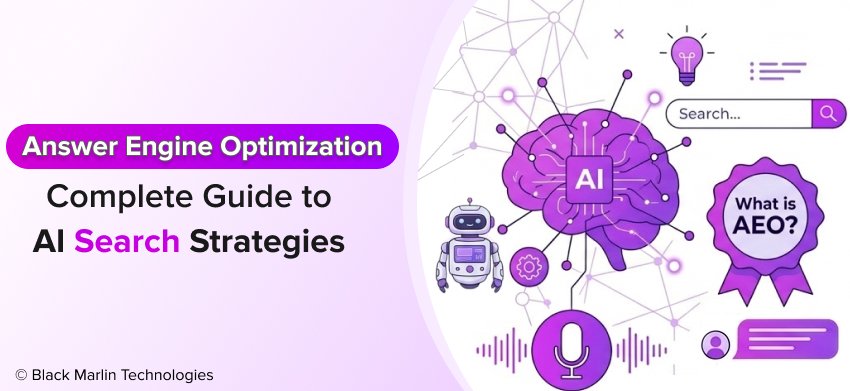 Many individuals prefer to address their inquiries to AI search tools such as ChatGPT, Perplexity, Bing Copilot, and Google’s AI Overviews. These tools do not provide an endless list of pages for one’s question; rather they provide the user with an accurate competent direct answer within seconds.
This change has created a new type of optimization called Answer Engine Optimization (AEO).
Answer Engine Optimization Services helps content creators write text for AI systems so that they can easily comprehend, and believe in such content when creating user answers. It also aims to make your content presented not only among the search results but as the answer that AI engines choose to display.
There is need for business owners, marketers, and website owners to grasp the concept of AEO as the rise in AI search is great. In terms of search visibility, sites tailored to organics will sooner or later have lots of “AI friendly” pages: adaptation of content helpful for geosocial search AI matching answers.
- What is Answer Engine Optimization (AEO)?
- Why AEO is Important in 2026
- How AI Search Engines Work
- Popular AI Search Engines
- AEO vs SEO: What is the Difference?
- Key Ranking Factors for AI Search (AEO)
- Clear and Direct Answers
- Structured Content
- Content Authority
- Entity Optimization
- Fresh and Updated Content
- Schema Markup
- Best AEO Strategies for 2026
- Write Question-Based Content
- Use Short Answer Paragraphs
- Create FAQ Sections
- Use Structured Data
- Build Authority Signals
- Optimize for Entities
- Best Tools for AEO Optimization
- AEO Content Framework
- Future of Search: SEO + AEO + GEO
- Key Metrics to Track AEO Performance
- Conclusion
- Frequently Asked Questions (FAQs)
What is Answer Engine Optimization (AEO)?
In the modern day, when a person is surfing the internet, he doesn’t necessarily want to visit numerous pages in search of relevant information. Many users, however, put up questions in AI facilitating tools for example in ChatGPT, Google AI Overviews, Perplexity, and Bing Copilot. Such already developed techniques are coded to answer questions of the users in a matter of seconds without even going through different web pages.
This is where Answer Engine Optimization (AEO) becomes important.
Answer Engine Optimization refers to the development and organization of information in a manner that is easily discernible by Artificial Intelligence-powered search engines in order to offer a particular response to a query. Instead of conventional means of ranking higher in the search results, AEO Essentials aim at ensuring that one’s write ups are the trusted answer that AI tools display.
Take SEO for instance; it aims at optimizing your webpage so that it appears in the top page of the results upon searching. However, AEO takes a step further and helps you optimize your page so that it is displayed even within the answer that a user gets from an AI based engine.
The difference is simple:
- Google Search: Shows a list of website links
- AI Search Engines: Provide a direct answer with source references
Therefore, if you article comprehensively discusses a subject; provide common questions answers and is well- organized, AI systems will have confidence in it a source. For this reason, many marketers regard Answer Engine Optimization to be very important in current SEO tactics taking into consideration the AI search to be used in future.
Why AEO is Important in 2026
The way people conduct searches on the Internet changes rapidly. The traditional user behavior of entering a short phrase into search engines like Google has been replaced by servers where full queries are expected to be asked, and the answers are given immediately. It is therefore worth mentioning that efficient tools like ChatGPT, Google AI Overviews and Perplexity are designed to deliver quick responses without making users visit multiple websites.
Because of this shift, Answer Engine Optimization is becoming a key part of modern digital marketing.
Several recent trends show why AEO matters so much in 2026:
It seems that 72% of consumers have a preference to consume online information about products, services, or even general information using an AI search engine.
Within the previous year-and-a-half, nearly 300% in the past 18 months, percentage of rise in the use of conversational Artificial Intelligent tools explain the adoption of AI search experience by individuals.
Increasingly, searches are now zero-click searches, where users do not open any website links for searching information beforehand but place a query to the AI only and the necessary information is already provided.
Those alternative strategies are making it hard for businesses to business as usual purely by relying on their page rank in traditional search engines. For the sake of enhancing their chances for the optimization of website images in AI database retrieval, there is a need for firms to ensure that websites optimize the content at the level of AI comprehension and even fit within the response generation framework of such systems.
How AI Search Engines Work
AI search engines function very differently than the traditional search engines. Unlike the latter, which throw a list of web links, AI search engines- such as ChatGPT, Google AI Overview, Perplexity, Bing Copilot- tries to understand the question of the user to give a more precise answer in return. This is why, these tools feel more conversational in approach as compared to others.
To provide accurate answers, AI search engines use several advanced technologies, including:
- Natural Language Processing (NLP)- the system must be able to understand human language and the context behind every question.
- Large Language Models (LLMs) – These are high-performance AI models trained on massive amounts of data for producing helpful responses.
- Knowledge Graphs – These are sets of connections that help significantly improve an understanding between topics, people, places, and entities.
- Semantic Search – Besides paying attention to just keywords, the technique needs to concentrate on query intent and context.
When someone asks a question, AI search engines usually follow a simple process:
- Understand the question – The AI analyzes the intent behind the user’s query.
- Find trusted sources – It searches through reliable websites and content to gather information.
- Combine information – The system analyzes multiple sources to identify the most useful insights.
- Generate an answer – The AI creates a clear and concise response for the user.
- Cite sources – Many AI search tools show references or links to the sources used in the answer.
Due to this approach, content which is concise and coherently presented is more likely to be consumed by AI systems. Hence, it explains why the visibility of content in AI-powered search results is now crucial, and as a result, the use of Answer Engine Optimization techniques is on the rise.
Popular AI Search Engines
The way things are now with how people get answers to queries online, is very quickly shifting. One no longer has to go through lists of websites to get what he or she wants in view of the fact that the artificial intelligence search engines are now playing a very big role in answering those queries.
Several major platformsare playing a crucial role in the advancement of AI-based search. These processes are enhanced by machine learning and the use of extensive language models to comprehend and provide effective answers to queries.
Some of the most popular AI search platforms include:
- ChatGPT – A conversational AI tool that provides detailed answers, explanations, and recommendations across many topics.
- Google AI Overviews – Google’s AI-powered search feature that summarizes information and displays quick answers directly in search results.
- Perplexity AI – An AI search engine designed to provide accurate answers along with source citations.
- Bing Copilot – Microsoft’s AI assistant integrated into Bing search to generate conversational responses.
- Gemini – Google’s advanced AI model that powers intelligent search experiences and interactive responses.
Whereas conventional search engines refer users to the search results made up predominantly of different web pages, these do not simply return but, rather give very concise answers at once. More than that, quite a few of them show citations or references and the origin of information.
Establishments and content makers are now aiming at Answer Engine Optimization because these AI search engines pick up different pieces of information and condense them for easy consumption.
AEO vs SEO: What is the Difference?
It’s a commonly asked disclosure how Answer Engine Optimization is different from the traditional Search Engine Optimization strategy. Different methods are used for the same purpose, which is increasing the online presence.
The traditional Search Engine Optimization is basically focused on improving the ranking of websites in search engine results pages or SERPs. Businesses enhance their websites by creating appropriate content based on keyword research, securing backlinks, and performing technical SEO for the purpose of having those pages on top in Google searches.
Now, answering engines are headed by Answer Engine Optimization where the purpose is how quickly content becomes the direct answer for every question user pose and search engines display. Rather than struggling to reach the top, AEO wants systems to process and comprehend content in a suitable manner to use in a proper citation.
Here is a simple comparison between SEO and AEO:
| SEO | AEO |
| Focuses on ranking webpages in search results | Focuses on providing direct answers |
| Uses keyword optimization | Uses question-based optimization |
| Measures success through clicks and traffic | Measures success through citations and mentions |
| Backlinks are a major ranking factor | Authority and clear explanations are important |
| Appears in traditional Google results | Appears in AI-generated answers |
In 2026, it will be ideal to combine strategies instead of picking either SEO or AEO. By making efforts to appeal to search engines and AI platforms as well for purposes of providing answers, companies are able to secure visibility within both traditional search results and AI based search engines.
Key Ranking Factors for AI Search (AEO)
With the progression of AI-based search engines, many cues are used to determine content to be utilized in answering questions. Unlike Answer Engine Optimization, traditional search engines concentrate more on keywords and link pointing than arguments related to clarity, organization or trust.
If your content is easy to understand and well organized, AI systems are more likely to select it as a reliable source when answering user questions.
Below are some of the most important ranking factors that influence visibility in AI search results.
-
Clear and Direct Answers
Search engines fed by AI look for content that provides quick, clear answers. When a user asks a query, systems quickly scope for answers that give concise, bridging information instead of complex and lengthy paragraphs. Overlaying short answers just below headers may contribute to a favourable selection of your pages.
-
Structured Content
Well-structured content makes it easier for AI systems to understand the information on a page. Using elements such as:
- Bullet points
- Numbered lists
- Tables
- Clear headings
helps AI models quickly scan and extract useful information. Structured formatting also improves readability for users.
-
Content Authority
AI engines typically prioritize information from websites that have a high level of trust from users and are highly respected. Such cases include, for instance, websites with high quality backlinks, professional authorship and regular updates of the content, which are more prone to be perceived as reliable information sources.
-
Entity Optimization
Modern AI search engine have come to understand the designated entities like brands, products, companies, and people. Clearly mentioning related entities within your content helps the AI systems acquire a better grasp of the subject matter and the context of your page.
-
Fresh and Updated Content
Search engines and AI increasingly favour newer and refreshed content. Content regularly updated with new stats, data and insights is more likely to be quoted by AI-generated responses.
-
Schema Markup
So-called schema markup helps search engines not only parse content but also make sense of it. For this reason, the use of certain schema types such as FAQ, Article or How-To may enhance the way a page is regarded by the AI systems and increase the probability of the information being obtained from that page.
As a result, organizations managing businesses have to identify and tailor competitive factors that would enable them to be more discoverable in AI searches. Therefore, it is very clear that for the purposes of search enhancement, it is critical to improve content taking on Answer Engine Optimization changes with time.
Best AEO Strategies for 2026
As AI tools keep growing, so too must the way businesses publish content. Answer engine optimization is all about framing content so that it becomes easy for AI systems to digest as well as to furnish it to the user as a direct answer to their question. By using these strategies, the chances of a content feature in AI would be maximized.
Below are some important AEO strategies for 2026 that can help improve visibility in AI-powered search.
-
Write Question-Based Content
Creating content in a way that directly addresses common inquiries that people search for has proven to be the best way to adopt SEO. It makes the task of AI search engines easier, as they inherently relate to natural language queries, so that content that is based on real questions is friendlier for them; they easily interpret and use it.
For example, instead of targeting only a short keyword, structure your headings around questions such as:
- What is AEO?
- How does AI search work?
- What are the best AEO strategies?
The question on content information-matching dynamics with specific intent displays for systems to surface up that key message for users quickly. That is why in such AI search cases, the question-focused content should be given due consideration.
-
Use Short Answer Paragraphs
Write clear, solid, and simple answer paragraph as an effective strategic approach while answering. Simple, direct answers win the most acceptance from AI engines as gestation in content will never serve the purpose.
The placing of only a 40-60-word direct response immediately following your heading is a wise move. This short para should make prudent sense in simple language, and detail is worked up further later in the content.
As an example, should your heading be “What is AEO?” the first paragraph would provide a quick and simple definition for Answer Engine Optimization (AEO). Further detail, examples, or any backing remarks can come after this part.
Short answer paragraphs help AI systems easily scan and extract the most important information. Because of this, well-structured answers are more likely to appear in AI-generated responses, featured snippets, and voice search results.
-
Create FAQ Sections
By making an FAQ section visible on your website, it’s another incredible AEO strategy. AI-based search engines look for information that provides direct responses to key questions online audiences post or are trending online. FAQs come in handy as they are presented in a question-answer format, making the content easy enough for AI to understand and extract an answer as required.
Adding FAQs to a page also ups the chances of getting showed up in AI-generated SERPs, voice search responses, and Featured snippets. The answer should be short, written in a simple language, and give enough information about the topic.
For example, an AEO-focused FAQ section might include questions like:
- What is AEO?
- Is AEO replacing SEO?
- How can businesses optimize content for AI search?
Organized, well-structured answers to actual audience questions make content more valuable to actual readers and easier for AI to figure into its interpretation. This relatively easy tactic can make a world of difference in the algorithmically determined searches.
-
Use Structured Data
Answer Engine Optimization (AEO) more often than not involves the use of structured data for a good reason. With structured data, search engines and AI systems have higher chances of appropriately interpreting the information contained in your webpage. In fact, structured data relies on providing extra information on the content so as to enable AI tools to better understand the information therein and present it accurately in the search results.
Schema markup is a form of structured data which tells search engines what each part of your content represents. The proper use of schema markup can enhance the way your content appears in AI search results, rich snippets, and voice search answers.
Some commonly used schema types for AEO include:
- FAQ Schema – Helps search engines understand question-and-answer content and display it directly in search results.
- How-to Schema – Useful for step-by-step guides, allowing AI systems to present instructions more clearly.
- Article Schema – Provides information about your article, such as the author, headline, and publication date.
By including structured data to web-sites, you simplify the process of indexing and ranking your content by Artificial Intelligence search engines. Consequently, the probability is higher that your data will be chosen and shown as a trusted answer in AI-powered search experiences.
-
Build Authority Signals
Another crucial aspect is strengthening the authority signals for Answer Engine Optimization. AI search engines like to draw information from Websites they consider to be reputable and creditable. If you have data from a reliable source, AIs likely would use it or cite it in answered questions.
Authority signal is useful for AI engines to understand that the website has valuable information to offer. The higher the authority, the higher the likelihood his content would be identified as a reliable source in the AI-based response generation.
You can improve your website’s authority by focusing on:
- Backlinks – Links from other reputable websites show that your content is valuable and trusted.
- Expert Mentions – Content created or reviewed by industry experts increases credibility.
- Citations – When your brand or website is mentioned across the web, it strengthens your reputation.
Constructing authority is a process, a gradual one but it’s a very important factor that AI search algorithms use to rate information. Information from websites with high authority will be more likely to be considered trustworthy and consequently used in AI-powered search results.
-
Optimize for Entities
Optimizing for entities is as vital as any other Answer Engine Optimization strategy. An entity is a distinct concept such as a brand, product, tool, person or technology-and these entities help AI search understand all the inter-relationships and meaning of the information in the content.
When the content includes well-known entities, AI systems find it easier to connect entities related to the content across the web. It helps the search engines identify the relevance of your content, paving the way for the chances that your content may be chosen as a resource for answers generated by AI.
To optimize for entities, include relevant and recognizable references within your content, such as:
- Brands – Companies or organizations related to your topic
- Tools – Platforms, software, or services commonly used in the industry
- Technologies – Important systems, frameworks, or innovations connected to the subject
naturally using entities through content aides AI search engines in understanding the relationship between subjects, thereby making that content easier to understand and more likely to appear on AI-serps.
Best Tools for AEO Optimization
There is no denying the fact that it is always easier to do Answer Engine Optimization when the right tools are used. These tools assist for in knowing the questions being asked, how the AI-based search engines operate, and the improvement of the content to ensure its visibility as well as in the AI-generated answers.
Many SEO platformsare currently extending their features to assist one in AI SEO, question research, and content layouts. This helps businesses create content that is more likely to be discovered and cited by AI systems.
Some popular tools that support AEO optimization include:
- Semrush: Semrushassists in SEO-related areas such as finding trends and searching relevant keywords and appending user inquiries. This can enhance writing with help of keyword analysis and a few topics essential to further creating content relevant for filling common user questions.
- Ahrefs: Ahrefs is widely used forbacklink analysis, keyword research, and competitive analysis to help find question-based keywords and content opportunities that could improve visibility in both traditional search results and AI-powered answers.
- AlsoAsked: The primary purpose for this tool is to derive related questions being asked by people on search engines. By visualizing these clusters and generating the corresponding questions, the data enables web developers to easily devise content which directly answers user queries with increased chances of appearing in AI responses.
- Perplexity AI: Perplexity is an AI search platform that answers questions along with their respective sources. Users can use the platform to gain insight into the ways in which AI engines formulate responses and access general and specific content.
- ChatGPT: ChatGPT can assist in generating ideas, recognizing prevailing questions, and producing structured content that adheres to AEO strategy. Many marketers prefer to use aspects of ChatGPT to familiarize themselves with conversational search behaviours that AI-friendly content formats call for.
- Surfer SEO: Surfer SEO optimizes content through data-driven suggestions aimed at enhancing heading structures, content modifications, and keyword enrichment to maximize search visibility on AI-driven search engines.
Then, businesses gain an advanced understanding of user intent and the interpretation of information by AI systems, thus assisting in strategies for content development in both SEO and AEO themselves.
AEO Content Framework
The process of planning and executing the creation of content for AEO involves the respondent following a strict yet easily understandable structure. These search engines help to digest content which can easily be understood and is presented logically in addition to the fact that questions of users are directly responded to. Where Articles are appropriately labelled form it is easier even for artificial intelligence systems to grasp the subject matter and find supporting details.
A well-structured AEO article not only improves visibility in AI search results but also makes the content more helpful for readers.
Here is a simple framework that works well for AEO-focused content:
- Start with a Short Definition: The first few lines should provide a short description of the subject. A brief definition at the beginning makes it easier for AI systems to quickly understand what the page is about.
- Use Clear Headings: The article needs to use clear, descriptive headings. Great headings help to lead the reader and AI through your article, showing where the key pieces of information are.
- Add Question-Based Sections: Structure your headings around real user questions. AI search engines look for direct answers to the questions asked by people online.
- Use Bullet Lists: The writing is easier to read when it follows lists and points. It is easier for AI to extract important data from lists so well-structured lists are helpful.
- Include FAQ Sections: FAQ sections provide a platform to answer related questions within one location-this format is very compatible with AI search and voice assistants.
- Add Data and Statistics: Adding data, research finds, or statistics increases the credibility of your content. Often AI systems prefer information supported by reliable data.
- Provide Examples: Examples are best at simplifying complicated ideas. They ensure that content is well understood by the readers and that the AI engine correctly detects the context of the topic.
If you follow this framework, you can create content that is friendly enough to users and AI search-engine-optimized so that the chances of the information being considered to be the answer in an AI-powered search result is increased.
Future of Search: SEO + AEO + GEO
| Type | Meaning |
| SEO | Search Engine Optimization |
| AEO | Answer Engine Optimization |
| GEO | Generative Engine Optimization |
- Search Engine Optimization focuses on improving website rankings in traditional search engines like Google and Bing. The goal is to increase organic traffic by optimizing keywords, backlinks, and website performance.
- Answer Engine Optimization focuses on structuring content so AI systems can easily understand it and present it as a direct answer when users ask questions.
- Generative Engine Optimization goes one step further by optimizing content specifically for AI systems that generate responses, summaries, and recommendations.
In the coming years, successful digital strategies will combine all three approaches. Businesses that start optimizing their content for AI-driven search experiences today will have a strong advantage as search continues to evolve.
Key Metrics to Track AEO Performance
To understand whether your Answer Engine Optimization strategy is working, it is important to track the right performance metrics. Unlike traditional SEO, where success is often measured by rankings and website traffic, AEO focuses more on how often AI systems use or reference your content when generating answers.
By monitoring specific indicators, businesses can evaluate how well their content is performing in AI-powered search environments.
Some important metrics to track include:
- AI Citations: AI citations occur when AI search engines reference your website as a source while generating an answer. If your content is frequently cited by AI tools, it shows that the system considers your information reliable and relevant.
- AI Brand Mentions: Brand mentions in AI-generated responses indicate that your company or website is being recognized as an authority on a topic. Increasing brand visibility in AI answers can help build trust and improve overall digital presence.
- Featured Snippets: Featured snippets are highlighted answer boxes that appear at the top of some search results. Content optimized for clear and direct answers has a higher chance of appearing in these snippets, which also increases visibility for AI-driven search features.
- Voice Search Results: Many AI assistants and smart devices rely on voice search to deliver answers. Tracking whether your content appears in voice search responses can help measure the effectiveness of your AEO strategy.
- Zero-Click Impressions: Zero-click searches happen when users get their answer directly from the search page or AI-generated response without clicking a website link. Monitoring these impressions can help you understand how often your content is being used as a source.
- AI Referral Traffic: AI referral traffic refers to visitors who arrive at your website through links provided by AI search tools. Tracking this traffic helps measure how AI-powered platforms are contributing to your website visits.
By analyzing these metrics, businesses can better understand how their content performs in AI-driven search environments and refine their Answer Engine Optimization strategy for improved visibility and authority.
Conclusion
Search is evolving quickly as artificial intelligence becomes a major part of how people find information online. Today, users are increasingly turning to AI-powered tools to ask questions and receive instant answers instead of browsing through multiple search results.
Because of this shift, Answer Engine Optimization is becoming an important extension of traditional SEO. Rather than focusing only on ranking webpages, businesses now need to create content that AI systems can easily understand, summarize, and cite as a trusted source.
By writing clear explanations, organizing content with proper headings and lists, answering common user questions, and building strong authority signals, websites can improve their chances of appearing in AI-generated responses.
As AI search continues to grow, combining SEO, AEO, and AI-friendly content strategies will help businesses stay visible and competitive in the future search landscape. Organizations that start optimizing for AI search today will be better positioned to reach users in the next generation of digital search experiences.
Frequently Asked Questions (FAQs)
- What is Answer Engine Optimization?
Answer Engine Optimization is the process of creating and structuring content so AI-powered search tools can easily understand it and provide it as a direct answer to user questions. Instead of focusing only on search rankings, AEO helps content become the information that AI platforms display in their responses.
- How is AEO different from SEO?
The main difference between AEO and SEO is their primary goal. Traditional SEO focuses on improving a website’s ranking in search engine results pages, while AEO focuses on providing clear answers that AI search engines can display directly. In modern search strategies, both SEO and AEO work together to improve online visibility.
- Why is AEO important for AI search?
AEO is important because more users are now relying on AI-powered search tools to find quick answers. These platforms generate responses using trusted sources across the web. Websites that optimize their content for AEO have a better chance of being referenced or cited in AI-generated answers.
- How do AI search engines work?
AI search engines analyze user questions using technologies like natural language processing and machine learning. They gather information from trusted sources, combine relevant insights, and generate a summarized answer. Many AI platforms also provide citations to show where the information comes from.
- What are the best AEO strategies?
Some effective AEO strategies include writing question-based content, providing clear and direct answers, using structured formatting such as headings and bullet points, adding FAQ sections, and building authority through trusted sources and backlinks.
- Can AEO improve website traffic?
Yes, AEO can help improve website visibility and traffic. When AI search engines reference or cite your content, users may visit your website to learn more about the topic. Over time, strong AEO strategies can increase brand awareness and drive more qualified traffic.