+1-(646) 362-1414
 +91 8826683820
 info@blackmarlintechnologies.com

Digital marketing feels harder than ever, and you’re feeling it too. New platforms, constant algorithm changes, AI tools at every point… wherever you look, there is always something to keep you busy. Today it is SEO that you are after, tomorrow you are dealing with paid digital ads, next minute you are working on short clips to amplify your brand on social media. Multitasking is the spectacle of today’s businesses, but doing everything only brings no good results.
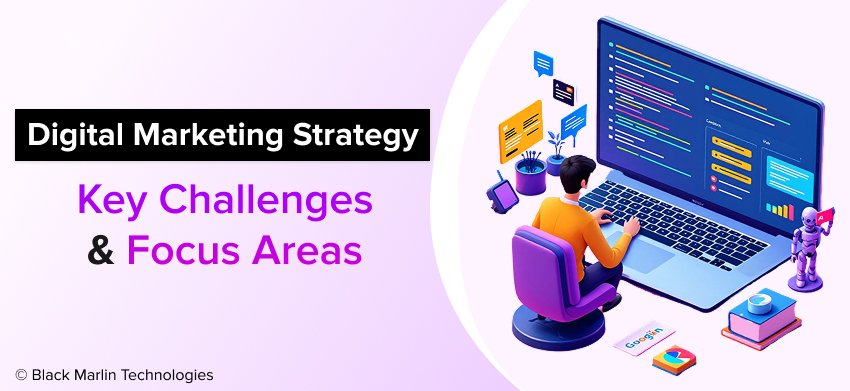 It is a truth that success is not just something borne out of random firing of bullets. It will flow from the implementation with a clear vision of what is of great importance to one’s business and audience. Lacking this mode of professional support, good ideas fall short of all subsequent tools and strategies.
In this guide, we’ll dissect the main impediments that marketing professionals run into in digital advertising focus areas. Understand how to simplify your work, avoid certain common pitfalls, and establish a system that is cohesive without complexity.
What Is a Digital Marketing Strategy?
A digital marketing strategy is a strategy and not a platform. It is not about first choosing between Facebook, Google Ads, or SEO; what comes first is deciding on the goals of your marketing and what those goals mean to you. Platforms follow not the other way round.
A strong digital marketing strategy links everything together: your business goals, your target audience, the right channels, and your desired end results. How Do we want to affect? What problem are we solving? Where should we show up? How will we know it’s working?
Many people tend to mix up strategy and tactics. Social media posting, ads, and blog-writing are all tactics. They are, indeed, action. Yet, without the proper direction, they call for hardly any results.
Simple example:
Posting daily on social media is not a strategy.
Knowing why you post, who you’re targeting, where to reach them, and how success is measured—that’s a digital marketing strategy.
Why Digital Marketing Strategies Are Failing Today
Most businesses invest enormous time and money into digital marketing, yet something still seems to elude them. And the problem is function. A digital marketing strategy, illuminating the way, can convert extremely active campaigns into some highly rewarding results.
- Too Many Channels, No Clear Focus – Brands seem to think that there needs to virtually be on Instagram, LinkedIn, Google Ads, email, and YouTube without understanding the right channel that delivers value. It all only makes a budget thinner than what is needed; people working on that end are not efficient enough; hence, there is no growth.
- Chasing Trends Instead of Customers – There is a new trend every month and suddenly they upend everything-from viral reels to AI tools. Instead of inquiring whether our audience even cares, many marketers embrace trends unquestioningly. Therefore, conversions suffer when decisions are based on trends and not customer requirements.
- Over-Dependence on Paid Ads – PPC ads assure immediate traffic, but dependency on them is risky. Increasing ad costs and poor quality leads gnaw away even at the most well-set budgets, leaving little space to grow in a healthy way through organic channels.
- Poor Measurement of Real ROI – Impressions and clicks look good on reports, but they do not always signify business results. The absence of lead tracking, sales tracking, and customer value tracking makes it hard to know what is actually working and what is not.
Key Challenges in Digital Marketing Today
Digital marketing is not just changing, but has become a more competitive and complex environment for businesses. A business that doesn’t adapt to its digital marketing strategy is left behind. In this article, we look into the main problems that marketers face today.
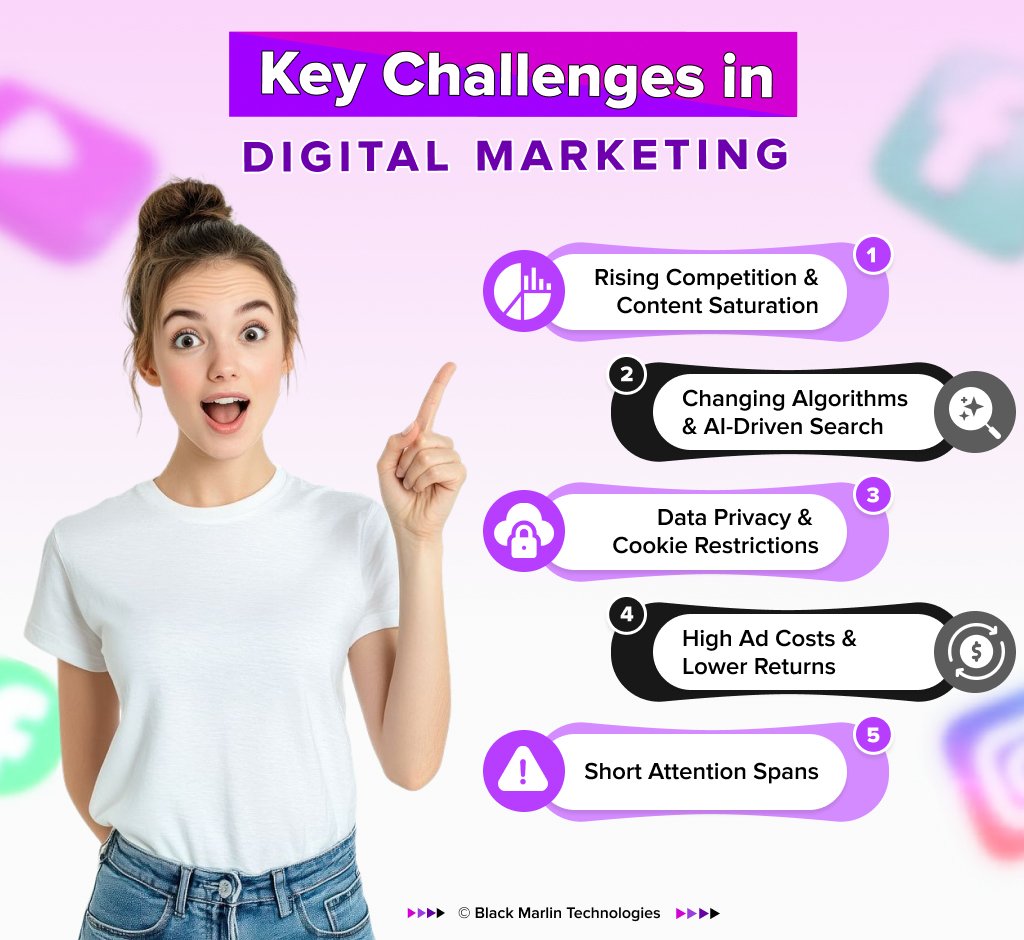
- Rising Competition & Content Saturation – Everyone is publishing content—all sorts of things, blog posts, videos, ads, emails, and social media posts. That’s why audiences are bombarded with information every day. The competitive edge changed from just uploading more to becoming more relevant. Good content drowns: it gets drowned out without a focused message.
- Changing Algorithms & AI-Driven Search – Search engines and social media platforms are constantly changing the way they rank and display content. Furthermore, the AI-driven search tools change the way of finding answers. All this dispossesses marketers of control and sows uncertainty about the effectiveness of their effort.
- Data Privacy & Cookie Restrictions – As third-party cookies disappear with stronger privacy protections, collecting user data becomes increasingly difficult. Instead businesses are now forced to utilize user-granted first-party data and their trust instead of relying solely on the tracking shortcuts.
- High Ad Costs & Lower Returns – The costs of paid advertising continue to increase, while the returns fail to be certain. In many businesses, there is the addition of higher advertising expenses, while the number of quality leads decreases-thus more and more pressure is being put on every dollar spent.
- Short Attention Spans – Users today want instant, clear answers. If a message cannot connect instantaneously, they abandon it. The long lead funnels, complex landing pages, and vague offerings are no longer effective.
Focus Areas for a Strong Digital Marketing Strategy
To succeed today, businesses need to shift from doing “more marketing” to doing better marketing. These focus areas help in building the future clear, effective, and future-ready digital marketing strategy.
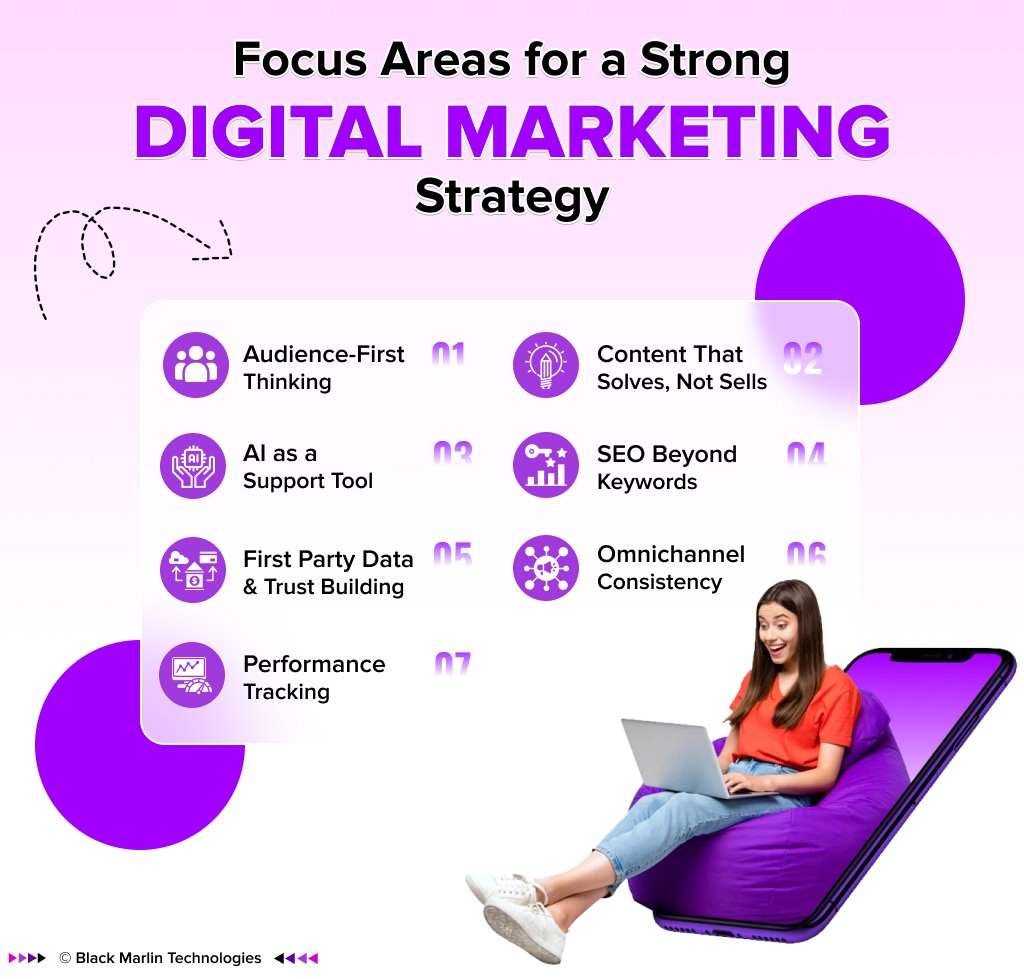
- Audience-First Thinking – A rigorous strategy starts with identifying the real problems of the customer, not just their age, location, or job title. Once you know what your target prospect is struggling with, you prepare content that can solve genuine questions and build trust. This approach leads to better engagement and long-term results.
- Content That Solves, Not Sells – Modern audiences avoid blatant marketing. In lieu of it, they favour content that enlightens them or aids them in making better decisions. Blogs, short videos, FAQs, and guides should offer solutions to a person’s problem first. When Content gives value to the public, conversions will naturally follow.
- AI as a Support Tool – AI can accelerate research powers, enhance optimization, and help personalize campaigns – but it cannot replace human thought. The art of deploying AI in the best of digital marketing strategic plans relies equally on people for the efficiency aspect and on people for creativity, the entire planning, and most decision-making.
- SEO Beyond Keywords – Today, SEO stands for much more than simply ranking for keywords; search engines also want to see that the content written is authoritative on a particular topic, has keywords that refer clearly to the search intent, and is really useful. Developing well-structured, practical pages will contribute to improved visibility and credibility over time.
- First-Party Data & Trust Building – Now with updated privacy regulations, businesses need to give more weight to the data collected by them directly, like email lists or CRM data. Engaging the community, offering value, and asking for permission can lead to a better customer relationship and enhanced targeting.
- Omnichannel Consistency – The website, social media, advertisement, and email campaign should all narrate the same story. An increased number of coherent messages throughout several touchpoints strongly enhances its brand recollection and ease of the customer’s experience.
- Performance Tracking – Tracking traffic is easy, but it doesn’t show real impact. A strong digital marketing strategy focuses on leads, sales, and customer retention. Measuring what truly matters helps teams improve faster and spend smarter.
A Simple Digital Marketing Strategy Framework
A good digital marketing strategy should be something that you can sieve through in one go. In fact, the simplest it is, the easier it will become for execution and adjustment. Make use of the following breakdown to guide you through focus and prevent any elements of overwhelm.
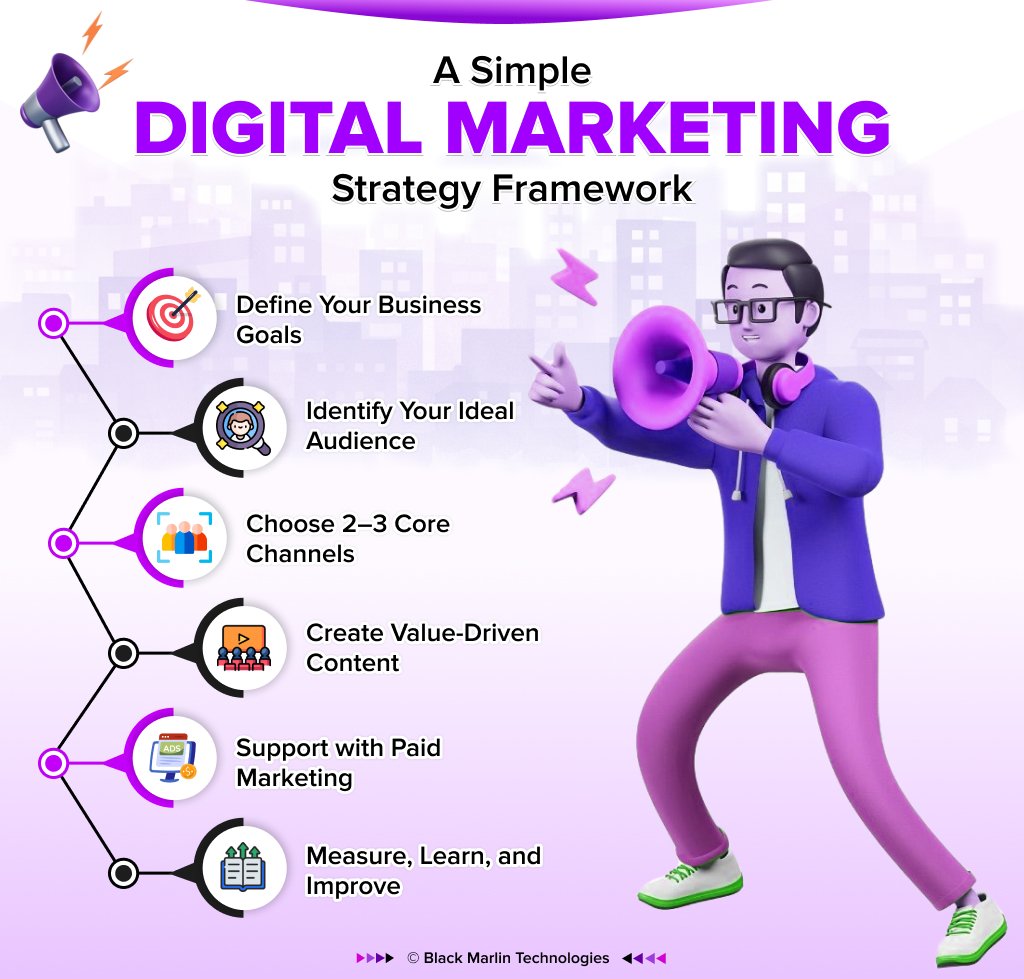
- Define Your Business Goals – The first thing is to be straight in what you hope to achieve. Would you consider more leads, sales, brand awareness, or repeat customers? Clear goals also mean that later, your strategy would have a direction and measuring success would be possible.
- Identify Your Ideal Audience – Know your target audience and the problems they want to tackle. Focus on customer pain points, questions, and behavior rather than simple demographics. The better you understand your audience, the better your results.
- Choose 2–3 Core Channels – It doesn’t have to be everywhere. Determined 2 or 3 channels where your audience is the most active-among them could be email marketing, social media, SEO-and do them well, before expanding elsewhere.
- Create Value-Driven Content – Your content defines, educates, and helps or guides users. Blogs, videos, FAQs, and points answering particular, authentic questions create trust as well as escalate engagement.
- Support with Paid Marketing – Employ paid advertising to expand the outreach to your page quicker but don’t depend merely upon that. It works best when backing strong content with a clear message.
- Measure, Learn, and Improve – Measure what counts (leads, conversations, customer retention). Every review period-whether it is weekly or monthly-is an opportunity for you to learn what works and tweak strategies.
Common Mistakes to Avoid in Digital Marketing
Despite a strong digital marketing strategy, some proverbial Pandora’s box can easily and most inadvertently throw a wrench in works. To avoid falling victim to the common errors, you can easily escape the whip of financial, time, and frustration losses.
- Doing Everything at Once – Doing so only causes burnout and poor performances. When there is no focus, nothing really formats well. It is more potent mastering a few major channels before considering the whole gamut.
- Copying Competitors Blindly – Some techniques your competitors use to their advantage might not work for your brand. Different people, different budgets, different goals require methods and methodologies. Instead of trying to mimic tactics, go for learning why something works and mesh it with your strategy.
- Ignoring Analytics – Running a campaign without tracking performance is like driving a car without any propulsion; the results will get blurry and far in the future without measurement. With no view into the data on a regular basis, one cannot study the positive outcomes occurred, nor be alerted where improvements are necessary. Analytics can replace guesses with a choice.
- Overusing Automation – Automation actually saves time, yet sometimes it makes marketing feel too impersonal. This is because automated messages without context or any relevance simply go unharvested. So, in essence, use automation as another way to further push your strategy while upholding the cause for human judgment.
FAQs
Q1. What is the biggest challenge in digital marketing today?
The biggest challenge in digital marketing today is standing out in a crowded space. With more brands creating content and running ads, competition is higher than ever. Without a clear digital marketing strategy, businesses struggle to reach the right audience and achieve meaningful results.
Q2. How often should a digital marketing strategy be updated?
A digital marketing strategy should be reviewed regularly—at least every three to six months. This helps businesses adapt to changing customer behavior, platform updates, and performance data while staying aligned with their goals.
Q3. Is AI replacing digital marketers?
No, AI is not replacing digital marketers. AI helps with research, automation, and optimization, but human skills like creativity, strategy, and decision-making are still essential. The most effective digital marketing strategies use AI as a support tool, not a replacement.
Q4. Which digital marketing channels matter most today?
There is no single best channel for every business. The most important channels are the ones where your audience is active. For many brands, this includes SEO, content marketing, social media, email marketing, and paid advertising—used together with a clear focus.
Final Thoughts
All successful digital marketing comes with the art of getting things done—less, but the right things that point to specific objectives. More than individual tactics, the strength in a marketing strategy serves as the foundation. Tools, platforms, and all trends can get old, but a strong plan gives the necessary momentum and direction in putting to use tactical muscles.
Remember all throughout: it’s quality, not quantity. You don’t have to be on every channel or rush after every trend. As soon as you get this right—what your audience really needs—and choose the right platforms, improvements will immediately follow.
But more than that, learn to adapt; do not follow trends blindly. Using insights derived from data and customer behavior should always be your guide.
If you feel you need help for reviewing or improving your existing digital marketing company, perhaps start from an auditing consultation. Or you can delve into our new beginner’s guide on structuring over-performing digital campaigns for long-lasting growth.