+1-(646) 362-1414
 +91 8826683820
 info@blackmarlintechnologies.com

Digital marketing just means using the Internet to promote your real-estate business. Rather than waiting for the foot traffic to come walking in the door or to find your ad in the paper, realtors can gain access to potential buyers and sellers where they regularly hang out—Google, social media, email, and property websites. If someone searches online for homes for sale near me or real estate agents in my city, digital marketing helps you show up at the right moment.
In 2026, digital marketing will be making a bigger push for real estate than ever before. People do their homework now before making a call, check out multiple listings on their mobiles and those agents who seem to be present and offering help online. New trends such as those with AI-powered search results, voice search, 30-second videos, and virtual real estate tours indefinitely are shaking up the way people find and choose their real estate agents. The ones who go along with these trends are able to expand rapidly, whereas those who sit back gradually lose visibility.
Digital marketing equals more clients found online, right? Rank on Google, make your social networking politics build up recognition, run ads when targeted precisely, and more and more people will be calling on you. The greater the visibility, the more the inquiries, more the crowds directed to your property features, and, finally, the more the deals closed up.
What Is Digital Marketing for Realtors?
Digital marketing for realtors is all about being found, being trusted, and being contacted. Consider it this way: When somebody wants to sell or buy a house, the first thing that they’ll do is look up Google; or they might be hanging out in social media. If you appear there with the right messages, you’ve won their attention.
It can get as basic as Real Estate SEO to boost website rankings, Social Media Marketing to display a property, Online Ads to connect with ready buyers, and Email or WhatsApp Marketing to stay engaged with leads. The aim is not about being everywhere, but only to be visible in the right places. Done the right way, digital marketing can help realtors draw quality leads, speeding up the trust-building process and allowing them to grow their business consistently in 2026.
- Getting Found Online – Think of how you search for something now. You open Google and type “houses for sale near me” or you scroll scrolling Instagram to watch some real estate videos. Digital marketing helps your real estate business show up on Google search results, Google map, social media platforms. This is done with the use of real estate SEO, local keywords, social media marketing to gain attention to your sites so that people may come to find you easily online.
- Getting Noticed – Attracting attention is not about just getting found; how one presents oneself online is important. A good, fast website with clear pictures, short videos, and virtual tours will grab hold of a head or two. Just as brightly lit shops are more welcoming, so is well-designed
- Getting Trusted and Contacted – Potential customers will tend to trust what a professional looks like, the information, reviews, blog posts, social media posts, or easy-to-access means of contact us. When buyers trust you, they click “Call,” send a message, or book a site visit.
Most Important Digital Marketing Channels
If you want to be successful as a realtor in 2026, you do not need to be everywhere online; you just need to focus on the right digital marketing channels where the buyers and sellers hang out most of the time to search, compare and make decisions. Together, these channels will help in attracting more real estate lead and converting them into real clients.
The first and the most important the SEO (search engine optimization) channel. SEO helps in getting your real estate website to appear on Google when people search for terms like buying a house near me, real estate near me and selling a house near me. For realtors, Local SEO is the most powerful marketing due to being able to post properties in a specific city or location. Getting on top means you get free traffic in the long run.
The next step is social media marketing, and with a social media presence, property businesses can have strong connections extended. Instagram, Facebook, YouTube,… whichever else, make the best means for cascading property photos, short videos, home tours and client success stories. Social media viewed online shows the human side of your business, hence making people feel comfortable when reaching out to contact you.
Another key channel includes paid advertisements such as Google Ads and social media ads. When it comes to paid advertising, you can reach people faster, especially those who are prepared to acquire, or sell, now. As messy as ads, email and WhatsApp marketing help keep in touch with leads, share new listings… and remind people that you are there when they are ready to move.

- Search Engine Optimization (SEO) – SEO can assure that a website will make it to Google’s first page when keywords like ‘home for sale near me’ or “real estate agents in my area” are searched. Higher SEO ranking helps fetch more visitors to your site organically without any payment for ads. The reputation of good SEO lies with using the right keywords, lightning-fast website speed, and local business listings.
- Website & Landing Pages – Your website is known as your online office. Users would expect that your website should be easy to handle and, of course, instantaneously get loaded on both big and small screens. Submitting clear property listings, there should be a short form, and any buttons which remain simple, such as “Call Now” or “Book A Visit,” need to help any one of your site visitors get in touch with you easily.
- Social Media Marketing – Platforms like Facebook, Instagram, and YouTube enable using photos, reels, and short videos to showcase homes. Trust can be built with social media through giving people the ability to visualize real homes, real stories, and real results. Social media also lets you stay visible even when people are not ready to purchase.
- Paid Advertising (Google & Social Ads) – Paid ads get you quick visibility: a consumer clicks here, enters a search query or becomes awakened to your ad when just scrolling through social media. All they require are ads for the recent listings, hot sales, or specific locations.
- Email & Messaging Marketing – Email and WhatsApp marketing will help you maintain a connection with the leads, by sharing new listings, price updates, or some helpful tips. Remember, the leads will always think of your brand, until they are ready to face the decision-making criteria.
How to Use Keywords to Rank in Google (Simple Guide for Realtors)
Keywords are the words or phrases people enter in a search bar on Google while looking for particular information. For instance, someone searching to buy a house may type in “houses for sale near me” or “top real estate agent in New York”. They are referred as search keywords. If these were used on your website in a natural conversational manner, Google understands that your particular website will be a good match among the several millions of searches and will show it in front of users.
Why Long-Tail Keywords Work Better
Long-tail keywords are longer and more specific search phrases. They help you gain attention from serious and ready to deal clients rather than those only idly browsing about. Such keywords imply less competition and more welcoming genuine clients, gave everyone well-thought-of reasons for the effectiveness of real estate SEO in 2026.
Where to Place Keywords Correctly
To rank in Google, keywords should be placed naturally in:
- Page titles and headings
- Sub-headings (H2, H3)
- Website content and blog posts
- Meta descriptions and image names
Avoid keyword stuffing. Write for people first, and search engines will follow.
Simple Steps to Find Good Keywords
Use Free Keyword Tools – It is the case that a tool like Google Trends or Google Keyword Planner would serve to enumerate for someone the very searches people are making, as well as how popular they become, in order to choose keywords that drive traffic.
Think Like a Home Buyer
Ask simple questions such as:
- “How much does a house cost in this area?”
- “Which is the best location to buy a home?”
These questions becomes powerful keywords and blog topics in helping your real estate website rank higher and get more leads.
Digital Marketing Plan for Realtors (Step-by-Step)
Digital marketing strategies for realtors don’t have to be technical and complicated. Think of it as using Google Maps for the business: deciding on where you want to go, and selecting the appropriate route to get you there. Similarly, a simple digital marketing roadmap helps realtors attract buyers, sellers, and investors online without spending time and money.
In 2026, a smart real estate digital marketing plan starts with following and understanding the audience well, setting clear goals, and taking on the right platform, i.e. Google, social media, and your website. You don’t have to post everywhere – only where potential clients are active. So when your message is clear and when your content is informative, then some people are likely to trust you and contact you.
The best part about digital marketing is actually that it is flexible and can be improved with ease. You can see who’s visiting your site, simply call them or message them. By repeating such techniques to suit the purpose of always fine-tuning or gradually enhancing their online footprint, brokers are thus able to generate consistent leads all year.
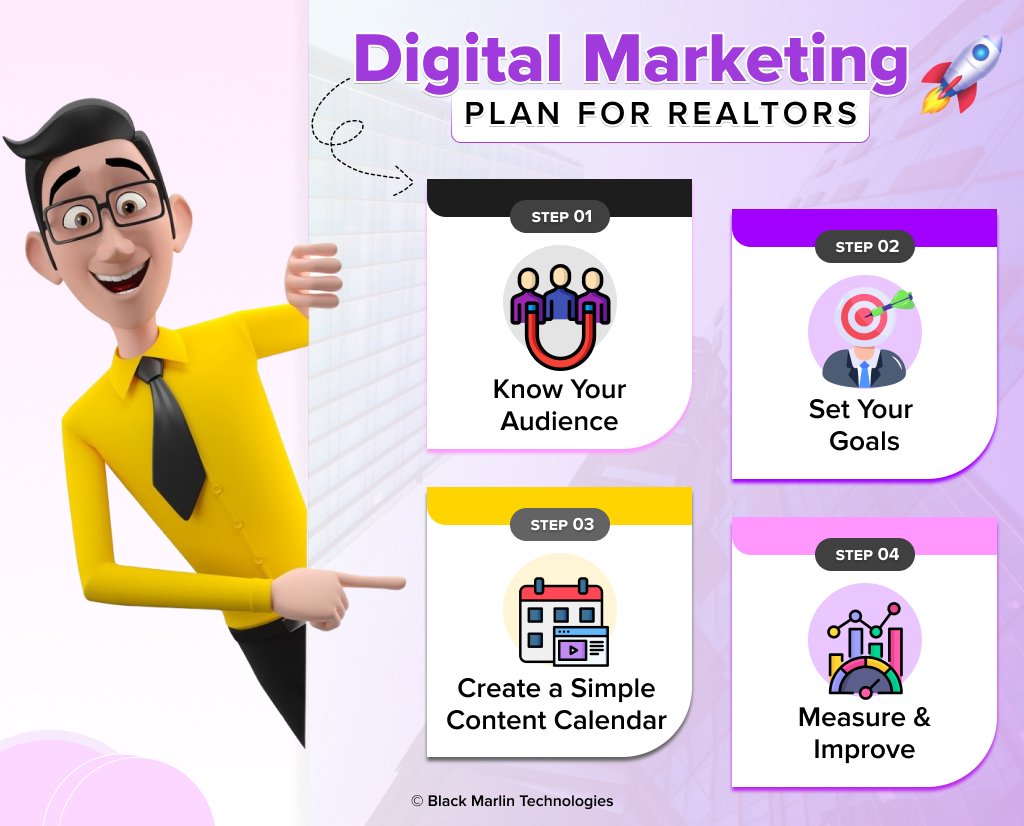
Step 1: Know Your Audience
Firstly, are you aware of whom you are speaking? Some people want to buy a home, some want to rent, and some investors want profit on their investments. Buyers care for location and price and renters care for convenience, while investors want returns. Comfort hands down makes it easier for you to bring your real estate marketing messages in a coherent and more cognizable way to the right market.
Step 2: Set Your Goals
Next, decide what you want from digital marketing. Your goals can be simple:
- Get more visitors to your website
- Get more inquiries and phone calls
- Get more property visits
Clear goals help you choose the right digital marketing strategy and avoid wasting time.
Step 3: Create a Simple Content Calendar
A content calendar tells you what to post and when to post. For example:
- Monday: Share a property photo
- Wednesday: Post a short video tour
- Friday: Answer a common buyer question
Make it easily understandable content such as “How to choose a good home” or “Things to check before buying a house.” Easy-to-understand content works best.
Step 4: Measure & Improve
You should check what is working and what isn’t. Simple numbers such as website visits, phone calls, text messages, and form submissions come in handy. When videos bring in leads, create more. When blog posts generate traffic, get more blogs. Replicating what works best improves digital marketing.
Common Mistakes Realtors Make Online
Many agents begin digital marketing with great intentions but not seeing results because of minor mistakes that could have been avoided. Not using keywords or using them wrongly just for the sake of it is one major issue. So if your website does not match up with whatever buyers input on Google, then your business stays obscured. Conversely, the constant and consistent repetition of a keyword may not assist with SEO rankings but will work against your rankings.
One of the common mistakes is putting up the same posts every single day. Simply sharing property pictures with no particularity about real estate tips, videos, or helpful tips makes you look less interesting online. People are seeking information and obviously are not looking for listings. Your profile then needs the mix of real-value-added posts: education posts, short videos, market updates, and success stories to keep them interested and keep faith building over time.
Ignoring online reviews in real estate is another big problem when digital marketing. These are often taken almost as seriously as testimonials. The moment there are no reviews or the fact that the reviews have young responses, potential clients may opt for another real estate agent. Replying to reviews and gently asking satisfied clients to provide voluntary feedback builds credibility and helps to encourage more people to contact you.
- Not using keywords the right way is one of the most common mistakes realtors make online. Many agents do not use keywords or add too many of them all of a sudden. If they are not naturally connected in the contents of the website, in the blogs, headings, search engines will not know what topics one’s page embodies, hence it will be harder for searchers to find a real estate business online.
- People’s interest may quickly wane if you repeat the same thing over and over. When you post property pictures over and over again, people tend to lose interest. The best approach is one that incorporates a variety of content types: short videos, buying tips, area updates, client success stories. In doing so, such sort of variety helps to keep your real estate marketing fresh and at the same time brings about a stronger bond between you and your audience.
- ignoring online reviewscan seriously harm trust and credibility. Reviews act as digital word of mouth. If a prospective buyer views unanswered or missing reviews then he might likely choose another realtor. Responding positively to reviews and persuading satisfied clients to give suggestions would boost trust and enhance your online reputation.
Frequently Asked Questions (FAQs)
1. What is digital marketing for realtors?
Digital marketing for realtors means promoting real estate services online using websites, SEO, social media, ads, and email to attract buyers and sellers.
2. Why is digital marketing important for realtors in 2026?
Most buyers search for homes online before contacting an agent. Digital marketing helps realtors get found, build trust, and generate more leads in a competitive market.
3. How long does real estate SEO take to show results?
SEO usually takes 3 to 6 months to show strong results. However, small improvements like local SEO and keyword optimization can bring traffic sooner.
4. Which digital marketing channel works best for realtors?
SEO, social media, and paid ads work best together. SEO brings long-term traffic, social media builds trust, and ads deliver quick leads.
5. Do realtors need a big budget for digital marketing?
No. Realtors can start with low-cost options like SEO, content marketing, and social media, then scale with paid ads as results improve.
6. How can realtors get more local leads online?
By using local keywords, optimizing Google Business profiles, collecting reviews, and creating content focused on nearby areas, realtors can attract more local clients.
Conclusion
Digital marketing for realtors is not impossible or technical. With the correct techniques, one can easily create an online presence while continuously having buyers and sellers wanting to contact you. Simple steps like correct keyword selection, posting of useful content and engagement about the things that are done by the people in the market you are targeting, can make a significant difference.
The key is to follow a definite process. Start by understanding your audience, set pragmatic goals, make useful content, and follow up on that one click. Don’t try and do everything together; small, consistent efforts turn into huge lessons when it comes to real estate digital marketing strategies.
Finally, you need to keep learning and adapting. Online trends keep changing every year, and 2026 will keep evolving in 2027. The few Realtors who keep curiosity alive, test ideas new to them, and make their digital strategies the best will be well ahead of the competition, ensuring a growing business faster.