+1-(646) 362-1414
 +91 8826683820
 info@blackmarlintechnologies.com

If you own a local business or work on local SEO, you’ve probably heard the term SEO citations—but what do they actually mean and why are they still considered important in 2026?
Simply put, SEO citations are online mentions of your business name, address, and phone number (NAP). These mentions can appear on business directories, local websites, social platforms, review sites, and even blog posts. Search engines use this information to confirm that your business is real, trustworthy, and located where you say it is.
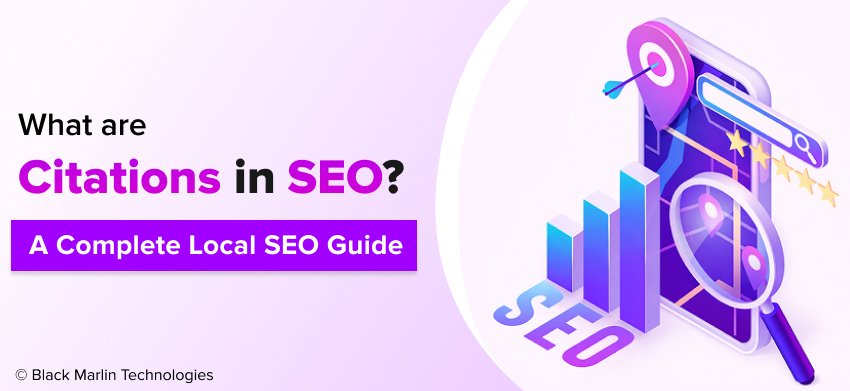 In 2026 local SEO, citations matter more than just being “listed somewhere.” Search engines now focus heavily on accuracy, consistency, and relevance. When your business details appear correctly across the web, it becomes easier for Google to trust your brand and show it in local search results—especially for “near me” searches.
In this comprehensive guide, you’ll learn what in SEO refers to citations, why they are important in local SEO rankings, what the different types of citations are, and the method of creating and managing them properly in 2026. No matter if you are a beginner or a business owner, this article will help you understand what citations are and use them to improve local visibility in an uncomplicated way.
- What Are Citations in SEO?
- Citations vs Backlinks: What’s the Difference?
- What Information Is Included in a Citation?
- Types of Citations in Local SEO
- Why Citations Matter in Local SEO in 2026
- How Local Citations Impact Rankings
- Step-by-Step: How to Build Local SEO Citations
- Why This Works
- Tools & Resources for Citation Management
- Citation Audit Checklist
- Common Local Citation Mistakes to Avoid
- Advanced Tips for Local SEO Citations in 2026
- Local SEO Trends to Consider 2026
- FAQs:
- Conclusion
What Are Citations in SEO?
Citations in SEO are online mentions of your business information—mainly your Name, Address, and Phone number (NAP). These mentions help search engines confirm that your business is real, active, and located where you say it is. The more accurate and consistent your citations are across the web, the stronger your local SEO foundation becomes.
Think of citations as digital references. The more often your accurate or business-related details or citation-related elements correctly appear on trusted websites, that boosts the trust the search engines will place in this information in local search results.
Citations vs Backlinks: What’s the Difference?
This is a commonly confused point so let’s keep it simple:
- Citations help with local visibility and trust
- Backlinks help with authority and ranking power
A mention does not have to have a dofollow external link to your website. All that one of those rather mysterious NAPs needs to have to support local SEO is a small mention. Backlinks, on the other hand, consist of a clickable URL and SEO equity, which impacts SEO status overall.
In brief:
Citations are to build local trust. Backlinks are to build SEO authority.
Both are significant but are really means to different ends.
What Information Is Included in a Citation?
A standard SEO citation includes:
- Business Name
- Address
- Phone Number (NAP)
Optional but highly valuable fields include:
- Website URL
- Business hours
- Categories/services
- Photos
- Business description
The more complete and consistent this information is, the better it supports your local SEO citations strategy.
Types of Citations in Local SEO
Structured Citations
Structured citations are those you will find on business listing and web directory sites where the data is required to be entered in certain fields.
Examples include:
- Business directories
- Social platforms
- Local listing sites
These citations come in a standardized structure, enabling search engines to read and verify the correct data about your business. Popular examples include platforms like Yelp, Facebook, and Yellow Pages.
Structured citations are especially important for local SEO beginners because they are easier to build and manage.
Unstructured Citations
Unstructured citations happen when your business is mentioned naturally on the web without a fixed format.
These can appear in:
- Blog posts
- News articles
- Online reviews
- Local event pages
For example, if a blog were to mention your business name and the city it is in, and enumerate your business name without the floating NAP elements, that would still work as a meaningful unstructured local citation. These citations are the real-world affirmations; hence, they add grace and power to your local power.
Why Citations Matter in Local SEO in 2026
In 2026 citations still play a vital role in local SEO. While search algorithms have been evolved with artificial intelligence and smart ranking systems, ultimately it still relies upon true business data to give credit for visibility.
However, let’s take a break and talk why citations are crucial for local SEO in 2026, in a fairly simple way.
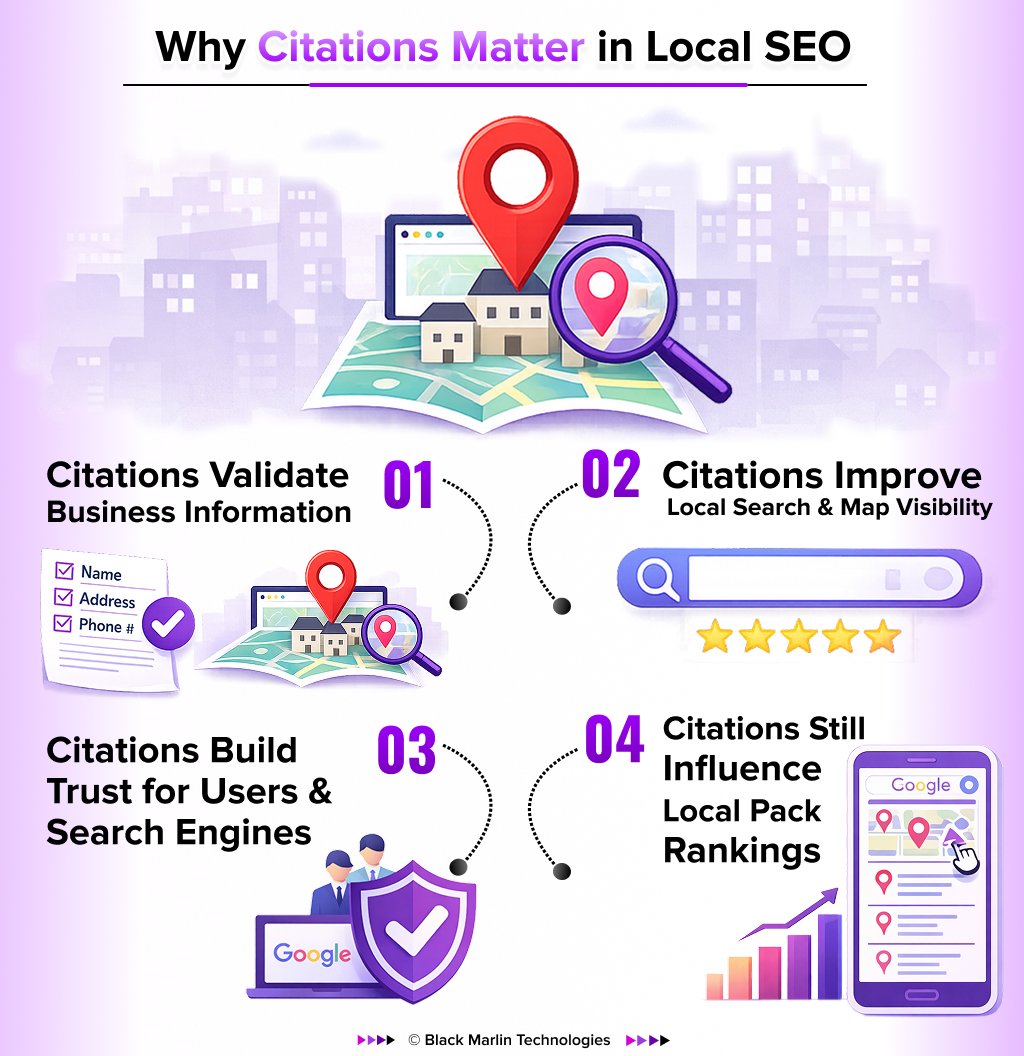
1. Citations Validate Business Information
Search engines want to display real respectable businesses to users. Your business name, address, and phone number appearing consistently over several websites indicate clearly that you are a legitimate business.
By matching up all your data everywhere, search engines can strongly authenticate the following:
- Your location
- Your contact information
- Your business authenticity
Such validation holds a massive belt-and-suspenders reinforcement of local rankings by the citations SEO; importantly, this holds for local businesses found trading in the same locality
2. Citations Improve Local Search & Map Visibility
Local citations directly support your visibility in:
- Local search results
- “Near me” searches
- Map-based listings
When your business is approximately listed on trustworthy directories and networking platforms, search engines have an easier opportunity to display your business for direct local searches. This is precisely how the citations assist in the map pack visibility, even without backlinks.
In simpler terms, more accurate citations = more chances to appear in local search results.
3. Citations Build Trust for Users & Search Engines
Citations don’t just help search engines—they also help real people.
When a user constantly sees your business across diverse platforms, it creates trust. Simultaneously, the search engine crawler makes use of this duplicated information to understand the trust signals.
Strong citation signals will also potentially:
- Reduce confusion by resolving mismatched details
- Enhance brand credibility
- Build on local SEO authority
Trust is a ranking signal: citations help create it.
4. Citations Still Influence Local Pack Rankings
People still consider citations as one of the foundational local SEO ranking factors in 2026. While reviews, proximity, and content are of great concern as well, citations play a crucial role in helping search engines identify the businesses an SMP is associated with.
The specific ways that citations support local optimization efforts are by:
- Reinforcing location relevance
- Supporting proximity-based searches
- Helping new or small businesses compete locally
Lacking good citations, the challenge to even compete with other well-reputed businesses or brands in a tight local market is a tall order.
How Local Citations Impact Rankings
Citations do not directly put a website on top, but they impact the evaluation of the business by search engines. Trust, relevance, and location are the key factors influencing those rankings in local SEO and citations support all three.
So how do local citations affect rankings? We are going to learn about it in a very simple way for basic users to understand.
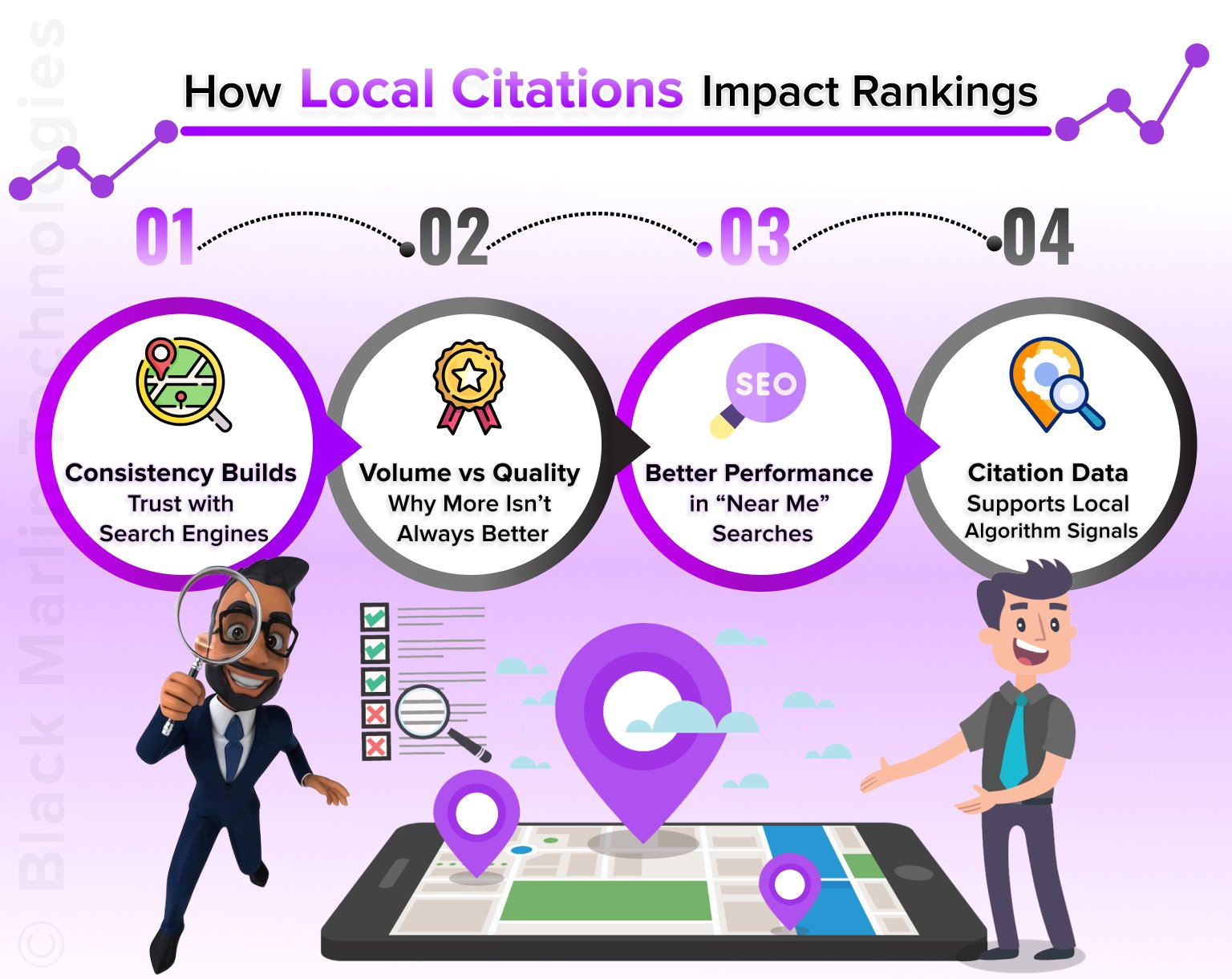
1. Consistency Builds Trust with Search Engines
Consistency is the greatest benefit of a local citation.
When search engines see the same name, address, and phone number on many reputable websites, the business stands as verified and trustworthy. The more consistent this information is, the higher the trust score for your business, thus making it easier for search engines to rank your business in local results.
Even small differences such as in spelling, abbreviations, or replacement of old phone numbers deplete trust. This is why consistency in citations is paramount in determining the effect of citations SEO on local rankings.
2. Volume vs Quality: Why More Isn’t Always Better
In the past, businesses tried to build as many citations as possible. In 2026, that approach no longer works.
Search engines now focus on:
- Quality of citation sources
- Relevance to your industry and location
- Accuracy of information
In the past, businesses tried to build as many citations as possible. In 2026, that approach no longer works.
Search engines now focus on:
- Quality of citation sources
- Relevance to your industry and location
- Accuracy of information
A few high-quality, relevant citations from trusted platforms are far more valuable than dozens of low-quality listings. This balance between volume and quality helps search engines clearly understand your business, without confusion or spam signals.’
3. Better Performance in “Near Me” Searches
“Near me” searches rely heavily on location accuracy and proximity. Local citations help search engines confirm where your business is physically located.
When citation data matches across platforms, search engines can efficiently relate your business to nearby search queries. How citations help nature’s pack visibility is by enhancing local intent searches, which optimize user experience as well.
Accurate citations increase your chances of appearing when users search for services near their location.
4. Citation Data Supports Local Algorithm Signals
Search engines use citation data as part of their local algorithm. This data operationally helps:
- Verify business legitimacy
- Confirm proximity to the searcher
- Understand local relevance
Google looks for consistency of the big business information across the web to confirm real-world legitimacy and proximity relevance. Marketers Selection combines all the citations aligned with your website and overall profile, creating a strong signal in favor of local SEO.
Step-by-Step: How to Build Local SEO Citations
Building local SEO citations has been no rocket science at all. Take five actionable steps to get it done in a proper, high-quality citation so as to build trust, create more vectors and optimize local ranking (2026).
Start with the platforms search engines give the most trust—to center around building your core data sources.
Need to set up a claimed and fully optimized business on:
Step 1: Claim and Optimize Basic Listings
- Google Business Profile
- Bing Places
- Apple Maps
Be sure that your NAP details are uniform for each listing added to those platforms. Categories, business hours, photos, and a shortened introduction atop whatever foundation you now have makes for a strengthened local SEO promotion.
Step 2: Submit to Trusted Directories
Once basic listings are maintained thoroughly, you may proceed to top-rated high-authority directory sites.
Focus on:
- Well-known general business directories
- Location-based local directories
- Industry-specific or niche directories
Quality is more important than quantity. A few accurate listings on authoritative websites carry more weight than dozens on small, no-name sites.
Step 3: Audit & Fix Inaccurate Listings
Some of the most common issues that arise in business listings as time goes on include:
- Duplicate listings
- Old addresses or phone numbers
- Consistent names and business names
Tools that can be used for a citation audit:
- Moz Local
- BrightLocal
- Whitespark
It is also a good idea to check manually by searching your business name and phone number in Google in order to catch something that tools might miss out on.
Step 4: Create Better Structured Citations
Your listing should not contain just the basic listing. A powerful structured citation is complete and useful in itself.
Improve your listings by adding:
- Detailed business descriptions
- Accurate business hours
- High-quality photos
- Website links and service areas
You show real trust to users and help search engines in understanding your business.
Step 5: Earn Unstructured Mentions
Several different ways in which the unstructured citations can come about when your business is mentioned online, albeit not in a fixed format.
You can earn them through:
- Local press coverage
- Industry blogs
- Reviews and testimonials
- Community or event mentions
Citations obtain real-life credibility in favor of your local SEO eat their way through.
Why This Works
The more structured citations you get across appropriate and high-quality websites, the more SERP trust signals you get. Put differently, when search engines see an accurate and consistent mention of your business from various sources on the net, they do identify your site as a trustworthy one worthy of high rankings for local queries.
Tools & Resources for Citation Management
Depending on the kind of tools used, managing local SEO citations could either be quite difficult or could be handled effectively with accuracy. In 2026, our main aim is not only to create citations, but to also monitor their accuracy day in and day out, correct any errors, and guarantee that they are consistent over time.
Read on to know freely and payable citation management tools, simple English presented.
1. Moz Local
Moz Local is a citation distribution tool that would help you manage and distribute your business listings in the best directories.
Benefits include:
- Ensuring NAP consistency
- Listing distribution
- Managing business data from one dashboard
It is a beginner-friendly tool, intending to save manual effort. Any newer businesses opting for automatization would benefit from this tool.
2. BrightLocal
BrighLocal is an acclaimed auditing and tracking tool for citations.
Best for:
- Finding missing or incorrect citations
- Monitoring citation growth
- Local SEO reporting
You would like to use this tool, since it provides wonderful insights into citations SEO, reinforcing local rankings.
3. Whitespark
Whitespark prides itself on citation discovery and niche opportunities immensely.
Best for:
- Finding industry-specific directories
- Building high-quality local citations
- Competitive citation research
This tool is perfect for people looking for more than just basic listings and attain local edge.
4. Yext
Yext uploads your listings onto many platforms at once, bringing a feasible delight for businesses.
Best for:
- Large businesses/multiple locations
- Real-time data updates
- Fast citation distribution
Pulling away from your payments in any form would usually result in a reduction in the control. So use it only with careful consideration of strategic value and placements.
5. Manual Listings
Not every citation should be automated.
Manual submissions are best for:
- Local chambers of commerce
- Industry associations
- Local blogs and news sites
In highly competitive local markets, manual listings often create higher trust and relevance.
Citation Audit Checklist
Here is a checklist for having the citations you create clean and friendly to Google rankings:
- Business name is spelled the same everywhere
- Address format is consistent (no variations)
- Phone number matches across all listings
- Website URL is correct and active
- No duplicate or outdated listings
- Business hours are accurate
- Categories and services are relevant
- Listings appear on trusted platforms only
After every 3–6 months, try to audit citations to boost the signal for a successful local SEO effort.
Common Local Citation Mistakes to Avoid
Even a little citation mismatching could result in a reduction in the effectiveness of your local SEO. Search engines are smarter in 2026, but they should also show discipline towards the accuracy and reliability of the information. Avoiding some of these frequently made mistakes helps in securing your rankings and visibility.
1. Mismatched NAP information
This is, by far, the most common and disastrous mistake.
Any time your name, address, or phone number gets distorted across local websites, it would lead to potential confusion among search engines, trashing out any trust and potentially affecting your organic local ranking.
- Always use one exact NAP format everywhere
- Update old listings after moving or changing phone numbers
2. Duplicate Listings
Duplicate citations happen when the same business appears multiple times on the same platform.
These duplicates:
- Split ranking signals
- Confuse search engines
- Create inaccurate data
Regular citation audits are able to detect duplicate listings and help remove or merge them before they take a toll on your local SEO performance.
3. Missing Website URLs
A miss represented most businesses do not fill in the website link for the citation.
Without a website URL:
- Users can’t easily visit your site
- Search engines miss an important trust signal
In reality, while citations do not pass link equity like backlinks, binding your website URL with your NAP enhances credibility, authority, and traffic.
4. Listing on Low-Quality Directory Sites
Not all local directories contribute to local SEO.
Bad Low-quality or spammy directories could:
- Reduce trust signals
- Associate your business with poor neighborhoods online
- Waste time and resources
Rather focus on relevant and high-domain-authority platforms, rather than making mass submissions.
Advanced Tips for Local SEO Citations in 2026
If you really want to step ahead of your competition in 2026, just creating citations isn’t enough. Instead look for ways to enhance and link to them, and also keep track of them, simply from a standpoint of a smarter local SEO strategy. Here are some advanced but easy-to-understand habits/tips for stepping up how you work with those citations.
1. Use Schema Markup for Local SEO
Let search engines better understand your business data with the help of schema markup.
When you integrate The Local Business-schema in your website, you:
- Reinforce your NAP details
- Match website data with citation data
- Reduce confusion for search engines
So in this way it brings a chain connection between your website concept and citation material, thereby enhancing trust and local ranking signals.
2. Combine Citation Strategy with Reviews
In 2026, citations and reviews work best together, not separately.
When your business appears on directories that also collect reviews:
- It strengthens trust signals
- Improves click-through rates
- Supports local pack rankings
Do encourage customers to leave their feedback on platforms where you already have citations. This alignment beats the twilight of both visibility and credibility.
3. Mix Local Content & Keywords
Citations become more powerful when supported by localized content.
To do this effectively:
- Create location-based service pages
- Use city and neighborhood keywords
- Match wording with your citation categories
This content alignment with citations lets the search engines figure out local relevance better so you have a fighting chance toward a competitive local ranking.
4. Track Citations Over Time
Local SEO is not a one-time task.
Tracking citations regularly helps you:
- Catch incorrect or outdated listings
- Remove duplicates early
- Maintain consistency after business changes
Get these audits at 3-6-month intervals just to keep those brilliant citations and trust signals bright.
Local SEO Trends to Consider 2026
1. Voice Search Optimization
The natural expression spoken to typewritten command utilized in voice search employs:
- Accurate citations
- Clear location signals
- Consistent business data
Quality citations can make a big difference if voice-based local answers are intended to potentially feature the inquirer’s business.
2. AI-Powered Search Results (AI SERPs)
The effect of AI on search engines has resulted in data received from different sources and an answer being generated.
Strong citations help AI systems:
- Verify business legitimacy
- Choose accurate local data
- Recommend trusted businesses
Businesses with consistent citations will likely be reported in AI-driven local results.
FAQs:
1. Do citations still matter in 2026?
Yes. Citations still matter in 2026 because they help search engines verify your business information, location, and legitimacy. Accurate and consistent citations support local rankings, map visibility, and trust signals.
2. How many citations should a business have?
There is no fixed number. Focus on quality over quantity. A business should have citations on major platforms, relevant directories, and industry-specific sites. Fewer high-quality citations are better than many low-quality ones.
3. Can citations replace backlinks?
No. Citations cannot replace backlinks. Citations improve local trust and visibility, while backlinks pass link equity and boost authority. Both work together as part of a complete local SEO strategy.
4. What’s the difference between a citation and a directory listing?
A citation is any online mention of your business name, address, and phone number (NAP). A directory listing is a type of structured citation that appears on business listing websites. All directory listings are citations, but not all citations are directory listings.
Conclusion
Local SEO in 2026, and citations remain a foundation. They aid the search engines in corroboratuon of the business information. The verification process also goes into checking the appetence of citations, location desirability, and formation of trustworthiness over the web. If your citations are accurate, consistent, and on the correct platforms, they would back up everything else: local rankings, map search prominence, reviews, and even AI’s search results.
Ready for movement? Work not in thought; work in actions:
- Audit your existing citations for accuracy
- Fix mismatched NAP and remove duplicates
- Build high-quality structured and unstructured citations
- Track your listings regularly to maintain consistency
An exciting sequence of successful, long-term steps that can be taken for the sake of stirring up more performance in the organic landscape of SEO!
Make sure to go ahead and have an audit of your business citations. Not sure where to start? Feel free to leave a comment with your experience. An easy, simple citation cleaning session could well be the missing piece holding you back from local visibility.