'>
<rect width='100' height='100' fill='%23B22234'/>
<!-- stripes -->
<g fill='%23fff'>
<rect y='10' width='100' height='10'/>
<rect y='30' width='100' height='10'/>
<rect y='50' width='100' height='10'/>
<rect y='70' width='100' height='10'/>
<rect y='90' width='100' height='10'/>
</g>
<!-- blue box -->
<rect width='50' height='50' fill='%233C3B6E'/>
</g>
</svg>)
'>
<rect width='100' height='100' fill='%23fff'/>
<rect width='100' height='33.33' y='0' fill='%23FF9933'/>
<rect width='100' height='33.33' y='66.66' fill='%23138808'/>
<!-- Ashoka Chakra -->
<circle cx='50' cy='50' r='9' fill='none' stroke='%23000080' stroke-width='2'/>
<g stroke='%23000080' stroke-width='1'>
<line x1='50' y1='41' x2='50' y2='59'/>
<line x1='41' y1='50' x2='59' y2='50'/>
<line x1='44' y1='44' x2='56' y2='56'/>
<line x1='56' y1='44' x2='44' y2='56'/>
</g>
</g>
</svg>)
 info@blackmarlintechnologies.com

Running paid ads without a valid, predetermined approach is like driving blindly-at least partially-just because it seems like you are making progress, you are actually just burning fuel. This is where a PPC checklist becomes relevant. Just for your preparatory information, a PPC checklist is a series of questions or points put in place to help you systematically consider, improve, and make a final decision on the various aspects of your pay-per-click marketing—from keywords to ads, target groups, distribution channels, budgets, etc., and to help you analyse your Google Analytics data.
 For any business looking to invest in PPC services, having a checklist is a must. Without it, you could easily miss budget leaks, placements of ads that don’t match search intent, or tracking for a different conversion, besides other minor problems like bad keyword groupings or irrelevant landing pages. These small anomalies will gradually drain away your ad spend and hurt your ROI.
When using a PPC checklist consistently, marketers find that their ads become significantly more relevant, saving on cost per click, indicating a stronger conversion rate. Clarity, consistency, and decision-making based on data are simply brought to the campaign based in-house or worked on by any PPC agency.
In this post, we will guide you through a very simple step-by-step PPC checklist worth following to improve ad performance, repair a common issue, and improve the ROI from your PPC pursuits—no jargon; rather these techniques that really do work.
- What Is a PPC Checklist & Why It Matters?
- Step-by-Step PPC Checklist
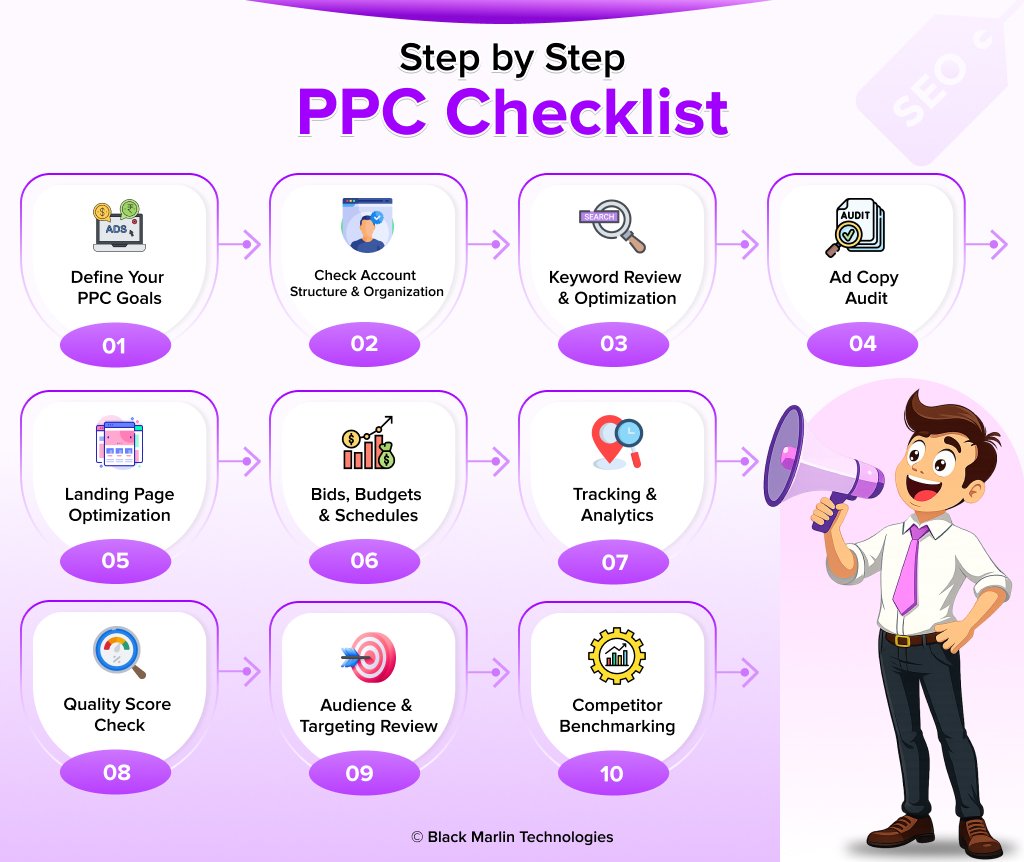
- Step 1: Define Your PPC Goals
- Step 2: Check Account Structure & Organization
- Step 3: Keyword Review & Optimization
- Step 4: Ad Copy Audit
- Step 5: Landing Page Optimization
- Step 6: Bids, Budgets & Schedules
- Step 7: Tracking & Analytics
- Step 8: Quality Score Check
- Step 9: Audience & Targeting Review
- Step 10: Competitor Benchmarking
- Quick PPC Checklist
- 1. PPC Goals & Metrics
- 2. Account Structure & Organization
- 3. Keyword Review
- 4. Ad Copy Optimization
- 5. Landing Page Experience
- 6. Bids, Budgets & Scheduling
- 7. Tracking & Analytics
- 8. Quality Score & Relevance
- 9. Audience & Competitor Review
- Common PPC Mistakes to Avoid
- Next Steps & What to Do After Your PPC Audit
- Conclusion
What Is a PPC Checklist & Why It Matters?
A PPC action checklist is a well-structured set of inspections designed to review, manage, and optimize your pay-per-click campaigns. It saves the time spent on wondering what to fix or improve when you reach different key areas—be it keywords, ads, bidding, tracking, or landing pages. This is a quality control system for your advertising quest collection.
One of the biggest benefits of using a PPC checklist is consistency. Without a solid process, marketers often skip over important checks, such as reviewing negative keywords, testing ad copy, or validating conversion tracking. These small oversights can result in wasted ad spend, poor targeting, and serving ads to the wrong audience. A checklist eliminates the option of missing important steps in a campaign, no matter how small or complex.
From a performance perspective, a nicely structured PPC checklist impacts vital statistics. Clearer targeting results in more precise ads leading to a better CTR (click-through rate). Other analytical matches that would tangentially include the landing page boost conversion. By doing regular optimization work, you develop a Quality Score, that helps to keep the CPC down. The best combination of practices would eventually derive much for ROI and stable results from the PPC campaigns.
Whether managing ads in-house or using specialized PPC services, a checklist underpins your campaigns, ensuring they’re focused and efficient and built for long-term success.
Step-by-Step PPC Checklist
 Step 1: Define Your PPC Goals
Before you launch or optimize any campaign, you need to be clear about what success looks like. The absence of defined goals prevents proper evaluation of your PPC setup because you will not be able to determine whether your ads are successful.
Start by setting clear conversion goals. You need to determine which business operation you want to track as your most important metric. Is it generating leads through form submissions? Are you trying to sell products through your online store? Do you want to persuade users to register for demonstrations and newsletters? Every PPC campaign should focus on one primary goal, not multiple mixed outcomes.
Next, define your ROI targets. You need to determine your maximum spending for each conversion which will help you identify your profitable campaign outcomes. The step holds critical importance for businesses that utilize PPC services because it enables them to match their advertising expenditures with actual business results instead of focusing solely on receiving clicks.
Finally, choose the right KPI metrics to track performance:
- CPC (Cost Per Click) to control ad spend
- CPA (Cost Per Acquisition) to measure conversion efficiency
- CTR (Click-Through Rate) to evaluate ad relevance
- ROAS (Return on Ad Spend) to understand profitability
When your goals and KPIs are clearly defined, every optimization decision becomes easier, smarter, and more data-driven.
Step 2: Check Account Structure & Organization
A well-organized PPC account is the backbone of strong ad performance. Your account structure needs to be organized because it will help your high-quality ads and keywords deliver better results. The structure needs to be reviewed because it should be treated as the first item on your PPC checklist.
Start with logical campaign naming. Campaign names should clearly reflect their purpose—such as product type, location, or goal. Your account growth requires this method because it helps better control budget management and performance analysis and problem detection.
Next, focus on campaign segmentation by objective. Separate campaigns based on goals like traffic, lead generation, or conversions. The practice of combining multiple objectives into a single campaign results in suboptimal outcomes because it creates difficulties in measuring success. Clear segmentation allows better bidding, messaging, and performance tracking.
Then, review your ad group structure. Each ad group should maintain complete alignment with the specific keywords which it contains. The close relationship between keywords, ads, and landing pages leads to increased ad relevance for user search queries.
Why this matters: A clean account structure leads to better ad relevance which increases click- hrough rates and enhances Quality Score results. The greater ad relevance results in lower click costs which produces higher returns on investment for your PPC campaigns.
Step 3: Keyword Review & Optimization
The success of PPC campaigns depends on proper keyword management which requires ongoing assessment and improvement procedures. The results of your campaign will suffer if your selected keywords do not match the actual search behavior of users.
Start by analyzing your target keywords. Identify which keywords are driving clicks, conversions, and revenue–and which ones are just spending money without results. You should pause or adjust bids for underperforming keywords because it helps to protect your budget.
Next, add negative keywords to eliminate wasteful spend. The exclusion of terms which include “jobs” and “free” and “cheap” and all other unrelated search phrases prevents your advertisements from reaching users who will not make a purchase. This simple step alone can significantly improve ROI.
Then, focus on balancing short-tail and long-tail keywords. Short-tail keywords generate traffic while long-tail keywords attract users who show strong interest in making a purchase. The combination of both methods provides greater audience reach while maintaining target audience suitability.
Finally, group keywords into tight themes within each ad group. The keywords which are closely related to each other enable you to create more suitable advertisements which direct visitors to landing pages that match their needs.
Pro Tip: Use keyword research tools to check search volume and CPC data. This method enables you to select keywords which match your needs for both search traffic and advertising expenses and conversion rates.
Step 4: Ad Copy Audit
Your ad copy is the first thing users see, so it plays a major role in whether they click—or scroll past. Even with the right keywords, weak or mismatched ad copy can hurt performance and waste budget.
Start by checking the relevance between your ad text and keywords. The language in your headlines and descriptions should closely match what users are searching for. When ads reflect search intent their trustworthiness increases which leads to higher click rates.
Next, test multiple headlines and descriptions. Do not depend on one particular advertisement version for your advertising campaign. Create variations that highlight different benefits, offers, or pain points. The data you obtain from this study will show which content most appeals to your target audience.
Make sure every ad includes a clear call to action (CTA). Phrases like “Get a Quote” and “Book a Demo” and “Start Free Trial” which help users understand their next step to better engage with the content.
Finally, you should conduct regular A/B tests on your advertisements to achieve better click-through rates. The process requires you to compare different performance metrics and stop using underperforming variants while you proceed to increase the successful versions. Your advertising campaigns maintain freshness and relevance through ongoing testing which helps you maintain competitiveness.
Step 5: Landing Page Optimization
Getting clicks is only half the job—your landing page is where conversions actually happen. The best-performing ads will not succeed if their landing page does not provide users with an efficient and relevant navigation experience.
Start by ensuring message match between the ad and the landing page. The page elements which include the headline and offer together with the used language, should display exactly what the user experienced in the advertisement. The users experience confidence in their correct location when there exists a strong message match, which leads to increased conversion rates.
Next, review page load speed and responsiveness. Users will leave your website if they experience slow page loading times or they encounter problems using your site on mobile devices. Your landing pages need to load quickly while providing seamless performance across different devices and maintaining simple user navigation.
Finally, focus on strong conversion paths. Your forms and buttons and CTAs need to show clear and visible and simple-to-use design. The process requires you to delete all extra fields which will help decrease distractions while you lead users to concentrate on one main task.
A well-optimized landing page will increase conversion and decrease your cost per acquisition, hence boosting your PPC returns.
Step 6: Bids, Budgets & Schedules
Your advertising budget gets controlled through bidding and budget settings which require continuous monitoring to prevent overspending and to maximize advertising opportunities. Even a well-optimized campaign can underperform if bids and budgets aren’t aligned with your goals.
Start by reviewing your bidding strategy. Your campaign objectives determine which bidding method between manual and automated bidding should be selected. Manual bidding provides better control to users but automated strategies enable conversion optimization when sufficient data exists.
The next step requires you to check whether your budgets match the objectives of your campaigns. High-priority campaigns should receive sufficient budget to perform, while low-performing or testing campaigns may need limits. Budget misalignment leads to two problems because it causes advertisements to stop running early and businesses to spend money without receiving any returns.
Final adjustments to bids require evaluation of location and device and time settings. Performance data analysis shows the most effective conversion locations. The organization should increase bids for locations and devices that perform well while it should decrease spending during times when conversion rates are low.
Smart bid and budget management enables your PPC campaigns to achieve better operational efficiency while maintaining expense control and delivering maximum return on investment.
Step 7: Tracking & Analytics
You need to measure things first before you can start to improve them. The combination of proper tracking with analytics tools lets you measure your PPC campaign performance while tracking your budget expenditures.
Start the process by checking whether conversion tracking has been established. The system needs to track all important user actions which include form submissions and purchases and phone calls and sign-ups. The absence of tracking or its malfunctioning will result in incorrect decision-making and unnecessary advertising expenditure.
Next, you need to verify both your UTM tags and your goals. The UTM parameters enable you to determine which specific campaigns and ads and keywords are producing results for your analytics platform. You must confirm that all goals have been established correctly because this process determines how conversions will be attributed to their proper sources.
Finally, you must establish enhanced measurement capabilities. The system tracks user behavior through scroll tracking and button clicks and engagement metrics which provide detailed information about user actions after they click. The analysis provides information about user drop-off points and areas that need improvement.
Accurate tracking and analytics turn raw data into actionable insights which help you optimize campaigns while increasing ROI and making confident PPC decisions based on data.
Step 8: Quality Score Check
The Quality Score system directly affects both your advertising success and your expenses for each click. Higher Quality Scores result in superior ad placements which decrease advertising costs, while lower scores lead to rapid budget depletion.
Start by reviewing the Quality Score for each keyword. You should find keywords that have low scores and then examine the reasons for their poor performance. The system lets you direct your optimization work to the areas that will produce the highest results.
Next, work on increasing the relevance of your campaigns through different methods. The keywords in your campaign must match with the ad copy and landing pages to create an effective connection. When users see ads and pages that closely match their search intent, engagement increases and Quality Score improves naturally.
Finally, focus on lowering CPC through ongoing optimization. Better Quality Scores often result in lower cost per click, which enables you to acquire additional visitors without increasing your expenses. The outcome is achieved through continuous advertisement updates, keyword enhancement, and landing page optimization.
Active Quality Score management leads to three benefits which include improved operational performance and greater ad exposure and higher financial returns for your PPC advertising campaigns.
Step 9: Audience & Targeting Review
Reaching the right audience is just as important as choosing the right keywords. The ads which have been written well will fail to perform when they reach audiences who have no interest in your product.
You need to establish your audience segments before you start your work. You should examine which groups your advertisements reach based on their demographic details and personal interests and buying intentions and geographical location and their prior engagement with your content. The defined audience groups enable you to show better matched advertisements which result in higher conversion rates.
Next, exclude irrelevant audience groups. The process requires you to identify two user groups which include users who click but do not convert and users who do not fit your ideal customer profile. The process of excluding these groups stops unnecessary expenses while maintaining your budget for high-quality prospect acquisition.
Regular audience reviews help refine targeting because they make advertisements more relevant while delivering better returns on investment. Your advertising campaigns become more effective when you reach users who have a higher likelihood of completing desired actions.
Step 10: Competitor Benchmarking
Competitor benchmarking enables you to assess your current PPC campaign performance while identifying potential market expansion areas. You can discover better solutions by analyzing existing successful methods instead of making random guesses.
Start by identifying your top competitors. The businesses which bid on the same keywords as their competitors while targeting identical audiences should be investigated. These are the brands competing for the same ad space and attention.
The next step requires an assessment of their keywords and advertising methods. The analysis needs to focus on their communication methods, promotional offers, and the keywords which they use at all times. The information provides you with knowledge about current market developments and customer behavior patterns.
Finally, look for gaps you can exploit. Identify keywords they aren’t targeting, pain points they don’t address, or messaging angles they’re missing. The existing gaps provide businesses with opportunities to enhance their market position while attracting customers who show strong purchasing intent at reduced expenses.
Regular comparisons of your competition keep your PPC strategy current, flexible, and aimed at the desired outcome.
Quick PPC Checklist
This quick checklist is designed for busy PPC managers who want a simple, no-fluff way to review campaigns. The checklist serves as an effective tool which can be used for weekly and monthly checks and pre-launch preparations to guarantee all essential items are checked.
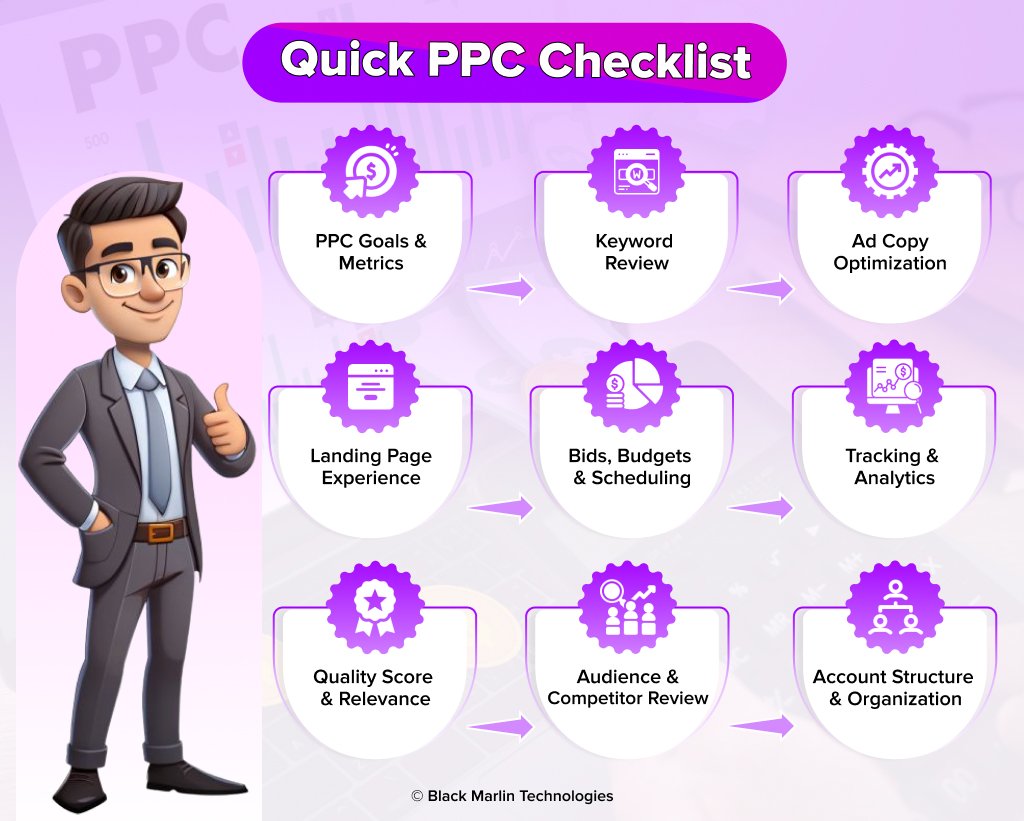
1. PPC Goals & Metrics
- Clear conversion goal defined (leads, sales, sign-ups)
- ROI targets set and aligned with business objectives
- Key metrics tracked (CPC, CPA, CTR, ROAS)
2. Account Structure & Organization
- Campaigns named clearly and logically
- Campaigns segmented by objective (traffic vs conversions)
- Ad groups tightly aligned with keyword themes
3. Keyword Review
- High-performing keywords identified and scaled
- Low-performing keywords paused or optimized
- Negative keywords added to reduce wasted spend
- Short-tail and long-tail keywords balanced
4. Ad Copy Optimization
- Ad copy matches keyword intent
- Multiple headlines and descriptions tested
- Clear CTAs included in every ad
- A/B tests reviewed and underperforming ads paused
5. Landing Page Experience
- Strong message match between ad and landing page
- Pages load quickly on desktop and mobile
- Forms and buttons are simple, visible, and conversion-focused
6. Bids, Budgets & Scheduling
- Bidding strategy reviewed (manual or automated)
- Budgets aligned with campaign priority
- Bid adjustments set by location, device, and time
7. Tracking & Analytics
- Conversion tracking verified and accurate
- UTM tags and goals checked
- Enhanced measurement enabled
8. Quality Score & Relevance
- Quality Score reviewed for all key keywords
- Ads and landing pages optimized for relevance
- CPC monitored and optimized
9. Audience & Competitor Review
- Audience segments clearly defined
- Irrelevant audiences excluded
- Competitors reviewed for keyword and messaging gaps
UX Tip: Save this checklist as a PDF or print it out to tick off items during audits. A simple checklist like this helps maintain consistency, reduce errors, and improve ROI across all PPC campaigns.
Common PPC Mistakes to Avoid
Even well-planned PPC campaigns can underperform if a few common mistakes are overlooked. The three problems need to be fixed because they will waste money and decrease performance while building total return on investment.
The most expensive error for advertising comes from marketers who fail to use negative keyword. The absence of exclusions leads to your ads appearing for nonrelevant searches, which results in attracting users who have no intention to make a purchase. The practice of updating your negative keyword list on a regular basis helps reduce unnecessary expenses while enhancing your ad targeting.
Another frequent issue is poor ad-to-landing page relevance. When ad messaging doesn’t match the landing page content, users feel confused and leave without converting. Strong message alignment builds trust and increases conversion rates.
Not checking Quality Score can also hurt performance. The existence of Low Quality Scores results in two outcomes because advertisers need to pay more per click and their ads will show less frequently. The process of regularly reviewing and optimizing keywords and ads and landing pages helps organizations maintain their performance scores while achieving better operational efficiency.
The use of keyword match types must be fully controlled because it determines all advertising processes. The selection of incorrect match types leads to two negative outcomes which include disabled audience access and undesired visitor acquisition. Your advertising campaigns will deliver optimal performance when you use a balanced strategy which targets specific search terms during appropriate times.
Avoiding these mistakes keeps your PPC campaigns focused, efficient, and profitable.
Next Steps & What to Do After Your PPC Audit
The first step of PPC audit completion starts the process but your next actions will decide your actual improvement results. The main approach requires organizations to select their activities according to which tasks will generate the most benefits for their business.
Start by fixing high-impact issues first. The team should work on resolving problems which directly impact spending and conversion rates because they stem from broken tracking systems and irrelevant keywords and poor landing page alignment and low Quality Scores. The implemented changes provide organizations with immediate advantages which result in better operational outcomes. The team should proceed to execute optimization activities which include testing new ad copy and adjusting bid amounts and refining target audience segments.
Once updates are online, you should monitor results closely while avoiding excessive changes to the system. The process helps you understand which aspects function correctly and which aspects require additional development work.
As for frequency, your PPC checklist should be a recurring process, not a one-time task:
- Weekly checks for budgets, bids, and performance trends
- Monthly reviews for keywords, ads, and landing pages
- Quarterly audits for structure, strategy, and competitor analysis
Regular audits of campaigns maintain their operational efficiency while providing scalability and matching business objectives, which helps organizations achieve sustainable success, thus increasing their return on investment from PPC campaigns.
Conclusion
A successful PPC campaign needs consistent data-backed smart optimization methods instead of relying on unpredictable outcomes. The step-by-step PPC checklist enables users to detect budget leaks while enhancing ad relevance and their Quality Scores which leads to improved decision-making through actual performance insights. The process needs to begin with establishing precise objectives and conducting keyword research which should lead to better landing page performance and results assessment.
The key takeaway is simple: regular audits lead to better outcomes. When you treat PPC optimization as an ongoing process—not a one-time task—you gain more control over spend, conversions, and growth.
If you require expert assistance, you should work with a reliable PPC agency, which will assist you in accelerating your business growth while protecting you from expensive errors. At Black Marlin Technologies, we provide data-based PPC solutions together with complete audits and targeted optimization services that align with your specific business objectives.