+1-(646) 362-1414
 +91 8826683820
 info@blackmarlintechnologies.com

SEO in 2026 will be very much different from what we are used to. Google is now driven by AI-driven search results, SGE (Search Generative Experience), voice search, visual search, smart ranking systems; thus, nouns and all the other old search engine optimization (SEO)-related methods like keyword stuffing, random backlink building, or e-publishing of a simple blog post are insufficient to grow.
 Today, people want content that is quick, precise, meaningful, and consistent with human norms. Trust it when Google sees this user experience on your website.
In this little guide, 2026 SEO strategies have been unlocked. Assuming that you are a beginner or just starting to learn SEO, in easy words, all of what shall be expounded upon will be made clear in order for you to do SEO perfectly well for your page or site to showcase the best example of how winning works-and to show your fellow competitors up.
- Why SEO in 2026 Looks Very Different
- Trend #1: AI-Powered SEO Workflows
- Trend #2: Search Experience Optimization (SXO)
- Trend #3: Zero-Click SEO
- Trend #4: Visual Search & Image SEO 2.0
- Trend #5: Voice Search Optimization in 2026
- Trend #6: Topic Authority Is More Important Than Backlinks
- Trend #7: First-Party Data SEO (Your Own Data = Higher Rankings)
- Trend #8: Programmatic SEO 2.0 (Smarter, AI-Driven Expansion)
- Trend #9: Content Refreshing With AI Insights
- Trend #10: EEAT-Focused Branding (Building Trust to Rank Higher)
- Step-by-Step: How to Implement These New SEO Tactics in 2026
- Mistakes to Avoid in SEO 2026
- Conclusion
Why SEO in 2026 Looks Very Different
2026 SEO, of course, is not just about keywords anymore but an impromptu series of events in his head that relate the search from the searchers to the great understanding from Google and how speedily content can solve a user’s problem. In a cleverer manner than before, wherein the search engines themselves are smarter, user demands have reached relatively new highs. That is how SEO changed by far:
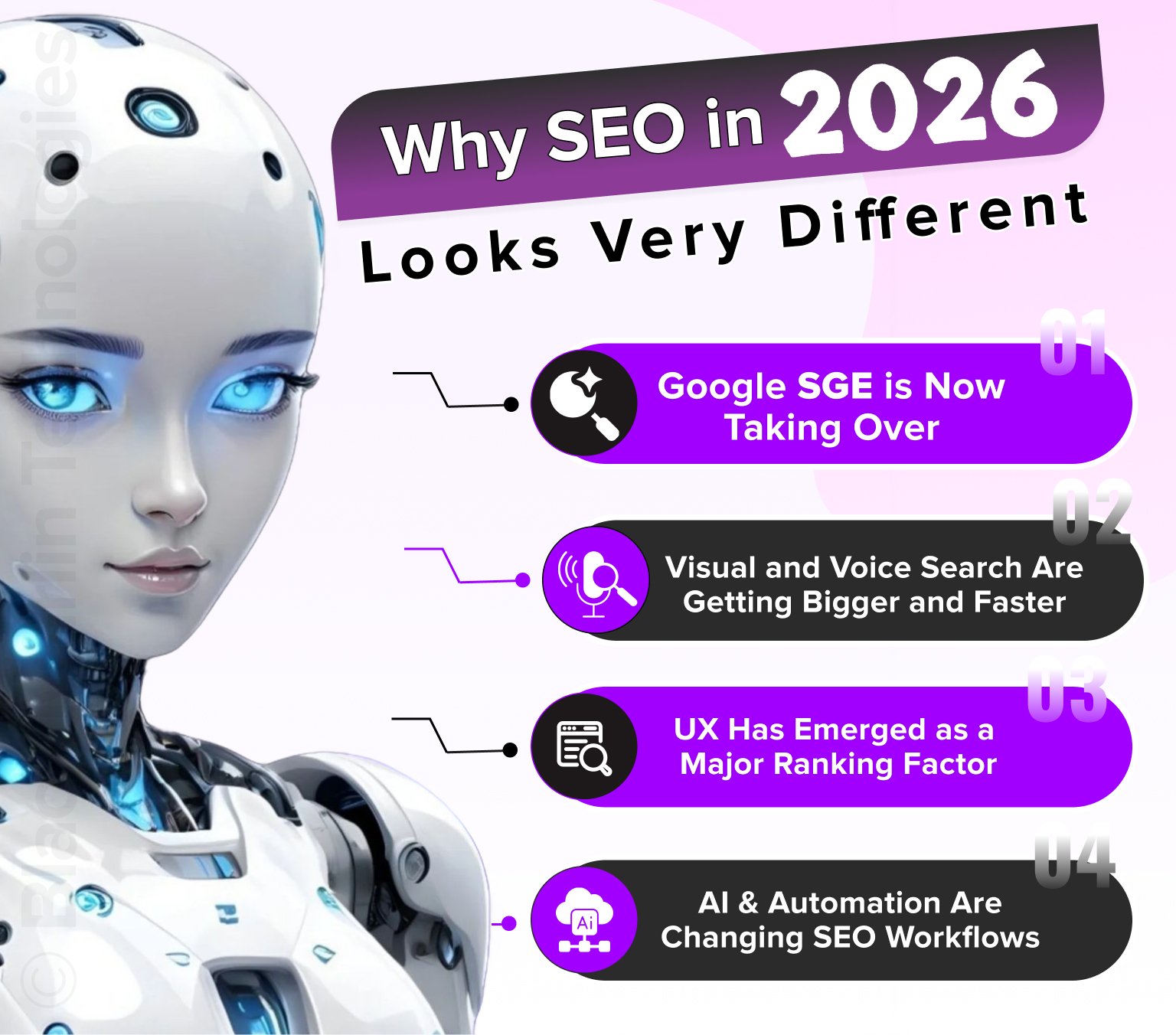
1. Google SGE (Search Generative Experience) is Now Taking Over
Google now provides summaries based on the AI mentioned above at the top of the search results. This makes it so fewer people click on the blue links that so well identified Google in the past. Now there is a need for all content to be acknowledged by experts, understandable, and supportive. That is the type of content that Google’s AI will always choose.
2. Visual and Voice Search Are Getting Bigger and Faster
People are now unusually imploring these searches right from Google Lens, voice assistants, or an image.
Therefore, your SEO should be working toward:
- Better images
- More conversant content
- Question-based headings
3. User Experience (UX) Has Emerged as a Major Ranking Factor
Google isn’t measuring feelings anymore, but it reads implicit signals like:
- How fast user finds an answer
- How smooth the page works
How long users stay on your website
Better UX = better rankings.
4. AI & Automation Are Changing SEO Workflows
AI tools provide assistance with:
- keyword research
- content ideas
- content optimization
- predicting ranking drops
Thus, SEO becomes faster and data-directed.
Trend #1: AI-Powered SEO Workflows
In 2026, AI tools have generated a higher backbone for modern SEO usage. AI tools for SEO decision-making make smarter, better, faster decisions-and more accurate. This is very important for SEO imbibable all over the entire process.
1. Predictive SEO (AI Can Predict Your Rankings Before They Change)
Predictive SEO applies AI to website analysis, competitive analysis, Google trends, etc. to foresee
- Which keywords will see a growth in search volume
- Which ones will fall in ranking?
- What topics will users want more information on next?
- Who will be the next threat from competitors?
This allows you to be two steps ahead and iron out the issue before traffic falls.
Tools: Semrush AI, Ahrefs Insights, Surfer Predict.
2. AI-Generated Content Briefs, Clusters & Outlines
AI actively creates, on behalf of the user, the following:
- Topic ideas
- Outlines
- Keyword clusters
- FAQ lists
- SEO briefs
It can save time and ensure content completion, coherence, helpfulness, and optimization.
3. AI-Assisted Content
AI can:
- draft fast content
- check spelling and clarity
- improve readability
- plant keywords
- create schema, FAQs, and headings
Still, editors, whether human or AI, are responsible for adding voice, theoretical credibility, and trust.
So, here will be the winning equation post-2026: AI for speed + Humans for quality.
4. Smart On-Page SEO by AI
Latest AI tools look over your pages and figure out exactly what is wrong with them:
- Where the keywords are missing
- Which Headings are poor
- Which images are low-quality
- What is missing on the internal links
- What content is considered thin
- What E-A-T signal type are very low
All of this is given to you in plain language to act upon and instantly better the rankings.
Trend #2: Search Experience Optimization (SXO)
Sur-Essen-Optimierung ist eine letzte Erneuerung von SEO in 2026. Damit vereint man SEO + UX (User Experience), um sicherzustellen, dass Ihre Inhalte nicht nur die Spitze erklimmen, sondern gleichzeitig auch den User zügig zufriedenstellen. Momentan wird von Google belohnt, wer eine flüssige, schnelle und nützliche Erfahrung anbietet.
Hier kommt es kurz und knapp zur Frage, wie SXO funktioniert:
1. Make Your Content Easy to Read
Niemand liest gerne hochtrabende Worte oder lange Absätze.
Ihr Inhalt sollte:
- kurze Sätze haben
- einen Punkt machen
- lieber eine Erklärung einbauen
- die Frage schon in den ersten fünf Sekunden beantworten
Je schneller die Benutzer-Umsetzung des Contents wird, desto mehr punktet er dabei bei Google.
2. Improve Page Speed & Mobile Experience
Die meisten Leute surfe auf ihrem Handy, folglich sollten Ihre Website schnell laden und gut aussehen.
Für SXO brauchen Sie:
- sehr schnell ladende Seiten
- eine einfache Layoutgestaltung
- keine Überflüssigen Pop-ups
- Gestaltung-Responsive (mobilfreundlich)
Mehr Bilder
Für eine angenehmere Erfahrung = Mehr Zeit auf der Internetseite = Besseres Ranking.
3. Satisfy the User First
In relation to the faint possibility that Google will notice when users land on the page and exit, the following should be true:
- The solution is immediately visible.
- Appropriate headers are visible.
- The images should grab attention, with their content matters.
- Videos should serve as summaries.
They must, to some extent, foster trust and improve the website-classification of search engines.
4. End All Causes of Friction for the Visitor-The Lesser, the Better
Elements that decelerate the visitor prove to be punishing for one’s SEO.
Do not allow:
- Menus that will confuse the visitor
- Too many ads
- Lengthy introductory paragraphs
- Difficult user forms
Design your website so that a 10-year-old can navigate it.
Trend #3: Zero-Click SEO
In 2026, when over 50% of Google searches returned are ending without a click, this goes without saying that the search engine giant is giving answers directly in Featured Snippets, SGE (AI Answers), Knowledge Panels, People Also Ask boxes, etc.
For you to stand a chance now, zero-click result optimization has become a must for your content.
1. Featured Snippets Optimization
With the big push coming from the SERP and resulting in so much traffic, optimizing for Featured Snippets is nothing less than an eternal quest.
- Short answers from 40–50 words
- Clear bullet points
- Simple definitions
- Numbered steps
- Comparison tables
- Question-based headings
Google loves a cut and dried answer.
2. Google SGE Ready Content
SEARCH Generative Experience of Google fetches antlers from the most trustworthy and helpful websites.
In order to get in SGE, the page should contain:
- expert insights
- real examples
- statistics
- FAQs.
- deliver apparent explanatory language
- wave off content
Google’s AI is widely believed to have benefitted heavily from facilitating friendly, human-centered, and authoritative statements in content, as against nondescript and keywords jam.
3. Guesstimate of People Also Ask (PAA)
Google shows several boxes of questions (PAA).
Here are some quick additions:
- short Q&A paragraphs
- conversational tone
- filler words like “what,” “why,” “how,” “when” that must form part of your main keyword
Every Q&A delivered is an added opportunity for higher rankings.
4. Use Schema Markups for Zero-Click Results
Schema will surely enhance Google’s vision of your information.
- FAQ schema
- How-to schema
- Review schema
- Product schema
- Video schema
But look at the visibility gain when users don’t even have to click.
5. Add High-Value Micro-Content
Google adores little bits of legit info, such as:
- quick tips
- facts
- mini definitions
- short steps
All of these bring your page closer to AI summaries and snippets.
Trend #4: Visual Search & Image SEO 2.0
Visual search exploded in 2016, now trending with Google Lens, Pinterest Lens, Instagram Search, and image-based AI search. It only means that your images and visuals are now just as important as your text.
An opportunity for SEO for visual search is the use of optimizing visual search very well — hugely for eCommerce, travel, food, fashion, real estate, and local businesses.
1. High-Quality Images Are Now a Ranking Factor
Google prefers clear, original, and high-resolution images.
This means:
- No blurry photos
- No generic stock images
- Use real product or brand photos
- Keep background clean and natural
Good visuals help ranking in Google Images and appearance in Google Lens results.
2. Image Metadata Optimization
Every image should be added to include the following.
- descriptive file name
- keyword-rich alt text in pure English
- appropriate image title
- rele`vant captions
For example, use IMG_7654.jpg_income-tax-debt-relief.jpg.
This is best-hd-lace-wig-human-hair-26-inch.jpg.
This will help Google understand the image instantly.
3. Visual Schema for Greater Visibility
When dealing with the schema, provide image-related details stating whether the image is for a product, recipe, or instructional guide.
Include schema types such as:
- Product
- Recipe
- How-To
- VideoObject
- ImageObject
This will enhance visibility for visual search.
4. Optimize for Google Lens Searches
Google Lens is now extensively and successfully used to identify products, hairstyles, outfits, locations, and objects.
For a Lens ranking:
- upload multiple image angles
- use lifestyle images and not just studio shots
- put keywords in image metadata
- ensure the image is indexable (not blocked by robots.txt)
5. Short Videos or Motion Clips
5–15 second short videos will help your rankings in Google Discover as well as Instagram Search, YouTube Shorts.
These visuals:
- increase engagement
- help users understand the product
- rank through visual-first search platforms
Video = increased trusts = improved SEO worth.
Also, use Infographics & Scrollers.
Visual summaries like diagrams, pie charts, infographics, etc. are whetted by Google. They help your content appear in:
- LAI summaries
- Featured Snippets
- Discover feed
- Educational searches
Make them direct, succinct, and comprehensible.
Trend #5: Voice Search Optimization in 2026
Voice search is being all gone by as people are using Google Assistant, Siri, Alexa, and in-car voice systems to make hands-free searches. By 2026, nearly all websites must of necessity be optimized for the conversational queries and should make the voice sound natural.
Voice search SEO is more of simple language, question-answering type of content, and quick answers.
1. Write Like You Speak (Conversational SEO)
Voice searches are like talking with people in real life with words.
Example:
Instead of typing: “best SEO trends 2026”
People say: “What are the new SEO trends for 2026?”
To optimize:
- Be natural and down-to-earth in language
- Avoid long, specific sentences
- Answer in informal conversation style
- Use “you,” “your,” and simple explanations
2. Focus on Question Keywords (Who, What, Why, How)
– Voice searches start like this:
- What
- Why
- How
- When
- Where
- Which
These serve as H2/H3 headers that may aid in being ranked for voice search results.
Example headings:
*What does Predictive SEO look like?
*How does zero-click SEO work?
Just brief answers here would suffice higher voice search rankings.
3. Short, Direct Answers Win Voice Results
Google often reads aloud the most direct and clear answer (usually, 30–45 words).
For Optimization:
- Create small answer boxes.
- Try to make your sentences succinct.
- Forego filler words.
- Ensure lucid explanations or days to do something.
If Google can speak it fast, then it will be taken along.
4. Target Long-Tail & “Near Me” Keywords
Long-term and “near me” keywords are usually used in voice search queries.
For example:
- “best HVAC repair service near me”
- “how to boost google ranking for my travel agency”
Natural long-tail expressions must be disseminated in your content.
5. Improve Local SEO for Voice Search
These instant and local requests in voice search are laced with still more local intentions.
To optimize:
- Update Google Business Profile.
- Add service areas.
- Add opening hours.
- Adding reviews stands all-important.
- Try to attack local keywords.
- Use schema markup.
Google is particularly interested in promoting local businesses in voice search.
6. Make Your Website Fast & Mobile-Friendly
The voice search comes through mobile devices in the main.
Your website therefore needs:
- to load in around 2 seconds
- to have a mobile UI style
- to avoid heavy images
- to use slightly rounded lettering
The greater the performance, the higher the voice search ranking.
Trend #6: Topic Authority Is More Important Than Backlinks
As of 2026, Google values how deeply you cover the topic rather than how many backlinks you might have. This concept is referred to as Topic Authority, which is probably one of the most influential signals for search ranking.
Instead of producing content without purpose, you have to show Google your expertise in a particular avenue by covering it from all angles, clarifying it with your knowledge or perspective.
1. Create Topic Clusters (Organized Content = Higher Rankings)
Topic clusters will enable Google to sense the depth of your site’s category, topic, and subtopic.
A cluster contains:
- one main umbrella pillar page (broad topic)
- multiple supporting blogs (subtopics)
- strong internal linking between them
Example:
Main Topic: SEO in 2026
Subtopics:
- Predictive SEO
- Zero-click SEO
- Voice search SEO
- Topic authority
- Visual search optimization
It is like a code that came from your website to indicate to Google—as far as 2026 SEO is concerned—“We have it all if you’re talking about our topic.”
2. Best Cover Every Important Subtopic in Your Niche
Google especially favors websites that thoroughly cover a topic from point A to point B.
Building topic authority requires listing every subtopic your audience would need, creating separate pages for each of these subtopics, and interlink- ing them properly while updating content regularly.
Also:
The more exhaustive your cluster, the more authoritative your cluster.
3. Write Egregiously Helpful Beginner-Friendly Content
Save your word count; a topic authority doesn’t require a lengthy article but a helpful one.
So, make your content:
- digestible
- full of examples
- full of FAQs
- full of statistics
- full of real insights
Longer time on page speaks trustingly about your website to Google.
4. Smart Internal Linking (Google Loves This)
Internal links form bridges between all your pages in a way that Google can understand them.
It is necessary in optimizing your internal linking to:
- Link pillar pages to subtopics,
- Link subtopics to your main pillar page,
- Keep anchor text very simple (e.g., “zero-click SEO guide”)
Internal linking well also advances the authority of the entire cluster.
5. Topical Relevance > Backlink Quantity
A strong topic cluster in 2026 can outrank large websites even with fewer backed backlinks.
Content must be more complete, more useful, better organized or Google ranks you higher.
Trend #7: First-Party Data SEO (Your Own Data = Higher Rankings)
Beginning in 2026: With its removal of third-party cookie power, Google will have only First -Party Data SEO as the chief power agent. It provides business entities a clear view as to the public uttermost actual desires without any outside help.
The more you know your audience, the better content you can create. And Google rewards that with higher rankings.
1. What is first-party data in simple terms?
First-party data is like the kind of data that is collected directly from your very own users, like:
- email sign-ups
- what are on-site searches that are being initiated
- sliding maxims of user behavior (Time on site, Pages Visited)
- Fill-able feedback forms
- doses of previous purchases
- insights into user’s exact whereabouts
- chatbot queries
This data is always current-on-time, private, and not to reveal, exclusively handy for SEO.
2. How Does First-Party Data Further Improve SEOs?
When you know exactly what your audience wants, you can create:
- better content topics
- more helpful product pages
- stronger FAQs
- Boosting the effectiveness of numerous SEO techniques
- Some key-editors that well feed to user-experience
- From site automation, bounce rate has a lesser functionality; thus higher ranking comes about only when users are more engaged.
3. High-Intent keywords to find are identified from first-party data.
When a change in terms of what is being sought is observable from the viewpoint of the audience, you should assume that a vote towards the failure is definitely on. Seriously consider the whole set of wordings captured from:
- internal searching inside the site
- email responses on newsletters
- customer feedback
- WhatsApp or chat inquiries
- social-media DMs
These insights provide real keywords that people habitually type in their searches; most of the time, they are long-tail keywords, hence ranking them is not a piece of cake.
Example:
Here are the users searching “best beginner SEO strategy 2026” within your site, initiate an all-encompassing guide for that term in the section.
4. Content Personalization Meets Engagement
By engaging first-party data-driven customized content depending on behavior considerations, is the reason why; A perfect example is set thereby
- getting product recommendations done
- Forming pages tailored to specific location
- Describe the relevant blogs
- Then you could invent customized email content
Engagement yields satisfaction yields SEO.
5. Build Trust with Users (Which Helps E-E-A-T)
By amassing ethical and transparent figures, the following points are reinforced:
- credibility
- expertise
- trust by the public
- brand authority
which directly affects E-A-T-your SGE and AI Ranking directly.
Trend #8: Programmatic SEO 2.0 (Smarter, AI-Driven Expansion)
Earlier versions of programmatic SEO sought to automatically produce thousands of similar landing pages by pushing them through template strategies. Approximately a decade before 2026, this small internet ghetto became somewhat cleaner, but spamming continued nevertheless. In contrast, Programmatic SEO 2.0 is aimed toward creating well-crafted, tailored, and scalable content that avoided canned, spammy, or thin pages.
1. What is Programmatic SEO 2.0?
Programmatic SEO 2.0 refers to an automated approach using AI to produce multiple optimized pages practically:
- location-based pages
- product variations
- service pages
- comparison pages
- FAQ pages
- data-based pages
The techniques involve ensuring that these pages are created provisionally via AI that are:
- unique
- relevant
- working
- not copied
- url-lingo envisaged for browsing phrase_intersect.
2. Dynamic Content Generation (AI-Powered)
A. I. now generates content blocks that adapt in real time according to:
- headers
- behavioral patterns
- trending topics
- pricing
- locale
- the calendar
- etc.
For instance:
A travel site could dynamically create the following type of subpage:
“Best hotels in Goa for families 2026,”
updated going with the current tide.
3. Avoidance for Thin and/or Duplicate Content Issues
The main issue in the phase of throwing only a small amount of content at the old AIs was the resulting thin content. The answer is:
- unique intro paras are written
- details focusing on the particular site are added
- FAQs creating pages
- accessing present market data
- human-editing to use templates
Every page trade is useful, not spammy.
4. Feel Good with Internal Linking on Scale
AI constructs internal linking automatically for connecting:
- pillar pages
- subtopic pages
- location pages
- related guides
The article aims to increase the integrity of the user’s movement and proceed confidently towards Topic Authority.
5. Best for Local, eCommerce & Marketplace Websites
Everything has the potential to get cranked up in Programmatic SEO 2.0:
- real estate
- travel
- e-commerce catalogs
- job portals
- local service businesses
- food platforms
This strategy may be scaled for any website having loads of pages.
6. Human Audit + AI Automation synergies
Voiding low quality website pages is a three-step equation: AI generates the base design, followed by a human revision, prior to publication of smarter pages for stricter results appraisal that maintain the stringent face of the website.
Trend #9: Content Refreshing With AI Insights
By 2026, Google is firm on recommending fresh, updated material over pages whose last updates go back to ensemble-years ago. Instead of new blogs on a daily basis, refreshing and optimizing previously published content brings optimal results, AI making this task faster and more advantageous.
Refreshing literally implies re-winning rankings, replenishing lost traffic, and maintaining competitiveness in the niche.
1 Why Do We Need to Work on Refreshing Content in 2026?
Google is all about:
- FRESH data
- CURRENT examples
- UPDATED statistics
- RECENT trends
- BETTER UX
In contrast, Google misses the grand scheme of usefulness if something is past its prime. Refreshing just keeps your pages alive and working.
2. Leverage AI Tools to Find Pages You Need to Update
It happens that AI platforms like Semrush, Surfer, and Ahrefs can identify:
- pages that are losing traffic
- pages that are losing rank
- the keywords that are no longer relevant
- subtopics that are missing
- out-of-date visual or data elements
This will save you hours of manual audits being carried out.
3. Adding new examples of information & FAQs
Some stock refurbishment activities will involve the following activities:
- Statistics
- screenshots/prints
- Videos/Short Videos
- Refreshing Instructions
- Real-World Scenarios
- Keyword Trends
- Frequently Asked Questions
This offers a good example to Google that your information can be viewed and updated with relative ease.
4. Improving Readability and User Experience
During the refresh, ensure:
- the paragraphs are few or less prolonged.
- the flow and wording are not confusing.
- the arrangement of content is legible.
- the structure of heading and subheading is clear.
- insert appropriate bullets under main headings.
- steer off-sized or slow-loading images, images that refuse to show up, or security-toolbar-installing images.
- implement order on the pages.
In order to encourage the readership, ensure that the content is easy to read and visually enticing.
5. Uphold E-A-T Signals
Introduce new or update:
- author bio
- source and references
- expert quotes
- exemplary instances
Such will build trust and therefore push up the SEO ranking even higher.
6. Freshen Up at Least Every 45–90 Days
Pages usually don’t look fresh forever.
Every 45–90-day update will keep the position stable, particularly with the fiercely competitive topics such as:
- SEO
- Finance
- Health
- Marketing
- Travel
- E-Commerce.
Trend #10: EEAT-Focused Branding (Building Trust to Rank Higher)
The latest trend in Google ranks is in favor of sites that demonstrate real expertise, real experience, and genuine trust as ranked by Google. So enjoys the credit belonging to the E. E. A. T in SEO, which stands for Expertise, Experience, Authoritativeness, Trustworthiness.
So, if Google sees your brand as a credible one, the better the ranking automatically goes—at least for AI-influenced SGE results.
It is true, no longer optional.
EEAT now acts as a pivotal ranking factor.
1. Show Real Experience
Google likes to crow real-life people talking about real-life work.
To better include Experience:
- Give real examples
- Add personal insights
- Include case studies
- Before and after results in that case
- Add actual screenshots or images
Hard evidence is better than beating around the bush imaginatively.
2. Focus on Expertise
Your work should be intelligent about a particular field.
Increase “Expertise” by:
- Include bios on the author
- Include shows of credentials
- Link to expert profiles (LinkedIn, social)
- Reduced-proficiency-level language-specific connotations:
- Sources of verifiable information are always required.
By doing so, Google gets a sense of your pedestal.
3. Establish Authority
Google believes in brand trust.
What you need to do to create an Authority:
- Consistently publish
- Be seen on good websites
- Get favorable reviews
- Create original research
- Have a strong social media presence
- Join in as a conversation maker within your community
The more you see your brand being seen around the Internet, the more highly regarded you will be.
4. Enhance Trust Signals (Highly Essential for SGE)
To feature in AI-answers, trust is of paramount importance.
So, enhance trust by:
- Putting up good contact details
- Using HTTPS
- Putting up privacy and refund policies
- Featuring customer reviews
- Adding trust badges
- Presenting information accurately
Google will love your site if it is safe and reliable.
5. Multimedia for Stronger EEAT
Include
- short videos
- images
- graphics
- quotations
- infographics.
Visual contents strengthen credibility and enhance user satisfaction.
Create Strong Author + Brand Pages at 1% Dev Center
1% Dev Center
Create a very detailed page consisting of:
- about the company
- team members
- achievements
- certifications
- awards
- case studies
- media mentions
The strong branded page across the website boosts up your EEAT score.
Step-by-Step: How to Implement These New SEO Tactics in 2026
Now that you are familiar with the SEO trends of 2026, here is a very simple and methodical approach to actually putting them into action and making progress. This framework will allow you to aid in the SEO process without getting overwhelmed, even if you are completely green.
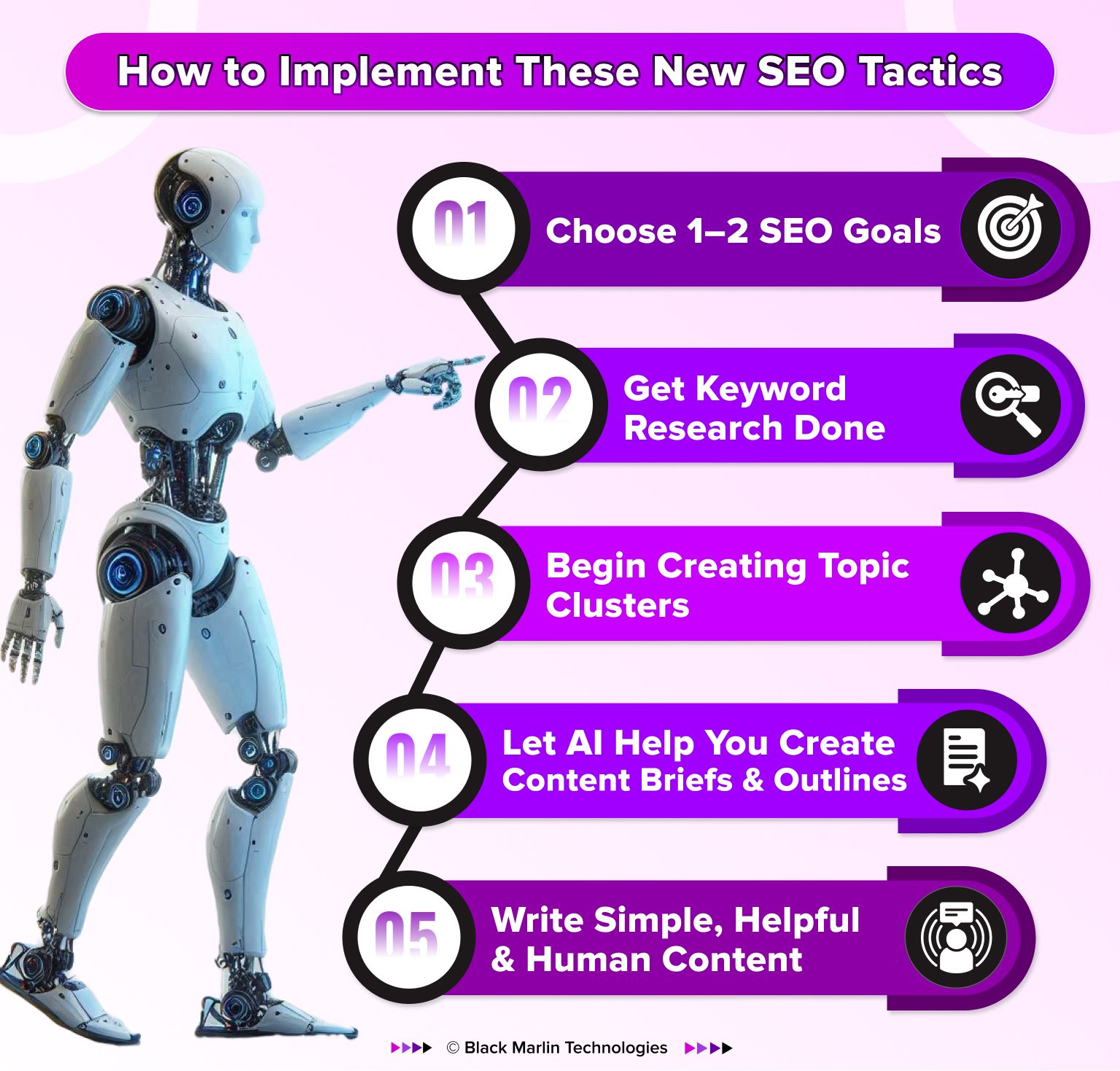
Step 1: Choose 1–2 SEO Goals
Don’t attempt it all at once!
Go for simple, crystal-clear goals, such as:
- increase website traffic
- get more leads
- rank for new keywords
- improve content performance
Goals should drive smart SEO decisions.
Step 2: Get Keyword Research Done (Use AI-Powered Tools)
Prioritize tools such as Semrush, Ahrefs, Ubersuggest, Gemini/ChatGPT, etc., to help find:
- trending keywords
- long-tail questions
- competitors’ keywords
- SGE compliant keywords
Target low competition + high intent keywords for faster wins.
Step 3: Begin Creating Topic Clusters (Earn Authority)
Adding value meant having your content organized according to a main topic. For instance:
Main Theme: SEO in 2026-
Clustering topics, such as voice search, visual SEO, predictive SEO, SGE, SXO, etc.
This makes the topic authority boost and helps Google to trust your site.
Step 4: Let AI Help You Create Content Briefs & Outlines
AI generates content outlines instead of you doing the research manually:
- outlines
- FAQs
- headings
- keyword placements
- content structures
This allows much quicker and targeted writing.
Step 5: Write Simple, Helpful & Human Content
Remember: Google ranks content that helps users first.
To help optimize your content:
- keep paragraphs short
- use bullets
- provide examples
- add images or videos
- provide direct answers
- remove any industry jargon.
Make it simple to be understood by a 10-year-old.
Mistakes to Avoid in SEO 2026
One wrong move can slow SEO growth. Dispite good strategies,wrong moves can stop SEO growth. 2026 Google is wiser, uses more AI, and is ever more intent on the user experience. That’s why avoiding these mistakes is as important as following the right tactics.
Here come the common, SEO mistakes to avoid in 2026, using only simple beginner-friendly language:
Mistake 1: overusing AI content without human editing.
Google can now notice:
- robotic writing
- repetitive phrases
- generic content
- low-quality drafts by AIs
AI for speed, but humans needed for
- personality
- depth
- accuracy
- unique insights
AI+Human = Best SEO content.
Mistake 2: Pray to high chances that it will bring you much fame.
Optimize for:
- Featured Snippets
- PAA
- AI overviews (SGE)
- Quick-answer boxes
If none of the content does, you could still be on page 1-but totally invisible.
Zero-click SEO is now a must, obligatory, not optional.
Mistake 3: Too Much Content, Too Little Update
Many websites continue producing new blog posts, forgetting the older ones.
In 2026, Google prefers
to have the site’s content being updated, refreshed, and of quality
than some one hundred old posts.
So update each post at least every 45-90 days.
Mistake 4: Weak User Experience (Slow, Confusing, Hard to Read)
If your site is
- slow
- cluttered
- has pop-ups
- confusing to navigate
…Google gets you an immediate demotion.
User experience (SXO) now plays into your ranking, so far so forth.
Mistake 5: Failing to Establish Topic Authority
Haphazardly publishing blog posts with no structured organization was so 1998.
Google wants structured related topic clusters in the year 2026.
If you’re not into building topical depth, → you won’t rank long-term.
Mistake 6: Ignoring Visual and Voice Search
Most sites are still not even bothering to optimize for image search, Google Lens, or voice queries.
Massive growth channels in 2026—don’t miss them.
Mistake 7: Thin Programmatic Pages
Creating a multitude of pages, primarily for:
- no duplicate content
- deemed to have low value
- content templates for one-size-fits-all
These things will be penalized or not considered by Google.
Apply Programmatic SEO 2.0: helpful, AI-guided, and human-edited content.
Mistake 8: Not Having an Internal Linking Strategy
Internal links signify to Google the content you are creating.
Without proper internal link building:
- Authority will not spread.
- Important landing pages don’t rank.
- Topic clusters appear weak.
Per page, 5-10 internal links should be added. Create linking that is natural and productive site-wide.
Mistake 9: Low EEAT (Expertise, Authoritativeness, Trustworthiness)L Signals (Low Trust)
When Google sees a site where:
- The author is whatsoever concealed
- Contact information isn’t shown
- Reviews are lacking
- Tangible examples have not been laid as evidence
Disregard it as an unreliable source and you have strong ranks on your hands.
Mistake 10: Targets on Difficult Keywords
High-volume keywords = High competition.
Instead:
- Long-tail keywords
- Question keywords
- Medium-competition subjects
- User-intent focused-length-phrase
Simple words = quick results.
Conclusion
SEO in 2026 is not about tricks, shortcuts, or tactics that date back as dead as a dino. It is simply about understanding what users want, making use of AI in a smart manner, and creating content that benefits people in a snappy and clear cut. Nowadays, Google emphasizes helpfulness, guaranteeing trust, excellent experience, and delivering user satisfaction. And guess what? Your strategy has got to be there.
Now for the straight-up truth:
- Helpful content over everything.
- Speedy, sweet user experience over all.
- Topic authority over all.
- Brands with strong EEAT over all.
- AI + human! A great blend!
All these described innovative paths- AI-made workflows, zero-click SEO, SXO, visual search, voice search, topic clusters, into first-party data, into programmatic SEO 2.0, and SEO into regular content refreshing-will enable you an advantage on competition and a better ranking in 2026 and coming years.